

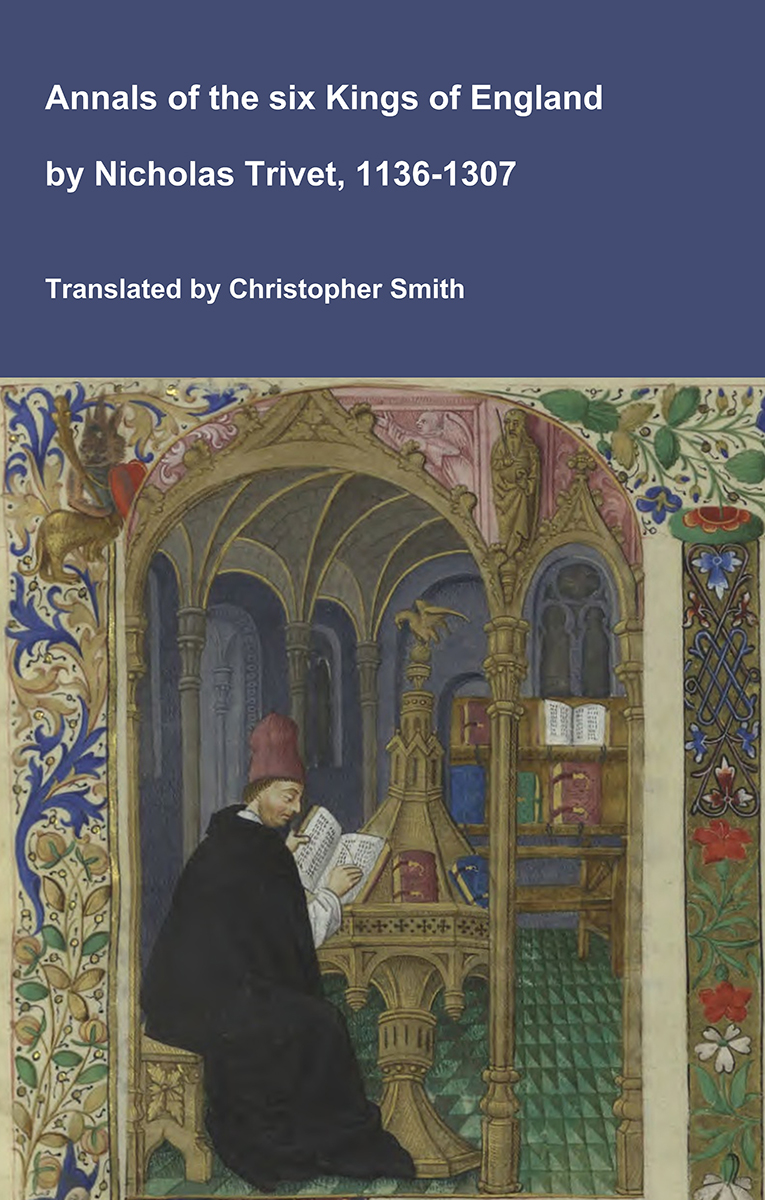
Annals of the six Kings of England by Nicholas Trivet
Translation of the Annals of the Six Kings of England by that traces the rise and rule of the Angevin aka Plantagenet dynasty from the mid-12th to early 14th century. Written by the Dominican scholar Nicholas Trivet, the work offers a vivid account of English history from the reign of King Stephen through to the death of King Edward I, blending political narrative with moral reflection. Covering the reigns of six monarchs—from Stephen to Edward I—the chronicle explores royal authority, rebellion, war, and the shifting balance between crown, church, and nobility. Trivet provides detailed insight into defining moments such as baronial conflicts, Anglo-French rivalry, and the consolidation of royal power under Edward I, whose reign he describes with particular immediacy. The Annals combines careful year-by-year reporting with thoughtful interpretation, presenting history not merely as a sequence of events but as a moral and political lesson. Ideal for readers interested in medieval history, kingship, and the origins of the English state, this chronicle remains a valuable and accessible window into the turbulent world of the Plantagenet kings.
Available at Amazon in eBook and Paperback format.
Carreg Coetan Arthur Burial Chamber is in Newport, Pembrokeshire, Prehistoric Wales Neolithic Burials.
Carreg Coetan Arthur Burial Chamber [Map]. Coflein: "is the most coastal of the group of Nevern valley chambered tombs, often categorised as belonging to the Irish Sea portal dolmen tradition... In 1979-80 excavations were undertaken over three seasons to ensure that the full extent of the site was protected from an adjacent housing development... Excavations tested the extent of the preservation of the cairn and chamber interior. The site had been substantially disturbed by cultivation and human and rodent interference, but remnants of an old ground surface protected by a covering of redeposited subsoil survived outside the south and east side of the chamber, below which lay one complete quartz-tempered round-bottomed Developed Bowl inverted on a prepared 'paved' surface and associated with cremated bone and charcoal which gave a date of c. 3650-3020 cal. BC.' Edited from Rees, S. 2012. page 51."
Archaeologia Cambrensis 1872 Pages 81-143. If the cromlech [Carreg Coetan Arthur Burial Chamber [Map]] close to the town of Newport does not present so imposing an appearance, from its magnitude, it is not inferior in interest, from its well preserved condition. The chamber measures 5 ft. 6 ins, by 4 ft. 6 ins. The capstone is 10 ft. by nearly 9, and is from 3 to 3½ ft. thick. It stands only on two of the four upright stones. Remains of a tumulus or carn still exist. It is called "Careg Coetan," and is associated with the name of Arthur.