Abbot John Whethamstede’s Chronicle of the Abbey of St Albans
Abbot John Whethamstede's Register aka Chronicle of his second term at the Abbey of St Albans, 1451-1461, is a remarkable text that describes his first-hand experience of the beginning of the Wars of the Roses including the First and Second Battles of St Albans, 1455 and 1461, respectively, their cause, and their consequences, not least on the Abbey itself. His text also includes Loveday, Blore Heath, Northampton, the Act of Accord, Wakefield, and Towton, and ends with the Coronation of King Edward IV. In addition to the events of the Wars of the Roses, Abbot John, or his scribes who wrote the Chronicle, include details in the life of the Abbey such as charters, letters, land exchanges, visits by legates, and disputes, which provide a rich insight into the day-to-day life of the Abbey, and the challenges faced by its Abbot.
Available at Amazon in eBook and Paperback format.
Devil's Quoit Burial Chamber is in Rhoscrowther, Pembrokeshire, Prehistoric Wales Neolithic Burials.
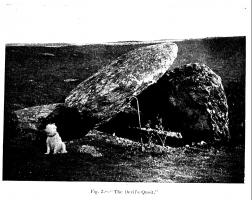
Devil's Quoit Burial Chamber [Map]A capstone, 3.7m by 2.4m and 0.5m thick, supported on the E by two upright orthostats 1.3m high, resting on a prostrate orthostat on the W. There is presently no trace of a mound, but a large, circular "agger" was noted in c.1810.
Archaeologia Cambrensis 1872 Pages 81-143. Newton Burrows [Devil's Quoit Burial Chamber [Map]] dolmen has been already given in the Arch. Camb.; but the representation here given is rather more faithful. The support at one end has given way, leaving the capstone in its reclining position. It is over 12 ft. long, and one of the upright stones measures 4 ft. 2 ins. Fenton describes it as having a slight trench round it, as is so frequently the case with the tumuli on the Wiltshire downs.
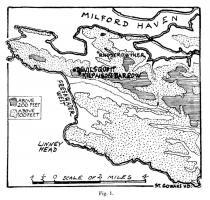
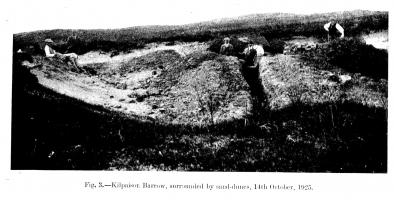
Archaeologia Cambrensis 1931 Volume 81 Pages 1-35. South-west of Rhoscrowther village the peninsula is little more than one mile in breadth, and from the ridge hereabouts a fine view is obtained; on the one side the open sea, on the other the beautiful estuary of Milford Haven. From the wide sandy beach of Freshwater West, 200 ft. below, the south-westerly gales have driven masses of sand on to the very crest of the ridge; the area thus enveloped is known as Kilpaison Burrows (Fig. 1). The plateau was probably free from these accumulations in prehistoric times. The Devil's Quoit [Map], a well-known dolmen (Fig. 2), is on the margin of the sand-covered area, and deep within it, 420 yards south-east of the dolmen, is the Bronze Age barrow now to be described1.
Note 1. See Pemb. 6-in. 0.8. Sheet XXXIX S.W. The Devil's Quoit is marked on this map.