

Adam Murimuth's Continuation and Robert of Avesbury’s 'The Wonderful Deeds of King Edward III'
This volume brings together two of the most important contemporary chronicles for the reign of Edward III and the opening phases of the Hundred Years’ War. Written in Latin by English clerical observers, these texts provide a vivid and authoritative window into the political, diplomatic, and military history of fourteenth-century England and its continental ambitions. Adam Murimuth Continuatio's Chronicarum continues an earlier chronicle into the mid-fourteenth century, offering concise but valuable notices on royal policy, foreign relations, and ecclesiastical affairs. Its annalistic structure makes it especially useful for establishing chronology and tracing the development of events year by year. Complementing it, Robert of Avesbury’s De gestis mirabilibus regis Edwardi tertii is a rich documentary chronicle preserving letters, treaties, and official records alongside narrative passages. It is an indispensable source for understanding Edward III’s claim to the French crown, the conduct of war, and the mechanisms of medieval diplomacy. Together, these works offer scholars, students, and enthusiasts a reliable and unembellished account of a transformative period in English and European history. Essential for anyone interested in medieval chronicles, the Hundred Years’ War, or the reign of Edward III.
Available at Amazon in eBook and Paperback format.
Garn Gilfach Burial Chamber is in Strumble Head, Pembrokeshire, Prehistoric Wales Neolithic Burials.
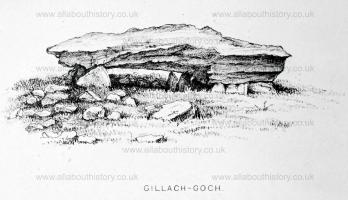
Archaeologia Cambrensis 1872 Pages 81-143. Proceeding onwards, towards Strumble Head, the cromlech-hunter will find one [Garn Gilfach Burial Chamber [Map]] at a place called in the Ordnance Map Gilfuch Goch, a view of which will be found in the Plates. It is of unusual character in having its capstone supported on a row of low stones,—so low that none but a very slender man, lying flat on the ground, could insinuate himself underneath. The capstone is nearly 14 ft. long, 8 wide, and 2 ft. thick, while all around are lying the relics of the former carn or tumulus. Mr. Blight did succeed in getting under the stone, but found only a fragment, of flint, which must have been placed there, as there is no natural flint in the country. It is also difficult to imagine how this grave could have been available for secondary interments, as the usual means of access to the interior do not exist. The following is Fenton's account, whose measurements do not exactly agree with those given above: "There is one more remarkable than the rest,—a large, unshapen mass of serpentine, 15 ft. by 8, and 2½ thick. Under the edges of it are placed nine or ten small, pointed, upright stones embedded in a strong pavement extending for some way round. These small supporters are seemingly fixed without any regard to their height, as only two or three bear the whole weight of the incumbent stone, one of which is so pressed by it as to have become almost incorporated with it. On the upper surface of the cromlech are three considerable excavations, near the centre; probably intended to have received the blood of the victim, or water for purification, if (as is the most general opinion) they were used as altars. Its height from the ground is very inconsiderable, being scarce one foot high on the lowest side; and on the other only high enough to admit of a person creeping under it, though when once entered the space enlarges from the upper stone, having a considerable concavity. The earth below is rich and black" (which he afterwards ascertained was chiefly the result of fire, as many bits of charcoal and rude pottery have been picked up there). A farmer informed Mr. Fenton that two or three years before his visit two spear-heads were found, laid across each other, and a knob of metal, suspected to have been gold.