

William of Worcester's Chronicle of England
William of Worcester, born around 1415, and died around 1482 was secretary to John Fastolf, the renowned soldier of the Hundred Years War, during which time he collected documents, letters, and wrote a record of events. Following their return to England in 1440 William was witness to major events. Twice in his chronicle he uses the first person: 1. when writing about the murder of Thomas, 7th Baron Scales, in 1460, he writes '… and I saw him lying naked in the cemetery near the porch of the church of St. Mary Overie in Southwark …' and 2. describing King Edward IV's entry into London in 1461 he writes '… proclaimed that all the people themselves were to recognize and acknowledge Edward as king. I was present and heard this, and immediately went down with them into the city'. William’s Chronicle is rich in detail. It is the source of much information about the Wars of the Roses, including the term 'Diabolical Marriage' to describe the marriage of Queen Elizabeth Woodville’s brother John’s marriage to Katherine, Dowager Duchess of Norfolk, he aged twenty, she sixty-five or more, and the story about a paper crown being placed in mockery on the severed head of Richard, 3rd Duke of York.
Available at Amazon in eBook and Paperback format.
Gwal y Filiast Burial Chamber is in Llanglydwen, Carmarthenshire, Prehistoric Wales Neolithic Burials.
Archaeologia Cambrensis 1872 Pages 81-143. Cut No. 7 represents the south or nearly south side of the Dolwilym chamber [Gwal y Filiast Burial Chamber [Map]]. The gap at the south-west corner was originally filled up by a slab, as already observed.
Cut No. 8 gives the north side, which consisted of a single slab joining the western one at right angles. The stone at the east end does not appear in the cut to be so much lower than the large western slab. A third and different view will also be found in one of the Plates.
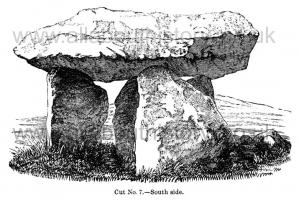
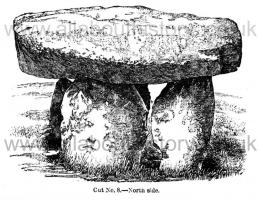
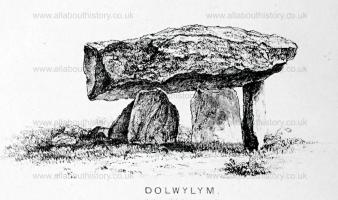
Archaeologia Cambrensis 1872 Pages 81-143. One ot the most perfect and interesting dolmens [Gwal y Filiast Burial Chamber [Map]] in Wales stands in the grounds of Dolwilym, in the northern extremity of the parish of Llanboidy, in Carmarthen-shire. The spot in which it is placed commands a singularly picturesque view of the vale and river of Taf, and is about midway down the steep slope on the right side of the river. Originally the chamber consisted of five or rather six stones, although only four now remain. The fifth, now missing, filled up the empty space at the south-west angle; and in all probability there was a second small stone at the eastern end, as the one now there could not, from its shortness, have closed that entrance. The western side is formed of one large stone on which the capstone rests; whence it is certain that the entrance was not here, but at the opposite end, towards which also the capstone gradually inclines. The upright stone at the eastern end is only about 2 ft. high; that at the opposite extremity being 4 ft. 4 ins.,—a difference that would not be expected from the almost horizontal position of the capstone. Sir Gardner Wilkinson gives the length and breadth, 11 ft. 6 ins. and 8 ft. 10 ins. Another measurement, taken diagonally, gave the two diagonals, 11 and 10 ft. There are several scattered stones lying about, all probablyconnected with the chamber and mound; of which last, however, hardly any traces remain. There are in all thirty-two stones within the circle; but the exact position, on account of the long and wet grass, was not ascertained with any accuracy of detail on the occasion of its being examined; but at any rate there are the remains of the circle of Isolated stones which constantly surrounded the base of the tumulus, at, some little distance from it. It has two names according to E. Davies, the author of the well known volumes on Celtic antiquities and Druids, one of Which is Burdd Arthur (Arthur's table), and the other, Gwâl y Vilast (the couch of the greyhound bitch). Of this animal there are many records scattered over Wales, Thus Ffynnon Milgi, in Llanelidan parish, in Denbighshire, is one instance. The inner sides of the upright stones are smooth and regular, while the lower face of the capstone, contrary to the more usual practice, is extremely rough and rugged. Near it is what is known as Crochan Arthur.