

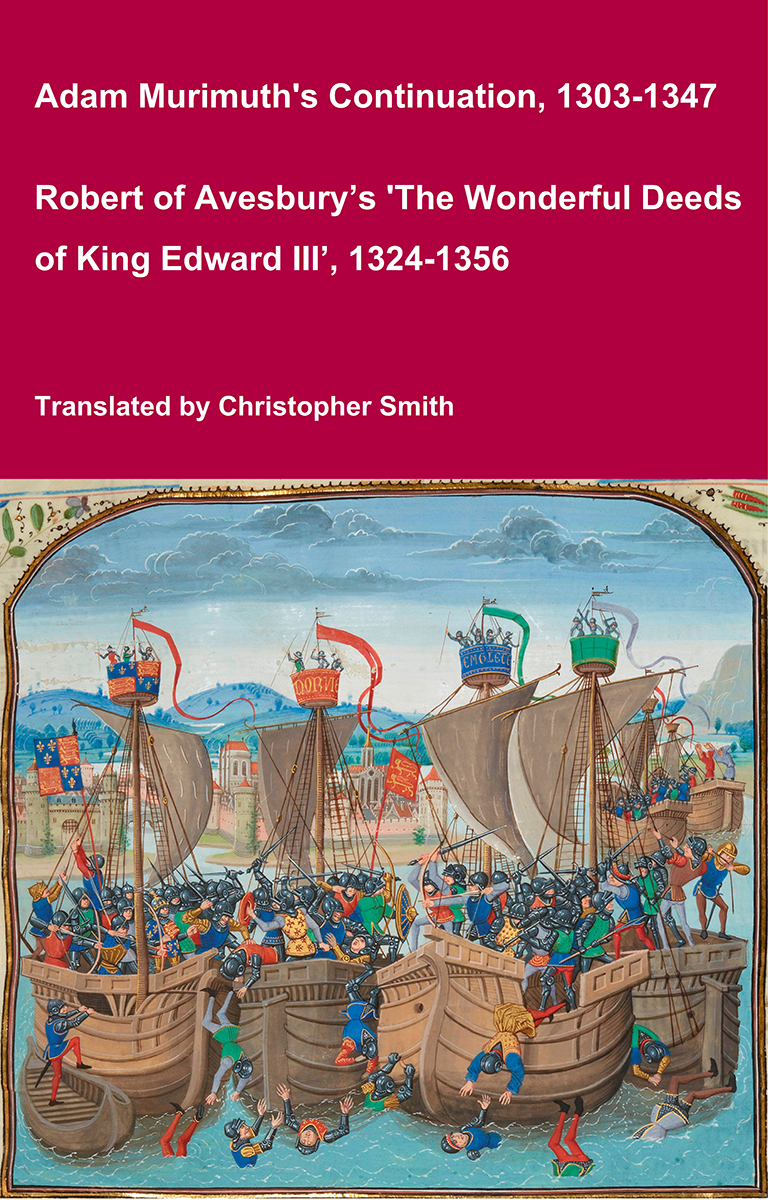
Adam Murimuth's Continuation and Robert of Avesbury’s 'The Wonderful Deeds of King Edward III'
This volume brings together two of the most important contemporary chronicles for the reign of Edward III and the opening phases of the Hundred Years’ War. Written in Latin by English clerical observers, these texts provide a vivid and authoritative window into the political, diplomatic, and military history of fourteenth-century England and its continental ambitions. Adam Murimuth Continuatio's Chronicarum continues an earlier chronicle into the mid-fourteenth century, offering concise but valuable notices on royal policy, foreign relations, and ecclesiastical affairs. Its annalistic structure makes it especially useful for establishing chronology and tracing the development of events year by year. Complementing it, Robert of Avesbury’s De gestis mirabilibus regis Edwardi tertii is a rich documentary chronicle preserving letters, treaties, and official records alongside narrative passages. It is an indispensable source for understanding Edward III’s claim to the French crown, the conduct of war, and the mechanisms of medieval diplomacy. Together, these works offer scholars, students, and enthusiasts a reliable and unembellished account of a transformative period in English and European history. Essential for anyone interested in medieval chronicles, the Hundred Years’ War, or the reign of Edward III.
Available at Amazon in eBook and Paperback format.
Kidwelly Castle is in Kidwelly, Carmarthenshire, Castles in Carmarthenshire.
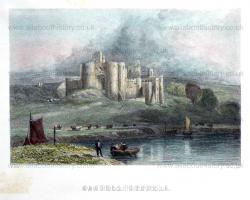
Kidwelly Castle [Map]. D Cox.
The Itinerary of Archbishop Baldwin through Wales: Book 1 Chapter 9. Thence we proceeded towards the river Lochor,86 through the plains in which Howel, son of Meredyth of Brecheinoc, after the decease of king Henry I., gained a signal victory over the English. Having first crossed the river Lochor, and afterwards the water called Wendraeth,87 we arrived at the castle of Cydweli [Map].88 In this district, after the death of king Henry, whilst Gruffydd son of Rhys, the prince of South Wales, was engaged in soliciting assistance from North Wales, his wife Gwenliana (like the queen of the Amazons, and a second Penthesilea) led an army into these parts [1136 Battle of Kidwelly]; but she was defeated by Maurice de Londres, lord of that country, and Geoffrey, the bishop's constable.89 Morgan, one of her sons, whom she had arrogantly brought with her in that expedition, was slain, and the other, Malgo, taken prisoner; and she, with many of her followers, was put to death. During the reign of king Henry I., when Wales enjoyed a state of tranquillity, the above-mentioned Maurice had a forest in that neighbourhood, well stocked with wild animals, and especially deer, and was extremely tenacious of his venison. His wife (for women are often very expert in deceiving men) made use of this curious stratagem. Her husband possessed, on the side of the wood next the sea, some extensive pastures, and large flocks of sheep. Having made all the shepherds and chief people in her house accomplices and favourers of her design, and taking advantage of the simple courtesy of her husband, she thus addressed him: "It is wonderful that being lord over beasts, you have ceased to exercise dominion over them; and by not making use of your deer, do not now rule over them, but are subservient to them; and behold how great an abuse arises from too much patience; for they attack our sheep with such an unheard-of rage, and unusual voracity, that from many they are become few; from being innumerable, only numerous." To make her story more probable, she caused some wool to be inserted between the intestines of two stags which had been embowelled; and her husband, thus artfully deceived, sacrificed his deer to the rapacity of his dogs.
Note 86. Lochor, or Llwchwr [Map], was the Leucarum mentioned in the Itineraries, and the fifth Roman station on the Via Julia. This small village is situated on a tide-river bearing the same name, which divides the counties of Glamorgan and Caermarthen, and over which there is a ferry. "Lochor river partith Kidwelli from West Gowerlande." - Leland, Itin. tom. v. p. 23. [The ferry is no more. The river is crossed by a fine railway bridge.]
Note 87. Wendraeth, or Gwen-draeth, from gwen, white, and traeth, the sandy beach of the sea. There are two rivers of this name, Gwendraeth fawr [Map], and Gwendraeth fychan, the great and the little Gwendraeth, of which Leland thus speaks: "Vendraeth Vawr and Vendraith Vehan risith both in Eskenning commote: the lesse an eight milys of from Kydwelli, the other about a ten, and hath but a little nesche of sand betwixt the places wher thei go into the se, about a mile beneth the towne of Kidwely."
Note 88. Cydweli [Map] was probably so called from cyd, a junction, and wyl, a flow, or gushing out, being situated near the junction of the rivers Gwendraeth fawr and fychan; but Leland gives its name a very singular derivation, and worthy of our credulous and superstitious author Giraldus. "Kidwely, otherwise Cathweli, i.e. Catti lectus, quia Cattus olim solebat ibi lectum in quercu facere:- There is a little towne now but newly made betwene Vendraith Vawr and Vendraith Vehan. Vendraith Vawr is half a mile of." - Leland, Itin. tom. v. p. 22.
Note 89. The scene of the battle [1136 Battle of Kidwelly] fought between Gwenllian and Maurice de Londres is to this day called Maes Gwenllian [Map], the plain or field of Gwenllian; and there is a tower in the castle of Cydweli still called Tyr Gwenllian. [Maes Gwenllian [Map] is now a small farm, one of whose fields is said to have been the scene of the battle.]
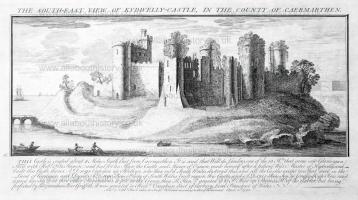
Kidwelly Castle [Map]. Samuel and Nathaniel Buck, 1740.
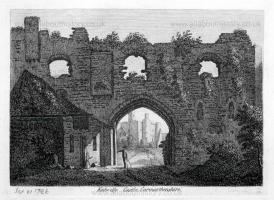
Kidwelly Castle [Map]. Godfrey, 1786.
Kidwelly Castle [Map]. Richard Colt Hoare (age 47), 1806.
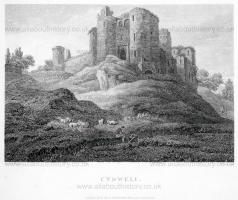

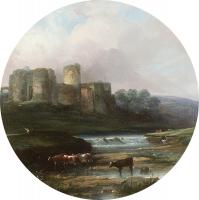
1851. William Pitt (age 33). Eagle Tower, Kidwelly Castle [Map].
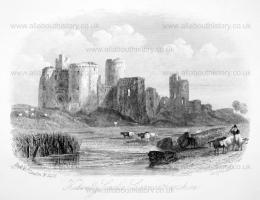
Kidwelly Castle [Map]. Rock & Co., 1853.
Norman Castles in Wales include Chepstow Castle [Map], Grosmont Castle [Map], Pembroke Castle [Map], Kidwelly Castle [Map], Haverfordwest Castle [Map], Walwyn's Castle [Map], Cardigan Castle [Map], Tenby Castle [Map], Abergavenny Castle [Map], Monmouth Castle [Map], Cilgerran Castle [Map] and Raglan Castle [Map].