

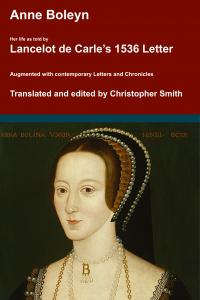
Anne Boleyn. Her Life as told by Lancelot de Carle's 1536 Letter.
In 1536, two weeks after the execution of Anne Boleyn, her brother George and four others, Lancelot du Carle, wrote an extraordinary letter that described Anne's life, and her trial and execution, to which he was a witness. This book presents a new translation of that letter, with additional material from other contemporary sources such as Letters, Hall's and Wriothesley's Chronicles, the pamphlets of Wynkyn the Worde, the Memorial of George Constantyne, the Portuguese Letter and the Baga de Secrets, all of which are provided in Appendices.
Available at Amazon in eBook and Paperback format.
Llandeilo is in Carmarthenshire.
Around 1081 Gruffudd ap Rhys King Deheubarth was born to Rhys ap Tewdwr King Deheubarth [aged 16] and Gwladys ferch Rhiwallon Mathrafal Queen Consort Deheubarth [aged 21] at Llandeilo. He married 1113 his half second cousin once removed Gwenllian Aberffraw Queen Consort Deheubarth, daughter of King Gruffudd ap Cynan of Gwynedd and Angharad Queen Consort Gwynedd, and had issue.
In 1234 Rhys Gryg ap Rhys Dinefwr [aged 69] died at Llandeilo. He was buried at St David's Cathedral, Pembrokeshire [Map].
On 17th June 1282 the army of Gilbert "Red Earl" Clare 7th Earl Gloucester 6th Earl Hertford [aged 38] were ambushed by the Welsh at Llandeilo.
William "The Younger" Valence was killed.
Much of Gilbert Clare's army of 1600 men was destroyed.
On 16th December 1889 Selina Lascelles [aged 48] died at Llandeilo.
Carreg Cennen Castle is also in Castles in Carmarthenshire.
Before 1197 Rhys ap Gruffydd "The Lord Rhys" Dinefwr [aged 64] commissioned (probably) the building of Carreg Cennen Castle [Map].
Before 17th June 1282 Gilbert "Red Earl" Clare 7th Earl Gloucester 6th Earl Hertford [aged 38] was captured at Carreg Cennen Castle [Map].
In 1287 Rhys ap Maredudd [aged 37] rebelled and led the capture of most of Ystrad Tywi, the heartland of Deheubarth, including Dinefwr Castle [Map] and Carreg Cennen Castle [Map]. Though the revolt was quelled by the autumn, it broke out again in November, and was only brought to a conclusion after a ten-day siege of Rhys' final stronghold, the castle at Newcastle Emlyn [Map], in January 1288.
In July 1403 Owain ap Gruffudd "Glyndŵr" Mathrafal Prince Powys [aged 44] attacked Carreg Cennen Castle [Map] with an army of eight hundred men but failed to take the castle it being defended by John Scudamore [aged 20] who subsequently married one of Owain's daughters Alys Mathrafal.
In 1462 Thomas ap Gruffyd Deheubarth surrendered at Carreg Cennen Castle [Map].
In 1462 Owain ap Gruffyd Deheubarth surrendered at Carreg Cennen Castle [Map].
Castles built by the Welsh for the Welsh include Dolbadarn Castle [Map], Dolforwyn Castle [Map], Dolwyddelan Castle [Map], Dryslwyn Castle [Map], Ewloe Castle [Map], Castell Dinas Brân [Map], Castell y Bere [Map], Carreg Cennen Castle [Map] and Arnold Arnaullt Castle [Map].
Dinefwr Castle is also in Castles in Carmarthenshire.
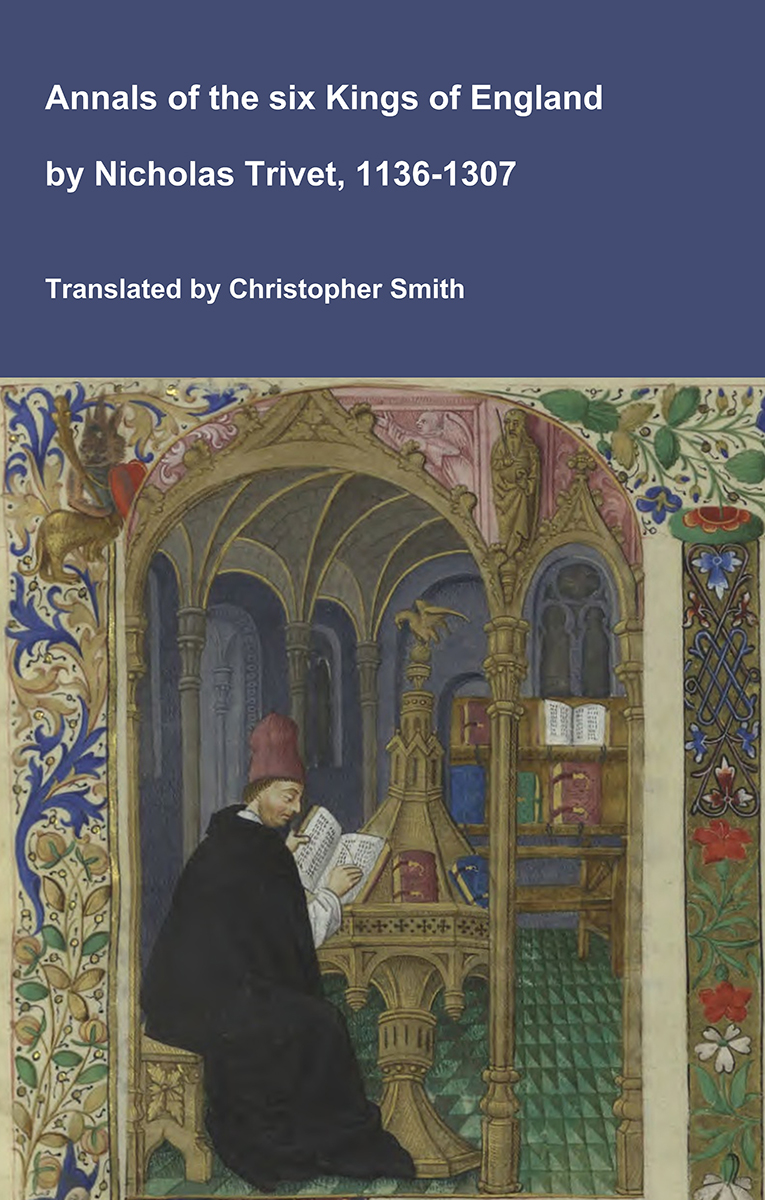
Annals of the six Kings of England by Nicholas Trivet
Translation of the Annals of the Six Kings of England by that traces the rise and rule of the Angevin aka Plantagenet dynasty from the mid-12th to early 14th century. Written by the Dominican scholar Nicholas Trivet, the work offers a vivid account of English history from the reign of King Stephen through to the death of King Edward I, blending political narrative with moral reflection. Covering the reigns of six monarchs—from Stephen to Edward I—the chronicle explores royal authority, rebellion, war, and the shifting balance between crown, church, and nobility. Trivet provides detailed insight into defining moments such as baronial conflicts, Anglo-French rivalry, and the consolidation of royal power under Edward I, whose reign he describes with particular immediacy. The Annals combines careful year-by-year reporting with thoughtful interpretation, presenting history not merely as a sequence of events but as a moral and political lesson. Ideal for readers interested in medieval history, kingship, and the origins of the English state, this chronicle remains a valuable and accessible window into the turbulent world of the Plantagenet kings.
Available at Amazon in eBook and Paperback format.
The Itinerary of Archbishop Baldwin through Wales: Book 1 Chapter 10. This ancient city [Carmarthen [Map]] is situated on the banks of the noble river Tywy, surrounded by woods and pastures, and was strongly inclosed with walls of brick, part of which are still standing; having Cantref Mawr, the great cantred, or hundred, on the eastern side, a safe refuge, in times of danger, to the inhabitants of South Wales, on account of its thick woods; where is also the castle of Dinevor [Map],92 built on a lofty summit above the Tywy, the royal seat of the princes of South Wales. In ancient times, there were three regal palaces in Wales: Dinevor in South Wales, Aberfrau in North Wales, situated in Anglesea, and Pengwern in Powys, now called Shrewsbury (Slopesburia); Pengwern signifies the head of a grove of alders. Recalling to mind those poetical passages:
"Dolus an virtus quis in hoste requirat?" ["who would seek for trickery or courage in an enemy?"]
and
"Et si non recte possis quocunque modo rem," ["And if you cannot do it rightly, do it in any way."]
my pen shrinks with abhorrence from the relation of the enormous vengeance exercised by the court against its vassals, within the comot of Caeo, in the Cantref Mawr. Near Dinevor [Map], on the other side of the river Tywy, in the Cantref Bychan, or the little cantred, there is a spring which, like the tide, ebbs and flows twice in twenty-four hours.93 Not far to the north of Caermardyn, namely at Pencadair [Map], that is, the head of the chair, when Rhys, the son of Gruffydd, was more by stratagem than force compelled to surrender, and was carried away into England, king Henry II. despatched a knight, born in Britany, on whose wisdom and fidelity he could rely, under the conduct of Guaidanus, dean of Cantref Mawr, to explore the situation of Dinevor castle, and the strength of the country. The priest, being desired to take the knight by the easiest and best road to the castle, led him purposely aside by the most difficult and inaccessible paths, and wherever they passed through woods, the priest, to the general surprise of all present, fed upon grass, asserting that, in times of need, the inhabitants of that country were accustomed to live upon herbs and roots. The knight returning to the king, and relating what had happened, affirmed that the country was uninhabitable, vile, and inaccessible, and only affording food to a beastly nation, living like brutes. At length the king released Rhys, having first bound him to fealty by solemn oaths and the delivery of hostages.
Note 92. Dinevor [Map], the great castle, from dinas, a castle, and vawr, great, was in ancient times a royal residence of the princes of South Wales. In the year 876, Roderic the Great, having divided the principalities of North and South Wales, and Powys land, amongst his three sons, built for each of them a palace. The sovereignty of South Wales, with the castle of Dinevor, fell to the lot of Cadell. [The ruins of Dinevor Castle still crown the summit of the hill which overshadows the town of Llandilo, 12 miles from Carmarthen.]
Note 93. There is a spring very near the north side of Dinevor park wall, which bears the name of Nant-y-rhibo, or the bewitched brook, which may, perhaps, be the one here alluded to by Giraldus.
In 1189 Maelgwn Dinefwr [aged 19] was imprisoned at Dinefwr Castle [Map].
In 1244 Rhys Mechel Dinefwr [aged 54] died at Dinefwr Castle [Map].
In 1287 Rhys ap Maredudd [aged 37] rebelled and led the capture of most of Ystrad Tywi, the heartland of Deheubarth, including Dinefwr Castle [Map] and Carreg Cennen Castle [Map]. Though the revolt was quelled by the autumn, it broke out again in November, and was only brought to a conclusion after a ten-day siege of Rhys' final stronghold, the castle at Newcastle Emlyn [Map], in January 1288.
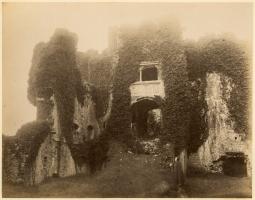
Around 1855. Benjamin Brecknell Turner [aged 40]. Dinefwr Castle [Map].