

Abbot John Whethamstede’s Chronicle of the Abbey of St Albans
Abbot John Whethamstede's Register aka Chronicle of his second term at the Abbey of St Albans, 1451-1461, is a remarkable text that describes his first-hand experience of the beginning of the Wars of the Roses including the First and Second Battles of St Albans, 1455 and 1461, respectively, their cause, and their consequences, not least on the Abbey itself. His text also includes Loveday, Blore Heath, Northampton, the Act of Accord, Wakefield, and Towton, and ends with the Coronation of King Edward IV. In addition to the events of the Wars of the Roses, Abbot John, or his scribes who wrote the Chronicle, include details in the life of the Abbey such as charters, letters, land exchanges, visits by legates, and disputes, which provide a rich insight into the day-to-day life of the Abbey, and the challenges faced by its Abbot.
Available at Amazon in eBook and Paperback format.
Llanfechell Burial Chamber is in Llanfechell, Anglesey, Prehistoric Anglesey Burial Chambers.
Llanfechell Burial Chamber [Map] is situated in a field north-west of, and close to, the farm house of Cromlech. It seems to have been a very large Cromlech originally, to judge from the appearance of the capstone and supports that are lying close together. The capstone rests with one end on the fallen suports, the other lying on the ground.. It is ten feet ten inches long by five feet eleven inches wide, and one foot four inches in thickness. I was told by an old man who lived near, that he remembered it much larger than it is at present, and that a piece was broken off and used for building about seventy years ago. The support that lies to the north-east of it is seven feet eight inches long by four feet wide; the others I have not measured.


Archaeological Journal Volume 28 1871 Pages 97-108. 25. Llanfechell [Map] par. (N). About a mile W. of the church, 6 miles from Amlwch, in a field adjoining a farm-house, that retains the name of "Cromlech," are three erect stones, 10 ft. in height, 12 ft. apart from each other, the remains as stated, of a cromlech of unusually lofty proportions. Mr. Longueville Jones, in his list of Early British Remains in Mona, in 1855, notices it as a cromlech thrown down and partly injured of late, with traces of a carnedd of stones surrounding it. Arch. Cambr. third series, vol. i. p. 24. Anghai-ad Llwyd also describes it: Hist, of Anglesey, p. 259. The capstone has disappeared.
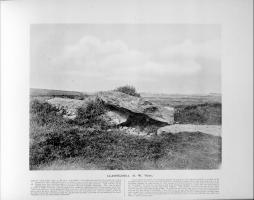
Cromlechs of Anglesey. Llanfechell Burial Chamber [Map]. In the Arch. Camb., vol. i. p. 366 [367], 1870, it is stated: "At a short distance from the church, on a rising ground, are three pillar-stones set in a triangle about ten feet high above the ground, which appear to have been the remaining supports of a covering stone long since removed. This chamber, in its original, must have been one of unusually lofty and imposing dimensions. The arm on which it stands is named Cromlech, which is supposed to confirm the supposition that a Cromlech once stood here. Lower down, however, on the slope of the hill, stood also a Cromlech at the time that the Ordnance Map was made, but it has since vanished, From which ever of the two monuments the arms is so called it would be desirable to ascertain by deeds how the arms has been so called, as the first use and meaning of the word "Cromlech" is not yet satisfactorilky explained."
I must correct the writer of the foregoing account by saying that the original Cromlech, as marked on the Ordnance Map, is still in situ, and very conspicuous, though its capstone has fallen down and a few of its remaining supports are lying beneath it. It is situated in a field north-west of, and close to, the farm house of "Cromlech". It seems to have been a very large Cromiech originally, to judge from the appearance of the capstone and supports that are lying close together, The capstone rests with one end on the fallen supports, and the other lying on the ground. It is ten feet ten inches long by five feet eleven inches wide, and one foot four inches in thickness. I was told by an old man who lived near, that he remembered it much larger than it is at present, and that a piece was broken off and used for building about seventy years ago. The support that lies north-east of it is seven feet eight inches long by four feet wide; the others I have mot measured.