

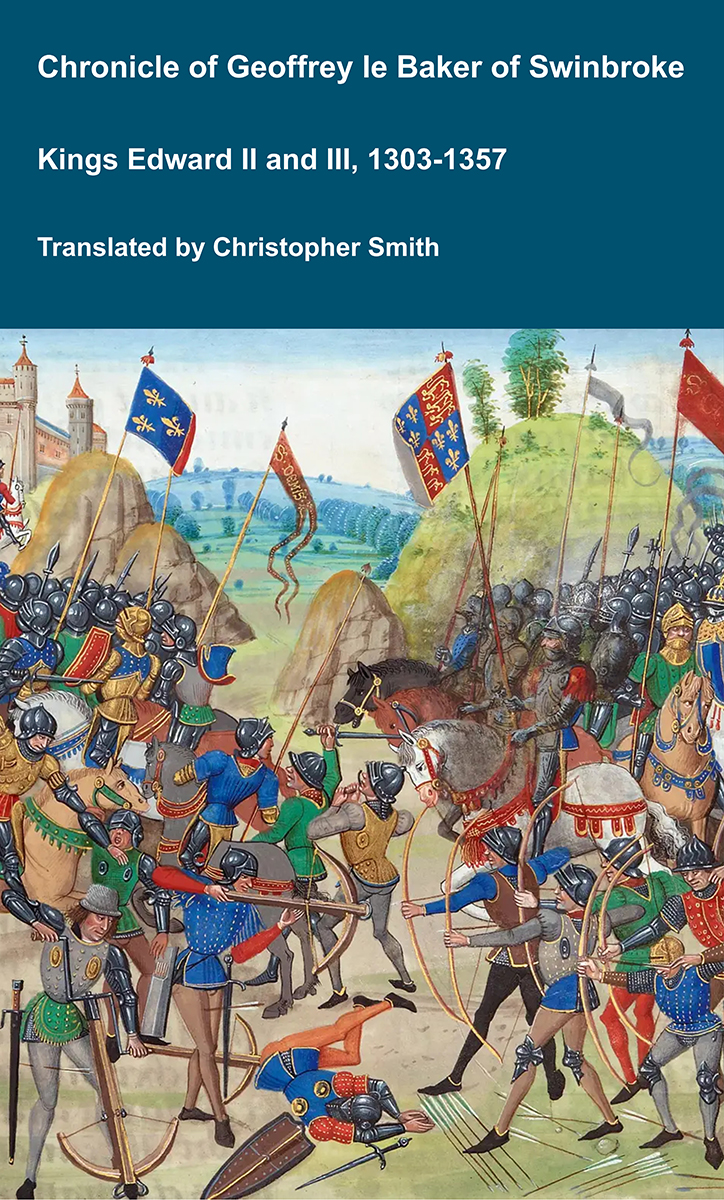
Chronicle of Geoffrey le Baker of Swinbroke
Baker was a secular clerk from Swinbroke, now Swinbrook, an Oxfordshire village two miles east of Burford. His Chronicle describes the events of the period 1303-1356: Gaveston, Bannockburn, Boroughbridge, the murder of King Edward II, the Scottish Wars, Sluys, Crécy, the Black Death, Winchelsea and Poitiers. To quote Herbert Bruce 'it possesses a vigorous and characteristic style, and its value for particular events between 1303 and 1356 has been recognised by its editor and by subsequent writers'. The book provides remarkable detail about the events it describes. Baker's text has been augmented with hundreds of notes, including extracts from other contemporary chronicles, such as the Annales Londonienses, Annales Paulini, Murimuth, Lanercost, Avesbury, Guisborough and Froissart to enrich the reader's understanding. The translation takes as its source the 'Chronicon Galfridi le Baker de Swynebroke' published in 1889, edited by Edward Maunde Thompson.
Available at Amazon in eBook and Paperback format.
Ligwy Burial Chamber is in Anglesey, Prehistoric Anglesey Burial Chambers.
Ligwy Burial Chamber [Map] is a Neolithic burial chamber in Lligwy, near the east coast of Anglesey, Wales. It consists of a circle of upright stones, made into a low chamber by a very large roof slab estimated at 25 tonnes. Excavation in 1909 found the remains of some 15 to 30 people, and pottery suggesting a late Neolithic date.
Archaeological Journal Volume 28 1871 Pages 97-108. 27. Lligwy [Map], Penrhos Lligwy par. (N).
A remarkable example, called also Coetan Arthur, adjoining the road from Red Wharf to Lligwy Bay, and on the estates of Lord Boston. Cap-stone of massive dimensions, 16 ft. by 13 ft. and 3 ft. 6 in. thick. Lewis, Topogr. Diet, of Wales: Angh. Llwyd, p. 341: Memoir by Rev. W. Wynn Williams, in 1867, Arch. Cambr., third series, vol. xiii. p. 135, where a N.E. and a S.E. view are given, with a plan. In 1845, as related by the late Rev. Hugh Jones, D.D. diggings for treasure at Lligwy exposed to view a quantity of bones, but their nature has not been stated, Arch. Journ., vol. ii. p. 269.