

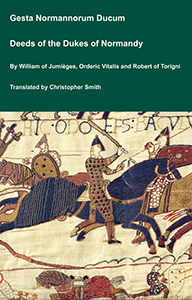
The Deeds of the Dukes of Normandy
The Gesta Normannorum Ducum [The Deeds of the Dukes of Normandy] is a landmark medieval chronicle tracing the rise and fall of the Norman dynasty from its early roots through the pivotal events surrounding the Norman Conquest of England. Originally penned in Latin by the monk William of Jumièges shortly before 1060 and later expanded at the behest of William the Conqueror, the work chronicles the deeds, politics, battles, and leadership of the Norman dukes, especially William’s own claim to the English throne. The narrative combines earlier historical sources with firsthand information and oral testimony to present an authoritative account of Normandy’s transformation from a Viking settlement into one of medieval Europe’s most powerful realms. William’s history emphasizes the legitimacy, military prowess, and governance of the Norman line, framing their expansion, including the conquest of England, as both divinely sanctioned and noble in purpose. Later chroniclers such as Orderic Vitalis and Robert of Torigni continued the history, extending the coverage into the 12th century, providing broader context on ducal rule and its impact. Today this classic work remains a foundational source for understanding Norman identity, medieval statesmanship, and the historical forces that reshaped England and Western Europe between 800AD and 1100AD.
Available at Amazon in eBook and Paperback format.
Montgomeryshire is in Powys.
The River Severn rises on Plynlimon [Map] after which it passes Llanidloes [Map], Caersws [Map], Welshpool [Map], Crew Green [Map], Shrawardine, Shropshire [Map], Shrewsbury, Shropshire [Map], Wroxeter, Shropshire [Map], Coalport, Shropshire [Map], Bridgnorth, Shropshire [Map], Bewdley, Worcestershire [Map], Stourport-on-Severn, Worcestershire [Map] to Worcester, Worcestershire [Map]
From Worcester the rivers flows through Upton-upon-Severn, Worcestershire [Map] to Tewkesbury, Gloucestershire [Map] where it is joined by the Warwickshire River Avon, Gloucester [Map] becoming the Severn Estuary around Thornwell, Monmouthshire [Map].
The River Dovey rises nears Pennant, Gwynedd [Map] from where it flows past Dinas Mawddwy, Gwynedd [Map], Aberangell [Map], Cemmaes, Montgomeryshire [Map], Machynlleth [Map] to Aberdyfi [Map] where it joins the Irish Sea.
The River Teme rises around three miles south of Dolfor [Map] in Powys. For much of its upper course it forms the border between England and Wales. It passes through, or near, Felindre, Radnoshire [Map], Knighton, Radnorshire [Map], Leintwardine, Herefordshire [Map], Bromfield, Shropshire [Map], Ludlow, Shropshire [Map], Tenbury Wells, Worcestershire [Map], Stanford Bridge, Worcestershire [Map], Shelsey Beauchamp, Worcestershire [Map], Leigh, Worcestershire [Map] and Bransford, Worcestershire [Map] after which it joins the River Severn around 3 km south of Worcester, Worcestershire [Map].
On 8th July 1785 Charles Montolieu Lamb 2nd Baronet was born to James Lamb aka Burges 1st Baronet [aged 33] and Anne Montolieu [aged 29] at Nantcribba Hall, Forden. He married (1) 30th June 1815 Mary Montgomerie Lady Lamb, daughter of Archibald Montgomerie 11th Earl Eglinton and Frances Twysden, and had issue (2) 28th October 1853 Frances Margesson Lady Lamb.
Lake Vyrnwy [Map] is a reservoir in Montgomeryshire, Wales, built in the 1880s for Liverpool Corporation Waterworks to supply Liverpool with fresh water.
The River Vyrnwy rises on the hills around Lake Vyrnwy [Map] from where it flows past Meifod, Montgomeryshire [Map], Llansantffraid-ym-Mechain [Map] after which it crosses from Wales into England, and flows to Melverley, Shropshire [Map] and Crew Green Bridge, Shropshire [Map] where it joins the River Severn.
On 5th March 1295 William Beauchamp 9th Earl Warwick [aged 58] defeated the army of Madog ap Llywelyn during the Battle of Maes Moydog at Llanfair Caereinion, Montgomeryshire [Map]. English losses were around 100 dead, Welsh around 700.
Annals of Worcester. On the fifth day of March [1295], William de Beauchamp [aged 58], Earl of Warwick, engaged in battle with the Welsh at a place called Meismeidoc [Map] in their language. He overcame seven hundred of them, besides those who were drowned and lethally wounded. However, Madoc ap Llywelyn, their disgraced prince, barely escaped.
Quinto die Martii Willelmus de Bello Campo comes Warewik commisit bellum cum Wallensibus in loco quod dicitur lingua eorum Meismeidoc [Map]; et prostravit ex illis de nobilioribus septingentos viros præter submersos et letaliter vul neratos. Sed Madocus ap Lewelin eorum princeps cum dedecore vix evasit.
The River Banwy aka Einion rises in the hills to the west of Llangadfan, Montgomeryshire [Map] through after which it flows through Llanfair Caereinion, Montgomeryshire [Map] before joining the River Vyrnwy.
The River Banwy aka Einion rises in the hills to the west of Llangadfan, Montgomeryshire [Map] through after which it flows through Llanfair Caereinion, Montgomeryshire [Map] before joining the River Vyrnwy.
The River Severn rises on Plynlimon [Map] after which it passes Llanidloes [Map], Caersws [Map], Welshpool [Map], Crew Green [Map], Shrawardine, Shropshire [Map], Shrewsbury, Shropshire [Map], Wroxeter, Shropshire [Map], Coalport, Shropshire [Map], Bridgnorth, Shropshire [Map], Bewdley, Worcestershire [Map], Stourport-on-Severn, Worcestershire [Map] to Worcester, Worcestershire [Map]
From Worcester the rivers flows through Upton-upon-Severn, Worcestershire [Map] to Tewkesbury, Gloucestershire [Map] where it is joined by the Warwickshire River Avon, Gloucester [Map] becoming the Severn Estuary around Thornwell, Monmouthshire [Map].
Henrici Quinti, Angliæ Regis, Gesta, is a first-hand account of the Agincourt Campaign, and subsequent events to his death in 1422. The author of the first part was a Chaplain in King Henry's retinue who was present from King Henry's departure at Southampton in 1415, at the siege of Harfleur, the battle of Agincourt, and the celebrations on King Henry's return to London. The second part, by another writer, relates the events that took place including the negotiations at Troye, Henry's marriage and his death in 1422.
Available at Amazon in eBook and Paperback format.
The River Vyrnwy rises on the hills around Lake Vyrnwy [Map] from where it flows past Meifod, Montgomeryshire [Map], Llansantffraid-ym-Mechain [Map] after which it crosses from Wales into England, and flows to Melverley, Shropshire [Map] and Crew Green Bridge, Shropshire [Map] where it joins the River Severn.
On 11th July 1700 William Williams 1st Baronet [aged 66] died. He was buried at Llansilin. His son William [aged 35] succeeded 2nd Baronet Williams of Gray's Inn.
The River Dovey rises nears Pennant, Gwynedd [Map] from where it flows past Dinas Mawddwy, Gwynedd [Map], Aberangell [Map], Cemmaes, Montgomeryshire [Map], Machynlleth [Map] to Aberdyfi [Map] where it joins the Irish Sea.
On 3rd March 1872 Frances Vane-Tempest [aged 21] died. She was buried at St Peter's Church [Map]. Memorial at St Mary's Church, Long Newton [Map].
Frances Vane-Tempest: On 19th September 1850 she was born to George Henry Vane-Tempest 5th Marquess Londonderry and Mary Cornelia Edwards Marchioness Londonderry.


On 26th June 1873 Avarina Mary Vane-Tempest [aged 15] died. She was buried at St Peter's Church [Map]. Memorial at St Mary's Church, Long Newton [Map].
Avarina Mary Vane-Tempest: On 15th July 1857 she was born to George Henry Vane-Tempest 5th Marquess Londonderry and Mary Cornelia Edwards Marchioness Londonderry.
The Times. 2nd February 1905. The funeral of Lord Henry Vane-Tempest [deceased] took place yesterday in the family vault in St. Peter's [Map], Montgomeryshire. The Bishop of Bangor [aged 59], assisted by the Rev J. Williams, rector of the parish, and the Rev. S. J. Evans, officiated. The principal mourmers were the Marquis [aged 52] and Marchioness of Londonderry [aged 48] (brother and sister-in-law), Lord Herbert Vane-Tempest [aged 42] (brother), and Mr. Beaumont [aged 44], M.P., and Lady Aline Beaumont [aged 41] (brother-in-law and sister). Continues.


The River Vyrnwy rises on the hills around Lake Vyrnwy [Map] from where it flows past Meifod, Montgomeryshire [Map], Llansantffraid-ym-Mechain [Map] after which it crosses from Wales into England, and flows to Melverley, Shropshire [Map] and Crew Green Bridge, Shropshire [Map] where it joins the River Severn.
On 23rd March 1594 Edward Herbert [aged 47] died at Montgomery.
Montgomery Castle is also in Castles in Montgomeryshire.
Anglo-Saxon Chronicle. 1095. Among these things it was made known to the king [aged 39], that the Welshmen in Wales had broken into a castle called Montgomery [Map], and slain the men of Earl Hugo, that should have held it. He therefore gave orders to levy another force immediately, and after Michaelmas went into Wales, and shifted his forces, and went through all that land, so that the army came all together by All Saints to Snowdon. But the Welsh always went before into the mountains and the moors, that no man could come to them.
In 1309 Hugh Audley 1st Baron Audley of Stratton Audley [aged 42] was appointed Governor of Montgomery Castle [Map].
The Deeds of the Dukes of Normandy
The Gesta Normannorum Ducum [The Deeds of the Dukes of Normandy] is a landmark medieval chronicle tracing the rise and fall of the Norman dynasty from its early roots through the pivotal events surrounding the Norman Conquest of England. Originally penned in Latin by the monk William of Jumièges shortly before 1060 and later expanded at the behest of William the Conqueror, the work chronicles the deeds, politics, battles, and leadership of the Norman dukes, especially William’s own claim to the English throne. The narrative combines earlier historical sources with firsthand information and oral testimony to present an authoritative account of Normandy’s transformation from a Viking settlement into one of medieval Europe’s most powerful realms. William’s history emphasizes the legitimacy, military prowess, and governance of the Norman line, framing their expansion, including the conquest of England, as both divinely sanctioned and noble in purpose. Later chroniclers such as Orderic Vitalis and Robert of Torigni continued the history, extending the coverage into the 12th century, providing broader context on ducal rule and its impact. Today this classic work remains a foundational source for understanding Norman identity, medieval statesmanship, and the historical forces that reshaped England and Western Europe between 800AD and 1100AD.
Available at Amazon in eBook and Paperback format.
In 1344 Nicholas de la Beche was appointed Governor of Montgomery Castle [Map].
Powis Castle is also in Castles in Montgomeryshire.
Around 1573 William Herbert 1st Baron Powis was born to Edward Herbert [aged 26] and Mary Stanley [aged 23] at Powis Castle [Map]. He married before 1598 his half third cousin once removed Eleanor Percy Baroness Herbert, daughter of Henry Percy 8th Earl of Northumberland and Katherine Neville Countess Northumberland, and had issue.
On 15th April 1822 Percy Egerton Herbert was born to Edward Herbert 2nd Earl Powis [aged 37] and Lucy Graham Countess Powis [aged 28] at Powis Castle [Map]. He married 4th October 1860 his fourth cousin twice removed Mary Caroline Louisa Petty Fitzmaurice and had issue.


On 24th June 1827 Robert Charles Herbert was born to Edward Herbert 2nd Earl Powis [aged 42] and Lucy Graham Countess Powis [aged 33] at Powis Castle [Map].

On 17th January 1848 Edward Herbert 2nd Earl Powis [aged 62] died. he had been shot accidentally in the thigh ten days before by his son George Herbert [aged 22] during a pheasant shoot at Powis Castle [Map]. He died His son Edward [aged 29] succeeded 3rd Earl Powis.
In 1570 Edward Blayney 1st Baron Blayney was born to David Lloyd Blayney at Gregynog Hall, Tregynon. He married 13th June 1605 Anne Loftus and had issue.