

Henrici Quinti, Angliæ Regis, Gesta, is a first-hand account of the Agincourt Campaign, and subsequent events to his death in 1422. The author of the first part was a Chaplain in King Henry's retinue who was present from King Henry's departure at Southampton in 1415, at the siege of Harfleur, the battle of Agincourt, and the celebrations on King Henry's return to London. The second part, by another writer, relates the events that took place including the negotiations at Troye, Henry's marriage and his death in 1422.
Available at Amazon in eBook and Paperback format.
Rhoslan Burial Mound is in Criccieth, Prehistoric Wales Neolithic Burials.
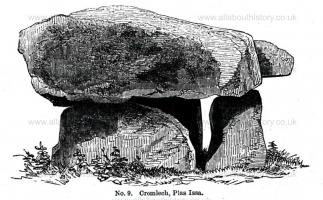
Archaeologia Cambrensis 1869 Page 118-147 Cromlechs in North Wales. At no great distance is another cromlech [Rhoslan Burial Mound [Map]] (cut No. 9), of a very different character from the last, in having a capstone of unusual thickness, 3¼ feet, if the other proportions of the stone are taken into consideration. It stands due east and west; the eastern entrance being formed by two uprights, on which the capstone rests, and which, therefore, could not have been removed for any subsequent interment. The opposite end of the capstone is supported by only one upright; but whether this was the original arrangement or not, must be mere speculation. The structure at present consists only of four stones, without reckoning the cap, namely the three supporters and one long slab which forms the northern side of the chamber, the side given in the cut. The whole of the southern side has been removed. It is situated on a farm called Plas Issa, near Criccieth.