

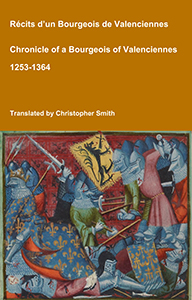
Chronicle of a Bourgeois of Valenciennes
Récits d’un bourgeois de Valenciennes aka The Chronicle of a Bourgeois of Valenciennes is a vivid 14th-century vernacular chronicle written by an anonymous urban chronicler from Valenciennes in the County of Hainaut. It survives in a manuscript that describes local and regional history from about 1253 to 1366, blending chronology, narrative episodes, and eyewitness-style accounts of political, military, and social events in medieval France, Flanders, and the Low Countries. The work begins with a chronological framework of events affecting Valenciennes and its region under rulers such as King Philip VI of France and the shifting allegiances of local nobility. It includes accounts of conflicts, sieges, diplomatic manoeuvres, and the impact of broader struggles like the Hundred Years’ War on urban life in Hainaut. Written from the perspective of a burgher (bourgeois) rather than a monastery or royal court, the chronicle offers a rare lay viewpoint on high politics and warfare, reflecting how merchants, townspeople, and civic institutions experienced the turbulence of the 13th and 14th centuries. Its narrative style combines straightforward reporting of events with moral and civic observations, making it a valuable source for readers interested in medieval urban society, regional politics, and the lived experience of war and governance in pre-modern Europe.
Available at Amazon in eBook and Paperback format.
St David's Cathedral, Pembrokeshire is in St David's.
In 872 Bishop Lumberth was consecrated Bishop of St David's.
In 1081 Rhys ap Tewdwr King Deheubarth (age 16) sought sanctuary at St David's Cathedral, Pembrokeshire [Map].
On 18th September 1115 Bishop Bernard was appointed Bishop of St David's.
On 14th December 1148 David Fitzgerald (age 42) was elected Bishop of St David's.
On 19th December 1148 Bishop David Fitzgerald (age 42) was consecrated Bishop of St David's at Canterbury Cathedral [Map] by Archbishop Theobald of Bec (age 58).
In 1176 Bishop Peter de Leia was appointed Bishop of St David's by King Henry II (age 42) despite the cathedral chapter preferring Gerald of Wales aka Cambrensis (age 29) aka Giraldus Cambrensis.
On 7th November 1176 Bishop Peter de Leia was consecrated Bishop of St David's at Canterbury Cathedral [Map].
The Itinerary of Archbishop Baldwin through Wales: Book 1 Chapter 13. From Haverford we proceeded on our journey to Menevia, distant from thence about twelve miles, and passed through Camros [Map],109 where, in the reign of king Stephen, the relations and friends of a distinguished young man, Giraldus, son of William, revenged his death by a too severe retaliation on the men of Ros. We then passed over Niwegal sands [Map], at which place (during the winter that king Henry II. spent in Ireland), as well as in almost all the other western ports, a very remarkable circumstance occurred. The sandy shores of South Wales, being laid bare by the extraordinary violence of a storm, the surface of the earth, which had been covered for many ages, re-appeared, and discovered the trunks of trees cut off, standing in the very sea itself, the strokes of the hatchet appearing as if made only yesterday.110 The soil was very black, and the wood like ebony. By a wonderful revolution, the road for ships became impassable, and looked, not like a shore, but like a grove cut down, perhaps, at the time of the deluge, or not long after, but certainly in very remote ages, being by degrees consumed and swallowed up by the violence and encroachments of the sea. During the same tempest many sea fish were driven, by the violence of the wind and waves, upon dry land. We were well lodged at St. David's [Map] by Peter, bishop of the see, a liberal man, who had hitherto accompanied us during the whole of our journey.
Note 109. Camros [Map], a small village, containing nothing worthy of remark, excepting a large tumulus. It appears, by this route of the Crusaders, that the ancient road to Menevia, or St. David's, led through Camros, whereas the present turnpike road lies a mile and a half to the left of it. It then descends to Niwegal Sands, and passes near the picturesque little harbour of Solvach, situated in a deep and narrow cove, surrounded by high rocks.
Note 110. The remains of vast submerged forests are commonly found on many parts of the coast of Wales, especially in the north. Giraldus has elsewhere spoken of this event in the Vaticinal History, book i. chap. 35.
On 28th April 1197 Rhys ap Gruffydd "The Lord Rhys" Dinefwr (age 65) died. He was buried at St David's Cathedral, Pembrokeshire [Map].
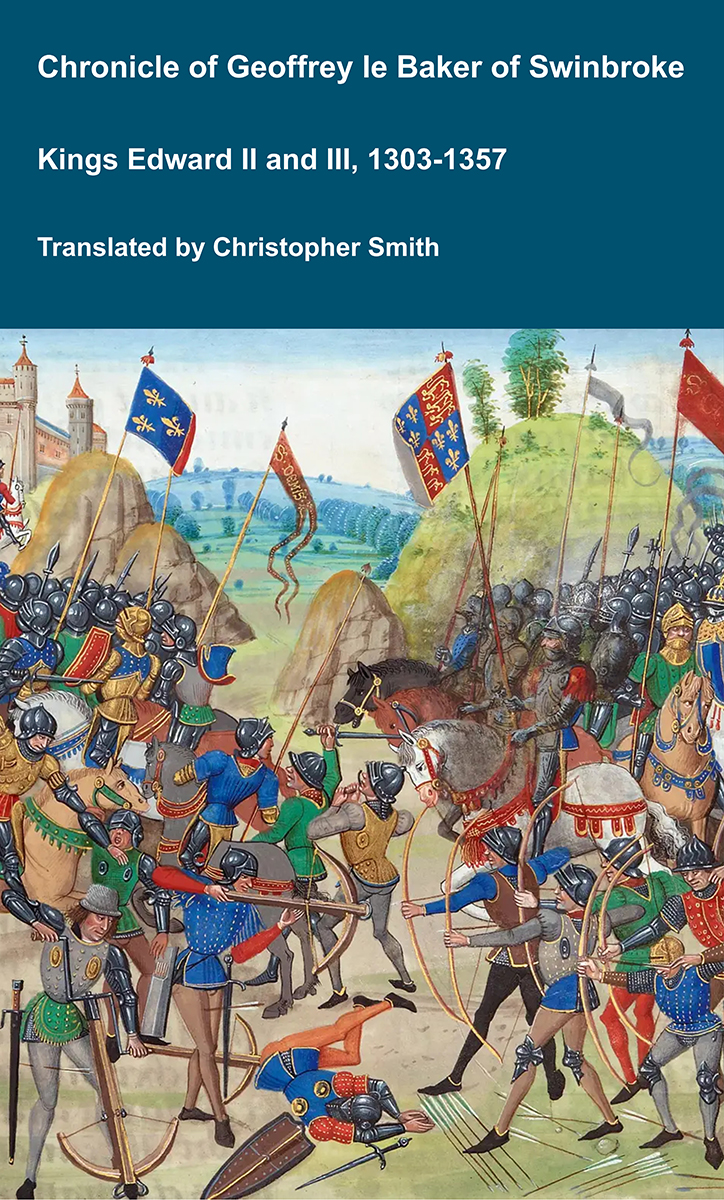
Chronicle of Geoffrey le Baker of Swinbroke
Baker was a secular clerk from Swinbroke, now Swinbrook, an Oxfordshire village two miles east of Burford. His Chronicle describes the events of the period 1303-1356: Gaveston, Bannockburn, Boroughbridge, the murder of King Edward II, the Scottish Wars, Sluys, Crécy, the Black Death, Winchelsea and Poitiers. To quote Herbert Bruce 'it possesses a vigorous and characteristic style, and its value for particular events between 1303 and 1356 has been recognised by its editor and by subsequent writers'. The book provides remarkable detail about the events it describes. Baker's text has been augmented with hundreds of notes, including extracts from other contemporary chronicles, such as the Annales Londonienses, Annales Paulini, Murimuth, Lanercost, Avesbury, Guisborough and Froissart to enrich the reader's understanding. The translation takes as its source the 'Chronicon Galfridi le Baker de Swynebroke' published in 1889, edited by Edward Maunde Thompson.
Available at Amazon in eBook and Paperback format.
In 1234 Rhys Gryg ap Rhys Dinefwr (age 69) died at Llandeilo. He was buried at St David's Cathedral, Pembrokeshire [Map].
In 1280 Bishop Thomas Bek (age 36) was appointed Bishop of St David's.
On 21st April 1328 Bishop Henry Gower was elected Bishop of St David's.
On 12th June 1328 Bishop Henry Gower was consecrated Bishop of St David's.
On 26th December 1339 Bishop Adam de Houghton was appointed Precentor of St David's Cathedral, Pembrokeshire [Map]. He resigned around 1350.
On 23rd May 1347 Cardinal John of Thoresby was appointed Bishop of St David's. he wa consecrated on 23rd September 1347.
On 20th September 1361 Pope Innocent VI provided Bishop Adam de Houghton to be Bishop of St David's, and he was consecrated a bishop by William Evendon, bishop of Winchester, at St Mary's, Southwark [Map].
On 5th May 1389 Bishop John Gilbert was translated to Bishop of St David's.
On 11th November 1397 Bishop Guy Mone Aka Mohun was consecrated as Bishop of St David's.
On 15th December 1417 Bishop Benedict Nichols was translated to Bishop of St David's.
On 1st June 1418 Bishop Benedict Nichols received possession of the temporalities at St David's Cathedral, Pembrokeshire [Map].
In 1433 Bishop Thomas Rodburn was elected Bishop of St David's.
Before 9th April 1483 Bishop Thomas Langton was nominated Bishop of St David's. He was consecrated around Aug/Sep 1483.
In 1508 Bishop Robert Sherbourne (age 55) was appointed Bishop of St David's.
In 1536 Bishop William Barlow (age 38) was consecrated Bishop of St David's.
Chronicle of Walter of Guisborough
A canon regular of the Augustinian Guisborough Priory, Yorkshire, formerly known as The Chronicle of Walter of Hemingburgh, describes the period from 1066 to 1346. Before 1274 the Chronicle is based on other works. Thereafter, the Chronicle is original, and a remarkable source for the events of the time. This book provides a translation of the Chronicle from that date. The Latin source for our translation is the 1849 work edited by Hans Claude Hamilton. Hamilton, in his preface, says: 'In the present work we behold perhaps one of the finest samples of our early chronicles, both as regards the value of the events recorded, and the correctness with which they are detailed; Nor will the pleasing style of composition be lightly passed over by those capable of seeing reflected from it the tokens of a vigorous and cultivated mind, and a favourable specimen of the learning and taste of the age in which it was framed.'
Available at Amazon in eBook and Paperback format.
On 9th September 1548 Bishop Robert Ferrar was appointed Bishop of St David's.
On 1st April 1554 the Lord Chancellor Bishop Edmund "Bloody" Bonner of London (age 54), assisted by Bishop Stephen Gardiner (age 71), Bishop Nicholas Ridley (age 54) and Bishop Cuthbert Tunstall (age 80), consecrated seven bishops at Southwark Cathedral [Map]:
Bishop George Cotes was consecrated Bishop of Chester.
Bishop Gilbert Bourne was consecrated Bishop of Bath and Wells.
Bishop James Brooks (age 41) was consecrated Bishop of Gloucester.
Bishop Maurice Griffiths (age 47) was consecrated Bishop of Rochester.
Bishop Henry Morgan was consecrated Bishop of St David's.
Bishop John White (age 44) was consecrated Bishop of Lincoln.
Bishop Robert Parfew aka Warton was consecrated Bishop of Hereford.
Henry Machyn's Diary. 1st April 1554. [The first day of April my lord chancellor (age 54) did consecrate six new bishops at St. Mary Overy's [Map], before the high altar; and a goodly mass was said. And when all] was done thay yede unto my lord ch[ancellor's,] for ther was as grett a dener as youe ha[ve seen.] Thes be the bysshopes names that wher consecrated, [doctor] Whyt (age 44), warden of Wynchastur, the bysshope of Ly[ncoln]; doctur Borne, bysshope of Bathe; doctur Morgan, bishop of sant Davys; doctur Brokes (age 41), bysshope of Gloss [ter]; doctur Cottes, bysshope of Westtchastur; bysshope of sant Asse changyd to be bysshope of Arfford; master [Griffith] (age 47) parsun of sant Magnus bysshope of Rochastur.
On 6th December 1559 Archbishop Thomas Young (age 52) was elected Bishop of St David's.
On 21st January 1560 two Bishops were consecrated...
Bishop Nicholas Bullingham (age 40) was consecrated Bishop of Lincoln.
Archbishop Thomas Young (age 53) was consecrated Bishop of St David's at Lambeth Palace [Map] by Archbishop Matthew Parker (age 55).
In 1615 Richard Milbourne was appointed Bishop of St David's.
On 18th November 1621 Archbishop William Laud (age 48) was appointed Bishop of St David's.


In 1687 Bishop Thomas Watson (age 49) was consecrated Bishop of St David's.
In 1743 Bishop Edward Willes (age 49) was appointed Bishop of St David's.
In 1774 Bishop James Yorke (age 43) was appointed Bishop of St David's.
In 1801 Bishop George Murray (age 39) was appointed Bishop of St David's.
On 23rd July 1825 Bishop John Jenkinson (age 43) was elected Bishop of St David's.
In Bishop Henry Morgan was deprived of the see of the Bishop of St David's.