

William of Worcester's Chronicle of England
William of Worcester, born around 1415, and died around 1482 was secretary to John Fastolf, the renowned soldier of the Hundred Years War, during which time he collected documents, letters, and wrote a record of events. Following their return to England in 1440 William was witness to major events. Twice in his chronicle he uses the first person: 1. when writing about the murder of Thomas, 7th Baron Scales, in 1460, he writes '… and I saw him lying naked in the cemetery near the porch of the church of St. Mary Overie in Southwark …' and 2. describing King Edward IV's entry into London in 1461 he writes '… proclaimed that all the people themselves were to recognize and acknowledge Edward as king. I was present and heard this, and immediately went down with them into the city'. William’s Chronicle is rich in detail. It is the source of much information about the Wars of the Roses, including the term 'Diabolical Marriage' to describe the marriage of Queen Elizabeth Woodville’s brother John’s marriage to Katherine, Dowager Duchess of Norfolk, he aged twenty, she sixty-five or more, and the story about a paper crown being placed in mockery on the severed head of Richard, 3rd Duke of York.
Available at Amazon in eBook and Paperback format.
St Winefrid's Well, Holywell is in Holywell, Flintshire.
St Winefrid's Well, Holywell [Map]
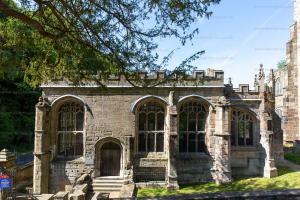
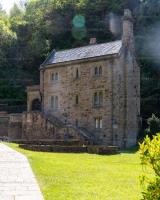
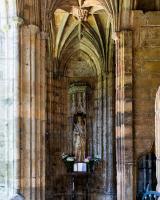
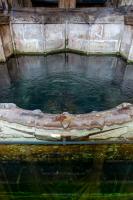
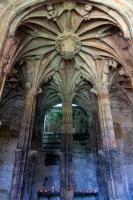
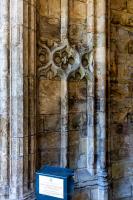
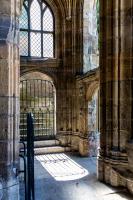
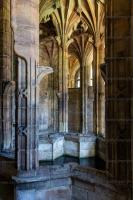
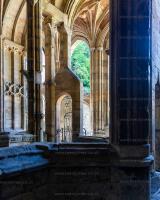
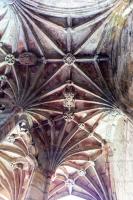
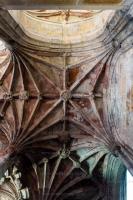
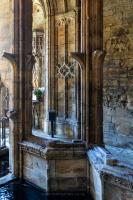
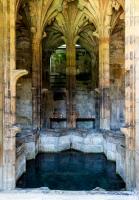
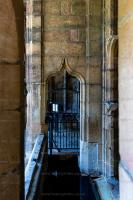
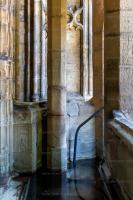
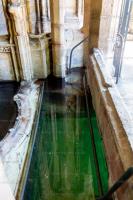
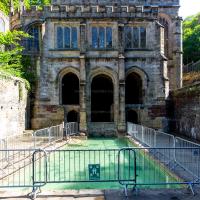
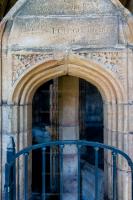
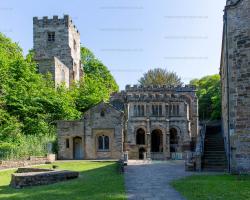
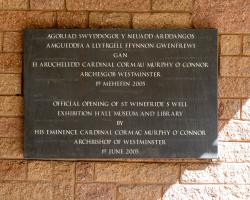
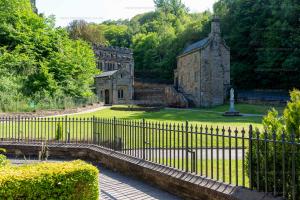
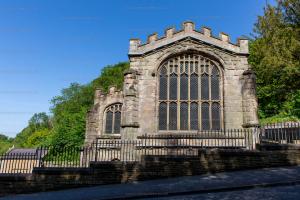
Before 1246 Dafydd ap Llewellyn Prince of Wales [aged 33] gave St Winefrid's Well, Holywell [Map] to Basingwerk Abbey [Map].
Chronicle of Adam of Usk [~1352-1430]. Before 11th March 1416. The king [aged 29] with great reverence went on foot in pilgrimage from Shrewsbury to St. Winifred's [Map] well in North Wales4.
Note 4. Holywell St. Winifred [Map], co. Flint. This pilgrimage of Henry V. does not appear to be recorded elsewhere. If Adam is correct in his statement, it probably took place early in 1416.
Dugdale's Warwickshire. Touching the said Lady Isabel [deceased] his Countesse I find, that she did not long survive him; for her Testament1 bears dare the date the first of December following, and the probat thereof 4. Febr. the same year. Of which Testament, forasmuch as it is very mememorable, I shall here deliver the substance; viz,. that her body should be interred in the Abby of Teskesbury [Map], and her great Templys2 with the baleys3 sold to the utmost, and delivered to the Monks of that house, so that they grutcht not with her burial there, and what else she had appointed to be done about the same. As also that her statue should be made all nakyd with her hair cast backwards according to the design and modell that one Thomas Porchalion had for that purpose and Mary Madg. laying her hands a-crosse, with S. John the Evang. on the right side and on the left side S. Anthony; and at her feet a Scocheon empaling her Arms with those of the Earle her late Husband, supported by two Gryphons, but on the sides thereof the statues of poor men and women in their poor array, with their beads in their hands. She also willed, that of her great Sharp a Challice should be made & offered to our Lady in the Lady-Chapell there at Tewkesbury and gave to our Lady of Caversham a Crown of Gold made of her Chain (weighing 25.l.) and other broken Gold in her Cabinet; and two Tablets, the one of S. Catherine, the other of S. George, the precious stones of which Tablets to be set in the said Crown. Her Tablet with the Image of our Lady, having a Glasse for it, she appointed to be offered unto our Lady of Walsingham with wide slieves, and a Tabernacle of silver like in the timbre to that over on; Lady of Caversham; and that her great Image of Wax, then at London, should be offered to our Lady of Worcester. To the Abby of Tewkesbury she gave her wedding Gown, and all her Cloaths of Gold, and Cloaths of Silk without Furs, saving one of Russet Velvet which she bequeathed to S. Winifride [Map]; further directing that all her precious Stones and Pearls should be sold, as also her silver Vessel and goods to perform her Will, whereof Sr. Will Mountfort, John Nansan, and John Norreii were consticuted Executors.
Note 1. Lussnam Q 27.
Note 2. Jewels hanging on womens foreheads by bodkins thrust into their hair.
Note 3. Pale, or Peach coloured Rubies.
A Tour of Wales by Thomas Pennant Volume 1. Sir Roger Mostyn.
It having pleased the king, by his royall grant, to bestow upon me ye antient chappell adjoining to St. Winifride's well [Map]; these are to desire you to give present possession, in my name, of the said chappell, to Mr Thomas Roberts, who will deliver this letter into yr hands. It being also my intention to have the place decently repaired, and put to a good use, I further desire, that you will aflfbard him yoiu: favour and protection, that he may not be distiu:bed in the performance thereof. You may rest assured, that what you do herein, according to my desire, shall be very kindly remembered by
Your Good Frind
May ye8th, 1687. Mary: Regina.
Whitehall.
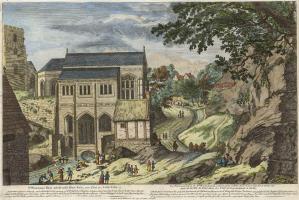
Around 1790. St Winefrid's Well, Holywell [Map]
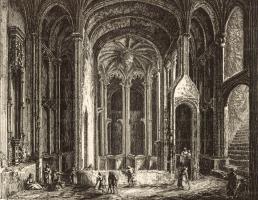
1813. St Winefrid's Well, Holywell [Map] by G Cuitt.
In 1828 Queen Victoria of the United Kingdom [aged 8] visited St Winefrid's Well, Holywell [Map] with her uncle King Leopold I of Belgium [aged 37].
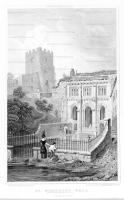
Wales Illustrated North Wales. St Winefrid's Well, Holywell [Map].
Chronicle of Walter of Guisborough
A canon regular of the Augustinian Guisborough Priory, Yorkshire, formerly known as The Chronicle of Walter of Hemingburgh, describes the period from 1066 to 1346. Before 1274 the Chronicle is based on other works. Thereafter, the Chronicle is original, and a remarkable source for the events of the time. This book provides a translation of the Chronicle from that date. The Latin source for our translation is the 1849 work edited by Hans Claude Hamilton. Hamilton, in his preface, says: 'In the present work we behold perhaps one of the finest samples of our early chronicles, both as regards the value of the events recorded, and the correctness with which they are detailed; Nor will the pleasing style of composition be lightly passed over by those capable of seeing reflected from it the tokens of a vigorous and cultivated mind, and a favourable specimen of the learning and taste of the age in which it was framed.'
Available at Amazon in eBook and Paperback format.
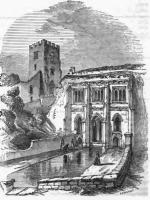
Robert Chambers 1832 ... The Book of Days ... A Miscellany of Popular Antiquities ...
The most famous holy well in the three kingdoms is undoubtedly that dedicated to St Winifred (Holywell, Flintshire) [Map] at whose shrine Giraldus Cambrensis offered his devotions in the twelth century, when he says she seemed 'still to retain her miraculous powers.' Winifred was a noble British maiden of the seventh century; a certain Prince Cradocus fell in love with her, and finding his rough advances repulsed, cut off the lady's head. Immediately he had done this, the prince was struck dead, and the earth opening, swallowed up his bodv. Meanwhile, Winifred's head rolled down the hill; where it stopped, a spring gushed forth, the blood from the head colouring the pebbles over which it flowed, and rendering fragrant the moss growing around. St Bueno picked up the head, and skilfully reunited it to the body to which it belonged, after which Winifred lived a life of sanctity for fifteen years, while the spring to which she gave her name became famous in the land for its curative powers.
The spring rises from a bed of shingle at the foot of a steep hill, the water rushing out with great impetuosity, and flowing into and over the main basin into a smaller one in front. The well is enclosed by a building in the perpendicular Gothic style (dating from the beginning of the reign of Henry VII), which forms a crypt under a small chapel contiguous to the parish church, and on a level with it; the entmnce to the well being by descent of about twenty steps from the street. The well itself is a star-shaped basin, ten feet in diameter, canopied by a most graceful stellar vault, and originally enclosed by stone traceried screens filling up the spaces between the supports. Round the basin is an ambulatory similarly vaulted.1 The sculptural ornaments consisted of grotesque animals, and the armorial-bearings of various benefactors of the shrine; among them being Catharine of Aragon, Margaret, mother of Henry II, and different members of the Stanley family, the founder both of the crypt and the chapel above it. Formerly, the former contained statues of the Virgin Mary and St Winifred. The first was removed in 1635; the fate of Winifred's to which a Countess of Warwick (1439) bequeathed her ruset velvet gown, is unknown. On the stones at the bottom of the well grow Bissus iolethus, and a species of red Jungermania moss in the vulgar tongue as Winifred's hair an blood. In the seventeenth century St Winifred could boast thousands of votaries.
James II paid a visit to the shrine in 1688, and received the shift worn by his great-grandmother at her execution, for his pains. Pennant found the roof of the vault hung with the crutches of grateful cripples. He says, 'the resort of pilgrims of late years to these Fontanalia has cosiderably increased; the greatest still a few are to be seen in the water, in deep devotion up to their chins for hours, sending up a number of evolutions well; or threading the arches a prescribed number of times.' An attempt to revive the public faith in the Flintshire saint made in 1805, when a pamphlet was published, detailing how one Winefred White, of Wolverhampton, experienced the benefit of the virtue of the spring. The cure is certified by a resident of Holywell, named Elizabeth Jones, in the following terms: 'l hereby declare that about three months ago, I saw a young woman calling Winefred White, walking with great difficulty on a crutch; and that on the following morning, the said Winefred White came to me running, and without any appearance of lameness, having as she told me, been immediately cured once bathing in St Winifred's Well.' It was of no avail, a dead belief vas not to be brought again to life even by Elizabeth Jones of Holywell.
Note 1. Archaeological Journal, iii, 148.
Archaeological Journal Volume 3 Page 148. St Winefrid's Well, Holywell [Map] at Holywell, Flintshire by Ambrose Poynter.