

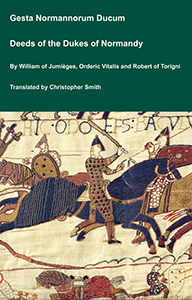
The Deeds of the Dukes of Normandy
The Gesta Normannorum Ducum [The Deeds of the Dukes of Normandy] is a landmark medieval chronicle tracing the rise and fall of the Norman dynasty from its early roots through the pivotal events surrounding the Norman Conquest of England. Originally penned in Latin by the monk William of Jumièges shortly before 1060 and later expanded at the behest of William the Conqueror, the work chronicles the deeds, politics, battles, and leadership of the Norman dukes, especially William’s own claim to the English throne. The narrative combines earlier historical sources with firsthand information and oral testimony to present an authoritative account of Normandy’s transformation from a Viking settlement into one of medieval Europe’s most powerful realms. William’s history emphasizes the legitimacy, military prowess, and governance of the Norman line, framing their expansion, including the conquest of England, as both divinely sanctioned and noble in purpose. Later chroniclers such as Orderic Vitalis and Robert of Torigni continued the history, extending the coverage into the 12th century, providing broader context on ducal rule and its impact. Today this classic work remains a foundational source for understanding Norman identity, medieval statesmanship, and the historical forces that reshaped England and Western Europe between 800AD and 1100AD.
Available at Amazon in eBook and Paperback format.
Bishop of St David's is in Bishops. See St David's Cathedral, Pembrokeshire [Map].
In 872 Bishop Lumberth was consecrated Bishop of St David's.
On 18th September 1115 Bishop Bernard was appointed Bishop of St David's.
On 14th December 1148 David Fitzgerald [aged 42] was elected Bishop of St David's.
On 19th December 1148 Bishop David Fitzgerald [aged 42] was consecrated Bishop of St David's at Canterbury Cathedral [Map] by Archbishop Theobald of Bec [aged 58].
In 1176 Bishop Peter de Leia was appointed Bishop of St David's by King Henry II [aged 42] despite the cathedral chapter preferring Gerald of Wales aka Cambrensis [aged 29] aka Giraldus Cambrensis.
On 7th November 1176 Bishop Peter de Leia was consecrated Bishop of St David's at Canterbury Cathedral [Map].
In 1280 Bishop Thomas Bek [aged 36] was appointed Bishop of St David's.
On 21st April 1328 Bishop Henry Gower was elected Bishop of St David's.
On 12th June 1328 Bishop Henry Gower was consecrated Bishop of St David's.
On 23rd May 1347 Cardinal John of Thoresby was appointed Bishop of St David's. he wa consecrated on 23rd September 1347.
On 20th September 1361 Pope Innocent VI provided Bishop Adam de Houghton to be Bishop of St David's, and he was consecrated a bishop by William Evendon, bishop of Winchester, at St Mary's, Southwark [Map].
The Deeds of the Dukes of Normandy
The Gesta Normannorum Ducum [The Deeds of the Dukes of Normandy] is a landmark medieval chronicle tracing the rise and fall of the Norman dynasty from its early roots through the pivotal events surrounding the Norman Conquest of England. Originally penned in Latin by the monk William of Jumièges shortly before 1060 and later expanded at the behest of William the Conqueror, the work chronicles the deeds, politics, battles, and leadership of the Norman dukes, especially William’s own claim to the English throne. The narrative combines earlier historical sources with firsthand information and oral testimony to present an authoritative account of Normandy’s transformation from a Viking settlement into one of medieval Europe’s most powerful realms. William’s history emphasizes the legitimacy, military prowess, and governance of the Norman line, framing their expansion, including the conquest of England, as both divinely sanctioned and noble in purpose. Later chroniclers such as Orderic Vitalis and Robert of Torigni continued the history, extending the coverage into the 12th century, providing broader context on ducal rule and its impact. Today this classic work remains a foundational source for understanding Norman identity, medieval statesmanship, and the historical forces that reshaped England and Western Europe between 800AD and 1100AD.
Available at Amazon in eBook and Paperback format.
On 5th May 1389 Bishop John Gilbert was translated to Bishop of St David's.
On 11th November 1397 Bishop Guy Mone Aka Mohun was consecrated as Bishop of St David's.
On 15th December 1417 Bishop Benedict Nichols was translated to Bishop of St David's.
In 1433 Bishop Thomas Rodburn was elected Bishop of St David's.
Before 9th April 1483 Bishop Thomas Langton was nominated Bishop of St David's. He was consecrated around Aug/Sep 1483.
In 1508 Bishop Robert Sherbourne [aged 55] was appointed Bishop of St David's.
In 1536 Bishop William Barlow [aged 38] was consecrated Bishop of St David's.
On 9th September 1548 Bishop Robert Ferrar was appointed Bishop of St David's.
On 1st April 1554 the Lord Chancellor Bishop Edmund "Bloody" Bonner of London [aged 54], assisted by Bishop Stephen Gardiner [aged 71], Bishop Nicholas Ridley [aged 54] and Bishop Cuthbert Tunstall [aged 80], consecrated seven bishops at Southwark Cathedral [Map]:
Bishop George Cotes was consecrated Bishop of Chester.
Bishop Gilbert Bourne was consecrated Bishop of Bath and Wells.
Bishop James Brooks [aged 41] was consecrated Bishop of Gloucester.
Bishop Maurice Griffiths [aged 47] was consecrated Bishop of Rochester.
Bishop Henry Morgan was consecrated Bishop of St David's.
Bishop John White [aged 44] was consecrated Bishop of Lincoln.
Bishop Robert Parfew aka Warton was consecrated Bishop of Hereford.
Henry Machyn's Diary. 1st April 1554. [The first day of April my lord chancellor [aged 54] did consecrate six new bishops at St. Mary Overy's [Map], before the high altar; and a goodly mass was said. And when all] was done thay yede unto my lord ch[ancellor's,] for ther was as grett a dener as youe ha[ve seen.] Thes be the bysshopes names that wher consecrated, [doctor] Whyt [aged 44], warden of Wynchastur, the bysshope of Ly[ncoln]; doctur Borne, bysshope of Bathe; doctur Morgan, bishop of sant Davys; doctur Brokes [aged 41], bysshope of Gloss [ter]; doctur Cottes, bysshope of Westtchastur; bysshope of sant Asse changyd to be bysshope of Arfford; master [Griffith] [aged 47] parsun of sant Magnus bysshope of Rochastur.
On 6th December 1559 Archbishop Thomas Young [aged 52] was elected Bishop of St David's.
On 21st January 1560 two Bishops were consecrated...
Bishop Nicholas Bullingham [aged 40] was consecrated Bishop of Lincoln.
Archbishop Thomas Young [aged 53] was consecrated Bishop of St David's at Lambeth Palace [Map] by Archbishop Matthew Parker [aged 55].
Chronicle of Walter of Guisborough
A canon regular of the Augustinian Guisborough Priory, Yorkshire, formerly known as The Chronicle of Walter of Hemingburgh, describes the period from 1066 to 1346. Before 1274 the Chronicle is based on other works. Thereafter, the Chronicle is original, and a remarkable source for the events of the time. This book provides a translation of the Chronicle from that date. The Latin source for our translation is the 1849 work edited by Hans Claude Hamilton. Hamilton, in his preface, says: 'In the present work we behold perhaps one of the finest samples of our early chronicles, both as regards the value of the events recorded, and the correctness with which they are detailed; Nor will the pleasing style of composition be lightly passed over by those capable of seeing reflected from it the tokens of a vigorous and cultivated mind, and a favourable specimen of the learning and taste of the age in which it was framed.'
Available at Amazon in eBook and Paperback format.
In 1615 Richard Milbourne was appointed Bishop of St David's.
On 18th November 1621 Archbishop William Laud [aged 48] was appointed Bishop of St David's.


In 1687 Bishop Thomas Watson [aged 49] was consecrated Bishop of St David's.
In 1743 Bishop Edward Willes [aged 49] was appointed Bishop of St David's.
In 1774 Bishop James Yorke [aged 43] was appointed Bishop of St David's.
In 1801 Bishop George Murray [aged 39] was appointed Bishop of St David's.
On 23rd July 1825 Bishop John Jenkinson [aged 43] was elected Bishop of St David's.
In Bishop Henry Morgan was deprived of the see of the Bishop of St David's.