All About History Books on Amazon
Chronicles of the Reigns of Edward I and II Volume 2
The Chronicles of the Reigns of Edward I and Edward II, Volume 2, comprising A Sorrowful Commendation on King Edward, the Life of Edward II by a Monk of Bridlington, Life of Edward II by a Monk of Malmesbury and Life of Edward by Thomas de la More, presents a rich collection of medieval English chronicles illuminating the political, military, ecclesiastical and social upheavals of the late thirteenth and early fourteenth centuries. The volume offers contemporary and near-contemporary accounts of the reigns of Edward I and Edward II, a period marked by war with Scotland, conflict between Crown and nobility, disputes over royal government, ecclesiastical tensions, rebellion, deposition and civil violence. Particular attention is given to the struggle surrounding Piers Gaveston, Thomas of Lancaster and the Despensers, as well as the turbulent final years of Edward II and the political circumstances that shaped the early reign of Edward III. These chronicles are especially valuable for their vivid narrative detail. They preserve speeches, political arguments, descriptions of battles and executions, accounts of parliaments and royal councils, reports of diplomatic missions, ecclesiastical controversies, prodigies and natural events, and contemporary judgements on the conduct of kings, magnates and churchmen. Written from differing institutional and regional perspectives, the texts reveal not only what happened but how medieval observers interpreted events, often through ideas of divine judgement, legitimate kingship, loyalty, treason and moral retribution. An important primary-source collection for readers interested in Edward I, Edward II, medieval politics, the Scottish wars, the baronial opposition, the fall of Edward II, church history and fourteenth-century England, Volume 2 provides an indispensable window into one of the most turbulent periods of the English Middle Ages.
Available at Amazon in eBook and Paperback format.
Around 1194 Alan Lord of Galloway was born.
Before 1209 Alan Lord of Galloway [aged 14] and Unamed Lacy were married.
In 1209 Alan Lord of Galloway [aged 15] and Margaret Dunkeld [aged 15] were married. She the daughter of David Dunkeld 8th Earl Huntingdon [aged 57] and Matilda Gernon Countess Huntingdon [aged 38].
Around 1210 [his daughter] Dervorguilla Galloway was born to Alan Lord of Galloway [aged 16] and [his wife] Margaret Dunkeld [aged 16]. She a great x 4 granddaughter of King Henry I "Beauclerc" England. She married before 1264 John Balliol and had issue.
Around 1222 [his brother-in-law] John Dunkeld 9th Earl Huntingdon 7th Earl Chester 8th Earl Northampton [aged 15] and Elen ferch Llewellyn Aberffraw Countess Huntingdon and Mar [aged 4] were married. He the son of [his father-in-law] David Dunkeld 8th Earl Huntingdon and [his mother-in-law] Matilda Gernon Countess Huntingdon [aged 51]. They were second cousin twice removed. He a great x 3 grandson of King Henry I "Beauclerc" England. She a granddaughter of King John of England.
Before 1228 [his wife] Margaret Dunkeld [aged 33] died.
In 1229 Alan Lord of Galloway [aged 35] and Rose Lacy were married.
Before 1234 [his son-in-law] William Forz 4th Earl Albemarle and [his daughter] Christiana Galloway were married. He the son of William Forz 3rd Earl Albemarle and Aveline Montfichet.
In 1234 Alan Lord of Galloway [aged 40] died.
Chronica Majora by Matthew Paris.
April 1236. About the same time, several nobles and powerful men from the various provinces of the West, namely from Galloway, the Isle of Man, and parts of Ireland, assembled at the instance of [his father-in-law] Hugh de Lacy [aged 60], whose [his wife] daughter had been married to Alan of Galloway, lately deceased, and they all united together for the purpose of restoring Galloway to the illegitimate son of the aforesaid Alan, and of annulling by force the just disposition made by the king of Scots [aged 37], who had distributed the inheritance amongst the three daughters of Alan, to whom it belonged by hereditary right. In order, therefore, to revoke and annul his distribution, and to restore the territory to the aforesaid Thomas, or to the son of Thomas, Alan's brother, or at least to one of that family, these presumptuous chiefs flew to arms, and, bursting forth into insolence, endeavoured to free themselves from the authority of the king. And in order to bring their attempts to the desired result, they entered into a strange kind of treaty, by means of a certain mode of divination, yet according to an abominable custom of their ancestors. For all these barbarians and their chiefs and magistrates drew blood from a vein near the heart, and poured it into a large cup, they then stirred and mixed it up, and afterwards, drinking to one another, quaffed it off, as a token that they were from that time forth allied by an indissoluble and, as it were, kindred treaty, and indivisible both in prosperity and adversity, even at the risk of their heads. They therefore provoked the king and the kingdom to war, burning their own houses and those of their neighbours, that the king, when he arrived, might not find either shelter or food for his army, and indulged in rapine and incendiarism, heaping injury on injury. On hearing of this, the king of Scotland collected his forces from all quarters, and, marching to meet them, drew up his forces in order and engaged them in open battle; and the fortune of war turning against the Galwegians, they were put to flight, and the royal troops, pursuing them at the sword's point, slew many thousands of them, and those who were taken alive by the king and his soldiers were put to an ignominious death without any chance of ransoming themselves. Some threw themselves on the king's mercy, and were consigned to close imprisonment by him till he could consult as to what should be done with them, and all of them, together with their descendants, he, not without good reason, disinherited. Having gained this victory the king glorified God, the lord of armies, and listening to good counsel, he sent word to [his future son-in-law] Roger de Quincy [aged 41], earl of Winchester, John Baliol [aged 28], and William, the son of the earl of Albemarle, that, as they had married the three sisters, the daughters of Alan of Galloway, they might now, as the disturbances were quelled, hold peaceable possession of the rights pertaining to them. This battle took place in the month of April, the fortune of war favouring the king of Scots.
[his illegitimate son] Thomas of Galloway was born illegitimately to Alan Lord of Galloway.
[his daughter] Helen Galloway Countess Winchester was born to Alan Lord of Galloway and Margaret Dunkeld. She a great x 4 granddaughter of King Henry I "Beauclerc" England. She married before 1250 her half third cousin Roger de Quincy 2nd Earl Winchester, son of Saer Quincy 1st Earl Winchester and Margaret Beaumont Countess Winchester, and had issue.
All About History Books on Amazon
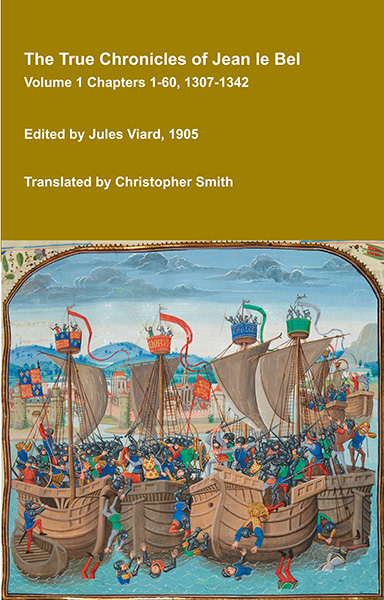
The True Chronicles of Jean le Bel Volume 1 Chapters 1-60 1307-1342
The True Chronicles of Jean le Bel offer one of the most vivid and immediate accounts of 14th-century Europe, written by a knight who lived through the events he describes, and experienced some of them first hand. Covering the early decades of the Hundred Years’ War, this remarkable chronicle follows the campaigns of Edward III of England, the politics of France and the Low Countries, and the shifting alliances that shaped medieval warfare. Unlike later historians, Jean le Bel writes with a strong sense of eyewitness authenticity, drawing on personal experience and the testimony of fellow soldiers. His narrative captures not only battles and sieges, but also the realities of military life, diplomacy, and the ideals of chivalry that governed noble society. A key source for Jean Froissart, Le Bel’s chronicle stands on its own as a compelling and insightful work, at once historical record and literary achievement. This translation builds on the 1905 edition published in French by Jules Viard, adding extensive translations from other sources Rymer's Fœdera, the Chronicles of Adam Murimuth, William Nangis, Walter of Guisborough, a Bourgeois of Valenciennes, Geoffrey le Baker of Swinbroke and Richard Lescot to enrich the original text and Viard's notes.
Available at Amazon in eBook and Paperback format.
[his daughter] Christiana Galloway was born to Alan Lord of Galloway and Unamed Lacy. She married before 1234 William Forz 4th Earl Albemarle, son of William Forz 3rd Earl Albemarle and Aveline Montfichet.
King John Balliol I of Scotland [1]
Philippa of Lancaster Queen Consort Portugal [1]
Joan Beaufort Queen Consort Scotland [1]
King Richard III of England [2]
Anne Neville Queen Consort England [4]
King Henry VII of England and Ireland [2]
Queen Anne Boleyn of England [1]
Catherine Parr Queen Consort England [5]
Mary of Guise Queen Consort Scotland [1]
Queen Catherine Howard of England [3]
Jane Grey I Queen England and Ireland [5]
King James I of England and Ireland and VI of Scotland [3]
George Wharton [35]
President George Washington [1]
Brigadier-General Charles Fitz-Clarence [136]
Queen Elizabeth II of the United Kingdom [578]
Queen Consort Camilla Shand [194]
Diana Spencer Princess Wales [1833]