All About History Books on Amazon
William of Worcester's Chronicle of England
William of Worcester, born around 1415, and died around 1482 was secretary to John Fastolf, the renowned soldier of the Hundred Years War, during which time he collected documents, letters, and wrote a record of events. Following their return to England in 1440 William was witness to major events. Twice in his chronicle he uses the first person: 1. when writing about the murder of Thomas, 7th Baron Scales, in 1460, he writes '… and I saw him lying naked in the cemetery near the porch of the church of St. Mary Overie in Southwark …' and 2. describing King Edward IV's entry into London in 1461 he writes '… proclaimed that all the people themselves were to recognize and acknowledge Edward as king. I was present and heard this, and immediately went down with them into the city'. William’s Chronicle is rich in detail. It is the source of much information about the Wars of the Roses, including the term 'Diabolical Marriage' to describe the marriage of Queen Elizabeth Woodville’s brother John’s marriage to Katherine, Dowager Duchess of Norfolk, he aged twenty, she sixty-five or more, and the story about a paper crown being placed in mockery on the severed head of Richard, 3rd Duke of York.
Available at Amazon in eBook and Paperback format.
Betrayal and Death of King Richard II is in Late Medieval Books.
Chronicle of the Betrayal and Death of Richard II, King of England, brought to light from a manuscript of the Royal Library of Paris, formerly preserved in the Abbey of St. Victor; with the variants furnished by ten other manuscripts, elucidations, and a glossary, by Benjamin Williams, F.S.A. Published for the English Historical Society. London: at the expense of the Society. 1846.
Chronicque de la Traïson et Mort De Richart Deux Roy Dengleterre, mise en lumière d'après un manuscrit de la Bibliothèque Royale de Paris, autrefois conservé dans l'abbaye de S. Victor; avec les variantes fournies par dix autres manuscrits, des éclaircissements, et un glossaire, par Benjamin Williams, F.S.A. À Londres: Aux Dépens De La Société. M.DCCC.XLVI.
Prefix Addendum 2:
Instructions delivered on behalf of the King to the Lord of Chartres and the Lord of Heugueville.
Instructions baillees de par le Roy a Monseigneur de Chartres et a Monseigneur de Heugueville. ( Archives du Royaume, Paris. J. 649. art. 55.)
Item: a hat of large pearls, made in the manner of a crown, with roses set upon crimson velvet, and with hanging buttons of white and green gold.
Item un chapeau de grosses perles fait a maniere de roses assiz sus veloux vermoil et de boutons pendans d'or blancs et vers.
Item: the said king gave her a deer with six large pearls and a sapphire in the middle.
Item le dit Roy li donna un serf a vj grosses perles et un saflir ou millieu.
Item: when the queen dined with the Duke of Lancaster, he gave her a fine gold brooch on the spiced dishes.
Item quant la Royne disna o le duc de Lanclastre il li donna un beau fermail d'or sur les espicez.
Item: the Earl Marshal gave her a gold hanap (cup) and a ewer.
Item le conte mareschal li donna un henap d'or et une esguiere.
Item: when the queen entered London, all the dukes, earls, bishops, and lords gave her great gifts, some gold hanaps and ewers, others tablets, diamonds, sapphires, and other rich gifts.
Item quant la Royne entra a Londres tous ducs. contes evesques et seigneurs li donnerent grans dons les uns henaps d'or et esguieres tableaux dyamans saffirs et autres grans dons.
Item: when she was at the house of the Duke of Lancaster, he gave her a great gold cup and a ewer, and to my lady [the duchess] a smaller one and a ewer.
Item quant elle fut a loustel du duc de Lenclastre il li donna une grant couppe d'or et une esguiere et ma dame une mendre et une esguiere.
All About History Books on Amazon
Chronicle of Walter of Guisborough
A canon regular of the Augustinian Guisborough Priory, Yorkshire, formerly known as The Chronicle of Walter of Hemingburgh, describes the period from 1066 to 1346. Before 1274 the Chronicle is based on other works. Thereafter, the Chronicle is original, and a remarkable source for the events of the time. This book provides a translation of the Chronicle from that date. The Latin source for our translation is the 1849 work edited by Hans Claude Hamilton. Hamilton, in his preface, says: 'In the present work we behold perhaps one of the finest samples of our early chronicles, both as regards the value of the events recorded, and the correctness with which they are detailed; Nor will the pleasing style of composition be lightly passed over by those capable of seeing reflected from it the tokens of a vigorous and cultivated mind, and a favourable specimen of the learning and taste of the age in which it was framed.'
Available at Amazon in eBook and Paperback format.
Item: the king gave her a coif of pearls set in the form of a trefoil, with large pearls.
Item le Roy li donna une coiffe de perles assise a maniere de triffle¹ et de grosses perles.
Item: the bishop of Asti, who was legate, gave her a frontlet of rubies and large pearls, said to be worth more than 3,000 francs.
Item levesque d'Ast qui estoit legat li donna un frontelet de rubiz et de grosses perlez que on disoit qu'il valoit plus de iij mille francs.
Item: the king gave her at Coventry a tablet of gold all adorned with pearls and stones.
Item le Roy li donna a Coîntre uns tableaux d'or tout pare de perlez et de pierres.
Item: at Lichfield the king gave her a very rich goblet of Venetian work.
Item a Listhenflic le Roy li donna un moult riche gobelet de leuvre de Venisse.
Item: at London there was given to her, on behalf of the city, a gold circlet set with stones and pearls, said to have cost 12,000 francs.
Item a Londres il fut donne de par la ville un sercle d'or fait a pierres et a perles que on disoit qu'il avoit couste xij mille frans.
Item: the king gave her, when she was crowned in London, a circlet of diamonds, rubies, and pearls, very rich.
Item le Roy li donna quant elle fut couronnee a Londres un sercle de dyamans rubiz et perles tres riche.
Item: the Duke of Brittany gave her a very rich brooch, a large ruby in the middle and large pearls.
Item le duc de Bretaigne li donna un fermail bien riche un grant rubi ou millicu et grosses perles.
Item: the Earl of Rutland gave her at Lichfield…
Item le conte de Roteland li donna a Licheflic 'Pro trèfle. Litchfield, January 1398.
Chronicle of the Betrayal and Death of Richard II, King of England
[June 1397] King Richard restored the city and castle of Brest to the Duke of Brittany in the year thirteen hundred fourscore and of Brest. sixteen;1 and when the Duke had received the said city, he turned out and dismissed all the soldiers who were therein: and upon the arrival of the garrison in England, then began the divisions between the King and his uncle the Duke of Gloucester, the Earl of Arundel, and many other lords.
Note 1. The Duke of Brittany surrendered the town and lordship of Brest to the King of England, by treaty dated 6th April, 1 Richard II, (1378,) until the termination of the war, on consideration of his receiving one hundred and twenty thousand francs of gold, and a castle in England of the value of seven hundred marcs per annum, (Rot. Parl, iii. 9. Rymer, Fœdera, vii. 100.) He was assigned the castle and lordship of Rysing in Norfolk, as well as the manor of Sevenhampton and hundred of Heleworth in the county of Wilts, to hold, inter alia, until the restoration of Brest. (Fœdera,) The restoration of Brest had been already agreed upon at the conference of Lelinghen in Oct, 1396, as has been already mentioned. (See Preface.) The order to John Drax, Sergeant-at-arms, to receive the castle, town, and outworks of Brest from John Earl of Huntingdon, and to deliver them up to the Duke of Brittany, is dated 7th April 1397, or 1396 old style; for the year 1307 did not then commence (nor until the time of Charles IX) until Easter-day, which fell, in 1397, upon the 22nd of April. Several preliminary agreements had been entered into, the previous month of March, with the Duke's ambassadors, the Bishop of Leon, and others, who were then in England, to the effect that the ransom of one hundred and twenty thousand francs of gold should be paid to William le Scrop, the Vice-chamberlain, in the city of Rennes, at Easter ; and that, three weeks after the payment had been made, Brest should be delivered up. The Duke was to make oath on the holy Gospels that he would not make war against the King, and that he would do his utmost to induce his son to do the same when he should be fourteen years of age. (Proceedings, &c. of the Privy Council, i. 64, 67.) The ransom was not paid, however, until the 16th of May. Further instructions were sent out to Drax, dated 28th May (Fœdera, vii. 852); and Brest was eventually surrendered, in exchange for the lands the Duke held in England, on the 12th June 1397. (Lobineau, Hist. de Bretagne, ii. 793.) It was therefore probably towards the end of June or the beginning of July that the garrison returned to England. —The 'franc d'or of Charles V. was worth twenty silver sous, Sixty-two were coined from the mark, or half-pound of gold, and it was consequently of the value of nine shillings English, (Le Blanc sur les Monnaies de France.) For the relative value of the franc d'or, see Mémoires sur I'appréciution de la fortune privée au moyen age, par M. C, Leber.' 3ej8L7WCIt is to be observed that King Richard held a feast at Westminster, when he declared his intention of going to Bristol. And straightway at this feast arrived the said soldiers who had held Brest for the King, who were received at dinner in the King's hall. When the dinner was over and the King had taken wine and comfits,1 the Duke of Gloucester said to the King 'My lord, have you not remarked at dinner our companions which are here?'
Note 1. After dinners of ceremony, it was usual to offer hypocras, wine, and comfits, (Vie privee des Frangais.) The comlfits were offered in boxes of gold or silver, Amongst others, I find confiture of aniseed, 16 sous the lb.; of nuts, 7 sous; 'sucre rosat,' 10 sous ; 'manucristi,' 10 sous; 'madrien,' 12 sous; 'paste du Roy,' 12 sous; sugar-plums, 10 sous; and citron, 12 sous the lb, (Original MS. of the Duke of Orleans, Bibl, du Roi.) At the conference of Charles VI, and Richard, held at Lelinghen in 1396, the wine and comfits were handed, after the dessert, to the former King by the Duke of Gloucester, to the latter by the Duke of Orleans. (Le Laboureur, Vie de Charles VI.) Upon the occasion of the Queen's dining with John of Gaunt, he placed a rich golden clasp upon the comfits handed to the Queen after dinner, which present she accepted. (See the list of Isabel's jewels, p. III.)
The King replied, 'Good uncle,I what companions do you mean?' My King and the lord,' said the Duke, 'they are your people who have Gloucester. come from Brest, who have faithfully served you, but have been badly paid, and know not what to take to.' And the King said that they should be paid in full; and, in fact, commanded that four good villages near London should be given up to them, that they might there live at his expense until they received their due.2 Then replied the Duke of Gloucester very proudly, 'Sire, you ought first to hazard your life in capturing a city from your enemies, by feat of arms or by force, before you think of giving up or selling any city which your ancestors, the Kings of England, have gained or conquered.'3
Note 1. The phrase 'Bel oncle' will perhaps strike the reader. As a proof that nothing more than 'good uncle's meant, we meet at page 20 of the Chronicle with 'Beau Sire Dieu.'
Note 2. The Monk of St. Denys remarks, that the citizens repcatedly complained of these soldiers to the Duke of Gloucester; which so excited his anger, that he feared not to tell the King he ought not to deliver his land to (the mercy of) foreign soldiers; but, after he had restored the cities which his predecessors had so laboriously acquired, he should have taken others from the enemy where they might lodge. (Chronicles, B. xvii. c. 20.)
Note 3. Most of the French chroniclers mention Richard's marriage with the daughter of France, and his restoration of Cherbourg and Brest, as the principal causes of his downfall, (Mezeray, Juvenal des Ursins, and Gaguin, Compendium super Francorum gestibus; Paris,1500. N.B. Gaguin was ambassador to England in 1480. Moréri.) The cession of Anjou and Maine to the father of his consort Margarel was, in like manner, a main cause of the unpopularity of Henry VI.
'The King of the French knew that Brest was a favourite retreat of the English, and an object of their particular solicitude; that they spared no expense to furnish it abundantly with all sorts of necessaries, and that they often sent there arms, victuals, and recruits. They often remarked, By Saint George! the French may curse us, but they will never hurt us here, unless they can starve us out.' (Chroniques du Moine de St. Denys.) Brest and Cherbourg (Cesaris Burgus), with Calais and Bordeaux, were nearly all that remained to the English in 1305 of their ancient possessions in France, and of all their conquests by Edward III. But they were the keys of so many provinces: Calais of Picardy, Cherbourg of Normandy, Brest of Brittany, and Bordeaux of Gascony. (Gaillard, Notices et Extraits des MSS, de la Bibl. du Roi, i. 373.) There is no doubt that they were of the utmost consequence as points from which they might make at will incursions into the neighbouring territory, and as places of retreat; — for instance, the English and Navarrese knights of the garrison of Cherbourg joined the expedition against the city of Nantes in 1381, and returned thence by land to Cherbourg after the failure of the expedition.
The discontent of the people on the restoration of the two fortresses was heightened by the fact that Richard had returned them without having received back an equivalent for the aid the English had made such great sacrifices to give to the Duke of Brittany and the King of Navarre, and more especially as they (the Duke and the King) had been the first to break faith with England. Richard had only received for them a very moderate sum, which was soon spent on his useless indulgences. After the defeat of Richard's forces in 1387 by the Duke of Gloucester and the young Earl of Derby, a letter was found from the French King, in which he mentioned his expectation of being put in possession of Cherbourg and Calais; and, upon the arrival of the Count St. Pol in, 1396, it was rumoured that his object was to treat for the restoration of the latter city, concerning which the Londoners remonstrated formally with the King, who had some difficulty in appeasing them, (Froissart, B, iv. c. 56, and others.) The French nation at this period attached the utmost importance to their regaining possession of Calais.
Eustace Deschamps, a contemporary poet, has a ballad, the burden of every stanza of which is:
'You shall never have peace unless they give back Calais.'
'Paix n' arez jà s'ilz ne rendent Calays.'
(MS. 7219. Bibl. du Roi; published by Crapelet.)
It was on the 27th Oct. 1393 that Richard ordered Robert Whiteney and John Melton to receive the castle and town of Cherbourg from the hands of John Golafre, captain, aud to deliver the same to the procurator of the King of Navarre. (Rot. Franc. 20 Ric. 11.)
[1397] To which the King answered very scornfully, 'What is that you say?" The Duke, his uncle, then repeated what he had before said. Upon which the King was very wroth, and said to the Duke, 'Do you think that I am a merchant or a traitor, that I wish to sell my land? By St. John the Baptist, no, no; but it is a fact that our cousin of Brittany has restored, and well and truly paid us the sum which our ancestors had lent him on the city of Brest; and, since he has honestly paid us, it is only just he should have his pledge back again.' Thus began the quarrel between the King and the Duke of Gloucester. It is true that they parted politely and with civil words, with as they were bound to do; but their distrust was by no means the less because they separated with civil words before the people; and the mistrust continued between the King and the Duke of Gloucester without any more disputes until a short time afterwards; and they continued to give each other a civil reception, but with a bad will, as is too much the case with the Duke and many others of the kingdom of England.1
Note 1. It appears that from this time the Duke of Gloucester retired to Pleshy and his other manors; which retirement, as Rapin remarks, was the cause of his ruin, inasmuch as his absence gave his enemies every opportunity to prejudice the King's mind against him. The Duke had lately bought the manors of Westcot, Bucks, and Newenham, Gloucester, with parts of the manors of Northamstede, Herts, and of Wetherfells in Essex, of Henry of Lancaster. (Rot. Pat. 20 Ric, II. 6th July.) The Dukes of York and Lancaster, in order that they might not be mixed up with the disputes, also retired to their castles; the latter taking with him his Duchess, who had some time been the companion of the young Queen. Sir Thomas Percy also at this time surrendered his office of Steward of the Household, according to Froissart; but, if he did so, he certainly returned to office, as he was in attendance upon Richard in that capacity in 1399.
Now there was an Abbot1 at St. Albans, twenty miles distant from London, in England, who was godfather to the Duke of Gloucester, and had held him over the font in baptism after his birth, which took place at Woodstock,2 beyond Oxford. There was also a Prior at Westminster,3 near London, who was a great friend of the Duke's, and of the said Abbot of St. Albans. The Abbot of St. Albans, godfather of the said Duke, sent to seek the great Prior of Westminster, and requested him, by message, to come and speak to him without delay,4 for that it would be greatly to his interest.
Note 1. John de la Moote, Abbot of St. Albans, succeeded his predecessor Thomas de la Mare, who died September 15th, 1396. (Dugdale, Monasticon.) His predecessor lived to a very advanced age, and, his health having broken down in 1389, he discontinued his attendance upon Parliament. There had been a squabble between him and the Abbot of Westminster for precedence in Parliament. Walsingham mentions sarcastically, that Richard, as he was riding from Daventry to London, in 1883, which journey he accomplished in one night, borrowed the palfrey of the Abbot of St. Albans, in exchange for one of his jaded horses, which he takes care to tell us he never returned. (Hist, Ang. p. 805.) It may be that it was in remembrance of this service, that Richard presented, in 1389, Robert Dyngle, Abbot of St. Albans, (I presume the locum tenens [literally 'holding the place' i.e. locum, stand-in] of Thomas de la Mare,) with a tun of Gascon wine. (Præstita in Wardrobe Accounts.) This little circumstance may explain to us that Walsingham was not likely to have reported any conspiracy in which the Abbot of St. Albans was concerned. I suspect that Robert Dyngle is the party in question in our narrative, as the Monk of Evesham and MS. Reg. 13. c. 1, report the Earl of Warwick to have said to the King, that it was the Abbot of Westminster that then was who, with others, induced him to join in the conspiracy. John de la Moote may not have yet taken possession of the abbacy.
Richard had not been so liberal a contributor us his predecessors to the abbey of St. Albans, Dugdale reports a donation of his of one hundred shillings to the convent and monastery, and fifty pounds towards the repairs of the Tynemouth Gate. (Monasticon, ii. 218.) It was the Abbot of St. Albans who, with the Bishop of Chester and the Abbot of Waltham, were appointed by Henry to perform the last offices to the supposed remains of Richard at Langley. (Walsingham, Ypod. Neust.)
Note 2. The MS. reads 'Howstoc,' and Stow's translation (MS. 6219. Harleian) 'Howstok.'There can be no doubt of the place intended, as the Duke was well known as Thomas of Woodstock, Pierre Salmon, secretary to Charles VI, calls it 'Houdescot, près de la cite Doncsenefort.' (Vie de I'Salmon, par Crapelet, p. 64.) The Editor's name has been frequently written Houliame by the French.
Note 3. 'Brother John Wortyng, Prior of the abbey of Westminster, Brother John Lakynghithe, Bailiff of the same abbey, and Brother Peter Combe, Sacristan, owe the King £21 per annum for the Priory of Folkestone in the hands of the King on account of the war existing between the King and those of France,' (Pipe Rolls, 23 Rich. 1I) After Henry's banishment, Richard gave two of his candelabra and six silver-gilt shields, which were formerly the property of John of Gaunt, to the Abbot and Convent of Westminster, (Pell Issue Rolls, June 30, 1399.)
Note 4. The expressive phrase of one of the Rouen MSS, 'without providing provender-bags for the horses,' will not escape the reader's attention; but perhaps nothing more may be meaut than 'sans faire demoures (demeure),' i.e. 'without delay.'
And when the Prior arrived at St. Albans, he was received at a great feast held at the chambers of the Abbot, where he found the Duke of Gloucester seated at dinner; and the Abbot and Prior scated themselves at the bottom of the Duke's table. After dinner, at the collation, the Abbot began and said to the Prior, 'So may God and St. George aid you! tell us, did you not have last night a vision of anything in the world?' 'Yes,' said the Prior. 'Then tell us now, Prior,' said the Duke, 'the truth of your vision.' Then fell the Prior down upon his knees before the Duke in the presence of the Abbot, and besought the Duke and the prelate that they would pardon him what he was about to tell of his vision, for he would much rather be silent than reveal it. The Abbot said to the Prior, 'Speak out boldly, my lord forgives you.' The Prior then said, 'By St. George, my lords, it was revealed to me last night (forgive me) that the kingdom would be lost by our Lord the King Richard.' Then said the Abbot, 'By the Virgin Mary, the like was revealed to me also, and I will give you, my lord and godson, a reason why I beg that you will not be displeased, because we have told our visions at your request; for you can see how matters go when a king begins to give away his cities, which his ancestors have acquired by war, for gold or silver, as the King our Lord has begun to do; that is to say, that he has restored two fortresses into the hands of his enemies, which were useful and profitable to the kingdom of England; for you very well know that he has restored Brest to the Duke of Brittany, and Cherbourg to the King of Navarre, which were useful and profitable for our kingdom of England in making war'1 Then answered the Duke to the Abbot and to the Prior that it should be effectually remedied, and that shortly: he afterwards added, 'I beg, between yourselves, that you will not fail to be at Arundel this day fortnight to dinner, and there we will dine together.'
Note 1. It must be confessed that the numerous expeditions and victories of Edward III had engendered not only a spirit of restlessness amongst a great portion of the people of England, but also a desire to enrich themselves with the spoils of their enemies. About the middle of the fourteenth century there was scarcely a female who could be styled a gentlewoman that had not in her house some portion of the spoils of furniture, silk, plate, or jewels, from Caen, Calais, or the cities beyond the sea (Walsingham, Hist. Angl. p. 168); and at the taking of Barfleur so much valuable booty was acquired, that the boys of the army set no value on gowns trimmed with fur. (Froissart.) Probably the following picture, drawn by a native of France at the accession of Charles VI1. is not much over-coloured.
'Violating continually the treaties of peace, they issued from their maritime retreat, from that corner of land at the extremity of the world ; and infesting, now Aquitaine, and now the coasts of France, they forcibly entered the suburbs, taking the inhabitants prisoners, taking away the small and large cattle; and, selling fire to the corn, they burnt alike that which was already harvested, as well as that which was in sheaves in the fields, and that which was still under foot.' (Chronicles of the Monk of St. Denys.)
We read, however, that at an earlier period, towards the close of the ninth century, the Normans had been guilty of the same, or greater, excesses towards the Franks, Such was the terror that they inspired, that the Franks fled at their approach, carrying away with them their treasures. The barbarians discovered their retreats in the forests, in caverns, and even in the mountains of Auvergne ; and the people saw no hope of mercy but from the aid of heaven. We read in the litanies of the times these doleful words: — 'From thunder and lightning, from sudden death, and from the sword of the Normans, Good Lord, deliver us.' (Les Reines de France, par Mlle, A. Telliez.)
After the Duke of Gloucester had left St. Albans, he returned to his house in London, and sent a sealed letter to the Earl of Derby,1 begging him to come to speak to him at Arundel on the day that the said Abbot and Prior would be there.
Note 1. Henry of Lancaster, Earl of Derby, who afterwards became successively Duke of Hereford, Duke of Lancaster, and King Henry IV. He was occasionally styled Henry of Bolyngbrok, Earl of Hereford, and Lord of Brecon. Vide the warrants for the appointment of his constable of the castle of 'Breken,' and his chief seneschal of his lordship of 'Breken' dated from Bolyngbrok, 26th June, II Ric. IL, and 20th March, 14 Ric. II. Rot. Pat.
[Around 25th July 1397] Afterwards he [Thomas of Woodstock 1st Duke of Gloucester [aged 42]] sent to the Earl Marshal,1 who was captain of Calais, to the Earl of Warwick, and to the Archbishop of Canterbury [aged 44],2 and desired that they would come to Arundel on a certain day; and he also sent to the Earl of Arundel to say that he would come to dine there with him, and that he would bring with him all the other lords. The Earl of Arundel [aged 51] returned him answer, that he would be right welcome, and all the lords it would please him to bring with him in his company. It is true that the Duke of Gloucester arrived at Arundel the eighth day before the month of August in the year thirteen hundred fourscore and sixteen,3 as well as the Earl of Derby, the Earl Marshal, the Archbishop of Canterbury, the Abbot of St. Albans, and the Prior of Westminster. As these lords were seated at dinner, there arrived the Earl of Warwick [aged 59];4 and when he joined the company of the lords, the Duke of Gloucester said to him, 'My brave man, you must take the same oath as we have taken:' and the Earl replied, 'My lord, what do you wish me to swear?' The Duke said, 'You will swear as we have done, if you please, to be true and faithful to the realm, and also to be true and faithful to each other.'
Note 1. Thomas of Mowbray [aged 29], Earl of Nottingham, the first hereditary Earl Marshal, shortly afterwards created Duke of Norfolk. He was then absent from Calais on furlough. His leave of absence is dated Oct, 3, 1396, extending for one year. The assigned reason is, that he might travel into Picardy for matters relating to the safe custody of the city. (Rymer, Fœdera,) Chastelnin's version calls him 'fustre cappitaine de Calleys.' I have not been able to obtain a satisfactory explanation of this word, The Earl could boast of royal descent by his mother Elizabeth, daughter and heiress of John Lord Segrave by Margaret Plantagenet, daughter and heiress of Thomas de Brotherton, Earl of Norfolk and Marshal of England, youngest son of Edward the First by his second consort, Margaret of France, (Dugdale, Baronage.)
Note 2. Thomas Fitzalan, third son of the Iate Earl of Arundel, he had been Bishop of Ely, and Chancellor, during the prosecution of Richard's favourites. He was afterwards translated to York, and succeeded Archbishop Courtenay in the see of Canterbury in August 1397, according to the Monk of Evesham, but in 1395 according to Spelman, (Concilia).
Note 3. As Brest was not given up till June 1397, this is undoubtedly a wrong date. It should have been August 1397, and I think it very probable that it was so in the original MS. The Monk of St. Denys in his chronicles corrects the error, 'At the head of the factions (anno 1397) was the King's uncle, the Duke of Gloucester, the Earl Arundel, and the Earl Warwick, who, as we have related, conspired the preceding year against the King.' (Chronicles of the Monk of St. Denys, chap. v. b. xviii.) (It must never be forgotten that the year commenced at Easter.) The London Chronicle places Gloucester's arrest on the 21st of July. The conspiracy was revealed before the middle of the month, and probably before the meeting at Arundel; for, on the 13th of July 1397, an order wns made out for the arrest of Gloucester, Arundel, and Warwick, (Rymer, Fœdera.) This order, agreed upon at Windsor, does not appear to have been issued, as a second order was made and published from Westminster on the 28th of the month, (Fœdera.)
Note 4. Thomas, son of Thomas Beauchamp, Earl of Warwick, by Catherine, daughter of Roger Mortemer, first Earl of March. Perhaps the Earl was the more readily induced to join the conspirators, as he would naturally be incensed at the loss of the honour of Gower, recovered at this time by the Earl Marshal. See Otterbourne, Scriptores Veleres, p. 189.
All About History Books on Amazon
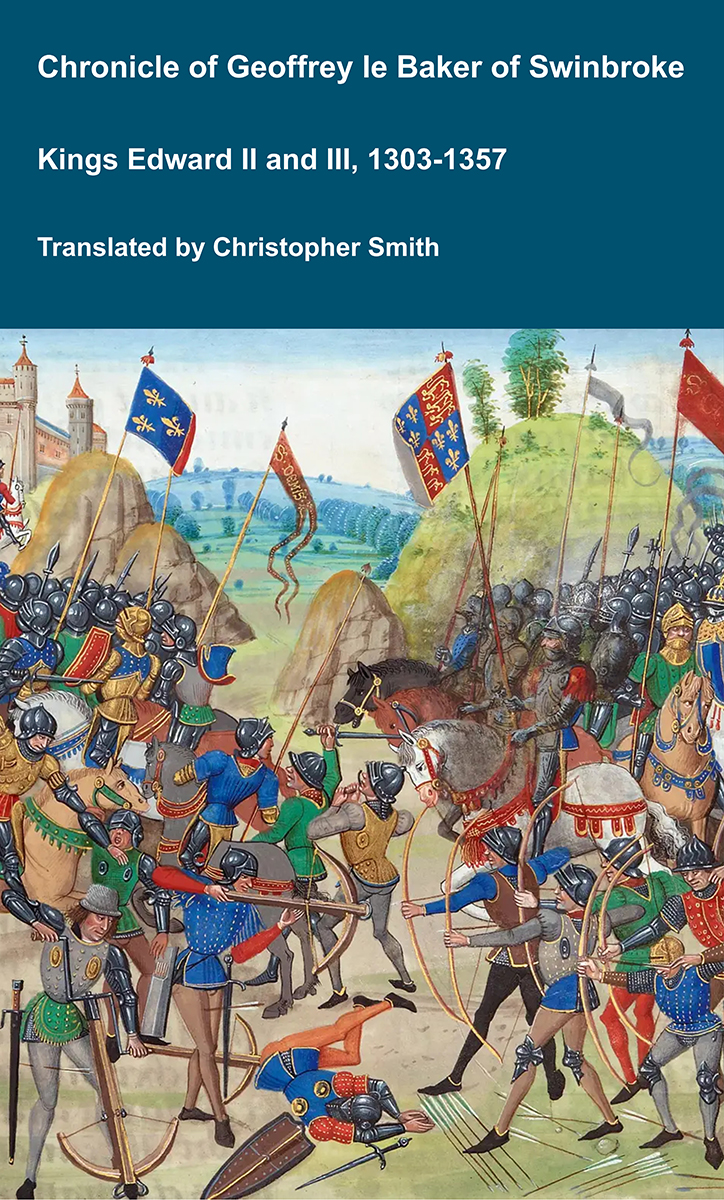
Chronicle of Geoffrey le Baker of Swinbroke
Baker was a secular clerk from Swinbroke, now Swinbrook, an Oxfordshire village two miles east of Burford. His Chronicle describes the events of the period 1303-1356: Gaveston, Bannockburn, Boroughbridge, the murder of King Edward II, the Scottish Wars, Sluys, Crécy, the Black Death, Winchelsea and Poitiers. To quote Herbert Bruce 'it possesses a vigorous and characteristic style, and its value for particular events between 1303 and 1356 has been recognised by its editor and by subsequent writers'. The book provides remarkable detail about the events it describes. Baker's text has been augmented with hundreds of notes, including extracts from other contemporary chronicles, such as the Annales Londonienses, Annales Paulini, Murimuth, Lanercost, Avesbury, Guisborough and Froissart to enrich the reader's understanding. The translation takes as its source the 'Chronicon Galfridi le Baker de Swynebroke' published in 1889, edited by Edward Maunde Thompson.
Available at Amazon in eBook and Paperback format.
That night all the lords rested at Arundel, and the morrow they heard mass, and the Archbishop of Canterbury chaunted the mass and gave the sacrament to the Duke of Gloucester, then to the Earl of Derby, to the Earl of Arundel his brother, and to the Earl Marshal, who had married the daughter of the Earl of Arundel, and afterwards to the Earl of Warwick. And when all the lords had been to mass, they retired to a council-chamber, and there were of accord to seize the noble King Richard, the Duke of Lancaster, and the Duke of York, and that they should be put in prison for ever; and that all the other lords of the council of King Richard should be drawn and hung. Such was their counsel and their oath, and such their determination, and it was to be put in execution in the month of August thirteen hundred fourscore and sixteen.
It is true that the Earl Marshal, who was captain of Calais, revealed to King Richard all their counsel, and informed him of the day when they were to begin to put it into execution. And when the King heard the news from the Earl Marshal, who was of their accord and undertaking in appearance, and not in fact; he said to the Earl, 'Take care what you say, for if I find it true, I will pardon you; but if I find it otherwise, assuredly you shall repent it.' To which the Earl Marshal replied, 'If you find it otherwise, let me be quartered and sent to the four ends of England: and be upon your guard, I beseech you.' And shortly after, these very words were plainly declared in open parliament, when the Earl of Arundel was condemned to death. And this matter being thus heard, the King1 went to dine in London in the house of his brother the Earl of Huntingdon,2 in the street behind the church of All Hallows, on the banks of the river Thames, and which was a right fair house.3 After dinner the King made the matter known to his council, who were of accord that the King should mount to horse with his
Note 1. King Richard was then residing at Eltham, where he left his Queen and most of his suite, (Froissart, B, iv. ch, 57.)
Note 2. John of Holand, half-brother to King Richard by his mother Joan, who, before her marriage with the Black Prince, was the widow of Thomas Earl of Kent, He was then Chamberlain of England, and was shortly afterwards created Duke of Exeter. He had married Elizabeth, daughter of John of Gaunt, Duke of Lancaster, and was thus brother-in-law to the Earl Derby. Thomas Earl of Kent, afterwards Duke of Surrey, was his nephew,
Note 3. In the Pipe Rolls, 1 Hen IV, mention is made 'of a cerlain house of John Holand, knight, brother to the King, (which formerly belonged to Michael de la Pole, Earl of Suffolk,) situate in Lumbarde strete, London, which lately came into the King's hands by the judgment of Parliament against the said Michael; which said house the King, on the 7th day of April, in the IIth year of King Richard II, gave to the aforesaid John Holand by inheritance during the King's pleasure, as is mentioned in the IIth of King Richard Il.' This magnificent palace, situate in the parish of All-Hallows the less, was called Cold Harborough, and also Poultney's Inn, by which name it was known in the time of Henry VI, It was so named from Sir John Poultney, four times Lord Mayor of London. The year following, 1398, Edmund Earl of Cambridge (second son of the Duke of York) had this house, and was there lodged. (Stow, B.206. See also the Preface.)
[3rd September 1399] The Duke of Lancaster went on the morrow to the Tower, with the Duke of York and the Earl of Rutland in his company; and, when there, he desired thund the Earl of Arundel to send King Richard to him. The Earl went to deliver his message; the which when the King had heard, he replied, 'Arundel, go tell Henry of Lancaster from me that I will do no such thing, and that, if he wishes to speak with me, he must come to me; otherwise I will not speak to him.' The Earl reported his answer to the Duke, upon which he and the other lords went to the King; and, for sure, none of the lords shewed any respect to the King except the Duke of Lancaster, who took off his hat and saluted him respectfully, and said to him, 'My lord, here is our cousin the Duke of Aumarle, and his father our uncle, who wish to speak with you.' To which the King answered, Cousin, they are not worthy to speak to me.' 'But have the goodness to hear them,' replied the Duke. Upon which the King uttered an oath, and York and said to his uncle of York, 'Thou villain! what wouldst base treason. thou say to me? and thou traitor of Rutland! thou art Rutland with neither worthy nor good enough to speak to me, nor to bear the name of Duke, Earl, or Knight: thou, and the villain thy father, have both of you foully betrayed me. I pray to God, and to St. John the Baptist, that cursed may be the hour wherein ye were born; by you and by your false counsel was my uncle of Gloucester put to death. Alas! that I should have ever been so fond of so false a traitor;1 for by thee the kingdom of England will be destroyed, I am convinced! The Earl of Rutland replied to the King, that in what he said he lied, and threw down his bonnet at his feet; which the King kicked two or three paces from him, and said to him, 'Traitor! I am King and thy lord, and will still continue King; and will be a greater lord than I ever was, in spite of all my enemies; and you are not fit to speak to me!' Upon this the Duke of Lancaster forbad the Earl to speak, or he would order the Constable and Marshal to lay the hand upon him till such time as he should repent. After these words the King asked the Duke of Lancaster, 'Why do you keep me so closely guarded by your men-at-arms? I wish to know if you acknowledge me as your lord and King, or what you mean to do with me?" The Duke replied, 'It is true you are my King and lord, but the council of the realm have ordered that you should be kept in confinement until the day of the meeting of Parliament.' The King again swore, and desired that the Queen his wife might come to speak to him. 'Excuse me, my lord,' replied the Duke, 'it is forbidden by the council.' Then was the King in great wrath, but he could not help himself, and said to the Duke, that he did great wrong both to him and to the Queen. The Duke replied, 'My lord, we cannot do otherwise till the Parliament meets.' The King was so enraged with this speech that he could scarce speak, and paced twenty-three steps down the room without uttering a word; and presently he broke out thus: 'O God of Paradise! O Virgin Mary! O St. John the Baptist and all the saints of Paradise, how can you suffer the great wrongs and treason which this people have committed and wish to commit against me, and my dear lady, my wife, and daughter of my dear and beloved lord and father the noble King of France, who little dreams of our miserable condition and in what danger we are placed! Now I see plainly that you are all false traitors to God, my lady, and me; this will I prove against any four of the best of you with my body, like a loyal knight as I am, and I never forfeited my knighthood.' (For it is true that my lord was all his life a good and loyal knight.) 'My grandfather, King Edward, gave me the crown before his death, God have mercy on him! and afterwards was I crowned by the consent of all the nobles, and of the whole country; and you have acknowledged me as your King these twenty-two years, how dare you use me so cruelly? I say that you behave to me like false men, and like false traitors to their lord; this will I prove, and fight four of the best of you, and there is my pledge:' saying which the King threw down his bonnet. The Duke of Lancaster fell on his knees, and besought him to be quiet till the meeting of Parliament, and there every one would bring forward his reason. 'At least, fair sirs, for God's sake let me be brought to trial, that I may give an account of my conduct, and that I may answer to all they would say against me.' Then said the Duke of Lancaster, 'My lord, be not afraid, nothing unreasonable shall be done to you.' And so he took leave of the King, and not a lord who was there durst utter a word.
Note 1. MS. Lebaud adds, 'Go to the devil, and may he carry you off!'
[30th September 1399] After this began the Parliament;1 and, when Henry of Lancaster entered, he found there already seated all the prelates of the kingdom, to wit, eighteen bishops and thirty-two mitred abbots, besides the other Estates, prelates. The Duke came in state thus: two archbishops and his four sons walking before him; and his two brothers, and the three Dukes, of Surrey, Aumarle, and Exeter (King Richard's half-brother), who all wore his livery, walking arm in arm after him. And when the Duke had entered, Sir Thomas Percy,2 bearing a white rod in his hand, sat down right before the Duke, and cried out 'Long live Henry of Lancaster, King of England!' when all the lords, prelates, and commons of England exclaimed 'Yes, yes, Henry of Lancaster shall be our King, and none other!' The Duke then sat himself down on the throne before he was crowned, in the place where the King is accustomed to sit. The first point that the Duke mentioned was, that he had come back to the country for the benefit of the realm and the people, and to take possession of his own inheritance; he then proved that King Richard had forfeited his life and his crown, for which he gave this reason, that he and his council had put to death, without cause or reason, the two greatest warriors of all the country! First, they have put to death,' said he, 'my dear uncle the Duke of Gloucester, son of good King Edward, and my cousin the Earl of Arundel; and then the King, when he went to Ireland, gave the realm to farm to four knights, the heads of three of whom I sent to the people of London, and the fourth is in prison at your disposition; and I maintain, that when a King sets his kingdom in a blaze, or destroys town or village by fire, as King Richard has done,3 that he has forfeited his crown. And know, that, if I had not come over, the kingdom was on the point of being undone. Consider the matter, my lords, and give a just judgment.' The council of the country and the Parliament answered him, 'To-morrow, my lord, we will give you our decision.' And such was the first day's proceedings of the Duke of Lancaster and of his Parliament, neither more nor less.
Note 1. Our chronicler appears imperfectly informed of the proceedings of Parliament, and omits the important fact, that Richard had resigned his crown on Monday, 29th September, it is to be feared, by compulsion. The meeting intended to be described in the text is that of the archbishops, the lords spiritual and temporal, and the people of the kingdom, in Westminster Hall, on Tuesday, the feast of St. Jerome, Sept. 30th, 1399. The Parliament had been summoned, in the name of Richard, to meet at Westminster on Michaelmas-day; but, as Richard had been compelled to resign his crown, those summonses were of no effect. On Tuesday, Sept. 30th, Richard's resignation was read and accepted, the King's seat in Westminster Hall being vacant. Henry then challenged his right to the realm of England, which was allowed by the lords and people present, and shewed them the signet Richard had given; and then, according to the Rolls of Parliament (which, however, it must be remembered, is an ex-parte statement), he was led to the throne by the Archbishops of Canterbury and York, amidst the applause of the people. (Rot. Parl. iii. 423. See also Rep. on the Dignity of a Peer, i. 3-19.) There was a Parliament held on the feast of St. Michael the Archangel at London, where the King was spoken to as to his deposition; and, seeing that many nobles as well as plebeians were disposed to accuse him, he asked permission, as it is said, to attend the Parliament once, and, placing the crown of the realm upon the ground, resigned his right to God.' (See Appendix C) Henry's speeches on the occasion are preserved in the Rolls of Parliament, and are given in Dr. Lingard's History of England. He claimed the kingdom by right of conquest, it being vacant by the resignation of Richard; and represented Edmund Earl of Lancaster, his maternal ancestor, without even the pretence of a proof, as in truth the elder brother of Edward I. The real heir to the throne was young Edmund Mortemer, Earl of March, grandson of the Duke of Clarence, John of Gaunt's elder brother; and Richard had proclaimed him as such before his departure for Ireland. Hæres malus, indeed,' said Edmund in 1397. Creton speaks of him to his private friends; and so is the pirate unto the merchant when he despoileth him of all that he hath.' (Sir J. Hayward, Life of Henry IV.) Seven persons were appointed commissioners to pronounce sentence of deposition on King Richard, and to intimate it Writs were issued in Henry's name for summoning a Parliament on the 6th October; but business was not proceeded with till Tuesday, October 14, the day following Henry's coronation.
Note 2. The subsequent conduct of the Earl of Worcester (Sir Thos. Percy) proves that he never fully approved of Henry's conduct. He was characterised by prudence and discretion, and had been chosen procurator for the clergy cautiously. Richard gave him one hundred marks, 5th July 1397. (Rot. Pat. 20 Ric. II. p. 1.) Henry allowed him to retain an annuity of 201. a-year which King Richard had given him, the 29th Sept., the 21st of his reign. (Rot. Claus. Mar. 28, 1 Hen. IV.)
Note 3. 'I know of no other town burnt but Cirencester, which the lords who rose in Richard's behalf set fire to; but that event happened in Jan, 1400. It is to be feared that the chronicler wrote this speech after his return to Paris in 1400. In other respects, the speech agrees in the main with the Rolls of Parliament.
Item, the morrow when the Duke was seated on the throne, where King Richard had been accustomed to sit, he sent one of the dukes to tell a knight, called Sir Baldwin Pigot,1 to summon the lords of the of Carlisle's favour of council and the commons. It is true that the Bishop of Carlisle, who was of the order of St. Benedict, rose from his seat and demanded leave to speak; which when he had obtained, he said as follows: My lords, consider well before you give judgment upon what my lord the Duke has set forth, for I maintain that there is not one present who is competent and fit to judge such a sovereign as my lord the King whom we have acknowledged our (liege) lord for the space of twenty years and more, and I will give you my reasons; there never was, nor is in this world, any false traitor nor wicked murderer, who, if he be taken prisoner by the hands of justice, is not, at the least, brought before the judge to hear his sentence. My lords, you have well and truly heard the accusations that my lord the Duke has made against King Richard; and it appears to me that you are about to give judgment, and to condemn King Richard, without hearing what he has to answer, or even his being present. Moreover, I say that my lord the Duke has more erred and offended against King Richard, than has the King against him; for we know full well that my lord the Duke was banished ten years by the council of the realm, and by the consent of his own father, for the great crime which he and the Duke of Norfolk committed; and he has returned to the country without the King's permission: and moreover I say he has done still worse, for he has seated himself on the throne, where no lord ought to sit other than the lawfully crowned King of England; wherefore I declare that you ought to bring King Richard in presence of the full Parliament to hear what he has to say, and to see whether he be willing to relinquish his crown to the Duke or not.' Then the Duke of Lancaster commanded that they should lay hands on the Bishop, and convey him to prison to St. Albans.2 And, after the Bishop was led away to prison, the Duke demanded sentence upon King Richard: upon which the Recorder of London said, 'My lords, it is ordered by all the prelates, by all the lords of the council, and by the commons of England, that The sentence John of Bordeaux, who has been called Richard King of England, be sentenced and condemned to be imprisoned in a royal castle; that he have the best bread and the best meat that can be found for gold or silver; and, if any should raise war for his deliverance, he should be the first that should suffer death for that attempt.'3 Thus was he falsely sentenced by the said Parliament.
Note 1. Query, Sir Baldwin Freville, who claimed, unsuccessfully, the office of champion in right of the castle of Tamworth. It appears to me that, by the word 'lendemain,' the following day was not strictly intended, as MSS. O and Y read 'lendemain le xiiie et xiiiie jour' respectively. It is probable that the Bishop of Carlisle's speech was delivered on Thursday, Oct. 23, when the Earl of Northumberland, by direction of Henry, asked the lords spiritual and temporal, in secret committee, 'what should be done with Richard lately King, saving his life, which King Henry wished: by all means to be held sacred?' The sentence of perpetual imprisonment, agreed upon that day, was confirmed by Henry in Parliament, and by the lords spiritual and temporal, on Monday Oct. 27th. The commons took no part in the sentence. Hall is of this opinion. He remarks, 'When it was demanded by the King's friends what should be done with King Richard, the Bishop of Carlisle, which was a man both well learned and well stomacked, rose up and said,' &c, (Rot. Parl. iii. 426-7.) On the 28th Oct. a warrant was addressed to the Abbot of St. Albans, enjoining him to deliver the person of the Bishop of Carlisle to the hearer, that he might appear the Wednesday following before the King and council. The Bishop had heen before committed to the custody of the Abbot of St. Albans, but was liberated on the 18th of Oct. (Rot, Claus. 1 Hen. IV.)
Note 2. It will be noticed that the Bishop of Carlisle was a Benedictine. If the author of the chronicle was a religieux of St. Denys, which was a Benedictine abbey, this may account in part for his eulogy of the Bishop. The Monk of Evesham remarks, that with difficulty his friends procured permission for his retirement or imprisonment. He speaks of his private character in no flattering terms; and adds, that he and the Bishop of Worcester (Tydeman) were the private companions and principal advisers of King Richard, passing with him the greater part of the night in idleness the year round, 'de quo multi multa loquuntur.' ['about whom many people say many things'] Of the Bishop of Worcester he remarks, that henceforth he renounced his jests and drolleries, devoted himself to his bishopric, and never after was seen at the King's bench, (Vita R. Ric. ed. Hearne, 168.) The Bishop of Carlisle was tried by special commission for communication with the insurgent lords in Jun, 1400, was found guilty, and committed to the Tower on the 10th of the month, (Fœdera.) He was pardoned on the 28th of November, restored to Henry's favour, accepted valuable preferment from him, and was returned a member of the Lower House of Convocation in 1406.
Note 3. Although Rapin states that all historians agree that this sentence was passed, I believe the latter clause is not supported by any other document. The MS, of the Bodleian Library, No. 2376, of part of which Mr, Webb has given a translation (Archaeol. XX. 280) does not mention it, but states expressly that Henry granted Richard his life; whereas the effect of this clause would have been, as Rapin remarks, to pass upon him a sentence of death, granting him his life only upon a contingency over which he could have no controul. It is remarkable that the commons did not join in the sentence against Richard. See Rot. Parl. iii. 426-7.
Item. The morrow, the third day of Parliament, the commons request of the Duke of Lancaster that three dukes might be put to death, that is to say, the Duke of Surrey Earl of Kent, the Duke of Aumarle Earl of Rutland, and the Duke of Exeter Earl Huntingdon, brother of King Richard.2 Item, the Lord Fitzwalter called to the field the Duke of Aumarle Earl Rutland, and charged him with being alike false and disloyal to King Richard, and traitor to the Duke of Lancaster and all the kingdom, traitor in fact to both parties. Item, the old Morley3 appealed Montagu who was Earl of Salisbury, and charged him with being a traitor both to King Richard and the Duke; and there were thrown (on the floor) at the said Parliament more than forty pledges of the lords to call one another to the field of battle, each charging the other with falsehood and treason.
Note 1. "Ortum est murmur maximum in communi populo contra Regem et Archiep. Cantuar, aliosque de Regis concilio, quod vitas salvassent hominum quos vulgus et morte dignissimos reputabat." i.e. "A great murmur arose among the common people against the King and the Archbishop of Canterbury and others of the King's council, because they had spared the lives of men whom the crowd judged most worthy of death." (Walsingham.)
Item, there was one named Hall who had assisted at the murder of the Duke of Gloucester, who was brought before Parliament and confessed the fact; and shortly after he was drawn two English leagues, and ripped open. After this he spoke, and they gave him some drink. They then drew out his bowels, which were burnt in his sight; and afterwards cut off his head, and quartered his body.1
Note 1. This barbarous execution agrees with the sentence passed upon Hall by the Parliament. MS. Y, adds, "his head was sent to Calais," which formed part of the sentence. (See Rot, Parl, iii. 453, and MS, Bodl, 2870, f. ceix.) Executions still more savage, at which humanity recoils, were inflicted during the wars of the Roses, (See Chron. of the White Rose of York.)
Item. The Duke of Lancaster pardoned all the lords their offences that those of the popular party wished to charge them with; but the Earl of Salisbury and the old Morley, these two lords were appointed to fight in a city which is called Newcastle.1
Note 1. John Vaux was sent by the Earls of Northumberland and Westmoreland, the Constable and Marshal of England, to the city of Newcastle-on-Tyne,and commissioned by them to make preparation for the trial of battle between the Earl of Salisbury and the Lord Morley. (Pell of Issue Rolls, Michs. 1 Hen. IV.) It does not appear by any known record that the trial took place. Henry must however have imprisoned the Earls of Huutingdon, Kent, Salisbury, and Gloucester immediately after he captured Richard, as find on the 18th of October an order to the Constable of the Tower of London to liberate John Earl of Sarum and Thos, Earl of Gloucester, an order to the Constable of the castle of Wallingford to liberate Thomas Duke of Surrey, and to the Constable of the castle of Hertford to liberate John Earl of Huntingdon. (Rot. Claus. 1 Hen, IV.) The Bishop of Carlisle was liberated the same day, Our chronicler subsequently states that Henry kept the lords nine weeks in prison, which agrees with this date.
The Saturday before his coronation the Duke made fifty-four knights in the hall of the Tower of London; of whom four were his sons, two his younger brothers, the seventh was the Earl of Arundel, the eighth was the young Earl of Stafford,1 the ninth Sir Frank de la Court, and of the other knights I have not the least knowledge.
Note 1. Edmund Earl of Stafford, and the Lord Hugh, brother to the Earl of Stafford, were amongst the peers knighted. (Lib. Pann, in Magna eran) The Lord Edmund had lately succeeded his brother Thomas in the earldom. He married, by the King's special license, on 28th June 1398, his brother's widow, Anne, daughter of the late Duke of Gloucester.