All About History Books on Amazon

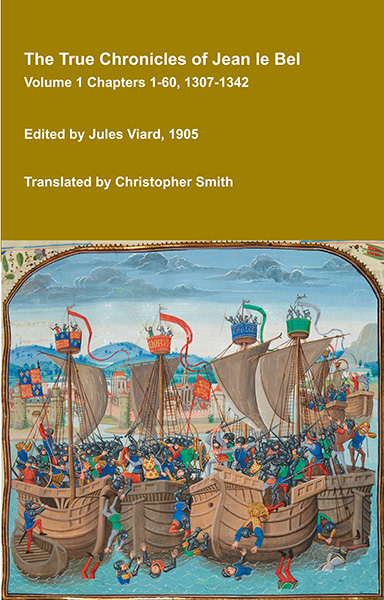
The True Chronicles of Jean le Bel Volume 1 Chapters 1-60 1307-1342

The True Chronicles of Jean le Bel offer one of the most vivid and immediate accounts of 14th-century Europe, written by a knight who lived through the events he describes, and experienced some of them first hand. Covering the early decades of the Hundred Years’ War, this remarkable chronicle follows the campaigns of Edward III of England, the politics of France and the Low Countries, and the shifting alliances that shaped medieval warfare. Unlike later historians, Jean le Bel writes with a strong sense of eyewitness authenticity, drawing on personal experience and the testimony of fellow soldiers. His narrative captures not only battles and sieges, but also the realities of military life, diplomacy, and the ideals of chivalry that governed noble society. A key source for Jean Froissart, Le Bel’s chronicle stands on its own as a compelling and insightful work, at once historical record and literary achievement. This translation builds on the 1905 edition published in French by Jules Viard, adding extensive translations from other sources Rymer's Fœdera, the Chronicles of Adam Murimuth, William Nangis, Walter of Guisborough, a Bourgeois of Valenciennes, Geoffrey le Baker of Swinbroke and Richard Lescot to enrich the original text and Viard's notes.

Available at Amazon in eBook and Paperback format.

Edward Oldcorne 1561-1606

In 1561 Edward Oldcorne was born in York.

In early 1589 Edward Oldcorne [aged 28] and Henry Garnet [aged 33] went to the West Midlands visiting Coughton, Warwickshire and settling at Baddesley Clinton.

On 3rd November 1601 Edward Oldcorne [aged 40] went on a pilgrimage to St Winefrid's Well, Holywell [Map] to obtain a cure for a cancer of the throat.

On 7th April 1606 Humphrey Lyttelton [aged 44], Edward Oldcorne [aged 45] Ralph Ashley and John Wintour [aged 26] were hanged, drawn and quartered at Red Hill, Worcester for their involvement in the Gunpowder Plot.

Criminal Trials by David Jardine. Another extract from the same Examination of Edward Oldcorne [aged 44]: He confesseth that upon Wednesday, being the 8th of November [1605], about two of the clock in the afternoon, 'there came Tesmond (Greenway) from Huddington, ‘from Mr. Robert Winter's, to Hendlip, and told Mr. Abington and him, that he brought them the worst news that ever they heard,' and said, 'that they were all undone.' And they demanding the cause, he said 'that there were certain gentlemen that meant to have blown up the Parliament-House, and that their plot was discovered a day or two before; and now they were gathered together some forty horse at Mr. Winter's house, naming Catesby, Percy, Digby, and others; and told them, 'their throats would be cut unless they presently went to join with them.' And Mr. Abington said, 'Alas! I am sorry.' And this examinate and he answered him that they would never join with him in that matter, and charged all his house to that purpose not to go with them. He confesseth that upon the former speeches made by Mr. Abington and this examinate to Tesmond, alias Greenway the Jesuit, Tesmond said in some heat, 'Thus we may see a difference between a flemmatike (phlegmatic) and a cholerice person!'’ and said that he would go to others, and specially into Lancashire, for the same purpose as he came to Hendlip to Mr. Abington.

Criminal Trials by David Jardine. Extract from an Examination of Edward Oldcorne [aged 45], dated the 5th of March, 1606: "He saith that Garnet told him that the Pope had granted an indulgence to all those that had the graines, and said these verses:

'Gentem auferte perfidam [Remove the faithless people]

Credentium de finibus; [from the borders of the faithful,]

Ut Christo laudes debitas, [so that we may to Christ]

Persolvamus alacriter.'" [gladly render what is due.]