

William of Worcester's Chronicle of England
William of Worcester, born around 1415, and died around 1482 was secretary to John Fastolf, the renowned soldier of the Hundred Years War, during which time he collected documents, letters, and wrote a record of events. Following their return to England in 1440 William was witness to major events. Twice in his chronicle he uses the first person: 1. when writing about the murder of Thomas, 7th Baron Scales, in 1460, he writes '… and I saw him lying naked in the cemetery near the porch of the church of St. Mary Overie in Southwark …' and 2. describing King Edward IV's entry into London in 1461 he writes '… proclaimed that all the people themselves were to recognize and acknowledge Edward as king. I was present and heard this, and immediately went down with them into the city'. William’s Chronicle is rich in detail. It is the source of much information about the Wars of the Roses, including the term 'Diabolical Marriage' to describe the marriage of Queen Elizabeth Woodville’s brother John’s marriage to Katherine, Dowager Duchess of Norfolk, he aged twenty, she sixty-five or more, and the story about a paper crown being placed in mockery on the severed head of Richard, 3rd Duke of York.
Available at Amazon in eBook and Paperback format.
Heydour, South Kesteven is in South Kesteven.
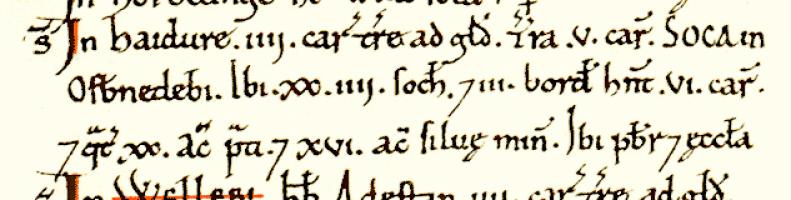
Heydour [Map] was a settlement in Domesday Book, in the hundred of Threo and the county of Lincolnshire. It had a recorded population of 28 households in 1086, putting it in the largest 40% of settlements recorded in Domesday.
Land of Guy of Craon. Households: 24 freemen. 3 smallholders. 1 priest. Land and resources: Ploughland: 5 ploughlands. 6 men's plough teams. Other resources: Meadow 80 acres. Woodland 16 acres. 1 church.
Owners. Tenant-in-chief in 1086: Guy of Craon. Lord in 1086: Vitalis. Lord in 1066: Aelfric (son of Godram).

Around 1679 Culverthorpe Hall [Map] was purchased by John Newton 2nd Baronet [aged 52].
John Newton 2nd Baronet: On 9th January 1626 he was born to Thomas Newton. In 1645 he and Mary Eyre were married. In 1661 John Newton 1st Baronet died. John Newton 2nd Baronet succeeded 2nd Baronet Newton of Barrs Court. It appears there is no genealogical connection between John Newton 1st Baronet and John Newton 2nd Baronet. The latter, apparently, paid a sum of money to inherit the Baronetcy. On 31st August 1699 he died. His son John succeeded 3rd Baronet Newton of Barrs Court. Susanna Wharton Lady Newton by marriage Lady Newton of Barrs Court.

On 4th January 1733 John Newton died at Culverthorpe Hall [Map]. He is reported to have died when he was removed from his crib by a pet monkey who then dropped him from the roof of the house; there are variations of the story. He was buried at St Michael's Church, Heydour [Map].
John Newton: On 16th October 1732 he was born to Michael Newton 4th Baronet and Margaret Coningsby 2nd Countess Coningsby.
Around 1910 Rodolph Ladeveze Adlercron [aged 36] puchased Culverthorpe Hall [Map].
In 1917 Major H. L. Archer Houblon sold Culverthorpe Hall [Map] and 2170 acres of land, realising a combined total of £49,550.
St Michael's Church, Heydour is also in Churches in Lincolnshire.
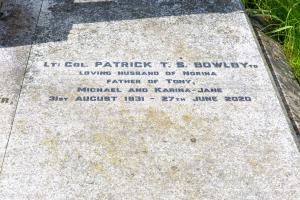
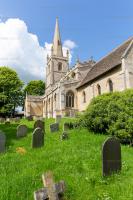
Graves of the Bowlby Family at St Michael's Church, Heydour [Map].
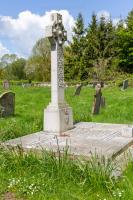
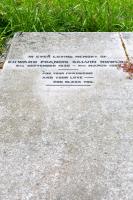
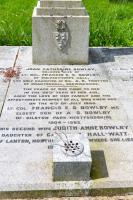
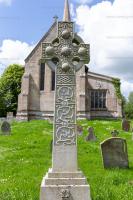
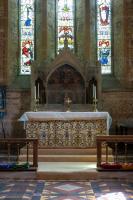
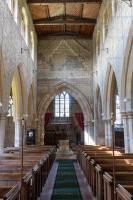
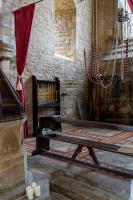
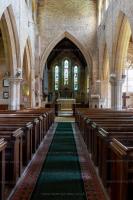
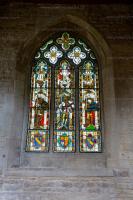
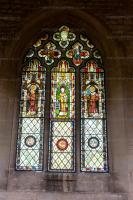
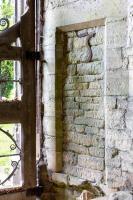
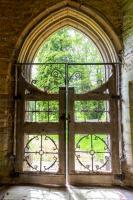
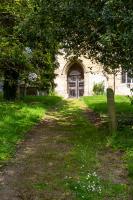
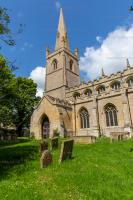
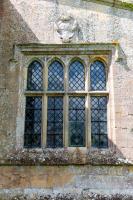
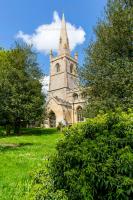
St Michael's Church, Heydour [Map] dates from the 12th century, with additions up to the 19th. The church has an Early English chancel with lancet windows and a 17th-century north funerary chapel, and a nave with a Perpendicular clerestory, including six tracery panelled windows.
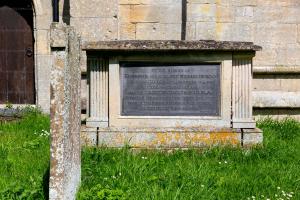
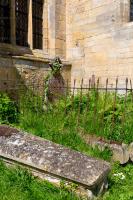
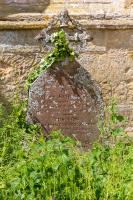
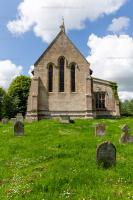

On 2nd August 1671 Elizabeth Babington [aged 63] died. She was buried at St Michael's Church, Heydour [Map].
Elizabeth Babington: On or before 9th August 1607, the date of her baptism at Rampton, Nottinghamshire, she was born. On 30th November 1624 Gervase Eyre and she were married at Rampton, Nottinghamshire.
On 11th May 1686 Abigail Heveningham [aged 26] died. She was buried at St Michael's Church, Heydour [Map].
Abigail Heveningham: In 1660 she was born to William Heveningham and Mary Carey. Before 9th June 1680 John Newton 3rd Baronet and she were married.


The History of William Marshal was commissioned by his son shortly after William’s death in 1219 to celebrate the Marshal’s remarkable life; it is an authentic, contemporary voice. The manuscript was discovered in 1861 by French historian Paul Meyer. Meyer published the manuscript in its original Anglo-French in 1891 in two books. This book is a line by line translation of the first of Meyer’s books; lines 1-10152. Book 1 of the History begins in 1139 and ends in 1194. It describes the events of the Anarchy, the role of William’s father John, John’s marriages, William’s childhood, his role as a hostage at the siege of Newbury, his injury and imprisonment in Poitou where he met Eleanor of Aquitaine and his life as a knight errant. It continues with the accusation against him of an improper relationship with Margaret, wife of Henry the Young King, his exile, and return, the death of Henry the Young King, the rebellion of Richard, the future King Richard I, war with France, the death of King Henry II, and the capture of King Richard, and the rebellion of John, the future King John. It ends with the release of King Richard and the death of John Marshal.
Available at Amazon in eBook and Paperback format.
On 4th January 1733 John Newton died at Culverthorpe Hall [Map]. He is reported to have died when he was removed from his crib by a pet monkey who then dropped him from the roof of the house; there are variations of the story. He was buried at St Michael's Church, Heydour [Map].
John Newton: On 16th October 1732 he was born to Michael Newton 4th Baronet and Margaret Coningsby 2nd Countess Coningsby.
On 12th February 1734 John Newton 3rd Baronet [aged 83] died. He was buried at St Michael's Church, Heydour [Map]; his monument sculpted by John Michael Rysbrack [aged 39]. His son Michael [aged 39] succeeded 4th Baronet Newton of Barrs Court. Margaret Coningsby 2nd Countess Coningsby [aged 25] by marriage Lady Newton of Barrs Court.
John Newton 3rd Baronet: Around 1651 he was born to John Newton 2nd Baronet and Mary Eyre. On 23rd January 1691 he and Susanna Wharton Lady Newton were married. On 31st August 1699 John Newton 2nd Baronet died. His son John succeeded 3rd Baronet Newton of Barrs Court. Susanna Wharton Lady Newton by marriage Lady Newton of Barrs Court.


On 19th April 1737 Susanna Wharton Lady Newton [aged 86] died. She was buried at St Michael's Church, Heydour [Map]. Monument sculpted by Peter Scheemakers [aged 46].
Susanna Wharton Lady Newton: Around 1651 she was born to Michael Wharton and Susan Paulett.


On 6th April 1743 Michael Newton 4th Baronet [aged 48] died. Baronet Newton of Barrs Court extinct. He was buried at St Michael's Church, Heydour [Map]. Sculpted by Peter Scheemakers [aged 52].


On 12th June 1761 Margaret Coningsby 2nd Countess Coningsby [aged 52] died. Earl Coningsbury extinct. She was buried at St Michael's Church, Heydour [Map]. Monument sculpted by John Michael Rysbrack [aged 66].


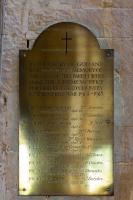
After 1918. Memorial at St Michael's Church, Heydour [Map] to those who fell in the Great War 1914-1918.
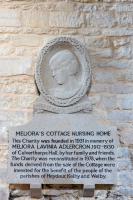
In 1930 Meliora Lavinia Adlercron [aged 18] died in a car accident. She was buried at St Michael's Church, Heydour [Map].
Funeral At Heydour. Sincere sympathy was aroused in the Grantham and Sleaford district last week for Brigadier-General B. L. and Mrs. Adlercron, of Culverthorpe Hall, when it became known that two of their daughters, Lilias and Meliora, had met with a serious accident whilst motoring on the Great North Road, near Colsterworth, on Monday week. It appears their saloon car, swerving to avoid child who crossed the road, skidded and overturned. Miss M. Adlercron was severely hurt, and died at her home on Saturday night. Fortunately, her sister escaped with slight injuries. Deceased, who was only, 19 years of age, entered into the social life of the neighbourhood. and was beloved by all with whom she came in contact. Educated partly at Culverthorpe, she afterwards went to Paris, where she studied art, to which she was devoted. Deceased was well known in hunting circles, especially in Lincolnshire, and was a popular member of the Belvoir Hunt.
The Inquest was held at Culverthorpe,on Monday, the District Coroner, Dr. Cragg, who sat with a jury, Dr. O. Giles, of Sleaford, said there were multiple injuries to the scalp and right knee, and innumerable cuts and abrasions of the body and back. No bones were broken. Death was due to septic absorption from the wounds, and from shock caused by the wounds.—P.C. England said he found two skid marks forty-four feet long, caused, he believed by the application of the brakes. After that there were marks all over the road for sixty-nine feet. It appeared as if the car had overturned and continued on its side, the skid marks being about four feet from the proper side of the road. Brigadier-General Adlercron. who identified the body, said his daughter had been driving for two and-a-half years.—The verdict was that deceased died as a result of injuries received when the car she was driving was suddenly overturned.
Meliora's sister Lilias, who survived, later went to live in Canada. She lived to a great age and before expiring expressed a wish to be buried next to her sister in Heydour graveyard. Their headstones are adjacent.
Meliora's Cottage Nursing Home. This Charity was founded in 1931 in memory of Meliora Lavinia Adlercron, 1912-1930 of Culverthorpe Hall, byher family and friends. The Charity was reconstituted in 1978, when the funds derived from the sale of the Cottage were invested for the benefit of the people of the parishes of Heydour, Kelbyand Welby.
Meliora Lavinia Adlercron: In 1912 she was born to Rodolph Ladeveze Adlercron.