

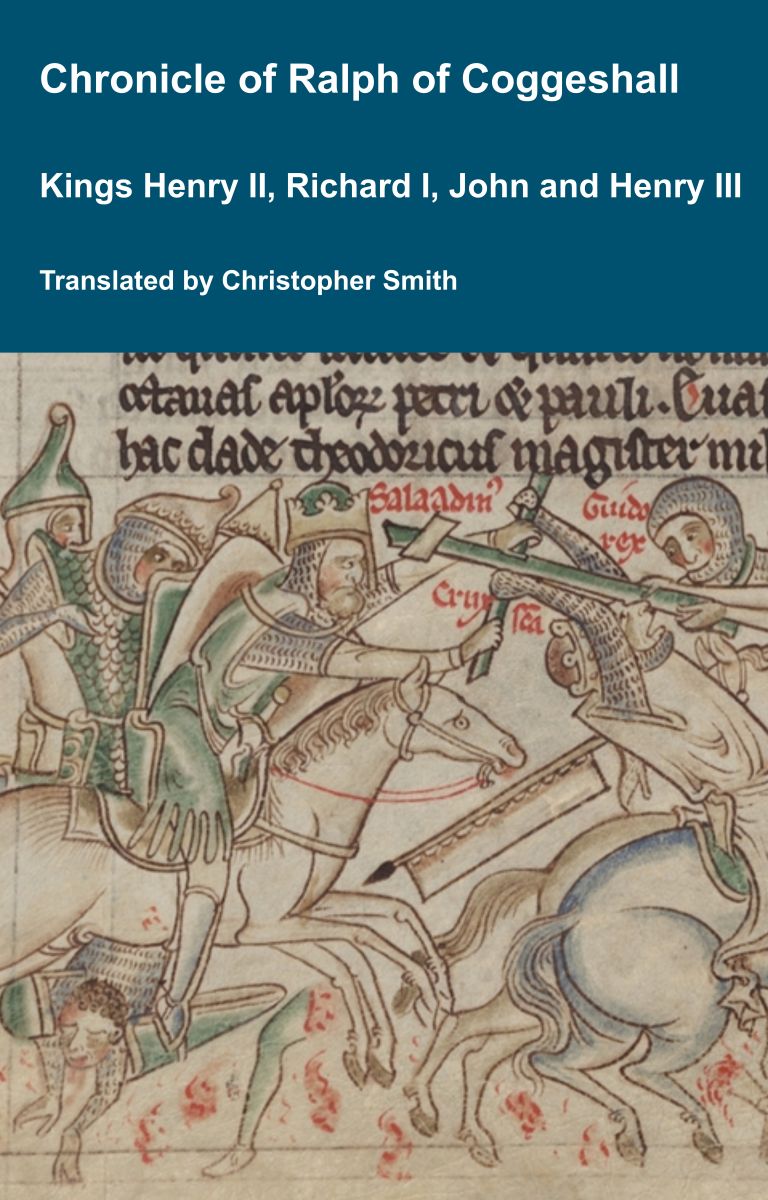
Chronicle of Abbot Ralph of Coggeshall
The Chronicle of Abbot Ralph of Coggeshall (Chronicon Anglicanum) is an indispensable medieval history that brings to life centuries of English and European affairs through the eyes of a learned Cistercian monk. Ralph of Coggeshall, abbot of the Abbey of Coggeshall in Essex in the early 13th century, continued and expanded his community’s chronicle, documenting events from the Norman Conquest of 1066 into the tumultuous reign of King Henry III. Blending eyewitness testimony, careful compilation, and the monastic commitment to record-keeping, this chronicle offers a rare narrative of political intrigue, royal power struggles, and social upheaval in England and beyond. Ralph’s work captures the reigns of pivotal figures such as Richard I and King John, providing invaluable insights into their characters, decisions, and the forces that shaped medieval rule. More than a simple annal, Chronicon Anglicanum conveys the texture of medieval life and governance, making it a rich source for scholars and readers fascinated by English history, monastic authorship, and the shaping of the medieval world.
Available at Amazon in eBook and Paperback format.
Christina of Wessex was appointed Abbot Romsey.
In or before 1045 [her father] Edward "The Exile" Wessex (age 28) and [her mother] Agatha were married. He the son of [her grandfather] King Edmund "Ironside" I of England and [her grandmother] Ealdgyth Unknown.
Flowers of History by Roger of Wendover 1057. 1057. Eadward king of England (age 54), being advanced in years, sent Aldred bishop of Worcester into Hungary, and recalled thence [her father] Eadward (age 41), son of [her grandfather] king Eadmund his brother, with the intention of making him his successor. Eadward came accordingly, with his son [her brother] Eadgar (age 6) and his daughters [her sister] Margaret (age 12) and Christina, but died not long after his arrival in the city of London, leaving the king the charge of his son Eadgar and his daughters before mentioned.
Around 1057 Christina of Wessex was born to [her father] Edward "The Exile" Wessex (age 41) and [her mother] Agatha.
On 19th April 1057 [her father] Edward "The Exile" Wessex (age 41) died.
On 15th October 1066 [her brother] King Edgar Ætheling II of England (age 15) was appointed II King of England.
Flowers of History. Before 25th December 1066. And as they all fled to [her future brother-in-law] Malcolm, king of Scotland (age 35), they were all honourably received by him. Then also, [her brother] Edgar Atheling (age 15), the legitimate heir of the kingdom of England, seeing his country plundered and disturbed on all sides, embarked on board ship with his mother [her mother] Agatha, and his sisters [her sister] Margaret (age 21) and Christina (age 9), and endeavoured to return into Hungary, where he had been born; but, a tempest arising, he was compelled to land on the coast of Scotland. And, in consequence of the occasion thus offered, it came to pass that Margaret was given as a bride to King Malcolm, whose exemplary life and virtuous death are plainly set forth in a book specially composed on that subject. But his sister Christina became a nun, and deserves our benediction as one who was married for ever to a heavenly bridegroom.
Anglo-Saxon Chronicle. 1067. This summer the child [her brother] Edgar (age 16) departed, with his mother [her mother] Agatha, and his two sisters, [her sister] Margaret (age 22) and Christina (age 10), and Merle-Sweyne, and many good men with them; and came to Scotland under the protection of [her future brother-in-law] King Malcolm (age 35), who entertained them all. Then began King Malcolm to yearn after the child's sister, Margaret, to wife; but he and all his men long refused; and she also herself was averse, and said that she would neither have him nor any one else, if the Supreme Power would grant, that she in her maidenhood might please the mighty Lord with a carnal heart, in this short life, in pure continence. The king, however, earnestly urged her brother, until he answered Yea. And indeed he durst not otherwise; for they were come into his kingdom. So that then it was fulfilled, as God had long ere foreshowed; and else it could not be; as he himself saith in his gospel: that "not even a sparrow on the ground may fall, without his foreshowing." The prescient Creator wist long before what he of her would have done; for that she should increase the glory of God in this land, lead the king aright from the path of error, bend him and his people together to a better way, and suppress the bad customs which the nation formerly followed: all which she afterwards did. The king therefore received her, though it was against her will, and was pleased with her manners, and thanked God, who in his might had given him such a match. He wisely bethought himself, as he was a prudent man, and turned himself to God, and renounced all impurity; accordingly, as the apostle Paul, the teacher of all the gentries, saith: "Salvabitur vir infidelis per mulierem fidelem; sic et mulier infidelis per virum fidelem," etc.: that is in our language, "Full oft the unbelieving husband is sanctified and healed through the believing wife, and so belike the wife through the believing husband." This queen aforesaid performed afterwards many useful deeds in this land to the glory of God, and also in her royal estate she well conducted herself, as her nature was. Of a faithful and noble kin was she sprung. Her father was [her father] Edward Etheling, son of [her grandfather] King Edmund. Edmund was the son of Ethelred; Ethelred the son of Edgar; Edgar the son of Edred; and so forth in that royal line: and her maternal kindred goeth to the Emperor Henry, who had the sovereignty over Rome. This year went out Githa, Harold's mother, and the wives of many good men with her, to the Flat-Holm, and there abode some time; and so departed thence over sea to St. Omer's.
Chronicon ex Chronicis by Florence and John of Worcester. 1068. After Easter [23rd March], the countess Matilda (age 37) came to England from Normandy, and was crowned queen by Aldred, archbishop of York, on Whitsunday [1lth May]. After this, Mariesweyn and Cospatric, and some of the most noble of the Northumbrian nation, in order to escape the king's tyranny, and fearing that, like others, they might be thrown into prison, took with them [her brother] Edgar (age 17) the etheling, with his mother [her mother] Agatha and his two sisters, [her sister] Margaret (age 23) and Christina (age 11), and, embarking for Scotland, wintered there under favour of [her future brother-in-law] Malcolm (age 36), king of Scots. Meanwhile, king William (age 40) marched his army to Nottingham, Nottinghamshire [Map], and, having fortified the castle there, proceeded to York [Map], where he erected two strong forts, and having stationed in them five hundred men, he gave orders that strong castles should be built at Lincoln, Lincolnshire [Map] and other places.
Before 1070 [her brother-in-law] King Malcolm III of Scotland (age 38) and [her sister] Margaret Wessex Queen Consort Scotland (age 24) were married. She by marriage Queen Consort Scotland. He the son of King Duncan I of Scotland and Bethóc Unknown Queen Consort Scotland.
Anglo-Saxon Chronicle. 1086. Then he went into Normandy; and [her brother] Edgar Etheling (age 35), the relation of King Edward, revolted from him, for he received not much honour from him; but may the Almighty God give him honour hereafter. And Christina (age 29), the sister of the etheling, went into the monastery of Rumsey [Map], and received the holy veil.
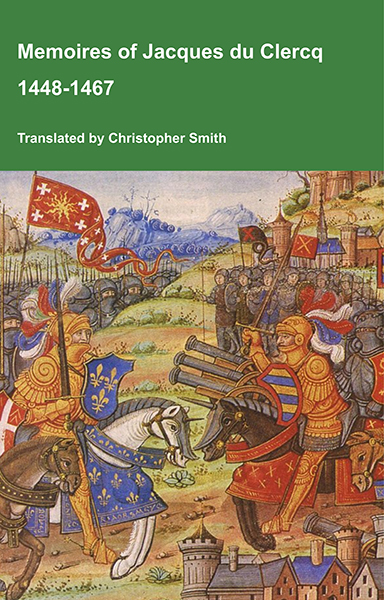
This is a translation of the 'Memoires of Jacques du Clercq', published in 1823 in two volumes, edited by Frederic, Baron de Reissenberg. In his introduction Reissenberg writes: 'Jacques du Clercq tells us that he was born in 1424, and that he was a licentiate in law and a counsellor to Philip the Good, Duke of Burgundy, in the castellany of Douai, Lille, and Orchies. It appears that he established his residence at Arras. In 1446, he married the daughter of Baldwin de la Lacherie, a gentleman who lived in Lille. We read in the fifth book of his Memoirs that his father, also named Jacques du Clercq, had married a lady of the Le Camelin family, from Compiègne. His ancestors, always attached to the counts of Flanders, had constantly served them, whether in their councils or in their armies.' The Memoires cover a period of nineteen years beginning in in 1448, ending in in 1467. It appears that the author had intended to extend the Memoirs beyond that date; no doubt illness or death prevented him from carrying out this plan. As Reissenberg writes the 'merit of this work lies in the simplicity of its narrative, in its tone of good faith, and in a certain air of frankness which naturally wins the reader’s confidence.' Du Clercq ranges from events of national and international importance, including events of the Wars of the Roses in England, to simple, everyday local events such as marriages, robberies, murders, trials and deaths, including that of his own father in Book 5; one of his last entries.
Available at Amazon in eBook and Paperback format.
Around 1093 Christina of Wessex (age 36) died.
Kings Wessex: Grand Daughter of King Edmund "Ironside" I of England
Great x 4 Grandfather: King Edward "Elder" of the Anglo Saxons
Great x 3 Grandfather: King Edmund I of England
Great x 4 Grandmother: Eadgifu Kent Queen Anglo Saxons
Great x 2 Grandfather: King Edgar I of England
Great x 3 Grandmother: Aelfgifu of Shaftesbury Queen Consort England
Great x 1 Grandfather: King Æthelred II of England
Great x 3 Grandfather: Ordgar Earldorman Devon
Great x 2 Grandmother: Aelfthryth Queen Consort England
GrandFather: King Edmund "Ironside" I of England
Great x 2 Grandfather: Thored Northumbria
Great x 1 Grandmother: Aelfgifu of York Queen Consort England
Father: Edward "The Exile" Wessex
GrandMother: Ealdgyth Unknown
Mother: Agatha