

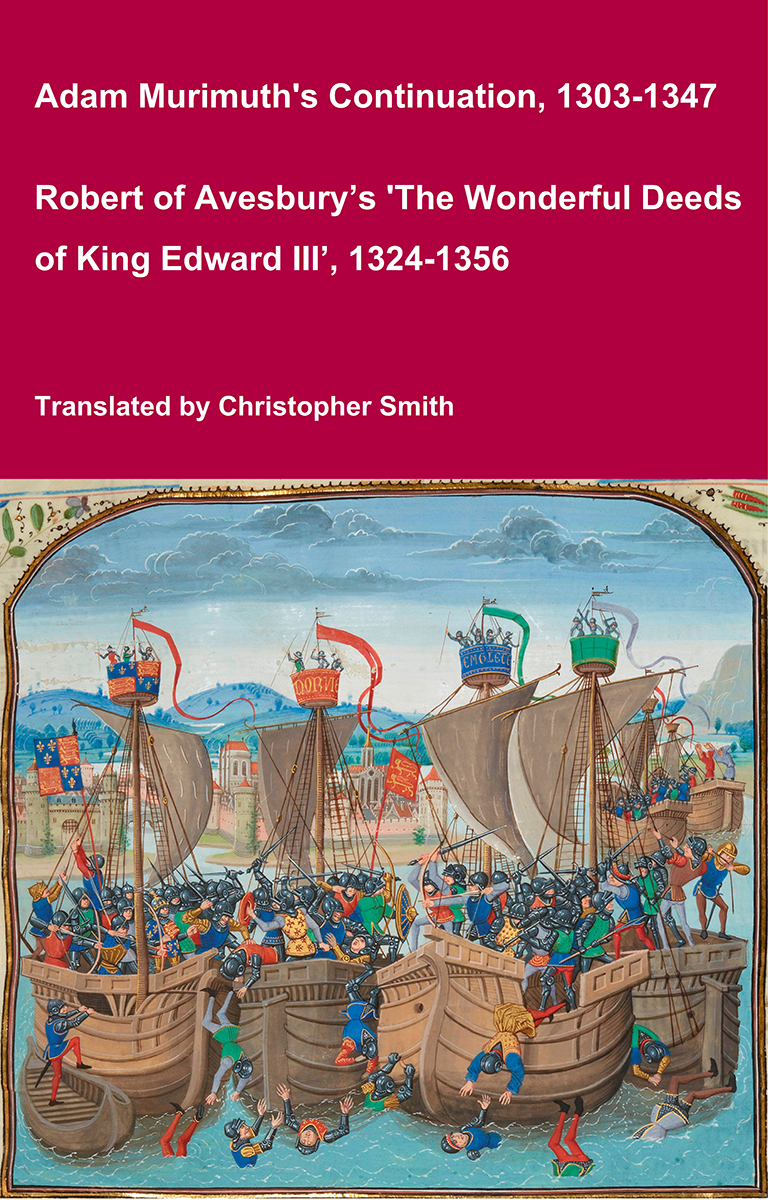
Adam Murimuth's Continuation and Robert of Avesbury’s 'The Wonderful Deeds of King Edward III'
This volume brings together two of the most important contemporary chronicles for the reign of Edward III and the opening phases of the Hundred Years’ War. Written in Latin by English clerical observers, these texts provide a vivid and authoritative window into the political, diplomatic, and military history of fourteenth-century England and its continental ambitions. Adam Murimuth Continuatio's Chronicarum continues an earlier chronicle into the mid-fourteenth century, offering concise but valuable notices on royal policy, foreign relations, and ecclesiastical affairs. Its annalistic structure makes it especially useful for establishing chronology and tracing the development of events year by year. Complementing it, Robert of Avesbury’s De gestis mirabilibus regis Edwardi tertii is a rich documentary chronicle preserving letters, treaties, and official records alongside narrative passages. It is an indispensable source for understanding Edward III’s claim to the French crown, the conduct of war, and the mechanisms of medieval diplomacy. Together, these works offer scholars, students, and enthusiasts a reliable and unembellished account of a transformative period in English and European history. Essential for anyone interested in medieval chronicles, the Hundred Years’ War, or the reign of Edward III.
Available at Amazon in eBook and Paperback format.
Paternal Family Tree: Wessex
In or before 943 [his father] King Edmund I of England [aged 21] and [his mother] Aelfgifu of Shaftesbury Queen Consort England were married. She by marriage Queen Consort England. He the son of [his grandfather] King Edward "Elder" of the Anglo Saxons and [his grandmother] Eadgifu Kent Queen Anglo Saxons.
Around 943 King Edgar I of England was born to [his father] King Edmund I of England [aged 22] and [his mother] Aelfgifu of Shaftesbury Queen Consort England at Winchester, Hampshire [Map].
In 944 [his mother] Aelfgifu of Shaftesbury Queen Consort England died.
In or after 944 [his father] King Edmund I of England [aged 23] and Æthelflæd of Damerham Queen Consort of England were married. She by marriage Queen Consort England. He the son of [his grandfather] King Edward "Elder" of the Anglo Saxons and [his grandmother] Eadgifu Kent Queen Anglo Saxons.
On 26th May 946 [his father] King Edmund I of England [aged 25] was murdered by Leofa, an exiled thief, whilst attending mass at Pucklechurch, Gloucestershire. He was buried at Glastonbury Abbey [Map]. His brother [his uncle] Eadred succeeded I King of England.
On 23rd November 955 [his uncle] King Eadred I of England died. His nephew [his brother] Eadwig succeeded I King of England.
Anglo-Saxon Chronicle. 955. This year died [his uncle] King Edred, on St. Clement's mass day, at Frome.41 He reigned nine years and a half; and he rests in the old minster. Then succeeded Edwy, the son of King Edmund, to the government of the West-Saxons; and Edgar Atheling [aged 12], his brother, succeeded to the government of the Mercians. They were the sons of King Edmund and of St. Elfgiva.
Note 41. So I understand the word. Gibson, from Wheloc, says-"in aetatis vigore;" a fact contradicted by the statement of almost every historian. Names of places seldom occur in old MSS. with capital initials.
In or before 958 [his brother] King Eadwig I of England and [his sister-in-law] Ælfgifu Queen Consort of England were married. She by marriage Queen Consort England. The were separated in 958 on the instruction of Archbishop Oda for being too closely related. He the son of [his father] King Edmund I of England and [his mother] Aelfgifu of Shaftesbury Queen Consort England.
In 958 a charter of King Edgar I of England [aged 15] describes Penkridge, Staffordshire [Map] as a "famous place". St Michael's Church, Penkridge [Map] was established as a Royal Free Chapel making it a Royal Peculiar. The church was independent of the Bishop of Lichfield and, correspondingly, the Archbishop of Canterbury.
On 1st October 959 King Eadwig I of England died. He was buried at Winchester, Hampshire [Map]. His brother Edgar [aged 16] succeeded I King of England.
Anglo-Saxon Chronicle. 959. This year died King Edwy, on the calends of October; and Edgar [aged 16] his brother took to the government of the West-Saxons, Mercians, and Northumbrians. He was then sixteen years old. It was in this year he sent after St. Dunstan [aged 50], and gave him the bishopric of Worcester; and afterwards the bishopric of London. In his days it prosper'd well; and God him gave, that he dwelt in peace the while that he lived. Whate'er he did, whate'er he plan'd, he earn'd his thrift. He also rear'd God's glory wide, and God's law lov'd, with peace to man, above the kings that went before in man's remembrance. God so him sped, that kings and earls to all his claims submissive bow'd; and to his will without a blow he wielded all as pleased himself. Esteem'd he was both far and wide in distant lands; because he prized the name of God, and God's law traced, God's glory rear'd, both far and wide, on every side. Wisely he sought in council oft his people's good, before his God, before the world. One misdeed he did, too much however, that foreign tastes he loved too much; and heathen modes into this land he brought too fast; outlandish men hither enticed; and to this earth attracted crowds of vicious men. But God him grant, that his good deeds be weightier far than his misdeeds, to his soul's redemption on the judgment-day.
Before 962 Æthelwald Ealdorman of East Anglia and [his future wife] Aelfthryth Queen Consort England [aged 16] were married. She the daughter of Ordgar Earldorman Devon. He the son of Æthelstan Half King.
Around 962 King Edgar I of England [aged 19] and Aelfthryth Queen Consort England [aged 17] were married. She by marriage Queen Consort England. She the daughter of Ordgar Earldorman Devon. He the son of King Edmund I of England and Aelfgifu of Shaftesbury Queen Consort England.
In 962 Æthelwald Ealdorman of East Anglia was killed by King Edgar I of England [aged 19]. King Edgar I of England had previously sent Æthelwald Ealdorman of East Anglia to [his wife] Aelfthryth Queen Consort England [aged 17] to offer her marriage to King Edgar I of England. Æthelwald decided to marry Aelfthryth Queen Consort England himself. King Edgar I of England sought revenge, killed Æthelwald and married Aelfthryth Queen Consort England. The story subject to much debate among historians.
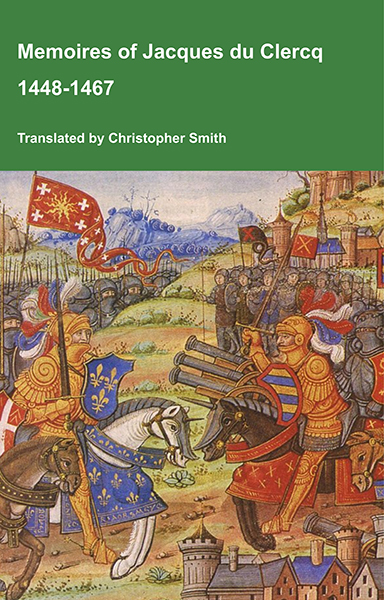
This is a translation of the 'Memoires of Jacques du Clercq', published in 1823 in two volumes, edited by Frederic, Baron de Reissenberg. In his introduction Reissenberg writes: 'Jacques du Clercq tells us that he was born in 1424, and that he was a licentiate in law and a counsellor to Philip the Good, Duke of Burgundy, in the castellany of Douai, Lille, and Orchies. It appears that he established his residence at Arras. In 1446, he married the daughter of Baldwin de la Lacherie, a gentleman who lived in Lille. We read in the fifth book of his Memoirs that his father, also named Jacques du Clercq, had married a lady of the Le Camelin family, from Compiègne. His ancestors, always attached to the counts of Flanders, had constantly served them, whether in their councils or in their armies.' The Memoires cover a period of nineteen years beginning in in 1448, ending in in 1467. It appears that the author had intended to extend the Memoirs beyond that date; no doubt illness or death prevented him from carrying out this plan. As Reissenberg writes the 'merit of this work lies in the simplicity of its narrative, in its tone of good faith, and in a certain air of frankness which naturally wins the reader’s confidence.' Du Clercq ranges from events of national and international importance, including events of the Wars of the Roses in England, to simple, everyday local events such as marriages, robberies, murders, trials and deaths, including that of his own father in Book 5; one of his last entries.
Available at Amazon in eBook and Paperback format.
Around 962 [his illegitimate son] King Edward I of England was born illegitimately to King Edgar I of England [aged 19] and Æthelflaed 2 Unknown.
Around 963 [his daughter] Edith of Wilton was born to King Edgar I of England [aged 20] and Wulfthryth of Wilton [aged 26].
Anglo-Saxon Chronicle. 963. This year died Wulfstan, the deacon, on Childermass-day;42 and afterwards died Gyric, the mass-priest. In the same year took Abbot Athelwold [aged 59] to the bishopric of Winchester; and he was consecrated on the vigil of St. Andrew, which happened on a Sunday. On the second year after he was consecrated, he made many minsters; and drove out the clerks43 from the bishopric, because they would hold no rule, and set monks therein. He made there two abbacies; one of monks, another of nuns. That was all within Winchester. Then came he afterwards to King Edgar [aged 20], and requested that he would give him all the minsters that heathen men had before destroyed; for that he would renew them. This the king cheerfully granted; and the bishop came then first to Ely [Map], where St. Etheldritha lies, and ordered the minster to be repaired; which he gave to a monk of his, whose name was Britnoth, whom he consecrated abbot: and there he set monks to serve God, where formerly were nuns. He then bought many villages of the king, and made it very rich. Afterwards came Bishop Athelwold to the minster called Medhamsted, which was formerly ruined by heathen folk; but he found there nothing but old walls, and wild woods. In the old walls at length he found hid writings which Abbot Hedda had formerly written;-how King Wulfhere and Ethelred his brother had wrought it, and how they freed it against king and against bishop, and against all worldly service; and how Pope Agatho confirmed it with his writ, as also Archbishop Deusdedit. He then ordered the minster to be rebuilt; and set there an abbot, who was called Aldulf; and made monks, where before was nothing. He then came to the king, and let him look at the writings which before were found; and the king then answered and said: "I Edgar grant and give to-day, before God and before Archbishop Dunstan [aged 54], freedom to St. Peter's minster at Medhamsted, from king and from bishop; and all the thorps that thereto lie; that is, Eastfield, and Dodthorp, and Eye, and Paston. And so I free it, that no bishop have any jurisdiction there, but the abbot of the minster alone. And I give the town called Oundle, Northamptonshire [Map], with all that thereto lieth, called Eyot-hundred, with market and toll; so freely, that neither king, nor bishop, nor earl, nor sheriff, have there any jurisdiction; nor any man but the abbot alone, and whom he may set thereto. And I give to Christ and St. Peter, and that too with the advice of Bishop Athelwold, these lands;-that is, Barrow, Warmington, Ashton, Kettering, Castor, Eylesworth, Walton, Witherington, Eye, Thorp, and a minster at Stamford. These lands and al the others that belong to the minster I bequeath clear; that is, with sack and sock, toll and team, and infangthief; these privileges and all others bequeath I clear to Christ and St. Peter. And I give the two parts of Whittlesey-mere, with waters and with wears and fens; and so through Meerlade along to the water that is called Nen; and so eastward to Kingsdelf. And I will that there be a market in the town itself, and that no other be betwixt Stamford and Huntingdon. And I will that thus be given the toll;-first, from Whittlesey-mere to the king's toll of Norman-cross hundred; then backward again from Whittlesey-mere through Meerlade along to the Nen, and as that river runs to Crowland; and from Crowland to Must, and from Must to Kingsdelf and to Whittlesey-mere. And I will that all the freedom, and all the privileges, that my predecessors gave, should remain; and I write and confirm this with the rood-token of Christ." (+)-Then answered Dunstan, the Archbishop of Canterbury, and said: "I grant, that all the things that here are given and spoken, and all the things that thy predecessors and mine have given, shall remain firm; and whosoever breaketh it, then give I him God's curse, and that of all saints, and of all hooded heads, and mine, unless he come to repentance. And I give expressly to St. Peter my mass-hackle, and my stole, and my reef, to serve Christ." "I Oswald, Archbishop of York, confirm all these words through the holy rood on which Christ was crucified." (+) "I Bishop Athelwold bless all that maintain this, and I excommunicate all that break it, unless they come to repentance."-Here was Bishop Ellstan, Bishop Athulf, and Abbot Eskwy, and Abbot Osgar, and Abbot Ethelgar, and Alderman Elfere; Alderman Ethelwin, Britnoth and Oslac aldermen, and many other rich men; and all confirmed it and subscribed it with the cross of Christ. (+) This was done in the year after our Lord's Nativity 972, the sixteenth year of this king. Then bought the Abbot Aldulf lands rich and many, and much endowed the minster withal; and was there until Oswald, Archbishop of York, was dead; and then he was chosen to be archbishop. Soon after another abbot was chosen of the same monastery, whose name was Kenulf, who was afterwards Bishop of Winchester. He first made the wall about the minster, and gave it then the name of Peterborough, which before was Medhamsted. He was there till he was appointed Bishop of Winchester, when another abbot was chosen of the same monastery, whose name was Elfsy, who continued abbot fifty winters afterwards. It was he who took up St. Kyneburga and St. Kyneswitha, that lay at Castor, and St. Tibba, that lay at Ryhall; and brought them to Peterborough, and offered them all to St. Peter in one day, and preserved them all the while he was there.
i.e. the secular clergy, who observed no rule; opposed to the regulars, or monks.
Note 42. i.e. the feast of the Holy Innocents; a festival of great antiquity.
Note 43. i.e. the secular clergy, who observed no rule; opposed to the regulars, or monks.
Around 963 King Edgar I of England [aged 20] abducted Wulfthryth of Wilton [aged 26] from the nunnery at Wilton Abbey [Map].
Anglo-Saxon Chronicle. 964. This year drove King Edgar [aged 21] the priests of Winchester out of the old minster, and also out of the new minster; and from Chertsey [Map]; and from Milton [Map]; and replaced them with monks. And he appointed Ethelgar abbot to the new minster, and Ordbert to Chertsey, and Cyneward to Milton [Map].
In 964 Ordgar Earldorman Devon was appointed Earldorman Devon by his son-in-law King Edgar I of England [aged 21].
Anglo-Saxon Chronicle. 965. This year King Edgar [aged 22] took [his wife] Elfrida [aged 20] for his queen, who was daughter of Alderman Ordgar.
Around 966 [his son] Edmund Ætheling was born to King Edgar I of England [aged 23] and [his wife] Aelfthryth Queen Consort England [aged 21]. He died aged five in 971.
Around 966 [his son] King Æthelred II of England was born to King Edgar I of England [aged 23] and [his wife] Aelfthryth Queen Consort England [aged 21]. He married (1) 985 Aelfgifu of York Queen Consort England, daughter of Thored Northumbria, and had issue (2) 1002 Emma aka Ælfgyfu of Normandy Queen Consort England, daughter of Richard "Fearless" Normandy I Duke Normandy and Gunnora Countess Ponthieu, and had issue.
Anglo-Saxon Chronicle. 969. This year King Edgar [aged 26] ordered all Thanet-land [Map] to be plundered.
In 971 [his son] Edmund Ætheling [aged 5] died.
In 973 Hywel ap Ieuaf King Gwynedd travelled to with his uncle Iago ap Idwal Aberffraw [aged 31] to meet with King Edgar I of England [aged 30] at Chester, Cheshire [Map].
In 973 King Edgar I of England [aged 30] was crowned In Bath, Somerset [Map]. The service forms the basis of the present English Coronation ceremony.
Abbot John Whethamstede’s Chronicle of the Abbey of St Albans
Abbot John Whethamstede's Register aka Chronicle of his second term at the Abbey of St Albans, 1451-1461, is a remarkable text that describes his first-hand experience of the beginning of the Wars of the Roses including the First and Second Battles of St Albans, 1455 and 1461, respectively, their cause, and their consequences, not least on the Abbey itself. His text also includes Loveday, Blore Heath, Northampton, the Act of Accord, Wakefield, and Towton, and ends with the Coronation of King Edward IV. In addition to the events of the Wars of the Roses, Abbot John, or his scribes who wrote the Chronicle, include details in the life of the Abbey such as charters, letters, land exchanges, visits by legates, and disputes, which provide a rich insight into the day-to-day life of the Abbey, and the challenges faced by its Abbot.
Available at Amazon in eBook and Paperback format.
Anglo-Saxon Chronicle. 975. Here ended his earthly dreams Edgar, of Angles king [aged 32]; chose him other light, serene and lovely, spurning this frail abode, a life that mortals here call lean he quitted with disdain. July the month, by all agreed in this our land, whoever were in chronic lore correctly taught; the day the eighth, when Edgar young, rewarder of heroes, his life-his throne-resigned. [his illegitimate son] Edward [aged 13] his son, unwaxen child, of earls the prince, succeeded then to England's throne.
Anglo-Saxon Chronicle. [28th June 975] Of royal race ten nights before departed hence Cyneward the good prelate of manners mild. Well known to me in Mercia then, how low on earth God's glory fell on every side: chaced from the land, his servants fled, their wisdom scorned; much grief to him whose bosom glow'd with fervent love of great Creation's Lord! Neglected then the God of wonders, victor of victors, monarch of heaven, his laws by man transgressed! Then too was driv'n Oslac beloved an exile far from his native land over the rolling waves, over the ganet-bath, over the water-throng, the abode of the whale, fair-hair'd hero, wise and eloquent, of home bereft! Then too was seen, high in the heavens, the star on his station, that far and wide wise men call lovers of truth and heav'nly lore "cometa" by name. Widely was spread God's vengeance then throughout the land, and famine scour'd the hills. May heaven's guardian, the glory of angels, avert these ills, and give us bliss again; that bliss to all abundance yields from earth's choice fruits, throughout this happy isle.45
Note 45. The following passage from Cotton Tiberius B iv., relating to the accession of [his illegitimate son] Edward the Martyr [aged 13], should be added here: "In his days, On account of his youth, the opponents of God Broke through God's laws; Alfhere alderman, And others many; And marr'd monastic rules; Minsters they razed, And monks drove away, And put God's laws to flight-Laws that King Edgar [aged 32] Commanded the holy Saint Ethelwold [aged 71] bishop Firmly to settle. Widows they stript oft and at random. Many breaches of right. And many bad laws have arisen since; And after-times prove only worse. Then too was Oslac the mighty earl hunted from England's shores.
On 8th July 975 King Edgar I of England [aged 32] died at Winchester, Hampshire [Map]. He was buried in Glastonbury Abbey [Map]. His son [his illegitimate son] Edward [aged 13] succeeded I King of England.
In 17th November 1002 [his former wife] Aelfthryth Queen Consort England [aged 57] died.
On 30th November 1016 [his grandson] King Edmund "Ironside" I of England [aged 26] died. He was buried near his grandfather King Edgar I of England in Glastonbury Abbey [Map].
Anglo-Saxon Chronicle. On the feast of St. Andrew [30th November 1016] died [his grandson] King Edmund [aged 26]; and he is buried with his grandfather Edgar at Glastonbury [Map]. In the same year died Wulfgar, Abbot of Abingdon; and Ethelsy took to the abbacy.
Samuel Pepys' Diary. 16th April 1665. Then home to dinner, where Creed dined with us, and so after dinner he and I walked to the Rolls' Chappell, expecting to hear the great Stillingfleete [aged 29] preach, but he did not; but a very sorry fellow, which vexed me. The sermon done, we parted, and I home, where I find Mr. Andrews, and by and by comes Captain Taylor, my old acquaintance at Westminster, that understands musique very well and composes mighty bravely; he brought us some things of two parts to sing, very hard; but that that is the worst, he is very conceited of them, and that though they are good makes them troublesome to one, to see him every note commend and admire them. He supped with me, and a good understanding man he is and a good scholler, and, among other things, a great antiquary, and among other things he can, as he says, show the very originall Charter to Worcester, of King Edgar's, wherein he stiles himself, Rex Marium Brittanniae, &c.; which is the great text that Mr. Selden and others do quote, but imperfectly and upon trust. But he hath the very originall, which he says he will shew me. He gone we to bed.


Kings Wessex: Son of King Edmund I of England
Great x 4 Grandfather: Ealmund King of Kent
Great x 3 Grandfather: King Egbert of Wessex
Great x 2 Grandfather: King Æthelwulf of Wessex
Great x 1 Grandfather: King Alfred "The Great" of Wessex
Great x 3 Grandfather: Oslac
Great x 2 Grandmother: Osburgh Queen Consort Wessex
GrandFather: King Edward "Elder" of the Anglo Saxons
Great x 2 Grandfather: Æthelred Mucel Mercia Earldorman Gaini
Great x 1 Grandmother: Æalhswith of Mercia Queen Consort of England
Great x 2 Grandmother: Eadburh of Mercia
Father: King Edmund I of England
Great x 1 Grandfather: Sigehelm Earldorman Kent
GrandMother: Eadgifu Kent Queen Anglo Saxons