

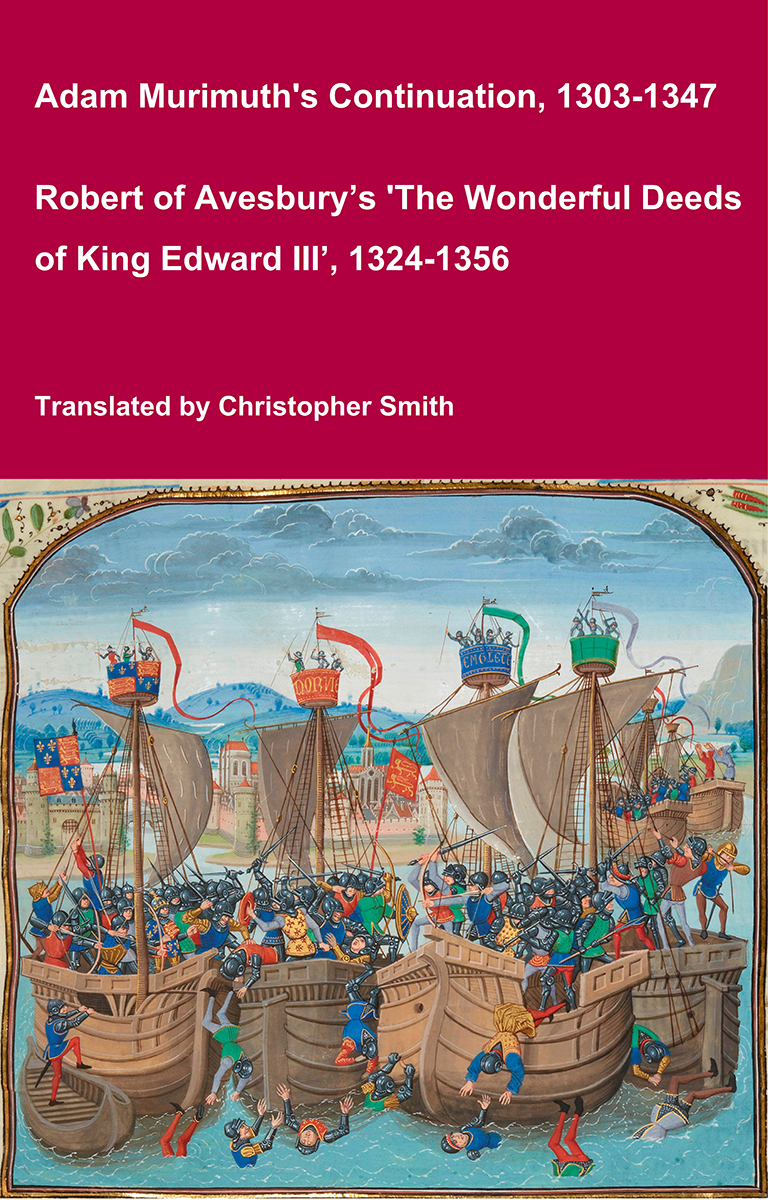
Adam Murimuth's Continuation and Robert of Avesbury’s 'The Wonderful Deeds of King Edward III'
This volume brings together two of the most important contemporary chronicles for the reign of Edward III and the opening phases of the Hundred Years’ War. Written in Latin by English clerical observers, these texts provide a vivid and authoritative window into the political, diplomatic, and military history of fourteenth-century England and its continental ambitions. Adam Murimuth Continuatio's Chronicarum continues an earlier chronicle into the mid-fourteenth century, offering concise but valuable notices on royal policy, foreign relations, and ecclesiastical affairs. Its annalistic structure makes it especially useful for establishing chronology and tracing the development of events year by year. Complementing it, Robert of Avesbury’s De gestis mirabilibus regis Edwardi tertii is a rich documentary chronicle preserving letters, treaties, and official records alongside narrative passages. It is an indispensable source for understanding Edward III’s claim to the French crown, the conduct of war, and the mechanisms of medieval diplomacy. Together, these works offer scholars, students, and enthusiasts a reliable and unembellished account of a transformative period in English and European history. Essential for anyone interested in medieval chronicles, the Hundred Years’ War, or the reign of Edward III.
Available at Amazon in eBook and Paperback format.
Effigy of William of Hatfield is in Monumental Effigies of Great Britain.
WAS the second son of Edward III by his Queen Philippa, and was born at Hatfield [Map], in Yorkshire, in 1335. He was christened after his maternal grandfather, William Earl of Hainault, died in his childhood, and was buried in the cathedral at York [Map]. The effigy is nearly four feet six inches in height, and may therefore be supposed that of a child about eleven years of age. This is a good example of the domestic attire of a noble youth of the day. On his head is a circlet surmounted by pearls. A rich juste-au-corps (probably embroidered cloth of golda) covers his figure. A mantle, the edge of which is indented into the form of a running pattern of ornamental foliage, falls over his breast and shoulders, and depends behind to the ancles. His shoes are divided into fretwork compartments, filled up with quatrefoils. His head is supported by angels, and his feet rest on a couchant lion. He wears a rich jewelled girdle round his hips; a characteristic mark of the monuments of this, and of many of the following century. It is not easy to imagine how a cincture thus placed sustained itself.
Details. Plate II. Profile. 1. Portion of the circlet and pearls. 9. Ornament on the juste-au-corps, or body coat. 3. Ornament on the shoes.
Note a. Thus Chaucer, describing the attire of a gallant youth:
"Embrouded was he, as it were a mede.
All full of freshe Bom es white and rede.
--- Short was his goune" ----
William of Hatfield: On 16th February 1337 he was born to King Edward III of England and Philippa of Hainaut Queen Consort England at Hatfield [Map]. He died shortly afterwards around 3rd March 1337. He was buried at York Minster [Map] where there is a monument to him in the north aisle. Coefficient of inbreeding 3.00%.

