

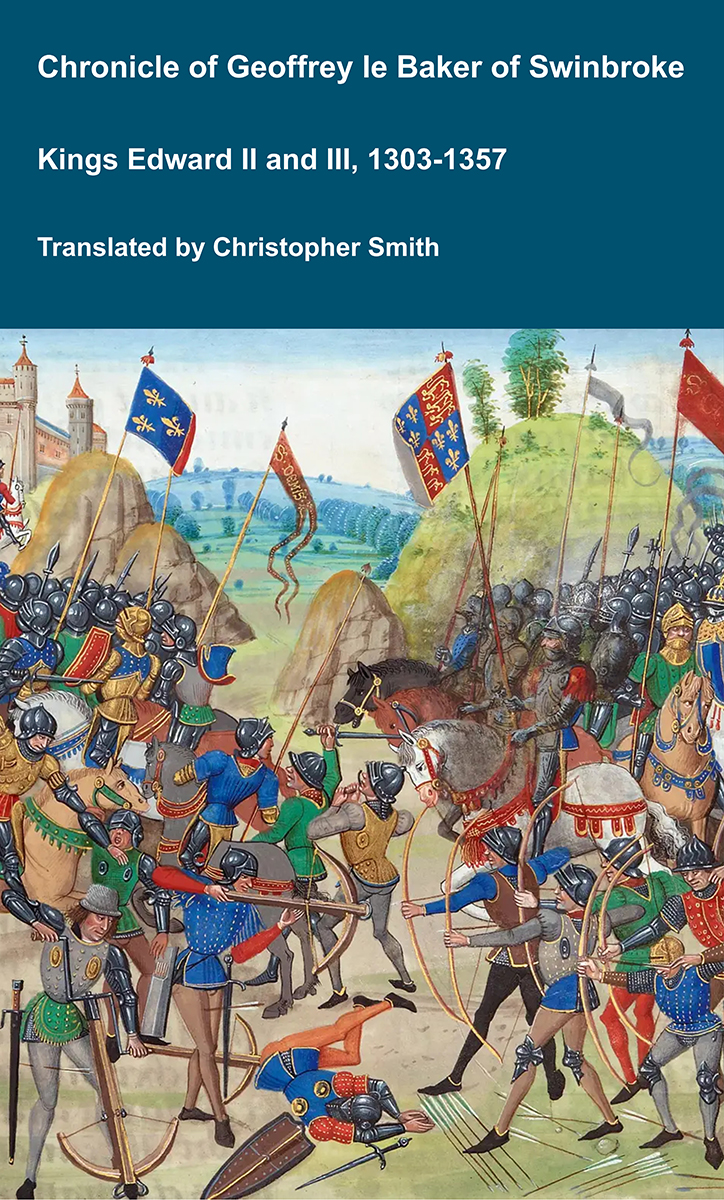
Chronicle of Geoffrey le Baker of Swinbroke
Baker was a secular clerk from Swinbroke, now Swinbrook, an Oxfordshire village two miles east of Burford. His Chronicle describes the events of the period 1303-1356: Gaveston, Bannockburn, Boroughbridge, the murder of King Edward II, the Scottish Wars, Sluys, Crécy, the Black Death, Winchelsea and Poitiers. To quote Herbert Bruce 'it possesses a vigorous and characteristic style, and its value for particular events between 1303 and 1356 has been recognised by its editor and by subsequent writers'. The book provides remarkable detail about the events it describes. Baker's text has been augmented with hundreds of notes, including extracts from other contemporary chronicles, such as the Annales Londonienses, Annales Paulini, Murimuth, Lanercost, Avesbury, Guisborough and Froissart to enrich the reader's understanding. The translation takes as its source the 'Chronicon Galfridi le Baker de Swynebroke' published in 1889, edited by Edward Maunde Thompson.
Available at Amazon in eBook and Paperback format.
Minutes of the Society of Antiquaries of London 1718 is in Minutes of the Society of Antiquaries of London.

5th February 1718. It was proposed for the first time by Mr President Norroy [aged 57] to engrave a drawing of Richard II's picture in Westminster Abbey taken by Mr Talmans [aged 40] direction agreed to.
Mr George Holmes [aged 56] is to do [?] to keep the books belonging to the Society till further order.
12th February 1718. Mr Samuel Gale [aged 35] Treasurer is authorized to pay Mr Vertue [aged 34] two guineas toward engraving the font of St James church. It is proposed for the second time to engrave RII'd's picture and agreed.
19th February 1718. It is proposed and agreed the 3rd time to engrave RII picture in Westminster Abbey and Mr Director Talman [aged 40] is desired and authorised to have a drawing tken of it with all convenient speed, in order thereto.
26th February 1718. A petition was offered by Mr President [aged 57] of Mr John Spoll[?], [?] seeking to be employed by the Society as a Messenger or transcriber of any English and Latin Papers, which was agreed to when there shall be occasion for any thing of that kind.
5th March 1718. It was ordered by the Society that all Members to be admitted into the same, be balloted for, and that a Balloting Box be prepared for that purpose.
23rd April 1718. It was unanimously order that a drawing of a horn presented to the Church of York [Map] by Ulphus Prince of Deira, in possession of Mr Samuel Gale be printed. (the first time).
7th May 1718. Bought by the Society the Portrait of Edwrd the Third for a Guinea which Mr Treasurer [aged 35] is ordered to pay.
Mr Bostue had the Drawing of Richard II delivered to him by Mr Director [aged 40] in order for engraving, for which he is to be paid Twenty Guineas. Mr Director [?] gives the use of the Drawing to the Society.
In order to defray the expenses, it is found necessary to raise a voluntary Subscription of Seven Shillings and Six Pence aa [?] of as many [?], for which they [?] the equivalent in prints of the same when finished.
Mr Vertue [aged 34] gives the Copper Plate, he is to be paid five Guineas down, five guineas when half finished, and the rest uponm delivery.
In the margin: Pictures of Henry VII and Eliza: his wife
Bought by the Society of Dr Stukeley [aged 30], Secretary, an old picture of Elizabeth wife of Harry VII for £12 0s 6d which Mr Tresurer is order to pay.
Bought by the Society an old picture of Henry VII for £1 0s 4d which Mr Treasurer is ordered to pay to Mr Norroy [aged 57].

14th May 1718. Mr Borkol [?] informed us his trees in Dean's Yard, Westminster were planted by Dr Feckenham last Abbot of Westminster.
Mr Gosling presented each Member with a print from his two Plates of Lord Bacon, for which thanks of the Society are returned to him, and Mr Director [aged 40] is ordered to present him with a couple of prints of St James' Font in their names.
Mr President [aged 57] exhibited a curious ancient deed, dated MCLXXVI [1426] 22:H:II being a Pacification between the Abbot of Canterbury and the men of the Isle of Thanet whereto are 124 witnesses cum pluribus alus[?] [with more]. Tis printed in the Dorom Scriptures into Chronica [?] p 1827. Edit 1652 but without the Witnesses.
The Secretary [aged 30] read a letter which gives an Account of a fine font in Ely Cathedral [Map], vast numbers of beautiful and with other monuments there, some pretty ancient. Opposite the door of the North Cross Isle, the pictures of the Archbishop of York, the Earl of Northumberland, and [?] other Bps [Bishops] who held out the Town against William the Conq. They are very ancient and pretty entire.
21st May 1718. Mr Alexander gave an account of an Ancient Gold Ring found at Bridewell [Map] in digging under a foundation tis a quarter of an inch broad enamelled.
Mr President [aged 57] produced an old Parliament deed dated about MCCXX [1220] sealed with the seal of the Abby of Tame, whose Abbot is an Arbitrator in a Cause between the Abbot of St Nicholas of Biddlesden [Map] and the Abbot of Oseney where he observes tis the only instance of Cistercian Order (Great Admirers of the Virgin Mary) of which the Abbot of Biddlesden was being dedicate to any other Saints.

4th June 1718. Mr Mirkleton [?] showed the Society a picture he has of William Earl of Pembroke, an other of an Earl of Essex.
Mr Warkhouse exhibited an old parchment deed with many seals to it being a Letter of Authority to grant livery and seizin to Sir Thomas Erpingham [Possibly Thomas Erpingham] of an Hospital lately called Berneys Inn in Norwich 10 H.III and likewise two Latin Letters from Abraham Wheeler to his patron Alderman Adams.
12th June 1718. Mr Samuel Gale [aged 35] presented to the Society a print of the Ground Plot and Prospect of Hull by Holler, for which their thanks and ordered to be returned to him.
He likewise brought a letter from the Reverend Dr Knight a Member of the Society containing an account of a large skeleton found near Chippenham, Cambs, with massey [?] chains and fetters, dug up near him and some penates dug up at Devizes.
Mr President [aged 57] being obliged to be in the country for the summer season was pleased to propose for Vice-President during his absence, Mr George Holmes [aged 56] which was unamimously approved of by the Society.

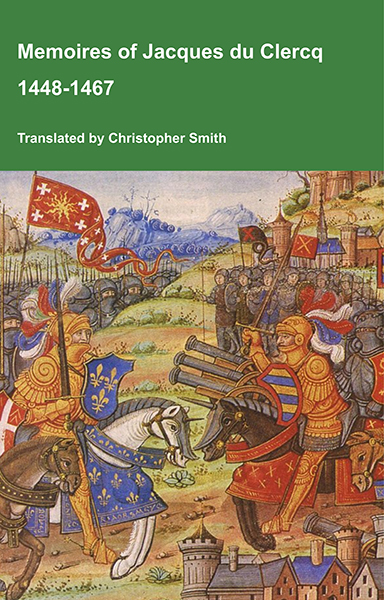
This is a translation of the 'Memoires of Jacques du Clercq', published in 1823 in two volumes, edited by Frederic, Baron de Reissenberg. In his introduction Reissenberg writes: 'Jacques du Clercq tells us that he was born in 1424, and that he was a licentiate in law and a counsellor to Philip the Good, Duke of Burgundy, in the castellany of Douai, Lille, and Orchies. It appears that he established his residence at Arras. In 1446, he married the daughter of Baldwin de la Lacherie, a gentleman who lived in Lille. We read in the fifth book of his Memoirs that his father, also named Jacques du Clercq, had married a lady of the Le Camelin family, from Compiègne. His ancestors, always attached to the counts of Flanders, had constantly served them, whether in their councils or in their armies.' The Memoires cover a period of nineteen years beginning in in 1448, ending in in 1467. It appears that the author had intended to extend the Memoirs beyond that date; no doubt illness or death prevented him from carrying out this plan. As Reissenberg writes the 'merit of this work lies in the simplicity of its narrative, in its tone of good faith, and in a certain air of frankness which naturally wins the reader’s confidence.' Du Clercq ranges from events of national and international importance, including events of the Wars of the Roses in England, to simple, everyday local events such as marriages, robberies, murders, trials and deaths, including that of his own father in Book 5; one of his last entries.
Available at Amazon in eBook and Paperback format.
13th August 1718. Mr Holmes Vice-President [aged 56] brought to the Society two curious antique Roman vessels of fine earth.
Mr Rawlinson brought two [?] prints with descriptions being old pictures, one of the Court of Charles V, the other of Joan of Bourbon. Specimens of ancient [?] paintings in one large sheet of paper. Jollain excidit [?].
27th August 1718. Dr Sukeley [aged 30] brought a brass Roman Lingula or Spoon, found at Reculver [Map] in Kent given him by Mr Anthony Knightly, Druggist in Newgate Street, whose father took it up.
11th November 1718. Mr Le Neve President [aged 57] exhibited to the Society a drawing of of the West View of the Abbey Gates of St Bennetts in the Holme [Map] in Norfolk, another view of the East side of the same, a view of the Gatehouse of the Lord Scales Palace at Middleton.

13th November 1718. Mr Norroy [aged 57] brought us an old roll in Parchment of the Blazon of the Coats of Aarms of all the County of Norfolk in the time of Henry VII said to be done by the Botton[?] herald to Sir John Falstaff. An old deed upon parchment of Edward the Confessor, a piece of great antiquity. Its a donation of a Mannor [Manor] in Great Swell [Map] in Gloucestershire to the Abby of Evesham [Map]. Likewise two curious old books of seals of the nobility, with many ancient deeds, &c.
26th November 1718. Mr Norroy [aged 57] amongst many other curious old deeds with seals to them, brought us the original decree of the University of Bonomia [Note. This reference to 'Bonomia' is obscure. Possibly an earl name for Trinity College, Cambridge University [Map] which was founded in 1546 by King Henry VIII of England and Ireland] against the Popes Authority for dispensing with the Marriage of Henry VIII and Queen Catherine, with the seal to it, and likewise a transcript of the Doomsday Book for Surrey, in the original hand and method.

10th December 1718. Mr Norroy [aged 57] brought us an old deed of Isabella de Fortibus with a Seal, where her Arms are impaled with those of her husband very remarkably thus.
And Roger Gale [aged 45] Esq brought an Inscription to be put upon the plate of Richard II with a very judicious disertation upon the date and painting of the same being in oil colours, for which he had the thanks of the Society.
10th December 1718. Mr James Hill brought a vast Collection of Drawings, views, Inscriptions, Ground Plots, and Observations in manuscripts, the Fruits of his Travels this summer in the west of England, well worthy of his judgement and skill in Antiquity, Diligence and Accuracy for which he had the deserved thanks of the Society, to which he is so considerable an Ornament.
24th December 1718. Mr Vertue [aged 34] brought a proof of the Plate of Richard II which had the initial approbation of the Society and their thanks for his Care and Accuracy therein and Mr Treasurer [aged 36] was ordered to pay him five Guineas more in part of this Agreement for Engraving.
Mr Vice-President [aged 56] by the [?] of the Society ordered Mr Director [aged 41] to provide us a Box to lay up the Books in.
Mr Samuel Gale brough several Antique Roman Vessels dug up at Port Mahon, and likewise as Treasurer exhibited where it appears he has [?] in Money upon Amount £29:04:06 and has paid £22:4:4. So remains in his hands £07:00:02.

31st December 1718. Mr Samuel Gale brough a large and accurate Discourse upon the Horn of Ulphus given to the Church of York which is Engraven in Copper by the Society, for which the thanks of the Society is Unanimously given to him, it being read over. A Latin Inscription to be put under the New Plate of Rich: II was read over and approved by the Society.