

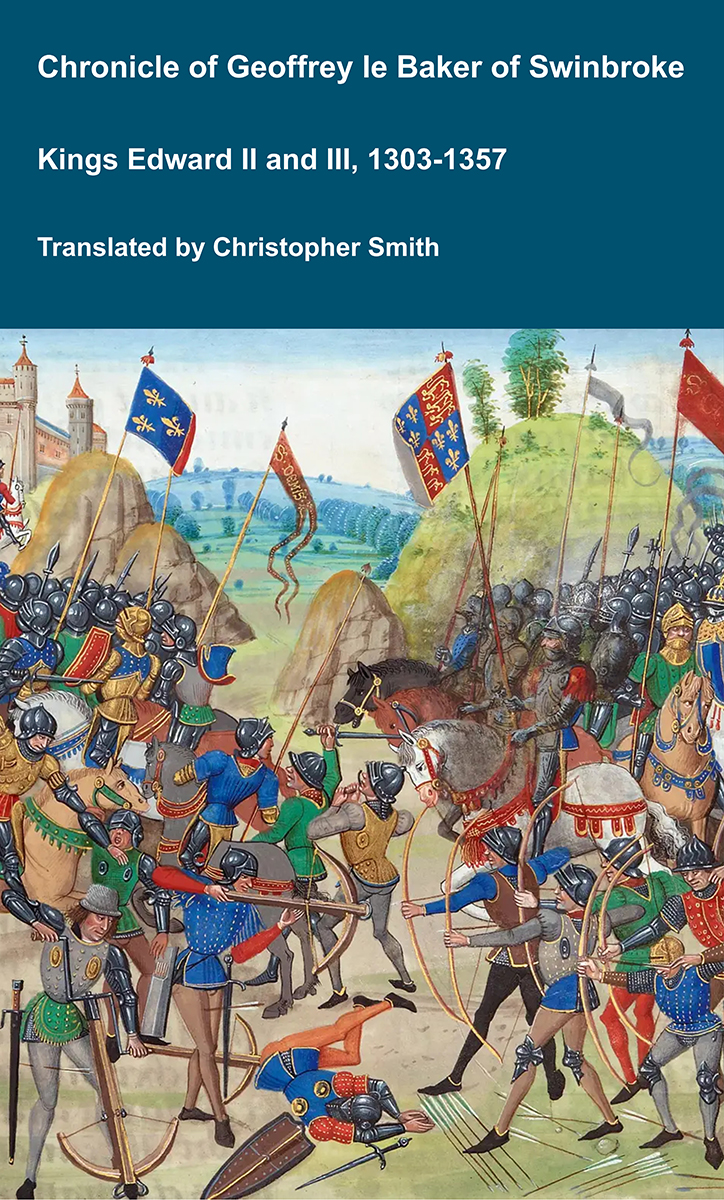
Chronicle of Geoffrey le Baker of Swinbroke
Baker was a secular clerk from Swinbroke, now Swinbrook, an Oxfordshire village two miles east of Burford. His Chronicle describes the events of the period 1303-1356: Gaveston, Bannockburn, Boroughbridge, the murder of King Edward II, the Scottish Wars, Sluys, Crécy, the Black Death, Winchelsea and Poitiers. To quote Herbert Bruce 'it possesses a vigorous and characteristic style, and its value for particular events between 1303 and 1356 has been recognised by its editor and by subsequent writers'. The book provides remarkable detail about the events it describes. Baker's text has been augmented with hundreds of notes, including extracts from other contemporary chronicles, such as the Annales Londonienses, Annales Paulini, Murimuth, Lanercost, Avesbury, Guisborough and Froissart to enrich the reader's understanding. The translation takes as its source the 'Chronicon Galfridi le Baker de Swynebroke' published in 1889, edited by Edward Maunde Thompson.
Available at Amazon in eBook and Paperback format.
Paston Letters is in Letters.
19th January 1454. 2.235. Newsletter Of John Stodeley1.
As touchyng tythynges, please it you to wite that at the Princes2 comyng to Wyndesore, the Duc of Buk' [aged 51] toke hym in his armes and presented hym to the Kyng in godely wise, besechyng the Kyng to blisse hym; and the Kyng yave no maner answere. Natheless the Duk abode stille with the Prince by the Kyng; and whan he coude no maner answere have, the Queene come in, and toke the Prince in hir armes and presented hym in like forme as the Duke had done, desiryng that he shuld blisse it; but alle their labour was in veyne, for they departed thens without any answere or countenaunce savyng only that ones he loked on the Prince and caste doune his eyene ayen, without any more.
Item, the Cardinalle [aged 74]3 hathe charged and commaunded alle his servauntz to be redy with bowe and arwes, swerd and bokeler, crossebowes, and alle other habillementes of werre, suche as thei kun medle with to awaite upon the saufgarde of his persone.
Item, th'erle of Wiltshire [aged 33]4 and the Lord Bonvile [aged 61] have done to be cryed at Taunton in Somerset shire, that every man that is likly and wole go with theym and serve theym, shalle have vjd. every day as long as he abidethe with theym.
Item, the Duk of Excestre [aged 23]5 in his owne persone hathe ben at Tuxforthe beside Dancastre, in the north contree, and there the Lord Egremond [aged 31]6 mette hym, and thei ij. ben sworne togider, and the Duke is come home agein.
Item, th'erle of Wiltshire, the Lord Beaumont, Ponynges, Clyfford, Egremond, and Bonvyle, maken all the puissance they kan and may to come hider with theym.
Item, Thorpe7 of th'escheker articuleth fast ayenst the Duke of York, but what his articles ben it is yit unknowen.
Item, Tresham [aged 34]8, Josep9, Danyelle10, and Trevilian11 have made a bille to the Lordes, desiryng to have a garisone kept at Wyndesore for the saufgarde of the Kyng and of the Prince, and that they may have money for wages of theym and other that shulle kepe the garyson.
Item, the Duc of Buk' hathe do to be made Ml. Ml. [2000] bendes with knottes, to what entent men may construe as their wittes wole yeve theym.
Item, the Duke of Somersetes herbergeour hath taken up all the loggyng that may be goten nere the Toure, in Thamystrete, Martlane, Seint Katerines, Tourehille, and there aboute.
Item, the Queene hathe made a bille of five articles, desiryng those articles to be graunted; wherof the first is that she desireth to have the hole reule of this land; the second is that she may make the Chaunceller, the Tresorere, the Prive Seelle, and alle other officers of this land, with shireves and alle other officers that the Kyng shuld make; the third is, that she may yeve alle the bisshopriches of this land, and alle other benefices longyng to the Kynges yift; the iiijth is that she may have suffisant lyvelode assigned hir for the Kyng and the Prince and hir self. But as for the vth article, I kan nat yit knowe what it is.
Note 1. [Egerton MS. 914, B.M.] There is no evidence that this letter had anything to do with the Paston correspondence, but as a very interesting political letter of the period we have thought it right to give it a place in the collection. The date is quite certain, being after the birth of Prince Edward in October 1453, and before the death of Cardinal Kemp in March 1454.
Note 2. Edward, only son of Henry VI. [aged 32], born 13th October 1453.
Note 3. John Kemp, Cardinal Archbishop of Canterbury.
Note 4. James Butler, Earl of Wiltshire and Ormond.
Note 5. Henry Holland.
Note 6. Thomas Percy, third son of Henry, Earl of Northumberland [aged 60].
Note 7. Thomas Thorpe, one of the Barons of the Exchequer, who was also Speaker of the House of Commons, but was at this time imprisoned in the Fleet in consequence of an action brought against him by the Duke of York.—(See Rolls of Parl. v. 239.)
Note 8. Thomas Tresham, who as 'Sir Thomas Tresham, Knight,' was attainted under Edward IV. for fighting on the Lancastrian side at Towton, but his attainder was afterwards reversed in Parliament 7 and 8 Edw. IV., on the ground that he was a household servant of Henry VI. and had been brought up in his service from a child.—Rolls of Parl. v. 616–617.
Note 9. William Joseph, who, with Thorpe, was frequently accused by the Yorkists of misleading the King.—Rolls of Parl. v. 280, 282, 332, 342.
Note 10. Thomas Daniel, Esq.—See p. 255, Note 2.
 Become a Member via our Buy Me a Coffee page to read more.
Edmund Clere To John Paston1
To my welbeloved cosyn, John Paston, be this delivered. 9th January 1455.
Right welbeloved cosyn, I recomaund me to you, latyng you wite such tidings as we have.
Blessed be God, the Kyng is wel amended, and hath ben syn Cristemesday, and on Seint Jones day 27th December 1454 comaunded his awmener [almoner] to ride to Caunterbury wyth his offryng, and comaunded the secretarie to offre at Seint Edwards.
And on the Moneday after noon the Queen came to him, and brought my Lord Prynce with her. And then he askid what the Princes name was, and the Queen told him Edward; and than he hild up his hands and thankid God therof. And he seid he never knew til that tyme, nor wist not what was seid to him, nor wist not where he had be whils he hath be seke til now. And he askid who was godfaders, and the Queen told him, and he was wel apaid.
And she told him that the Cardinal was dede, and he seid he knew never therof til that tyme; and he seid oon of the wisist Lords in this land was dede.
And my Lord of Wynchestr [aged 57] and my Lord of Seint Jones were with him on the morow after Tweltheday, and he speke to hem as well as ever he did; and when thei come out thei wept for joye.
And he seith he is in charitee with all the world, and so he wold all the Lords were. And now he seith matyns of Our Lady and evesong, and herith his Masse devoutly; and Richard shall tell yow more tidings by mouth.
I pray yow recomaund me to my Lady Morley, and to Maister Prior2, and to my Lady Felbrigge3, and to my Lady Hevenyngham4, and to my cosyn your moder, and to my cosyn your wife.
Wreten at Grenewich on Thursday after Twelftheday. Be your cosyn, Edmund C.
Note 1. [From Fenn, i. 80.] There is no doubt about the date of this letter. The King fell ill at Clarendon in the autumn of 1453, and remained in a state of utter imbecility during the greater part of the year 1454, so that in March a deputation from the House of Peers, sent to communicate with him on the death of his Chancellor, Cardinal Kemp, was obliged to report that they had been utterly unable to obtain from him any answer or sign that he understood the least thing said to him. It appears from this letter that his recovery was about Christmas, when he heard for the first time of the birth of his son fourteen months before, and of the death of Cardinal Kemp nine months before.
Note 2. Probably the Prior of Bromholm.
Note 3. Catherine, widow of Sir Simon Felbrigg. She was the daughter of Anketill Mallory, Esq. of Winwick, in Northamptonshire.
Note 4. Sir John Heveningham married Elizabeth [aged 55], daughter of Sir John Reedesham. Unless he married a second time, this Elizabeth was now his widow. Their son, also John [aged 18], married Alice Savile [aged 3] sometime before 1460.
Become a Member via our Buy Me a Coffee page to read more.
James Gresham To John Paston.48.1
To my right worshipfull maister, John Paston, at Norwiche, be this delyvred. 28th October 1455
Please it your maistership to wete48.2 ....
Here be many marvaylos tales of thynggs that shall falle this next moneth, as it is seyd; for it is talked that oon Doktor Grene, a preest, hath kalked [calculated ?] and reporteth, that by fore Seynt Andreu day next comyng shall be the grettest bataill that was sith the bataill of Shrewisbury,48.3 and it shall falle bytwene the Bisshoppes Inne of Salesbury and Westminster Barres, and there shall deye vij. Lords, whereof iij. shuld be bisshoppes. Althis and meche more is talked and reported. I trust to God it shall not falle so.
Also there is gret varyance bytwene the Erll of Devenshire and the Lord Bonvyle, as hath be many day, and meche debat is like to growe therby; for on Thursday at nyght last passed, the Erll of Denshyres sone and heir come with lx. men of armes to Radford's49.1 place in Devenshire, whiche was of counseil with my Lord Bonvyle; and they sette an hous on fyer at Radfords gate, and cryed and mad an noyse as though they had be sory for the fyer; and by that cause Radfords men set opyn the gats and yede owt to se the fyer; and for with th'erll sone forseid entred into the place and intreted Radford to come doun of his chambre to sp[e]ke with them, promyttyng hym that he shuld no bodyly harm have; up on whiche promysse he come doun, and spak with the seid Erll sone.
In the mene tyme his menye robbe his chambre, and ryfled his huches,49.2 and trussed suyche as they coude gete to gydder, and caryed it awey on his own hors. Thanne th'erll sone seid, 'Radford, thou must come to my lord my fadir.' He seid he wold, and bad oon of his men make redy his hors to ride with hem, whiche answerd hym that alle his hors wern take awey; thanne he seid to th'erll sone, 'Sir, your men have robbed my chambre, and thei have myn hors, that I may not ride with you to my lord your fadir, wherfor, I pray you, lete me ride, for I am old, and may not go.'
It was answerid hym ageyn, that he shuld walke forth with them on his feete; and so he dede till he was a flyte49.3 shote or more from his place, and thanne he was ..... softly, for cawse he myght not go fast. And whanne thei were thus departed, he turned .... oon; forwith come ix. men ageyn up on hym, and smot hym in the hed, and fellid .... of them kyt his throte.
This was told to my Lord Chaunceler49.4 this fornoon .... messengers as come of purpos owt of the same cuntre. This matier is take gretly .... passed at ij. after mydnyght rod owt of London, as it is seid, more thanne .... the best wyse. Summe seyne it was to ride toward my Lord of York, and summe .... k, so meche rumor is here; what it menyth I wot not, God turne it .... at Hertford,50.1 and summe men ar a ferd that he [King Henry VI of England and II of France [aged 33]] is seek ageyn. I pray God .... my Lords of York, Warwyk, Salesbury and other arn in purpos to conveye hym ....... &c. The seid N. Crome, berer her of, shall telle you suche tydynggs ....... in hast, at London, on Seint Simon day and Jude.Yowr poerJ. Gr.
Note 48.1. [From Fenn, i. 114.] This letter was written in 1455, at the time of the King's second attack of illness, which happened while he was under the control of the Duke of York and the Earls of Warwick and Salisbury, as mentioned at the end of the letter. In the latter part of the letter some words are lost by the decay of the original MS.
Note 48.2. Here, says Fenn, follows an account of some law business, etc.
Note 48.3. Fought in 1403 between King Henry IV. and the rebel Percies.
Note 49.1. 'Nicolas Radford,' says Fenn in a note, 'was an eminent lawyer, and resided at Poghill, near Kyrton.' In Pole's Description of Devonshire, p. 219, we find that one Nicolas Radford dwelled at Upcot in Henry VI's time, 'after whose death controversy arose betwixt John Radford of Okeford and Thomazin, sister of the said Nicholas,' who had married Roger Prous.
Note 49.2. A hutch was a coffer or chest standing on legs.
Note 49.3. A flight was 'a light arrow formed for very long and straight shots.'—Halliwell.
Note 49.4. Archbishop Bourchier.
Note 50.1. The King was at Hertford, as appears by the Privy Seals, in August and September 1455, and not improbably in October also.
Become a Member via our Buy Me a Coffee page to read more.
9th February 1456. John Bocking To Sir John Fastolf1.
To the right reverent and worshipful Sir, and my right good maister, my maister Sir John Fastolf, at Castre.
Right reverent and my right worshipful maister, I recomaunde me to yow in my right humble wise. Please hit your right good maistership to wyte that on Sonday laste I sent yow many and divers lettres and writynges, by Lampet, of all matiers that I hadde knowlege at that tyme redy to answere. And now suche tidinges as ar here, but fewe that ar straunge, excepte that this day my Lordes York and Warwik comen to the Parlement in a good aray, to the noumbre of iijc. [300] men, all jakkid2 and in brigantiens3, and noo lord elles, wherof many men mervailed. It was seid on Saterday my Lord shuld have ben discharged this same day. And this day was seide, but if he hadde come stronge, he shuld have bene distrussid; and no man knoweth or can sey that ony prefe may be hadde by whom, for men thinken verily there is no man able to take ony suche enterprinse.
The Kyng, as it was tolde me by a grete man, wolde have hym chief and princepall counceller, and soo to be called hise chef counceller and lieutenant as longe as hit shuld lyke the Kyng; and hise patent to be made in that forme, and not soo large as it is by Parlement. But soome men thinken it wil ner can otherwise bee; and men speke and devyne moche matere of the comyng this day in suche array to Westminster. And the Lordes speken this day in the Parlement of a greet gleymyng sterre that but late hathe be seen diverse tymes, merveilous in apperyng. The resumpsion, men truste, shall forthe, and my Lordes of Yorkes first power of protectorship stande, and elles not, &c. The Quene [aged 25] is a grete and strong labourid woman, for she spareth noo peyne to sue hire thinges to an intent and conclusion to hir power.
I have seid to the bringer here of more to declare yow alle a longe. And as for hise comyng, ye like to understande that your nevew, my Maister Filongley, hathe laboured and doon that he cowde or myght to hise preferraunce; but as for to make hym freman and at hise ease, to hise profite and worship, it can not bee with owte William Lyne be here, that boughte hise prentishode of his maister, to hise grete hurte and castyng of bakke by ij. or iij. yere of tyme loste; and ne were it that the maister and wardeyns of the Taillours tendre hym, be cause of yow and of Fynynglee, hise firste maister, that solde hym to William Lyne, as weel as the seide Lyne and Richard, shuld alle lese ther fredoms, as ye shall more pleinly understande by the reporte of the seid Richard, &c.
This day was my Lord Devenshire at Westminstre, and shuld have apperid, but he was countermaundid. As to youre matier of Wentworthe, the trety contynueth, and is putte by the arbitrours in Fortescu and Yelverton, and we have day of newe til Friday come sevenyght. God graunte it take a good ende. The lawe is with us clerly, as weel in th'atteynte as therinne as yette, blessid be our Lord, hoo have you in hise most noble governaunce.
Written in your place this Moneday of Fastyngange4, ml. cccclv.Your humble servaunt, J. B.
And that ye like to write a good lettre for Richard Fastolf to Sir Roger Chamberleyn, and to Thornton, Chamberleyn of London, and to both of hem, &c.
Note 1. [From MS. Phillipps, 9735, No. 265.]
Note 2. i.e. in coats of mail.—See vol. ii. p. 322, Note 3.
Note 3. See vol. ii. p. 155, Note 2.
Note 4. Fastingong was Shrovetide.—See vol. ii. p. 131, Note 1.
Become a Member via our Buy Me a Coffee page to read more.
23rd January 1461. 3.430. Clement Paston To John Paston
To hys rythe worchypfwll broder, John Paston.
Rythe reverent and worchypfwl broder, I recomawnde to yow, certyfyyng yow that yowr letter was delyveryd to me the xxiii. day of Januar abowthe none seasson, and Rychard Calle rode in the mornyng, and therfor I brak [opened] yowr letter, if ther wer any aftr mater; and I dede Christofer Hauswan goo to my Lord of Cawnterbure2 to tell him, as yowr letter rehersyd, and my Lord seyd he hadde spokyn with yowr man ther of the day be fore, and if the Byshop of Norwyche wod not doo so mwche for him, he hys the les behold to him. Notwithstandyng, he sayd, he wold save yow harmles agens John Yowng; but and ye do well remember thys Lord have many maters to thynge on, and if it be forgeten, the harm is yowrs, and also if the word [world] torn, John Yong will not doo at hys prayer.
And my Lord Fitzwater [aged 35]3 is ryden northewards, and it is sayd in my Lord of Cawnterberys howse that he hethe takyn ijc. [200] of Andrew Troloppys4 men. And as for Colt,5 and Sir Jamys Strangwysse, and Sir Thomas Pykeryng, they be takyn or ellys dede. The comyn voysse is that they be de dede. Hopton6 and Hastyngs7 be with the Erle of Marche, and wer no at the fewlde.8 Wat word that ever he have fro my Lords that be here, it is well doo, and best for yow, to see that the contre be allweys redy to come bothe fote men and hors men, qwen they be sent for; for I have herd seyde the ferthere Lords will be here soner that men wen, I have arde sayde, er iij. weks to an ende; and also that ye xwld come with more men, and clenlier arayed than anoder man of yowr cwntre xwld, for it ly the more up on yowr worchyp, and towcheythe yow more nere than odermen of that cwntre, and also ye be mor had in favour with my Lords here. In this cwntre every man is well wyllyng to goo with my Lords here, and I hope God xall helpe hem, for the pepill in the northe robbe and styll, and ben apoyntyd to pill all thys cwntre, and gyffe a way menys goods and lufflods in all the sowthe cwntre, and that wyll ask a myscheffe. My Lords that ben here have as moche as they may do to kep down all thys cwntre more than iiij. or v. schers, for they wold be up on the men in northe, for it ys for the welle of all the sowthe.
I pray yow recomawnde me to my moder, and that I prayed her of her blyssyng. I pray yow exscwse me to her that I wryte her no letter, for thys was y now a doo. I dare not pray yow to recomawnde me to my swster yowr wyff, and the masenger I trow be so wysse he can not doyt. Ye mwst pay him for hys labor, for he taryd all nyt in thys town for thys letter.
Wrytyn the xxiij. day of Janware in haste, wan I was not well at hesse. God have [you] in Hys keping.
By Clement Paston, Yowr broder.
Note 1. [From Fenn, i. 202.] This letter appears to have been written after the battle of Wakefield, when the victorious army, led on by Margaret of Anjou, was marching southwards.
Note 2, Archbishop Bourchier.
Note 3, Sir John Radcliff of Attleborough, styled Lord Fitzwalter in right of his wife [Elizabeth Fitzwalter Baroness Dinham 8th Baroness Fitzwalter [aged 30]], only daughter and heiress of Walter Fitzwalter, seventh lord. This John was at the battle of Ferrybridge on the 29th March 1461, and died, probably of his wounds, on the 6th April following.—See G. E. C.'s Complete Peerage.
Note 4. Andrew Trollope, whose desertion of the Duke of York at Ludlow in 1459 caused the dispersion of the Yorkist leaders. He was killed at the battle of Towton in March 1461, fighting on the Lancastrian side.
Note 5. Thomas Colt.—See Rolls of Parliament, v. 348.
Note 6. Walter Hopton.—See Rolls of Parliament, v. 368.
Note 7. William, son of Sir Leonard Hastings.—See Rolls of Parliament, ib.
Note 8. The battle of Wakefield.
4th April 1461. 3.450. William Paston and John Playters to John Paston [aged 39].
To my maister, John Paston, in hast,
Please you to knowe and wete of suche tydyngs as my Lady of York hath by a lettre of credens, under the signe manuel of oure Soverayn Lord King Edward, whiche lettre cam un to oure sayd Lady this same day, Esterne Evyn, at xj. clok, and was sene and red by me, William Paston.
Fyrst, oure Soverayn Lord [aged 18] hath wonne the feld, and uppon the Munday next after Palmesunday, he was resseved in to York with gret solempnyte and processyons. And the Mair the Yorkist cause and Comons of the said cite mad ther menys to have grace be Lord Montagu [aged 30] and Lord Barenars [aged 45], whiche be for the Kyngs coming in to the said cite desyred hym of grace for the said cite, whiche graunted hem grace. On the Kyngs parte is slayn Lord Fitz Water [deceased], and Lord Scrop [aged 23] sore hurt; John Stafford, Horne of Kent ben ded; and Umfrey Stafford, William Hastyngs [aged 30] mad knyghts with other; Blont is knygth, &c.
On the contrary part is ded Lord Clyfford [deceased], Lord Nevyle [deceased], Lord Welles [deceased], Lord Wyllouby, Antony Lord Scales, Lord Harry, and be supposyng the Erle of Northumberland, Andrew Trollop, with many other gentyll and comons to the nomber of xx.ml. (20000).
Item, Kyng Harry, the Qwen, the Prince, Duke of Somerset, Duke of Exeter, Lord Roos, be fledde in to Scotteland, and they be chased and folwed, &c. We send no er un to you be cause we had non certynges tyl now; for un to this day London was as sory cite as myght. And because Spordauns had no certeyn tydyngs, we thought ye schuld take them a worthe tyl more certayn.
Item, Thorp Waterfeld is yeldyn, as Spordauns can telle you. And Jesu spede you. We pray you that this tydyngs my moder may knowe.
Be your Broder,
W. Paston.
T. Playters.
Note 1. 'On a piece of paper pinned to the above letter,' says Fenn, 'is a list of the 268 names of the noblemen and knights, and the number of soldiers slain at the above battle of Towton, as follows:
Comes Northumbriæ [deceased].
Comes Devon [deceased].
Dominus de Beamunde.
Dominus de Dacre [deceased].
Dominus Henricus de Bokyngham.
Dominus de Scales Antony Revers.
Dominus de Wellugby.
Dominus de Malley Radulfus Bigot Miles.
Millites.
Sir Rauff Gray.
Sir Ric. Jeney.
Sir Harry Bekingham.
Sir Andrew Trollop.
With xxviij.ml. (28000) nomberd by Harralds.
Become a Member via our Buy Me a Coffee page to read more.
18th April 1461. Thomas Playters To Master John Paston1
To my maister, John Paston, Esquyer.
Please your Maisterchep to wete, that I have spokyn with Essex, in the matter that ye wete of, and fynd him be his talkyng wel dysposed, not withstandyng he woll not falle to no conclusyon to engrose up the mater, tyll the chef baron be com to London, and that he be mad privy to the mater, which we loke after this same secund Saterday after Esterne; and as for Notyngham he is not yet comyn to London.
Item, as for tydyng, it is noysed and told for trouth of men of worchip, and other, that the Erle of Wylchyr is taken, Doctor Morton, and Doctor Makerell, and be brougth to the kyng at York. Maister William also spak with a man that sey hem.
Item, sir, I herd of Sir John Borceter and Christofer Hanson, that Herry the sext is in a place in York schire is calle Coroumbr; suche a name it hath, or muche lyke. And there is sege leyde abowte, and dyvers squyers of the Erle of Northumbrelands, and gadered them to geder, a v. or vj.ml. [five or six thousand] men, to byger [bicker] with the sege, that in the mene while Herry the sexte myght have ben stole a way at a lytyll posterne on the bak syde; at whiche byker ben slayn iij.ml. [3000] men of the North. Sir Robert of Ocle and Conyrs leyth the sege on our syde, and thei it is that have do this acte. Sum say the Qwen, Somerset and the Prince schuld be there. Item, it is talked now for trouthe, the Erle of Northumberland is ded. Item, the Erle of Devenshire is ded justely.
Item, my Lord Chaunceler is to York. Item, the King and the Lords com not here before Whitsontyde, as it is sayde. Item, sir, sone uppon the chef baron comyng I schall send you a lettre, with Godds grace, who preserve you, and have you in His blyssed kepyng.
Your, Thomas Playters.
At Cokermouthe was the Erle of Wylchire taken, and these other Doctors. Item, som men talke Lord Wellys, Lord Wyllouby, and Skales ben on lyve. Item, Sir Robert Veer is slayn in Cornewayll, as it is tok for trouthe.
Note 1. [From Fenn, i. 222.] This letter relates mainly to occurrences just after the battle of Towton in April 1461.
Become a Member via our Buy Me a Coffee page to read more.
Archaeologia Volume 47 1882 Section 16. He himself seems to have collected about the same time a force of some sort, Scots perhaps and Borderers, and to have got as far south again as Ryton and Brancepath,c in Durham, and indeed to have penetrated into Yorkshire, for, if we can trust Thomas Playter writing to John Paston on April 18, 1461, Henry was then besieged at a place in that county which he calls "Coroumbr, such a name it hath or muche lyke," the Queen and Prince Edward being reported to be with him.
Note c. Paston Letters, ed. Gairdner, 356.
1461. Thomas Playter To John Paston
To my right good maister, John Paston, in all hast.
After my most special recommendacion, please your maisterchip wete, the Kyng, be cause of the sege a boute Carelylle, chaunged his day of Coronacion to be upon the Sunday nexst after Seynt John Baptyste, so the'ntent to spede hym northward in all hast; and how be it, blyssed be God, that he hath now good tydynggs, that Lord Mountagu hath broken the sege, and slayn of Scotts vjml [6000] and ij. knyghes, whereof Lord Cliffords brother is one, yet not wythstandyng he wol be crowned the sayd Sunday. And John Jeney enformed me, and as I have verely lerned sethen, ye ar inbylled to be made knygth at this Coronacion.Wheder ye have understandyng before hand, I wot not; but and it lyke you to take the worchip uppon you, consyderyng the comfortable tytynggs afore seyd, and for the gladnesse and plesour of al your welwyllers, and to the pyne and dyscomfort of all your ille wyllers, it were tyme your gere necessarye on that by halfe were purveyd fore, and also ye had nede higth you to London, for as I conceyve the knygthes schuld be made uppon the Saterday by for the Coronacion; and as moche as may be purveyed for you in secrete wyse wythouten cost I schall by speke for you, if nede be, ayens your comyng, in trust of the best; neverthelesse, if ye be dysposed, ye had nede send a man by fore in all hast, that no thing be to seke. William Calthorp is inbylled, and Yelvertoun is inbylled, whiche caused Markham; because Yelverton loked to have ben chef juge, and Markham thynketh to plese hym thus. And as for the mater ayens Poutrell, we can no farther procede, tyl we have my maister your faders testament. I sent my maistres a letter for it. No more, but I pray Al myghty Jesu have you in His kepyng.
Your, Thomas Playter.
Become a Member via our Buy Me a Coffee page to read more.
30th August 1461. 3.480. Lord Hungerford and Robert Whityngham to Margaret Of Anjou1.
A la Reyne D'Engleterre [en] Escote.
Madam, please it yowr gode God, we have sith our comyng hider, writen to your Highnes thryes. The last we sent by Bruges, to be sent to you by the first vessell that went into Scotland; the oder ij. letters we sent from Depe, the ton by the Carvell in the whiche we came, and the oder in a noder vessell. But, ma dam, all was oon thyng in substance, of puttyng you in knolege of the Kyng your uncles2 deth, whom God assoyll, and howe we sta[ n ]de arest [arrestea], and doo yet; but on Tuysday next we trust and understande, we shall up to the Kyng, your cosyn germayn3. His Comyssaries, at the first of our tarrying, toke all our letters and writyngs, and bere theym up to the Kyng, levyng my Lord of Somerset in kepyng atte Castell of Arkes4, and my felowe Whityngham and me, for we had sauff conduct, in the town of Depe, where we ar yete. But on Tyysday next we understand, that it pleaseth the said Kyngs Highnes that we shall come to hys presence, and ar charged to bring us up, Monsieur de Cressell, no we BailIyf of Canse, and Monsieur de la Mot.
Ma dam, ferth [ftar] you not, but be of gode comfort, and beware that ye aventure not your person, ne my Lord the Prynce,5 by the See, till ye have oder word from us, in less than your person cannot be sure there as ye ar, [and] that extreme necessite dryfe you thens; and for God sake the K yngs Highnes be advysed the same. For as we be enformed, Th' erll of March6 is into Wales by land, and hath sent his navy thider by see; and, Ma dame, thynketh verily, we shall not soner be delyvered, but that we woll come streght to you, withaut deth take us by the wey, the which we trust he woll not, till we see the Kyng and you peissible ayene in your Reame; the which we besech God soon to see, and to sen you that your Highnes. desireth. Writen at Depe the xxx tl dey of August. Your true Subgettes and Liege men.
Hungerford. Whityngham.
At the bottom of the Copy of the Letter is added:
Theese ar the names of those men that ar in Scotland with the Qyene. The Kyng Herry is at Kirkhowbre with iiij. men and a childe.
Quene Margaret is at Edenburgh and hir son.
The Lord Roos [aged 33] and his son.
John Ormond, Sir Edmund Hampden, William Taylboys, Sir Henry Roos, Sir John Fortescu, John Courteney, Sir Thomas Fyndern, Myrfyn of Kent, Waynesford of London, Dauson, Thomas Thompson of Guynes, Thomas Burnby, Borret of Sussex. Thomas Brampton of Guynes, Sir John Welpdalle, Mr. Roger Clerk, of London, John Audeley of Guynes, John Retford, late Coubitt, Langheyn of Irland. Giles Senctlowe, Thomas Philip of G[i]ppeswich, John Hawt.
Note 1. [From Fenn, i. 246.] That this letter was written in the year 1461 is sufficiently evident from its contents. The MS. from which it was printed by Fenn was a copy in the handwriting of Henry Windsor, and was manifestly the enclosure referred to in his letter No. 483. It bore the same paper-mark as that letter.
Note 2. Charles VII of France. He died on the 22nd July 1461.
Note 3. Lewis Xl, son of Charles VII.
Note 4. Arques, in Normandy, south of Dieppe.
Note 5. Edward, son of Henry VI.
Note 6. Edward IV, whom the Lancastrians did not yet recognise as king.
Become a Member via our Buy Me a Coffee page to read more.
1st November 1462. John Paston, Junior, To His Father1
To my ryth reverent and worchepfull fadyr, John Paston, be thys delyveryd in hast.
Ryth reverent and worchepfull fadyr, I recomand me on to yow, beseechyng yow lowly of your blyssyng. Plesyt you to have knowlage that my Lord2 is purposyd to send for my Lady, and is lyke to kepe his Crystmas here in Walys, for the Kyng hathe desyered hym to do the same. Wherfor I beseche yow that [ye] wole wychesave to send me sume mony by the berer herof; for, in good feythe, as it is not on knowyng to yow that I had but ij. noblys in my purse, whyche that Rychard Call took me by your comandement, when I departyd from yow owt of Norwyche. The berer herof schuld bye me a gowne with pert of the mony, if it plese yow to delyver hym as myche mony as he may bye it with; for I have but on gowne at Framyngham and an other here, and that is my levere gowne, and we must were hem every day for the mor part, and one gowne withowt change wyll sone be done.
As for tydyngs, my Lord of Warwyk yed forward in to Scotland as on Saterday [30th October 1462] last past with xx.ml. [20,000] men; and Syr Wylliam Tunstale is tak with the garyson of Bamborowth, and is lyke to be hedyd, and by the menys of Sir Rychard Tunstale3 is owne brodyr.
As sone as I here any more tydyngys, I schall send hem yow by the grace of God, who have yow in Hys kepyng. Wretyn in hast, at the Castle of the Holte [Map], upon Halowmas Daye.
Your sone and lowly servaunt,
J. Paston, Junior.
Note 1. [From Fenn, i. 266.] In the month of October 1462, as we learn from
William Worcester, Margaret of Anjou came out of France, whither she had fled in spring, with a force of 2000 men, landed on the coast of Northumberland, and laid siege to Bamborough, which she took and placed in the keeping of the Duke of Somerset.
Note 2. The Duke of Norfolk.
Note 3. Sir Richard Tunstal was on Queen Margaret's side, while his brother William, it seems, was on that of King Edward.
Become a Member via our Buy Me a Coffee page to read more.
11th December 1462. John Paston the Youngest to John Paston the Elder
To my ryth worchepful brodyr John Paston, the elder, sone of John Paston, Esquyer, be thys delyveryd in hast.
Ryth worchepfull brodedyr, I recomaunde me to yow. Plesyt yow to wet, that as thys day we had tydyngs here, that the Scottys wyll come in to Inglend with in vij. days aftyr the wrytyng of thys lettyr, for to rescue these iij. castellys, Alnewyk, Donsamborowe and Bameborowe, whyche castellys wer besegyd, as on yesterdaye. And at the sege of Allnewyk lythe my Lord of Kent and the Lord Scalys; and at Donsameborow castyll lythe the Erle of Wyrcetyr [and] Syr Rafe Grey; and at the castyll of Bameborow lythe the Lord Montagwe and Lord Ogyll, and othyr dyvers Lordys and gentylmen that I knowe not; and ther is to hem owt of Newe Castyll ordynans inowe, bothe for the segys and for the feld, in cas that ther be ony feld takyn, as I trow there shall none be not yet, for the Scottys kepe no promes. My Lord of Warwyk lythe at the castyll of Warcorthe, but iij. myle owt of Alnewyk, and he rydyth dayly to all thes castelys for to overse the segys; and if they want vataylys, or any othyr thyng, he is redy to pervey it for them to hys power. The Kyng comandyd my Lord of Norfolk for to condyth vetaylys and the ordynans owt of New Castyll on to Warcorthe Castyll, to my Lord of Warwyk; and so my Lord of Norfolk comandyd Syr John Howard, Syr William Peche, Syr Robert Chamberlyen, Rafe Ascheton and me, Calthorp and Gorge, and othyr, for to go forthe with the vytalys and ordynans on to my Lord of Warwyk; and so we wer with my Lord of Warwyk with the ordynans and vytalys yesterdaye. The Kyng lythe at Durham, and my Lord of Norfolk at New Castyll. We have pepyll inow here. In cas we abyd here, I pray you purvey that I may have here more mony by Crystmas Evyn at the ferthest, for I may get leve for to send non of my wagyd men home ageyn; ne man can get no leve for to go home but if they stell a wey, and if they myth be knowe, they schuld be scharply ponyschyd. Mak as merry as ye can, for ther is no joperte toward not yet. And ther be any joperte, I schall sone send yow word, by the grase of God. I wot well ye have more tydyngys then we have here, but thes be true tydyngs.
Yelverton and Jeney ar lek for to be gretly ponyschyd, for because they came not hedyr to the Kyng. They ar morkyn [marked] well inowe, and so is John Bylyngforthe and Thomas Playter; wherefor I am ryth sory. I pray yow let them have wetyng therof, that they may purvey their excuse in hast, so that the Kyng may have knowlage why that they come not to hym in ther one personys; let them come or send ther excuse to me in wrytyng, and I schall purvey that the Kyng schall have knowlage of ther excuse; for I am well aqueyntyd with my Lord Hastyngys, and my Lord Dakarys, whyche be now gretest abowt the Kyngys person; and also I am well aqueyntyd with the yonger Mortymere, Fererys, Hawte, Harpor, Crowmer, and Bosewell, of the Kyngys howse.
I pray yow let my grandam [Agnes Barry] and my cosyn Clere have knowlage how that I desyryd you to let hem have knowlage of the tydyngys in thys letyr, for I promysyd for to send them tydyngs.
I pray yow let my modyr have cnowelage how that I, and my felawscep, and your servauntys ar, at the wrytyng of this lettyr, in good hell, blesyd be God.
I pray yow let my fadyr have knowlage of thys lettyr, and of the todyr lettyr that I sent to my modyr by Felbryggys man; and how that I pray bothe hym and my modyr lowly of her blyssyngys.
I pray yow that ye wole send me some lettyr how ye do, and of your tydyngys with yow, for I thynk longe that I here no word fro my modyr and yow.
I pray yow that thys bill may recomand me to my systyr Margery, and to my mastres Jone Gayne, and to all gode mastyrys and felawys within Castyr. I sent no lettyr to my fadyr, never syn I departyd fro yow, for I kowd get no man to London, and never sythe.
I pray yow in cas ye spake with my cosyn Margaret Clere, recomande me to hyr; and Almythy God have yow in Hys kepyng.
Wretyn at Newcastyll on Saterday next aftyr the Consepsion of owyr Lady.
Your,
John Paston, the Yongest.
I pray yow let Rychard Call se thys lettyr.
Become a Member via our Buy Me a Coffee page to read more.
1st March 1464. John Paston The Youngest To John Paston, His Father1
To my rygte reverent and worchepfull fadyr, John Paston, dwellyng in Castyr, be thys delyveryd.
Ryth reverent and worchepfull fadyr, I recomand me on to yow, besechyng yow lowly of your blyssyng, desyryng to here of yowyr wellfar and prosperyte, the whyche I pray God preserve on to Hys plesans, and to yowyr hertys desyir; besechyng yow to have me excusyd that ye had no wrytyng fro me syth that I departyd frome yow; for so God me helpe, I send yow a lettyr to London anon aftyr Kandylmas, by a man of my Lordys; and he forgat to delyver yt to yow, and so he browt to me the lettyr ayen; and sythe that tyme I kowd get no messenger tyll now.
As for tydyngs, syche as we have here I send yow. My Lord and my Lady2 ar in good hele, blyssyd be God, and my Lord hathe gret labore and cost here in Walys for to take dyvers gentyllmen here whyche wer consentyng and helpyng on to the Duke of Somersettys goyng; and they were apelyd of othyr se[r]teyn poyntys of treson, and thys mater. And bycause the Kyng sent my Lord woord to keep thys contre, is cause that my Lord terythe here thus longe. And now the Kyng hathe geve my Lord power, whedyr he wole do execusyon upon thes gentyllmen, or pardon hem, whedyr that hym lyst; and as fertheforthe as I kan undyrstand yet, they shall have grase. And as sone as thes men be come in, my Lord is perposyd to come to London, whyche I supose schall be within thys fortnyght. The menys namys that be apechyd ar thes, John Hanmer, and Wylliam hys sone, Roger Pulyston, and Edward of Madok; these be men of worchepe that schall come in.
The Comenys in Lancasher and Chescher wer up to the nombyr of a x. ml. [10,000] or more, but now they be downe ayen; and one or ij. of hem was hedyd in Chestyr as on Saterday last past.
Thomas Danyell3 is here in Chesscher, but I wot not in what plase, he hathe sent iij. or iiij. letyrys to Syr John Howard, syne my Lord come hedyr.
And othyr tydynggs her we none here, but that I supose ye have herd before; I supose veryly that it schall be so nye Esterne4 er ever my Lord come to London, that I schal not move [q. mowe? i.e. be able] come home to yow before Estern; wherfor I besech yow, that ye wole wyche save [vouchsafe] that one of your men may send a byll to myne oncyll Clement, or to som othyr man, who that ye wole, in youyr name, that they may delyver me the mony that I am behynd of this quarter syn Crystmas, and for the next quarter, in parte of that some that it plesid yow to grant me by yer; for by my trowthe, the felawchep have not so myche mony as we wend to have had be ryth myche; for my Lord hath had gret costs syn he came hedyr. Wherfore I besech yow, that I may have this mony at Estern, for I have borowyd mony that I must paye ayen after Estern: and I pray to Allmyty God have yow in kepyng.
Wretyn in the Castyll of the Holte, in Walys, the fyrst day of Marche.Your sone and lowly servant,
John Paston, the yongest
Note 1. [From Fenn, i. 284.] 'The Duke of Somerset's going' here referred to cannot well be his flight to Scotland in 1462 (see No. 512), though the time of year at which this letter is dated would agree very well with that supposition; for it appears by Letter 511 that John Paston, the father, was at that time residing in the Temple and not at Caister; nor indeed have we distinct evidence of his being at the latter place before 1464. Moreover, in the beginning of 1463, Somerset had just made his peace with King Edward and been received into favour, but early in 1464 he rebelled again. There can be little doubt, therefore, that this year is the true date.
Note 2. John Mowbray, Duke of Norfolk, and Elizabeth, his wife.
Note 3. This gentleman had a reversionary grant of the constableship of Rising Castle in 1448, 27 Hen. VI. He married Margaret, daughter of Sir Robert Howard, and sister of Sir John, afterwards Duke of Norfolk. He is said to have been attainted in the 1 Edw. IV., but fully restored both in blood and possessions in the 14th of the same King. He was esquire of the body to Henry VI.—F.
Note 4. In 1464 Easter Day fell on the 1st of April.
Become a Member via our Buy Me a Coffee page to read more.
[16th June 1487] Knights Made At The Battle Of Stoke1
Sir Edmond Benyngfeld. Sir Jamys Blount. Sir Richard Croft. Sir [Humfrey] Stanley. [Sir Richard De]levere, Sir J[ohn] Mortumer. Sir William Troutbeke. The sone and heyr of the Lord Audeley, 2 Sir Edward Noreys. Sir Robert Clyfford. Sir George Hopton. Sir John Paston. Sir Thomas Lovell. Sir Humfrey Savage. Sir Herry Willoughby Sir John Sapcotes. Sir William Vampage. Sir Antony Brone. Sir Gregory . . Sir Thomas Bl[ount]. Sir Robert Cheyny. Sir William Car[ew]. Sir John Wy[ndham], Sir Simond .... Sir Roger Be[llingham]. Sir John .... Sir George Nevil .... Sir Robert Radcly[ff]. Sir Jamys Par[ker]. Sir Edward Dar[ell]. Sir Edward Pekeryn[g]. Sir Thomas of W[olton]. Sir William Sand[es].
Note 1. [Add. MS. 34,889, f. 135.] This is only a fragment, the first part of which is lost. The seven names at the beginning are the end of a list of knights bannerets made upon the field. Then follow the names of those who were merely dubbed knights; but this list, too, is imperfect, not merely by the mutilation of some names, but because another leaf would certainly have been required to give them all. Compare another copy of these lists in Leland's Collectanea iv. 214-15, where the names in the second list stand in a different order. Several of the mutilated names here have been filled in from Leland; but, curiously enough, that list gives no Sir Gregory and no Sir Simon. Since this was in type the Editor has found a complete list, more accurate than Leland's, which will be printed at the end of these letters.
Note 2. Sir James Audeley [aged 24], as his name is given in Leland's list. This was Sir James Touchet, who succeeded his father as Lord Audeley in 1491, and was beheaded and attainted in 1497.