

Chronicle of Walter of Guisborough
A canon regular of the Augustinian Guisborough Priory, Yorkshire, formerly known as The Chronicle of Walter of Hemingburgh, describes the period from 1066 to 1346. Before 1274 the Chronicle is based on other works. Thereafter, the Chronicle is original, and a remarkable source for the events of the time. This book provides a translation of the Chronicle from that date. The Latin source for our translation is the 1849 work edited by Hans Claude Hamilton. Hamilton, in his preface, says: 'In the present work we behold perhaps one of the finest samples of our early chronicles, both as regards the value of the events recorded, and the correctness with which they are detailed; Nor will the pleasing style of composition be lightly passed over by those capable of seeing reflected from it the tokens of a vigorous and cultivated mind, and a favourable specimen of the learning and taste of the age in which it was framed.'
Available at Amazon in eBook and Paperback format.
Paternal Family Tree: Anjou aka Plantagenet
Maternal Family Tree: Aoife ni Diarmait Macmurrough Countess Pembroke and Buckingham 1145-1188
On 30th December 1292 [his father] Henry Plantagenet 3rd Earl of Leicester 3rd Earl Lancaster [aged 11] and [his mother] Maud Chaworth [aged 10] were married. He the son of [his grandfather] Edmund "Crouchback" Plantagenet 1st Earl of Leicester 1st Earl Lancaster [aged 47] and [his grandmother] Blanche Capet Queen Navarre [aged 44].
Around 1310 Henry of Grosmont 1st Duke Lancaster was born to [his father] Henry Plantagenet 3rd Earl of Leicester 3rd Earl Lancaster [aged 29] and [his mother] Maud Chaworth [aged 27] at Grosmont Castle [Map]. He a great grandson of King Henry III of England.
On 3rd December 1322 [his mother] Maud Chaworth [aged 40] died.
On 29th March 1324 [his father] Henry Plantagenet 3rd Earl of Leicester 3rd Earl Lancaster [aged 43] was restored 3rd Earl of Leicester.
On 16th November 1327 [his brother-in-law] William Donn Burgh 3rd Earl of Ulster [aged 15] and [his sister] Maud Plantagenet Countess Ulster [aged 17] were married. She by marriage Countess of Ulster. She the daughter of [his father] Henry Plantagenet 3rd Earl of Leicester 3rd Earl Lancaster [aged 46] and [his mother] Maud Chaworth. They were second cousin once removed. He a great grandson of King Edward I of England. She a great granddaughter of King Henry III of England.
Around 1328 Henry of Grosmont 1st Duke Lancaster [aged 18] and Isabel Beaumont Duchess Lancaster [aged 8] were married. She the daughter of Henry Beaumont Earl Buchan [aged 49] and Alice Comyn Baroness Beaumont. He the son of Henry Plantagenet 3rd Earl of Leicester 3rd Earl Lancaster [aged 47] and Maud Chaworth. They were fourth cousins. He a great grandson of King Henry III of England. She a great x 4 granddaughter of King Henry I "Beauclerc" England.
In 1330 Henry of Grosmont 1st Duke Lancaster [aged 20] was knighted.
On 6th November 1330 [his brother-in-law] John Beaumont 2nd Baron Beaumont [aged 12] and [his sister] Eleanor Plantagenet Countess Arundel and Surrey [aged 12] were married. She the daughter of [his father] Henry Plantagenet 3rd Earl of Leicester 3rd Earl Lancaster [aged 49] and [his mother] Maud Chaworth. He the son of [his father-in-law] Henry Beaumont Earl Buchan [aged 51] and Alice Comyn Baroness Beaumont. They were fourth cousins. He a great x 4 grandson of King Henry I "Beauclerc" England. She a great granddaughter of King Henry III of England.
In 1336 Henry of Grosmont 1st Duke Lancaster [aged 26] was appointed King's Lieutenant in Scotland.
In 1337 Henry of Grosmont 1st Duke Lancaster [aged 27] was created 1st Earl Lincoln. [his wife] Isabel Beaumont Duchess Lancaster [aged 17] by marriage Countess Lincoln.
Abbot John Whethamstede’s Chronicle of the Abbey of St Albans
Abbot John Whethamstede's Register aka Chronicle of his second term at the Abbey of St Albans, 1451-1461, is a remarkable text that describes his first-hand experience of the beginning of the Wars of the Roses including the First and Second Battles of St Albans, 1455 and 1461, respectively, their cause, and their consequences, not least on the Abbey itself. His text also includes Loveday, Blore Heath, Northampton, the Act of Accord, Wakefield, and Towton, and ends with the Coronation of King Edward IV. In addition to the events of the Wars of the Roses, Abbot John, or his scribes who wrote the Chronicle, include details in the life of the Abbey such as charters, letters, land exchanges, visits by legates, and disputes, which provide a rich insight into the day-to-day life of the Abbey, and the challenges faced by its Abbot.
Available at Amazon in eBook and Paperback format.
After the feast of Saint Lambert, in the month of September [17th September], in the year of grace 1339, King Edward departed from Vilvoorde in Brabant1 to burn and lay waste the kingdom of France and to fight King Philip of Valois, who, as he claimed, held it by force and wrong. With him, from his realm of England, were sixteen hundred men-at-arms of very noble chivalry. Among them was the Bishop of Lincoln, valiant and bold, who had long labored in these affairs. There was also the young Earl of Derby1, son of Sir Henry of "the Crooked Neck," Earl of Lancaster, who later performed so many feats of arms in so many places that he ought to be accounted valiant and more than valiant, as indeed he was regarded. After the death of his father, who had been a most worthy man, the noble King Edward granted him the title of Duke of Lancaster, and so he was called duke, as he still is.
Aprez la feste Saint Lambert, ou moys de septembre, l'an de grace mil CCC et XXXVIIII, se parti le roy Edowart de Vilvorde en Brabant pour ardoir et exillier le royaume de France et pour combatre au roy Philippe de Valoys, qui le tenoit à force et à tort, et avoit avecques luy, de son royaume d'Angleterre, XVIc armeures de fer de trés noble chevalerie, desquelz lung estoit l'evesque de Lincolle, prœu et hardi, et qui longuement avoit travaillé pour ces besongnes, et si estoit le jœune conte Derby, filx à messire Henry au Tort Col, conte de Lencaste, qui puis fist tant de proesses de son corps et en tant de lieux, que on le doibt tenir pour prœu et plus que prœu, et aussy le tindrent les gens. Et aprez le trespas de son pere, qui fut moult preudoms, le noble roy Edowart luy donna le nom d'estre duc de Lancaste, siques en l'apella duc, encores fait on.
Note 1. According to E. Déprez (op. cit., p. 256), Edward left Brussels on 6 September and, passing through Vilvoorde and Nivelles, came to lodge at the abbey of Saint-Ghislain (Spiennes/Spinlieu) near Mons. From Mons, where he was on the 13th, he reached Quiévrain on the 16th, and on the 20th he was at Valenciennes. See also Chronographia regum francorum, vol. II, p. 70.
1. D'après E. Déprez (op. cit., p. 256), Édouard avait quitté Bruxelles le 6 septembre, et, passant par Vilvorde et Nivelles, il était venu loger à l'abbaye de Spinlieu, aux portes de Mons. De Mons, où il était le 13, il avait atteint Quiévrain le 16, et le 20 il était à Valenciennes. Voy. aussi Chronographia regum francorum, t. II, p. 70.
Note 1. The Earl of Derby [aged 51], who had married Isabel of Beaumont, died on 24th March 1360. See concerning him Froissart, ed. Kervyn de Lettenhove, vol. XXI, pp. 88–90. [The editor is mistaken here. Henry of Grosmont died 23rd March 1361. He was son of Henry, 3rd Earl of Lancaster, sometimes known as 'Crooked Neck'.]
1. Le comte de Derby, qui avait épousé Isabelle de Beaumont, mourut le 24 mars 1360. Voy. sur lui Froissert, éd. Kervyn de Lettenhove, t. XXI, p. 88 à 90.
 Become a Member via our Buy Me a Coffee page to read more.
On 10th March 1340 [his father-in-law] Henry Beaumont Earl Buchan [aged 61] died at Buchan. His son [his brother-in-law] John [aged 22] succeeded 2nd Baron Beaumont. [his sister] Eleanor Plantagenet Countess Arundel and Surrey [aged 21] by marriage Baroness Beaumont.
On or before 4th April 1340 [his daughter] Maud Plantagenet Duchess Lower Bavaria was born to Henry of Grosmont 1st Duke Lancaster [aged 30] and [his wife] Isabel Beaumont Duchess Lancaster [aged 20] at Bolingbroke Castle, Lincolnshire [Map]. The exact date of her birth uncertain. The Inquisition of her father in May 1361 refers to Blanche being "Maud lady of Henaud [Hainault], aged 21 years on the feast of St. Ambrose last". The Feast of the Ambrose being the 4th of April so Maud was born on or before the 4th of April 1340. She a great x 2 granddaughter of King Henry III of England. She married (1) 1344 her third cousin once removed Ralph Stafford, son of Ralph Stafford 1st Earl Stafford and Margaret Audley Countess Stafford (2) 1352 her fourth cousin once removed William Wittelsbach I Duke Lower Bavaria, son of Louis Wittelsbach IV Holy Roman Emperor and Margaret Hainaut Holy Roman Empress, and had issue.
Before 24th June 1340 [his brother-in-law] John Mowbray 3rd Baron Mowbray [aged 29] and [his sister] Joan Plantagenet Baroness Mowbray [aged 28] were married. She by marriage Baroness Mowbray. She the daughter of [his father] Henry Plantagenet 3rd Earl of Leicester 3rd Earl Lancaster [aged 59] and [his mother] Maud Chaworth. They were half third cousin twice removed. He a great x 4 grandson of King Henry "Curtmantle" II of England. She a great granddaughter of King Henry III of England.
On 24th June 1340 King Edward III of England [aged 27] attacked the French fleet at anchor during the Battle of Sluys capturing more than 200 ships, killing around 18000 French. The English force included John Beauchamp 1st Baron Beauchamp Warwick [aged 24], William Bohun 1st Earl of Northampton [aged 30], Henry Scrope 1st Baron Scrope of Masham [aged 27], William Latimer 4th Baron Latimer of Corby [aged 10], John Lisle 2nd Baron Lisle [aged 22], Ralph Stafford 1st Earl Stafford [aged 38], Henry of Grosmont 1st Duke Lancaster [aged 30], Walter Manny 1st Baron Manny [aged 30], Hugh Despencer 1st Baron Despencer [aged 32] and Richard Pembridge [aged 20].
Thomas Monthermer 2nd Baron Monthermer [aged 38] died from wounds. His daughter Margaret succeeded 3rd Baroness Monthermer.
Before 10th November 1341 [his brother-in-law] Henry Percy 11th and 3rd Baron Percy [aged 20] and [his sister] Mary Plantagenet Baroness Percy [aged 21] were married. She by marriage Baroness Percy of Alnwick. She the daughter of [his father] Henry Plantagenet 3rd Earl of Leicester 3rd Earl Lancaster [aged 60] and [his mother] Maud Chaworth. They were half third cousin once removed. He a great x 5 grandson of King Henry "Curtmantle" II of England. She a great granddaughter of King Henry III of England.
On or before 25th March 1342 [his daughter] Blanche Duchess of Lancaster was born to Henry of Grosmont 1st Duke Lancaster [aged 32] and [his wife] Isabel Beaumont Duchess Lancaster [aged 22] at Bolingbroke Castle, Lincolnshire [Map]. The exact date of her birth uncertain. The Inquisition of her father in May 1361 refers to Blanche being "aged 19 years at the feast of the Annunciation last". The Feast of the Annunciation being the 25th of March so Blanche was born on or before the 25th of March 1342. She a great x 2 granddaughter of King Henry III of England. She married her half second cousin once removed John of Gaunt 1st Duke Lancaster, son of King Edward III of England and Philippa of Hainaut Queen Consort England, and had issue.
In 1344 [his son-in-law] Ralph Stafford and Maud Plantagenet Duchess Lower Bavaria [aged 3] were married. She the daughter of Henry of Grosmont 1st Duke Lancaster [aged 34] and Isabel Beaumont Duchess Lancaster [aged 24]. He the son of Ralph Stafford 1st Earl Stafford [aged 42] and Margaret Audley Countess Stafford [aged 26]. They were third cousin once removed. He a great x 2 grandson of King Edward I of England. She a great x 2 granddaughter of King Henry III of England.
On 23rd April 1344 King Edward III of England [aged 31] created the Order of the Garter. The date nominal as there are different accounts; some sources say 1348.
2 Henry of Grosmont 1st Duke Lancaster.
3 Thomas Beauchamp 11th Earl Warwick.
4 Jean Grailly.
5 Ralph Stafford 1st Earl Stafford.
6 William Montagu 2nd Earl Salisbury.
7 Roger Mortimer 2nd Earl March.
9 Bartholomew "The Younger" Burghesh 2nd Baron Burghesh.
10 John Beauchamp 1st Baron Beauchamp Warwick.
11 John Mohun 2nd Baron Mohun of Dunster.
12 Hugh Courtenay.
13 Thomas Holland 1st Earl Kent.
15 Richard Fitzsimon.
16 Miles Stapleton.
17 Thomas Wale.
18 Hugh Wrottesley.
19 Neil Loring.
20 John Chandos.
21 James Audley.
22 Otho Holland.
23 Henry Eam.
24 Sanchet Abrichecourt.
Become a Member via our Buy Me a Coffee page to read more.
14th December 1344 [his future brother-in-law] Richard Fitzalan 3rd or 10th Earl of Arundel 8th Earl of Surrey [aged 38] and Isabel Despencer Countess Arundel [aged 32] marriage annulled by Pope Clement VI on the grounds that he had never freely consented to marry Isabel. He, at this time, is believed to be having an affair with her first cousin [his sister] Eleanor [aged 26] who he married four months later.
In or before 1345 [his brother-in-law] Ralph Ufford [aged 42] and [his sister] Maud Plantagenet Countess Ulster [aged 34] were married. She the daughter of [his father] Henry Plantagenet 3rd Earl of Leicester 3rd Earl Lancaster [aged 63] and [his mother] Maud Chaworth.
On 5th April 1345 [his brother-in-law] Richard Fitzalan 3rd or 10th Earl of Arundel 8th Earl of Surrey [aged 39] and [his sister] Eleanor Plantagenet Countess Arundel and Surrey [aged 26] were married at Ditton Church, Stoke Poges. She by marriage Countess Arundel. She the daughter of [his father] Henry Plantagenet 3rd Earl of Leicester 3rd Earl Lancaster [aged 64] and [his mother] Maud Chaworth. He the son of Edmund Fitzalan 2nd or 9th Earl of Arundel and Alice Warenne Countess Arundel. They were half third cousins. He a great x 5 grandson of King John of England. She a great granddaughter of King Henry III of England.
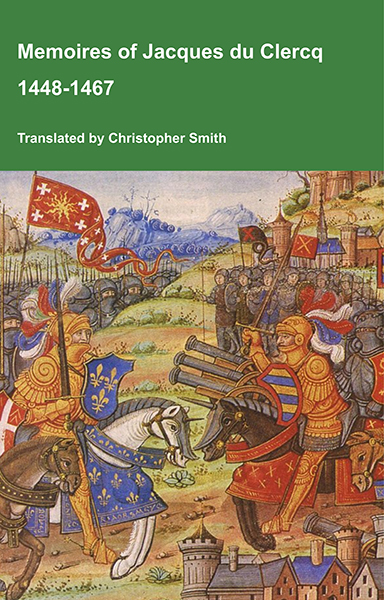
This is a translation of the 'Memoires of Jacques du Clercq', published in 1823 in two volumes, edited by Frederic, Baron de Reissenberg. In his introduction Reissenberg writes: 'Jacques du Clercq tells us that he was born in 1424, and that he was a licentiate in law and a counsellor to Philip the Good, Duke of Burgundy, in the castellany of Douai, Lille, and Orchies. It appears that he established his residence at Arras. In 1446, he married the daughter of Baldwin de la Lacherie, a gentleman who lived in Lille. We read in the fifth book of his Memoirs that his father, also named Jacques du Clercq, had married a lady of the Le Camelin family, from Compiègne. His ancestors, always attached to the counts of Flanders, had constantly served them, whether in their councils or in their armies.' The Memoires cover a period of nineteen years beginning in in 1448, ending in in 1467. It appears that the author had intended to extend the Memoirs beyond that date; no doubt illness or death prevented him from carrying out this plan. As Reissenberg writes the 'merit of this work lies in the simplicity of its narrative, in its tone of good faith, and in a certain air of frankness which naturally wins the reader’s confidence.' Du Clercq ranges from events of national and international importance, including events of the Wars of the Roses in England, to simple, everyday local events such as marriages, robberies, murders, trials and deaths, including that of his own father in Book 5; one of his last entries.
Available at Amazon in eBook and Paperback format.
 Bourgeois de Valenciennes. It happened a long time after the matters spoken of above, about the feast of Saint John the Baptist in the year 1344, that King Edward of England sent forces into Gascony, where the duke of Normandy was waging war and had gained towns and castles. He sent there the Earl of Derby1, the Earl of Pembroke2, and my lord Walter of Mauny, with many others. These took and won the castle of Bergerac and more than forty towns and fortresses, and they pressed the French so hard that they defeated them. There were taken prisoner the Count of L’Isle, the Count of Valentinois, the Viscount of Murendon, the Viscount of Monder, the Viscount of Villemur, the Viscount of Bouquentin, my lord Charles of Poitiers, my lord Roger, brother of the Count of Comminges, and many other counts, viscounts, and some three hundred knights. The others were slain or drowned in a river called the Viane. This battle took place in the year 13453.
Il avint une grànt espasse de tamps après ces choses dessus dittes, environ le Saint-Jehan-Baptiste, l'an mil IIIc et XLIIII, que le roy Édowart d'Engleterr e envoia en Gascongne où le duch de Normendie guerrioit et avoit gaigniet villes et chasteaulx, et y envoia le conte d'Erby, le conte de Pennebourc et monseigneur Gaultier de Mausny et pluseurs aultres, lesquels prinrent et gaignèrent le chastel de' Bergerac et bien XL que yilles que forteresses, et s'approchèrent dos François telement qu'ils les desconfireut; et y fut prins le conte de Lille, le conte de Valentinois, le visconte de Murendon, le visconte de Monder, le visconte de Villemur, le visconte de Bouquentin, monseigneur Charles de Poitiers, monseigneur Rogier, frère au conte de Cominges, et pluseursaultres contes et viscontes, et chevaliers bien IIIc. Et les aultres furent mors et noyés en une rivière qu'on nomme Viane et fut ceste bataille l'an mil IIP et XLIIII.
Note 1. Henry of Grosmont [aged 35], 1310-1361, Earl of Derby, subsequently 1st Duke of Lancaster, first cousin of King Edward III.
Note 2. Laurence Hastings [aged 26], 1319-1348, created Earl of Pembroke in 1339. He was a great-grandson of the last Earl of Pembroke of the previous creation Aymer de Valence who died in 1324.
Note 3. The original text has 1344. The Battle of Bergerac was fought in August 1345. Froissart, Book 3, Chapters 210-211: "At sunrise the English, who had been ordered to make the assault by water in their ships, were fully prepared. The captains among them were the Earl of Pembroke and the Earl of Hereford. With them were many young knights and squires who had come there of their own eager will, to advance themselves in arms. In that fleet there was a great number of archers. They advanced swiftly and came up to a great barrier that stood before the palisade, which was soon broken down and cast to the ground. The men of Bergerac and the commonalty of the town perceived that in no way could they endure against that assault. They began to lose heart and went to the Count of L’Isle and to the knights who were there, and said to them: 'My lords, consider what you wish to do. We are in danger of being utterly lost. If this town is taken, we shall lose our goods and our lives as well. It would be better for us to surrender it to the Earl of Derby than to suffer greater harm.' Then the Count of L’Isle answered and said: 'Come, let us go where you say the danger lies, for we will not surrender it in this manner.' Thereupon the knights and squires of Gascony who were there came forward toward the palisades and set themselves to the defense with great courage. The archers, who were in their barges, shot so thickly and so straight that scarcely anyone could appear without putting himself in danger of being slain or grievously wounded. Within the town, together with the Gascons, there were some two hundred Genoese crossbowmen, who did them great service; for they were well shielded against the shooting of the English and sorely troubled the English archers throughout that day. There were many wounded on both sides. At length the English, who were in their ships, pressed the attack so vigorously that they broke down a great section of the palisade. When those of Bergerac saw the peril, they came forward and asked for a truce, that they might take counsel concerning their surrender. It was granted to them for the remainder of the day and the following night until sunrise, on condition that they should not strengthen themselves in any way. Thus each side withdrew to its lodgings. That night the barons of Gascony who were there held a great council, to determine how they might conduct themselves. When they had taken counsel, they had their horses saddled and their goods loaded, mounted, and departed about midnight. They rode toward the town of La Réole, which is not far from there. The gates were opened to them; they entered within and lodged and quartered themselves throughout the town."
Become a Member via our Buy Me a Coffee page to read more.
Around 25th August 1345 Henry of Grosmont, Earl of Derby [aged 35], commanded the English forces at Bergerac, Dordogne during the Battle of Bergerac. The English army including Walter Manny 1st Baron Manny [aged 35] won a decisive victory over the French with Henri Montigny captured.
On 22nd September 1345 [his father] Henry Plantagenet 3rd Earl of Leicester 3rd Earl Lancaster [aged 64] died at Leicester Castle [Map]. His son Henry [aged 35] succeeded 4th Earl of Leicester, 4th Earl Lancaster.
After 22nd September 1345 [his father] Henry Plantagenet 3rd Earl of Leicester 3rd Earl Lancaster [deceased] was buried at Church of the Annunciation of our Lady of the Newark [Map], or possibly the Hospital Chapel, at a ceremony attended by King Edward III of England [aged 32] and his wife Philippa of Hainaut Queen Consort England [aged 35]. His son Henry of Grosmont 1st Duke Lancaster [aged 35] subsequently had his remains moved to St Mary de Castro Leicester, Leicestershire [Map].
On 21st October 1345 Henry of Grosmont 1st Duke Lancaster [aged 35] commanded an English army including Walter Manny 1st Baron Manny [aged 35] at Auberoche, Perigueux during the Battle of Auberoche. The battle was a significant victory for the English with the French forces being heavily defeated. The ransoms alone made a fortune for many of the soldiers in Derby's army, as well as Derby himself, who was said to have made at least £50,000 from the day's captives, and sealed his reputation as 'one of the best warriors in the world'.
In June 1347 John Warenne 7th Earl of Surrey [aged 60] died. His nephew [his brother-in-law] Richard [aged 41] succeeded 8th Earl Surrey. [his sister] Eleanor Plantagenet Countess Arundel and Surrey [aged 28] by marriage Countess Surrey. Conisbrough Castle [Map] reverted to the Crown.
On 3rd August 1347 the English captured Calais [Map] providing England with a French port for the next two hundred years. Thomas Beauchamp 11th Earl Warwick [aged 34] commanded, John Lisle 2nd Baron Lisle [aged 29], Richard Vache and Henry of Grosmont 1st Duke Lancaster [aged 37] fought during the year long siege.
In 1349 Henry of Grosmont 1st Duke Lancaster [aged 39] was created 1st Earl Derby. [his wife] Isabel Beaumont Duchess Lancaster [aged 29] by marriage Countess Derby.
On 7th July 1349 [his sister] Joan Plantagenet Baroness Mowbray [aged 37] died in Yorkshire.
On 29th August 1350 the English fleet defeated a Castilian fleet at Winchelsea [Map] during the Battle of Winchelsea. Around twenty Castilian ships were captured; several were sunk. For the English King Edward III of England [aged 37] and his son Edward "Black Prince" [aged 20], James Audley [aged 32], Henry Scrope 1st Baron Scrope of Masham [aged 37], Henry of Grosmont 1st Duke Lancaster [aged 40] and John Sully [aged 67] fought.
In 1351 Henry of Grosmont 1st Duke Lancaster [aged 41] was created 1st Duke Lancaster by King Edward III of England [aged 38]. [his wife] Isabel Beaumont Duchess Lancaster [aged 31] by marriage Duchess Lancaster.
Lionel of Antwerp 1st Duke of Clarence [aged 12] was created 1st Earl of Ulster.
[his future son-in-law] John of Gaunt 1st Duke Lancaster [aged 10] was created 1st Earl Richmond.
Ralph Stafford 1st Earl Stafford [aged 49] was created 1st Earl Stafford.
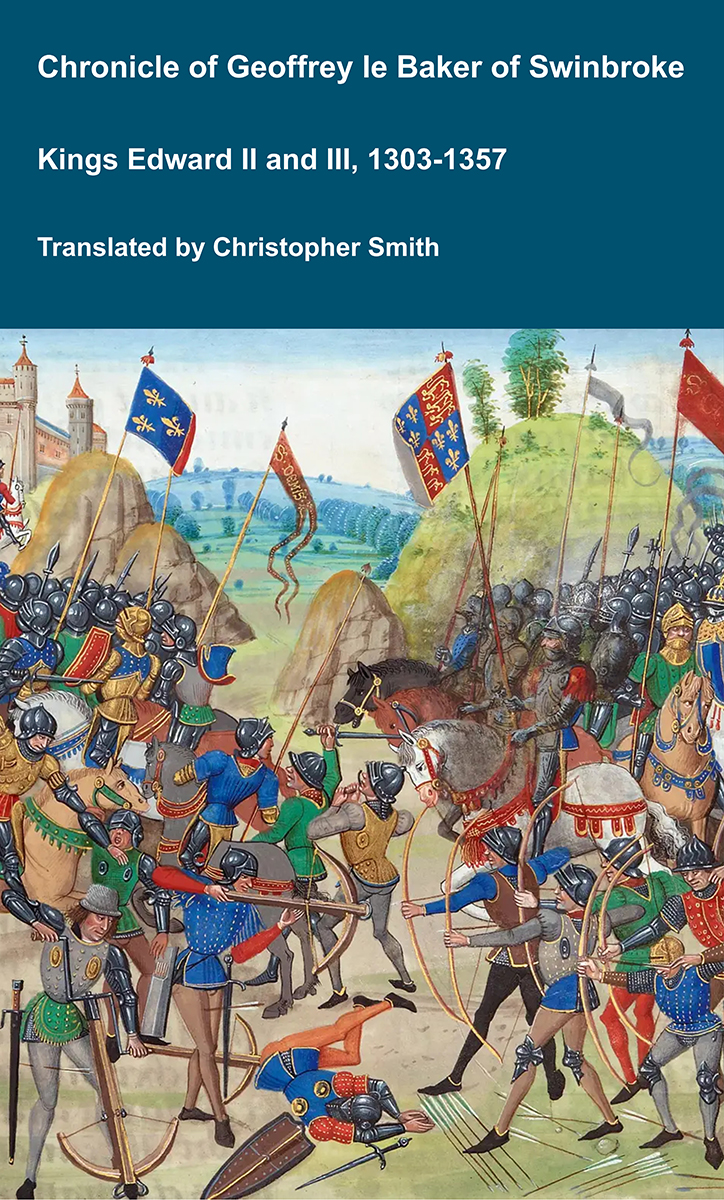 Chronicle of Geoffrey le Baker of Swinbroke. In the year of Christ 1351, and the 25th year of the king's reign, after the octave of the Purification of the Glorious Virgin [2nd February 1351], at the parliament held in London at Westminster, Lord Henry [aged 41], son of [his father] Henry, Earl of Lancaster, himself Earl of Lincoln, Leicester, Derby, Grismond, and Ferrers, was made Duke of Lancaster, receiving liberties and privileges from the royal bounty such as no other earl had ever held. Also Lord Lionel of Antwerp [aged 12], the king's son, was made Earl of Ulster in Ireland, Lord [his future son-in-law] John of Gaunt [aged 10], his brother, was made Earl of Richmond and Lord Ralph of Stafford [aged 49], formerly a baron, was created Earl of the same name.
Anno Christi MCCCLJ et regis XXV post octabas Purificacionis Virginis gloriose, in parliamento Londoniis apud Westmonasterium celebrato, dominus Henricus filius Henrici comitis Lancastrie, ipse comes Lincolnie, Leicestrie, Derbie et Grossimontis atque de Ferrariis, factus est dux Lancastrie, datis sibi libertatibus atque privilegiis munificencia regali qualia nullus comitum habebat. Item, dominus Leunecius de Andewerpe, regis filius, fit comes de Holvestria in Hybernia, et dominus Tohannes de Gandavo, germanus eius, fit comes Richemundie, et dominus Radulfus de Staffordia, pridem baro, comes eiusdem tituli creabatur.
In 1352 [his son-in-law] William Wittelsbach I Duke Lower Bavaria [aged 21] and Maud Plantagenet Duchess Lower Bavaria [aged 11] were married in London. She by marriage Duchess Lower Bavaria. He by marriage Earl of Leicester. She the daughter of Henry of Grosmont 1st Duke Lancaster [aged 42] and Isabel Beaumont Duchess Lancaster [aged 32]. He the son of Louis Wittelsbach IV Holy Roman Emperor and Margaret Hainaut Holy Roman Empress [aged 40]. They were fourth cousin once removed. He a great x 4 grandson of King Henry "Curtmantle" II of England. She a great x 2 granddaughter of King Henry III of England.
In 1353 Henry of Grosmont 1st Duke Lancaster [aged 43] founded at Church of the Annunciation of our Lady of the Newark [Map].
Archaeologia Volume 35 1853 XXXIII. On the 19th [Apr 1358], still in London, the Chancellor and Treasurer of England and Sir John de Wynewyk dined with the Queen [aged 63]; and the Prince of Wales [aged 27] and Duke of Lancaster [aged 48] visited her after dinner.
On 19th May 1359, or thereabouts, a double-royal wedding celebration took place at Reading Abbey, Berkshire [Map] whereby two children of King Edward III of England [aged 46] were married:
[his son-in-law] John of Gaunt 1st Duke Lancaster [aged 19] and Blanche Duchess of Lancaster [aged 17] were married. She by marriage Countess Richmond. She the daughter of Henry of Grosmont 1st Duke Lancaster [aged 49] and Isabel Beaumont Duchess Lancaster [aged 39]. He the son of King Edward III of England and Philippa of Hainaut Queen Consort England [aged 48]. They were half second cousin once removed. She a great x 2 granddaughter of King Henry III of England.
John Hastings 2nd Earl Pembroke [aged 11] and Margaret Plantagenet Countess of Pembroke [aged 12] were married. At the time John Hastings 2nd Earl Pembroke was a ward of King Edward III of England who would enjoy the benefit of the substantial revenue of the Earldom of Pembroke until John came of age nine years later in 1368. She died two or so years later probably of plague. She the daughter of King Edward III of England and Philippa of Hainaut Queen Consort England. He the son of Laurence Hastings 1st Earl Pembroke and Agnes Mortimer Countess of Pembroke [aged 42]. They were half fourth cousins. He a great x 5 grandson of King John of England.
On 13th April 1360 a freak weather event known as Black Monday Hailstorm occurred as the army of King Edward III of England [aged 47] were camped outside Chartres [Map]. Thomas Beauchamp 11th Earl Warwick [aged 47], William Bohun 1st Earl of Northampton [aged 50], Henry of Grosmont 1st Duke Lancaster [aged 50], Edward "Black Prince" [aged 29] and Walter Mauny were present. Around one thousand English were killed, with up to six thousand horses. King Edward III of England believed the event to be an Act of God and proceeded to negotiate with the French resulting in the Treaty of Brétigny.
On 28th April 1360 Guy Beauchamp died from injuries received during the Black Monday Hailstorm.
In 1361 [his wife] Isabel Beaumont Duchess Lancaster [aged 41] died.
On 23rd March 1361 Henry of Grosmont 1st Duke Lancaster [aged 51] died at Leicester Castle [Map]. He was buried at Church of the Annunciation of our Lady of the Newark [Map]. Duke Lancaster, Earl Lincoln extinct.
[his daughter] Blanche Duchess of Lancaster [aged 18] succeeded 5th Countess Lancaster and 2nd Countess Derby. [his son-in-law] John of Gaunt 1st Duke Lancaster [aged 21] by marriage Earl Lancaster, Earl Derby.
Maud Plantagenet Duchess Lower Bavaria [aged 20] succeeded 5th Countess of Leicester.
Chronicle of Geoffrey le Baker of Swinbroke
Baker was a secular clerk from Swinbroke, now Swinbrook, an Oxfordshire village two miles east of Burford. His Chronicle describes the events of the period 1303-1356: Gaveston, Bannockburn, Boroughbridge, the murder of King Edward II, the Scottish Wars, Sluys, Crécy, the Black Death, Winchelsea and Poitiers. To quote Herbert Bruce 'it possesses a vigorous and characteristic style, and its value for particular events between 1303 and 1356 has been recognised by its editor and by subsequent writers'. The book provides remarkable detail about the events it describes. Baker's text has been augmented with hundreds of notes, including extracts from other contemporary chronicles, such as the Annales Londonienses, Annales Paulini, Murimuth, Lanercost, Avesbury, Guisborough and Froissart to enrich the reader's understanding. The translation takes as its source the 'Chronicon Galfridi le Baker de Swynebroke' published in 1889, edited by Edward Maunde Thompson.
Available at Amazon in eBook and Paperback format.
Inquisitions Post Mortem 118. 118. Henry duke of Lancaster.
Writ, Wyndesore, 25 March, 35 Edward III [1361].
Chronicle of Geoffrey le Baker of Swinbroke. In the nineteenth year of the king's reign, Henry, Earl of Derby,1 later created Duke of Lancaster, and the Earls of Devon and Pembroke, as well as Lord Ralph Stafford; not yet Earl of Stafford but still a baron, and Lord Walter de Mauny, were sent to Gascony. There, having conquered walled towns and castles, they won many glorious battles with great bravery. The town of Aiguillon,2 which they captured by assault, was placed under the guardianship of Ralph of Stafford. Afterward, they moved against other towns, such as Bergerac, which due to its strength was called "the chamber of the French," and also Saint-Jean, La Réole, and many other large, strong, and well-fortified places, which they captured through great effort and perilous assaults. In these campaigns, the Duke of Lancaster fought in underground tunnels, which were being dug to undermine the towers and walls, and suffered fierce attacks from the valiant defenders, fighting hand-to-hand against the besieged. And, something unheard of before, he knighted both Gascon and English soldiers in those very tunnels. Indeed, by conquering towns, cities, castles, and fortresses numbering two hundred and fifty, he marched across a large part of Gascony and advanced as far as Toulouse. There, he invited the ladies of Toulouse and noble maidens, through letters, to dine with him, his fellow nobles, and Lord Bernard de Libreto,3 a loyal Gascon. But, with God's protection, he did no harm to the city or its inhabitants, except for instilling in them unbearable terror, as those who had been besieged later told me. The terror was such that even mendicant friars took up arms, and the Prior of the Carmelite order of the Blessed Virgin Mary in Toulouse, bearing a silver banner with a golden image of the Virgin, led the citizens of his quarter from the walls. He raised his banner in defence,4 and by this display, he stirred pious devotion in the duke and many in the army, though some mocked him as well.
Anno Domini MCCCXLV, regis XIX, Henricus comes Derbie, postea dux Lancastrie creatus, et comes Devonie et comes Pembrochie et dominus Radulfus, nondum comes Staffordie set baro, et dominus Walterus de Magne Vasconiam destinantur; ubi, conquisitis villis muratis et castris, multa gloriosa certamina fortiter vicerunt. Villam Daguiloun per insultum adquisitam deputabant custodie Radulphi Staffordie. Postea diverterunt se ad alias villas, ut Brigerak, vocatam pre sua fortitudine 'cameram Francorum,' et ad villam sancti Iohannis et de la Ruele et alias multas grandes et fortes et bene munitas, quas magnis laboribus et insultibus periculosis adquisierunt. Ibi dux Lancastrie, militans in fossatis subterraneis que pro diruendis turribus et muris effodiebantur, graves a virilibus defensoribus insultus paciebatur, et manualiter contra obsessos dimicavit, et, quod antea fuit inauditum, in eiisdem fossatis milites tam Vascones quam Anglicos effecit. Quippe villas, civitates, castra et fortalicia ducentas l. conquirendo, magnam partem Vasconie et usque Tolosam transequitavit, ubi dominas Tolosanas et virgines nobiles per suas literas ad convivandum secum et suis comitibus et domino Bernardo de Libreto, Aquitannico fideli, invitavit. Set, civitatem Deo conservante, nihil eius incolis malefecit, nisi quod terrorem intollerabilem, ut obsessi mihi retulerunt, eiis intulit; ita quod, religiosis mendicis ad arma compulsis, prior Carmelitarum beate Marie Tolose, sub vexillo argenteo ymaginem auream beate Virginis habente, de quarterio sui incolatus civibus prefectus, ostendens suum vexillum ad muros, per armorum errancias descriptum ducem ad devocionem piam et quam plures de exercitu, atque nonnullos ad derisionem, provocavit.
Note 1. Henry of Grosmont succeeded as earl of Lancaster, 22nd September 1345, and was created duke on the 6th March 1352. Hugh Courtenay succeeded as earl of Devon in 1341; died in 1377. Laurence de Hastings was created earl of Pembroke, 12th October 1339; died in 1348. Ralph de Stafford succeeded as baron Stafford in 1308, and was created earl on the 5th March 1351; died in 1372.
Baker is very confused as to the capture of the different places. Bergerac was first taken on the 24th August 1345, Aiguillon, early in December, La Réole, in January 1346. The Saint-Jean-d'Angely was not taken till September 1346. Derby did not go near Toulouse, although it is not impossible that some incursion was made thither. Baker says that he had his information from persons who were besieged there; but he was quite capable of confusing events, and he is most probably referring to the expedition of 1349.
Note 2. Aiguillon, is located at the confluence of Rivers Lot and Garonne. Bergerac is on the River Dordogne. La Réole and Saint-Jean-d'Angely are both on the Garonne downstream of Aiguillon.
Note 3. Bernard, sire d'Albret; died 1358.
Note 4. This seems to mean: by the procession of his banner, on which the picture of the Virgin stood for his armorial device.
Kings Wessex: Great x 8 Grand Son of King Edmund "Ironside" I of England
Kings Gwynedd: Great x 12 Grand Son of Maredudd ab Owain King Deheubarth King Powys King Gwynedd
Kings Seisyllwg: Great x 14 Grand Son of Hywel "Dda aka Good" King Seisyllwg King Deheubarth
Kings Powys: Great x 12 Grand Son of Maredudd ab Owain King Deheubarth King Powys King Gwynedd
Kings England: Great Grand Son of King Henry III of England
Kings Scotland: Great x 7 Grand Son of King Duncan I of Scotland
Kings Franks: Great x 15 Grand Son of Charles "Charlemagne aka Great" King of the Franks King Lombardy Holy Roman Emperor
Kings France: Great x 9 Grand Son of Hugh I King of the Franks
Kings Duke Aquitaine: Great x 12 Grand Son of Ranulf I Duke Aquitaine
Great x 4 Grandfather: Geoffrey Plantagenet Duke Normandy 
Great x 3 Grandfather: King Henry "Curtmantle" II of England Grand Son of King Henry I "Beauclerc" England
Great x 4 Grandmother: Empress Matilda  Daughter of King Henry I "Beauclerc" England
Great x 2 Grandfather: King John of England Son of King Henry "Curtmantle" II of England
Great x 4 Grandfather: William "Saint" Poitiers X Duke Aquitaine
Great x 3 Grandmother: Eleanor of Aquitaine Queen Consort Franks and England
Great x 4 Grandmother: Aenor Chatellerault Duchess Aquitaine
Great x 1 Grandfather: King Henry III of England Son of King John of England
Great x 4 Grandfather: William "Taillefer" Angoulême VI Count Angoulême
Great x 3 Grandfather: Aymer Angoulême I Count Angoulême
Great x 2 Grandmother: Isabella of Angoulême Queen Consort England
Great x 4 Grandfather: Peter Courtenay 
Great x 3 Grandmother: Alice Courtenay Countess Angoulême
Great x 4 Grandmother: Elizabeth Courtenay 
GrandFather: Edmund "Crouchback" Plantagenet 1st Earl of Leicester 1st Earl Lancaster Son of King Henry III of England
Great x 4 Grandfather: Alfonso II King Aragon 
Great x 3 Grandfather: Alfonso Barcelona II Count Provence
Great x 4 Grandmother: Sancha Ivrea Queen Consort Aragon 
Great x 2 Grandfather: Raymond IV Count Provence
Great x 4 Grandfather: Rainou of Sabran
Great x 3 Grandmother: Gersenda II Sabran Countess Provence
Great x 1 Grandmother: Eleanor of Provence Queen Consort England
Great x 4 Grandfather: Humbert Savoy III Count Savoy
Great x 3 Grandfather: Thomas Savoy I Count Savoy
Great x 4 Grandmother: Beatrice Macon Countess Savoy
Great x 2 Grandmother: Beatrice Savoy Countess Provence
Great x 4 Grandfather: William I Count Geneva
Great x 3 Grandmother: Margaret Geneva Countess Savoy
Father: Henry Plantagenet 3rd Earl of Leicester 3rd Earl Lancaster Grand Son of King Henry III of England
Great x 4 Grandfather: Louis VII King of the Franks
Great x 3 Grandfather: King Philip II of France 2 x Great Grand Son of King William "Conqueror" I of England
Great x 4 Grandmother: Adèle Queen of the Franks  Great Grand Daughter of King William "Conqueror" I of England
Great x 2 Grandfather: King Louis VIII of France 3 x Great Grand Son of King William "Conqueror" I of England
Great x 4 Grandfather: Baldwin Flanders V Count Hainaut
Great x 3 Grandmother: Isabelle Flanders Queen Consort France
Great x 4 Grandmother: Margaret Metz Countess Hainaut and Flanders
Great x 1 Grandfather: Robert Capet Count of Artois Great Grand Son of King Henry "Curtmantle" II of England
Great x 4 Grandfather: Sancho III King Castile
Great x 3 Grandfather: Alfonso VIII King Castile
Great x 4 Grandmother: Blanche Ramirez Queen Consort Castile
Great x 2 Grandmother: Blanche Ivrea Queen Consort France Grand Daughter of King Henry "Curtmantle" II of England
Great x 4 Grandfather: King Henry "Curtmantle" II of England Grand Son of King Henry I "Beauclerc" England
Great x 3 Grandmother: Eleanor Plantagenet Queen Consort Castile Daughter of King Henry "Curtmantle" II of England
Great x 4 Grandmother: Eleanor of Aquitaine Queen Consort Franks and England
GrandMother: Blanche Capet Queen Navarre 2 x Great Grand Daughter of King Henry "Curtmantle" II of England
Great x 4 Grandfather: Godfrey Reginar VIII Duke Lower Lorraine
Great x 3 Grandfather: Henry Reginar VIII Duke Lower Lorraine I Duke Brabant
Great x 4 Grandmother: Margaret Luxemburg Duchess Lower Lorraine 
Great x 2 Grandfather: Henry Reginar II Duke Brabant Great Grand Son of King Stephen I England
Great x 4 Grandfather: Matthew Metz Count Boulogne
Great x 3 Grandmother: Maud Metz Grand Daughter of King Stephen I England
Great x 4 Grandmother: Marie Blois I Countess Boulogne Daughter of King Stephen I England
Great x 1 Grandmother: Matilda Reginar Countess Saint Pol 2 x Great Grand Daughter of King Stephen I England
Great x 3 Grandfather: Philip Swabia
Great x 2 Grandmother: Marie Swabia Duchess Brabant
Henry of Grosmont 1st Duke Lancaster  Great Grand Son of King Henry III of England
Great x 1 Grandfather: Patrick Chaworth 
GrandFather: Patrick Chaworth
Mother: Maud Chaworth
Great x 4 Grandfather: William Beauchamp 
Great x 3 Grandfather: Walter Beauchamp
Great x 4 Grandmother: Jeanne de Saint Valéry
Great x 2 Grandfather: William Beauchamp
Great x 4 Grandfather: Roger Mortimer 
Great x 3 Grandmother: Joan Mortimer
Great x 4 Grandmother: Isabel Ferrers 
Great x 1 Grandfather: William Beauchamp 9th Earl Warwick
Great x 3 Grandfather: William Maudit
Great x 2 Grandmother: Isabel Maudit
Great x 4 Grandfather: Waleran Beaumont 4th Earl Warwick 
Great x 3 Grandmother: Alice Beaumont
Great x 4 Grandmother: Alice Harcourt Countess Warwick 
GrandMother: Isabella Beauchamp
Great x 3 Grandfather: Geoffrey Fitzpeter 1st Earl Essex
Great x 2 Grandfather: John Fitzgeoffrey
Great x 4 Grandfather: Roger Clare 2nd Earl Hertford
Great x 3 Grandmother: Aveline Clare Countess Essex
Great x 4 Grandmother: Maud St Hilary Countess Hertford
Great x 1 Grandmother: Maud Fitzjohn Countess Warwick
Great x 4 Grandfather: Roger Bigod 2nd Earl Norfolk 
Great x 3 Grandfather: Hugh Bigod 3rd Earl Norfolk
Great x 4 Grandmother: Ida Tosny Countess Norfolk 
Great x 2 Grandmother: Isabel Bigod
Great x 4 Grandfather: William Marshal 1st Earl Pembroke 
Great x 3 Grandmother: Maud Marshal Countess Norfolk and Surrey
Great x 4 Grandmother: Isabel Clare Countess Pembroke