The History of William Marshal was commissioned by his son shortly after William’s death in 1219 to celebrate the Marshal’s remarkable life; it is an authentic, contemporary voice. The manuscript was discovered in 1861 by French historian Paul Meyer. Meyer published the manuscript in its original Anglo-French in 1891 in two books. This book is a line by line translation of the first of Meyer’s books; lines 1-10152. Book 1 of the History begins in 1139 and ends in 1194. It describes the events of the Anarchy, the role of William’s father John, John’s marriages, William’s childhood, his role as a hostage at the siege of Newbury, his injury and imprisonment in Poitou where he met Eleanor of Aquitaine and his life as a knight errant. It continues with the accusation against him of an improper relationship with Margaret, wife of Henry the Young King, his exile, and return, the death of Henry the Young King, the rebellion of Richard, the future King Richard I, war with France, the death of King Henry II, and the capture of King Richard, and the rebellion of John, the future King John. It ends with the release of King Richard and the death of John Marshal.
Available at Amazon in eBook and Paperback format.
Paternal Family Tree: Calverley
Around 1324 Hugh Calverley was born to [his father] David Calverly of Lea.
Bentleys Miscellany Volume 45. VI. Now turn we to the other side, and let us see what way
Haughty Sir Robert Pembroke chose his comrades for the fray.
Sir Robert Knolles1 he first did take — next Sir Hugh Calverley [aged 26]2
With Richard de la Lande — three better might not be.
Hervé de Lexualen came next, Walton and Bélifort.
The last-named giant knight an iron mallet bore,
Its weight was five and twenty pounds — yes, twenty-five and more!
Note 1. Robert Knolles [aged 25] was but of mean parentage in the county of Chester, but by his valour advanced from a common soldier in the French wars under Edward III to a great commander. Being sent general of an army into France, in dislike of their power, he drove the people before him like sheep, destroying towns, castles, and cities, in such manner and number, that long after, in memory of this act, the sharp points and gable ends of overthrown houses and minsters were called Knolles's Mitres. After which, to make himself as well- beloved of his country, he built a goodly fair bridge at Rochester, over the Medway, with a chapel and chauntry at the east end thereof. He built much at the Greyfriars, Tondo, and a hospital at Rome for English travellers and pilgrims. He deceased at his manor of Scone Thorpe, in Norfolk—was buried by the Lady Constance his wife, in the Church of Greyfriars, London, 18th August, 1407." —Weerer's Funeral Monuments. Sir Robert was created a Knight of the Garter by Richard II.
Note 2. This distinguished knight ("Cavualay le vaillant, le hardy jourencel," i.e. Cavualay the valiant, the bold young squire, as he is styled in the Lay) was the eldest son of David Calverley (or Calveley), of Yea, in Cheshire. He first appeared as one of the combatants in the noted conflict described in the Lay; next at the Battle of Aurai, 1364; then as a captain of Free Companies in tlic service of Henry of Trastamare; and after other exploits too numerous to particularise, he ended his brilliant and adventurous carcer by founding a college at Bunbury [Map], in his native county. His body was interred in the chancel of his college, where his armed effigy reposes on one of the most sumptuous altar-tombs that his county can boast."— Ormerod's Cheshire . It has been asserted, but not proved, that Sir Hugh Calverley married a queen of Arragon.
On 26th March 1351 the Combat of the Thirty was an arranged joust, or melee, between selected combatants from both sides of the conflict, fought at Guillac, a site midway between the Breton castles of Josselin and Ploërmel among 30 champions, knights, and squires on each side.
Robert Knollys [aged 26] took part.
Hugh Calverley [aged 27] fought, was captured and ransomed.
The date of the battle sometimes given as the 27th of March 1351. De la Borderie, History of Brittany, vol. III, p. 514, note 4: Up to now, all historians who have written about the Battle of the Thirty have dated it to March 27, 1351. That is also the date inscribed on the commemorative pyramid at Mi-Voie. However, this date is one day Officer According to a contemporary poem, the battle was fought on a Saturday, the eve of Laetare Sunday (Jerusalem), that is, the fourth Sunday of Lent. In 1351, Easter fell on April 17, so Laetare Sunday was March 27. Therefore, the eve of that Sunday—the day of the Battle of the Thirty—was not March 27, but March 26. See the title and conclusion of the poem, ed. Crapelet, pp. 13 and 35, and stanza 34, Crapelet p. 30.
On 29th September 1364 Battle of Auray decided the Breton Succession in favour of John Montfort V Duke Brittany [aged 25]. The Breton and English army was commanded by John Chandos [aged 44] and included William Latimer 4th Baron Latimer of Corby [aged 34], Miles Stapleton [aged 44] and Hugh Calverley [aged 40]. Charles of Blois Duke Brittany [aged 45] was killed. Bertrand Geusclin [aged 44] surrendered.
Archaeologia Volume 22 Section XVI. [April 1377] About that tyme was the Earle of Salisburye & Sir Richard of Anglisisino sent into Fraunce to treate of peace, at least a truce of ii yeares or more, but they could not obtayne any longer truce then for a moneth,which they utterly refused. Whereupon they stayed in Fraunce about thes things (& some thinking they might saffely have passed betwixt Callais & Dovarp) about 50 takynge shype wer forthwith intercepted by the galleys, & wer slayne, only ii men & ii wimen excepted, even yn the syghte of the townes men of Calays, they beinge not able to helpe them; Sr Hugh Cavarley [aged 53]q at the tyme beinge capityne of Callais toke this so greate injury in very evill parte, especially for that it was done while they were yet treatynge for peace, but he coulde not helpe it, but forthe with he toke with hym a number of his best and chosen out men, & purposynge to requite those injuries so don by the French men that troubled the peace, he made a roode in to Fraunce, kylled a great nombar of men, and brought bake with hym a greate booty of artillery & cattaile, the messengers returned into England & brought nothing backe but rumour of warrs.
Note o. Stow calls him "Sir Richard Anglisisin, a Poyton," but his true name was Guichard D'Angle, a distinguished and accomplished knight, according to Froissart, who says that the young King, Richard the Second, was, at his grandfather's death, placed under the tuition "de ce gentil Chevalier, Messire Guichard D'Angle, par l'accord de tout le pais, pour l'instruire en nobles vertus." i.e. "of this noble knight, Sir Guichard d'Angle, by the agreement of the whole country, to instruct him in noble virtues." He was created Earl of Huntingdon, and dying in London, was buried in Austin Friars church. Chaucer the poet (called by Froissart, Geoffroy Caucher) seems to have been also employed in the unsuccessful negociation mentioned in the text.
Note p. The spelling of Dovar in the text (which was by no means uncommon) may furnish an acceptable variation to those persons who are fond of adopting alterations in the names of towns, similar to that by which Dover has lately been transformed into Dovor.
Note q. To shew the unsettled state of the orthography of proper names at this period, I will just remark, that in documents preserved in Rymer's Fœdera, I find the name of this distinguished commander given with not fewer than six variations.
Thomas Walsingham [~1422]. [Before 16th December 1379]. Lord Hugo Kalverlee [aged 55] and Lord Thomas Percy, and several others whose earlier actions had been hidden, before they were about to board the ships, had it publicly proclaimed throughout the country that those who had been troubled by their men in any way, whether by inflicted injuries or by any other means or causes, could come before the day of embarkation and would receive proper satisfaction for any grievances they wished to complain about. As a result, it happened that the people, with devout prayers, followed them to the sea, just as, on the other hand, they had pursued Lord John Arundel with dire imprecations.
Dominus Hugo Kalverlee ef Dominus Thomas Percy, et nonnulli alii quos hme priaemissa latebant, antequam naves ascensuri erant, fecerunf proclamari per patriam voce publica, ut venirent ante diem mnavigationis qui molestati fuerant per suos ullo modo, vel per illatas injurias, vel per alias quascunque vias vel causas, habituri condignam satisfactionem de quibuscunque transgressionibus conqueri volnissent: unde contigit, ut ipsos 'devotis precatibus populus prosequeretur ad mare, sicut e contra Dominum Johannem Arundelle diris imprecationibus fuerant insecuti.
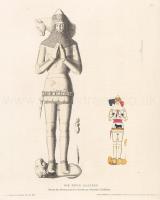
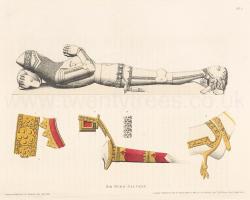
On 23rd April 1394 Hugh Calverley [aged 70] died. He was probably buried in St Boniface's Church, Bunbury [Map]. Monument Early Plate Bascinet Period. Finely carved Calf's Head on the breastplate representing Hugh Calveley's canting arms. Calf's Head Crest. Hip Belt. Basinet with unusual decorated Orle.


Effigy of Sir Hugh Calveley. SIR HUGH CALVELEY, or Calverley, of Lea, in Cheshire, was a most eminent soldier in the reign of Edward the Third, and his successor Richard the Second. In 1350 we find him one of the combatants in the celebrated pitched trial of arms, or combât-à-l'outrance fought between thirty men-at-arms on the English side, and thirty on that of the Bretons, called, in allusion to the number of the champions on either party, the Battle of Trente. Sir Richard Brembre commanded the English hand, and Marshal Beaumanoir the French. Among the companions of the valiant Calveley (twenty of whom were English, the rest foreigners) were, Sir Robert Knolles, also a most distinguished knight, Croquart the Freebooter, the gigantic Hulbitee, and Thomelin de Billefort, so called from his wielding an enormous weapon of the axe kind. Sir Richard Brembre was slain fighting hand-in-hand with the famous Bertram du Guesclin; Calveley, Knolles, and Croquart, the poor remains of the English party, were taken prisoners to the Castle of Josselina.
Effigy of Sir Hugh Calveley. The above are some few passages of the military career of this renowned English knight. He founded in 1386, the tenth year of the reign of Richard II a college at Rome, and at Bunbury [Map] in Cheshire. A story is extant, upon no certain foundation, that he married a Queen of Arragon. He might indeed while in Spain with the Black Prince have formed an alliance with some noble lady of the Spanish court. He reposes in an altar-tomb in Bunbury church, Cheshire [Map], which bears his eRigy as represented, and is surrounded by Gothic niches, intermixed with escutcheons.
Details. Plate 1. The effigy as originally painted. On the surcoat—the coat of Calveley, Argent, a fess Gules, between three calves Sable. Crest, a calf's head Sable. On the basinet is a rich circlet or wreath. The feet rest on a golden lion. Plate H. Profile. 1. Portion of the wreath on the basinet enlarged; also ornament of the rim of the basinet, with lace of the camail. 2. Girdle, chain suspending the sword, scabbard of the sword. 3. Mails of the hauberk and camail. 4. Part of the greave, solerette, spur, and ornamented strap.