

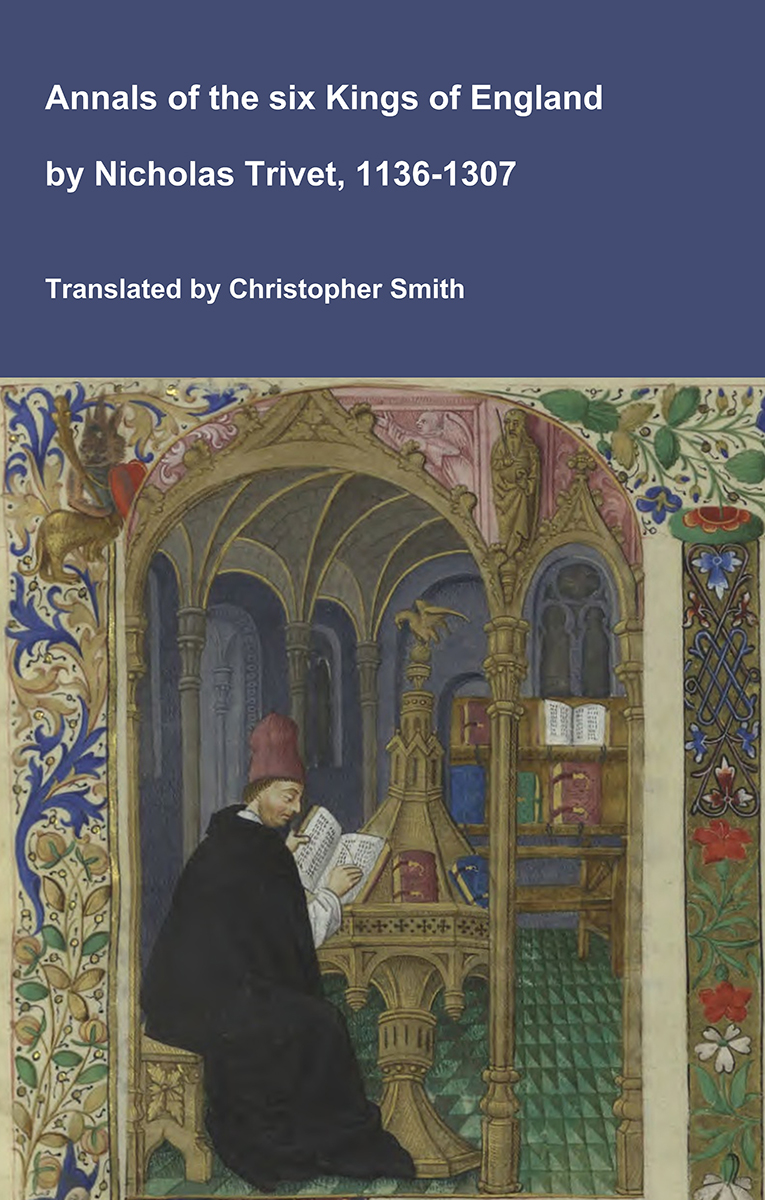
Annals of the six Kings of England by Nicholas Trivet
Translation of the Annals of the Six Kings of England by that traces the rise and rule of the Angevin aka Plantagenet dynasty from the mid-12th to early 14th century. Written by the Dominican scholar Nicholas Trivet, the work offers a vivid account of English history from the reign of King Stephen through to the death of King Edward I, blending political narrative with moral reflection. Covering the reigns of six monarchs—from Stephen to Edward I—the chronicle explores royal authority, rebellion, war, and the shifting balance between crown, church, and nobility. Trivet provides detailed insight into defining moments such as baronial conflicts, Anglo-French rivalry, and the consolidation of royal power under Edward I, whose reign he describes with particular immediacy. The Annals combines careful year-by-year reporting with thoughtful interpretation, presenting history not merely as a sequence of events but as a moral and political lesson. Ideal for readers interested in medieval history, kingship, and the origins of the English state, this chronicle remains a valuable and accessible window into the turbulent world of the Plantagenet kings.
Available at Amazon in eBook and Paperback format.
John Buckler is in Painters.
On 30th November 1770 John Buckler was born at Calbourne, Isle of Wight.
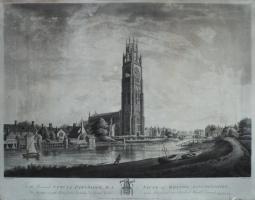
1798. John Buckler (age 27). To the Reverend Samuel Partridge, M.A. Vicar of Boston, Lincolnshire
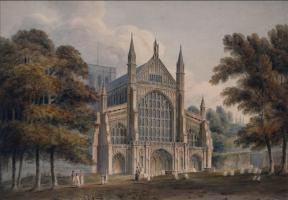
1801. John Buckler (age 30). Winchester Cathedral [Map].
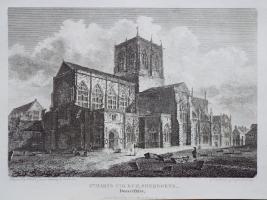
1803. John Buckler (age 32). St. Mary's Church [Map], Sherborn, Dorsetshire.
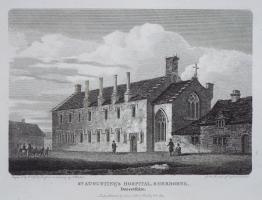
1803. John Buckler (age 32). St Augustine's Hospital, Sherborn.
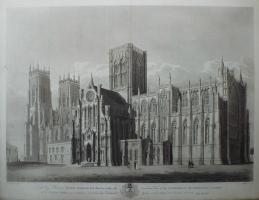
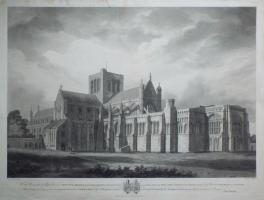
1808. John Buckler (age 37). South East View of the Cathedral Church of Winchester [Map].
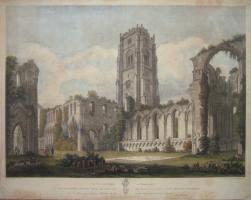
1809. John Buckler (age 38). Fountains Abbey, North Yorkshire [Map].
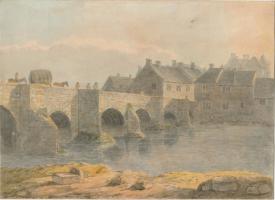
1809. John Buckler (age 38). Burton-upon-Trent Bridge.
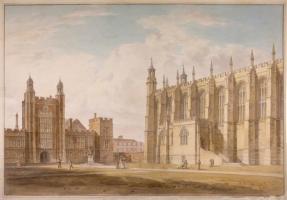
Around 1814. John Buckler (age 43). Eton College [Map].
The History of William Marshal was commissioned by his son shortly after William’s death in 1219 to celebrate the Marshal’s remarkable life; it is an authentic, contemporary voice. The manuscript was discovered in 1861 by French historian Paul Meyer. Meyer published the manuscript in its original Anglo-French in 1891 in two books. This book is a line by line translation of the first of Meyer’s books; lines 1-10152. Book 1 of the History begins in 1139 and ends in 1194. It describes the events of the Anarchy, the role of William’s father John, John’s marriages, William’s childhood, his role as a hostage at the siege of Newbury, his injury and imprisonment in Poitou where he met Eleanor of Aquitaine and his life as a knight errant. It continues with the accusation against him of an improper relationship with Margaret, wife of Henry the Young King, his exile, and return, the death of Henry the Young King, the rebellion of Richard, the future King Richard I, war with France, the death of King Henry II, and the capture of King Richard, and the rebellion of John, the future King John. It ends with the release of King Richard and the death of John Marshal.
Available at Amazon in eBook and Paperback format.
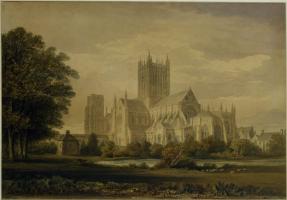
1821. John Buckler (age 50). Wells Cathedral [Map].
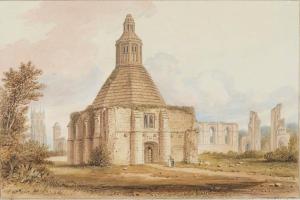
1825. John Buckler (age 54). Abbots Kitchen, Glastonbury Abbey.
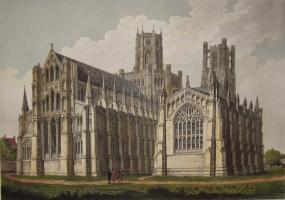
1850. John Buckler (age 79). Ely Cathedral [Map].

Before 1851. John Buckler (age 80). Font in St Werburgh's Church, Hanbury [Map] showing a round bowl resting on a cluster of stunted pillars, upon round steps.
On 6th December 1851 John Buckler (age 81) died
Archaeologia Volume 29 Section III. The task of completing Mr. Stothard's design has been recently adopted by Mr. George Hollis (the son-in-law of Mr. John Buckler, F.S.A.), and his son Mr. Thomas Hollis: and among the objects of their earliest attention have been the royal effigies just named. In the course of making his drawings from the monument of Richard the Second, Mr. Thomas Hollis discovered that the robes of the effigies, and the platform or bed upon which they are placed, are ornamented with various patterns, punctured upon the metal, which had become so entirely concealed by the accumulated dirt of centuries that they were at length forgotten and unknown.