

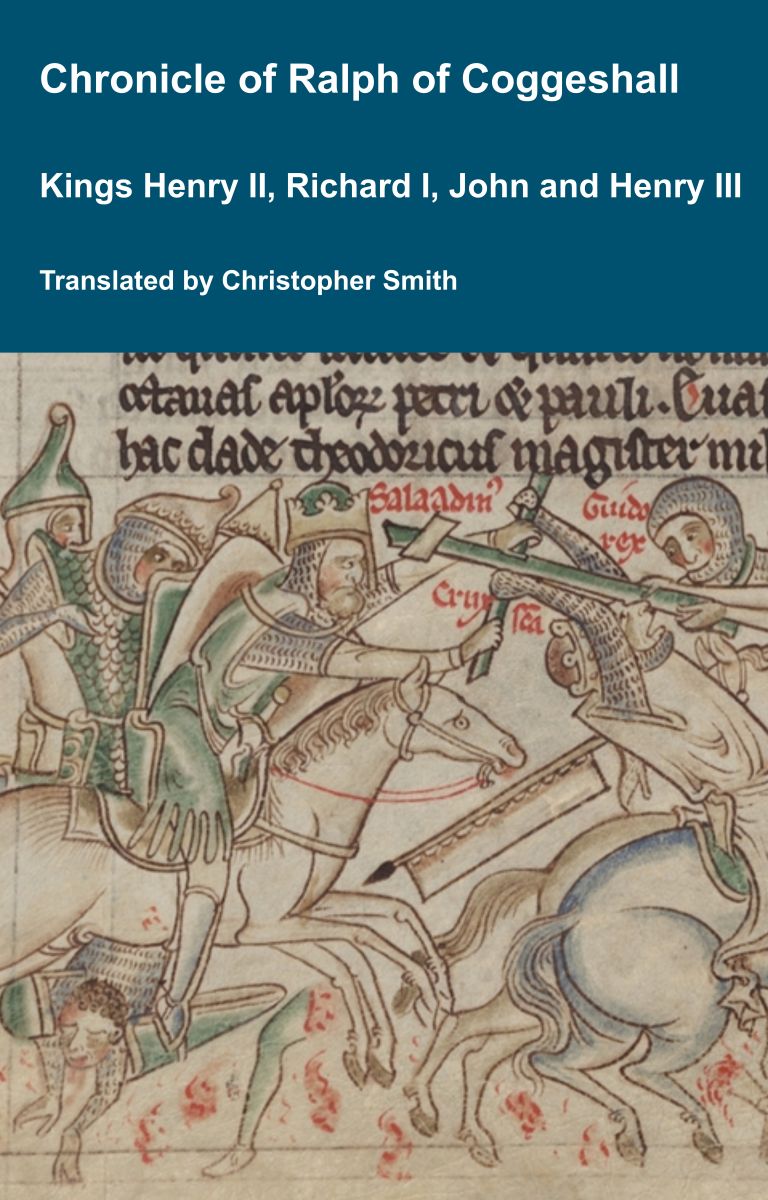
Chronicle of Abbot Ralph of Coggeshall
The Chronicle of Abbot Ralph of Coggeshall (Chronicon Anglicanum) is an indispensable medieval history that brings to life centuries of English and European affairs through the eyes of a learned Cistercian monk. Ralph of Coggeshall, abbot of the Abbey of Coggeshall in Essex in the early 13th century, continued and expanded his community’s chronicle, documenting events from the Norman Conquest of 1066 into the tumultuous reign of King Henry III. Blending eyewitness testimony, careful compilation, and the monastic commitment to record-keeping, this chronicle offers a rare narrative of political intrigue, royal power struggles, and social upheaval in England and beyond. Ralph’s work captures the reigns of pivotal figures such as Richard I and King John, providing invaluable insights into their characters, decisions, and the forces that shaped medieval rule. More than a simple annal, Chronicon Anglicanum conveys the texture of medieval life and governance, making it a rich source for scholars and readers fascinated by English history, monastic authorship, and the shaping of the medieval world.
Available at Amazon in eBook and Paperback format.
Before 1320 [his father] Gilbert Stapleton and [his mother] Agnes aka Matilda Fitzalan were married.
In 1320 Miles Stapleton was born to [his father] Gilbert Stapleton and [his mother] Agnes aka Matilda Fitzalan.
In 1321 [his father] Gilbert Stapleton died.
In or before 1326 Roger Strange 4th Baron Strange Knockin and [his future wife] Joan Ightham Baroness Strange Knockin were married. She by marriage Baroness Strange Knockin.
On 23rd April 1344 King Edward III of England created the Order of the Garter. The date nominal as there are different accounts; some sources say 1348.
2 Henry of Grosmont 1st Duke Lancaster.
3 Thomas Beauchamp 11th Earl Warwick.
4 Jean Grailly.
5 Ralph Stafford 1st Earl Stafford.
6 William Montagu 2nd Earl Salisbury.
7 Roger Mortimer 2nd Earl March.
9 Bartholomew "The Younger" Burghesh 2nd Baron Burghesh.
10 John Beauchamp 1st Baron Beauchamp Warwick.
11 John Mohun 2nd Baron Mohun of Dunster.
12 Hugh Courtenay.
13 Thomas Holland 1st Earl Kent.
15 Richard Fitzsimon.
16 Miles Stapleton.
17 Thomas Wale.
18 Hugh Wrottesley.
19 Neil Loring.
20 John Chandos.
21 James Audley.
22 Otho Holland.
23 Henry Eam.
24 Sanchet Abrichecourt.
 Become a Member via our Buy Me a Coffee page to read more.
On 3rd November 1348 [his mother] Agnes aka Matilda Fitzalan died in Bedale.
Annales of England by John Stow. This yeere, on Saint Georges day [23rd April 1350], the king held a great and solemne feast at his castle of Windsor, where he had augmented the chappel which Henry the first and other his progenitors, kings of England, had before erected, of eight chanons. He added to those eight chanons a deane and fifteene chanons more, and 24 poore and impotent knights, with other ministers and servants, as appeareth in his charter dated the two and twentieth of his reigne. Besides the king, there were other also that were contributors to the foundation of this colledge, as followeth: i. The sovereigne king Edward the third, 2. Edward, his eldest sonne, prince of Wales, 3. Henry, duke of Lancaster, 4. the earle of Warwicke, 5. Captaine de Bouch, 6. Ralph, earle of Stafford, 7. William Montacute, earle of Salisburie, 8. Roger, lorde Mortimer, earle of March, 9. sir John de Lisle, 10. sir Bartholomew Burwash, 11. sir John Beauchampe, 12. sir John Mahune, 13. sir Hugh Courtney, 14. sir Thomas Holland, 15. sir John Grey, 16. sir Richard Fitz Simon, 17. sir Miles Stapleton, 18. sir Thomas Walle, 19. sir Hugh Wrothesley, 20. sir Nele Loring, 21. sir John Chandos, 22. sir James de Audley, 23. sir Othes Holland, 24. sir Henry Eme, 25. sir Sechet Dabridgecourt, 26. sir Wiliam Panell. All these, together with the king, were clothed in gownes of russet, poudered with garters blew, wearing the like garters also on their right legges, and mantels of blew with scutcheons of S. George. In this sort of apparell they, being bare-headed, heard masse, which was celebrated by Simon Islip, archbishop of Canterbury, and the bishops of Winchester and Excester, and afterwards they went to the feast, setting themselves orderly at the table, for the honor of the feast, which they named to be of S. George the martyr and the choosing of the knights of the Garter.
On 30th November 1350 Miles Stapleton and Joan Ightham Baroness Strange Knockin were married.
Around 1355 [his son] John Stapleton was born to Miles Stapleton. He died aged nine in 1364.
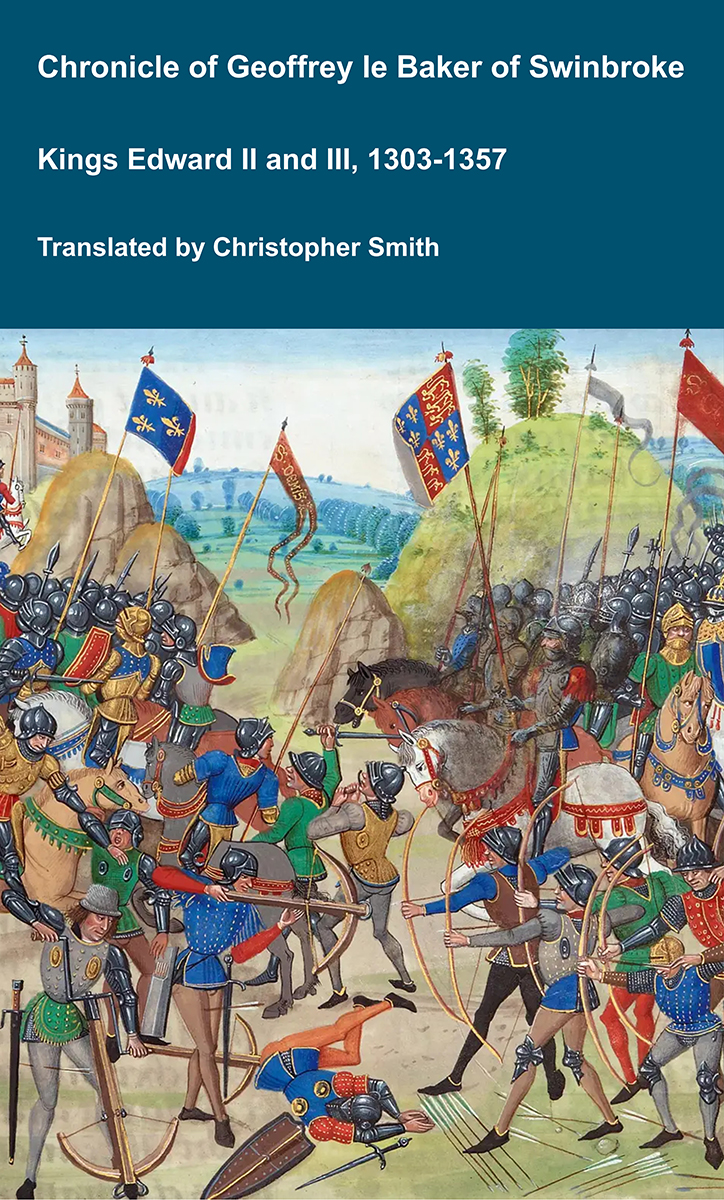 Chronicle of Geoffrey le Baker of Swinbroke. Accordingly, after offering homage and an oath of fealty,1 he received by the King's command Sir Miles de Stapleton, a man of great virtue and remarkable devotion to the Blessed Virgin, yet well-instructed in the conduct of war, as a most faithful partner in the desired enterprise. These renowned warriors, with two thousand men in arms, set out for Normandy, scouring the countryside, capturing walled towns and other strongholds; some they burned, others they received in surrender or ransom, and they advanced as far as a certain castle2 only nine leagues from the city of Paris. Nor did they cease from this labour until, having agreed to a truce, which will be related in the following year,3 they returned to England.
Igitur, offerens homagium et iurata fidelitate, recepit ex ordinacione regis dominum Milonem de Stapiltone, virum magne probitatis et mire devocionis ad Virginem beatam, set bellicis negociis experienciis egregiis instructum, collegam fidelissimum laboris optati. Prenominati viri bellicosi, cum duobus milibus togatorum Neustriam profecti, patriam transequitarunt, capientes opida murata et alias municiones, et, nonnullis igne consumptis, aliis deditis et redemptis, processerunt usque ad castrum quoddam, quod IX leucis dumtaxat distinguitur a civitate Parisiensi. Nec a tanto labore vacare curabant quousque, treugis initis, annali proximo dicendis, in Angliam redierunt.
Note 1. Baker is here going back upon Lancaster's raid, already referred to. Sir Miles Stapleton was one of the founders of the Garter; he died in 1364.
Note 2. Verneuil was the furthest point reached by Lancaster.
Note 3. This would imply that Baker intended to carry on his chronicle.
On 23rd June 1357 [his son] Miles Stapleton was born to Miles Stapleton at Ingham, Norfolk.
Before 1364 [his son] John Stapleton died.
On 29th September 1364 Battle of Auray decided the Breton Succession in favour of John Montfort V Duke Brittany. The Breton and English army was commanded by John Chandos and included William Latimer 4th Baron Latimer of Corby, Miles Stapleton and Hugh Calverley. Charles of Blois Duke Brittany was killed. Bertrand Geusclin surrendered.
On 4th December 1364 Miles Stapleton died.
In or before 1365 [his former wife] Joan Ightham Baroness Strange Knockin died.
Effigy of Sir Miles Stapleton and his Lady. Miles Stapleton and [his former wife] Joan Ightham Baroness Strange Knockin
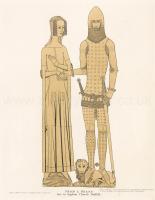
Effigy of Sir Miles Stapleton and his Lady. ONE of those engraved plates familiarly termed brasses. It is on the floor of the chancel of Ingham church, Norfolk, and commemorates Sir Miles Stapleton, Knight of the Garter, and his wife, Joan, daughter of Sir Oliver Ingham, and widow of Lord Strange, of Knockyn. He died on Wednesday before the feast of St. Nicholas, 38 Edward III. (December 4,1364.) The lady, perhaps from courtesy as a coheiress, is placed on the knight's right hand. An elegant crocketed gothic canopy and pinnacles surmount the figures. These have suffered some mutilation. Into the verge of the stone has been inserted a fillet of brass, with this inscription:
Priez pour les almes de Monseur Miles de Stapleton, et Dame Johanne, sa femme, fille de Monseur Oliver de Ingham, fondours de ceste maison; qe dieu de jour almes eit pitie.
[Pray for the alms of Sir Miles of Stapleton, and Dame Johanne, his wife, daughter of Sir Oliver of Ingham, founders of this house; may god of day almes have mercy]
That portion printed in the black letter alone now remains, the rest is supplied from Bloomfield.
[his daughter] Joan Stapleton was born to Miles Stapleton.