

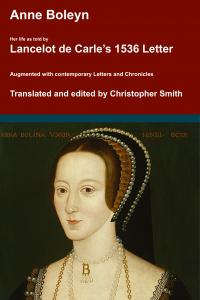
Anne Boleyn. Her Life as told by Lancelot de Carle's 1536 Letter.
In 1536, two weeks after the execution of Anne Boleyn, her brother George and four others, Lancelot du Carle, wrote an extraordinary letter that described Anne's life, and her trial and execution, to which he was a witness. This book presents a new translation of that letter, with additional material from other contemporary sources such as Letters, Hall's and Wriothesley's Chronicles, the pamphlets of Wynkyn the Worde, the Memorial of George Constantyne, the Portuguese Letter and the Baga de Secrets, all of which are provided in Appendices.
Available at Amazon in eBook and Paperback format.
Before 24th March 1300 [his father] William Latimer 3rd Baron Latimer of Corby and [his mother] Elizabeth Botetort Baroness Latimer Corby were married. She by marriage Baroness Latimer of Corby.
On 24th March 1330 William Latimer 4th Baron Latimer of Corby was born to [his father] William Latimer 3rd Baron Latimer of Corby and [his mother] Elizabeth Botetort Baroness Latimer Corby at Scampston, Ryedale.
Before 2nd November 1335 [his father] William Latimer 3rd Baron Latimer of Corby died. William Latimer 4th Baron Latimer of Corby succeeded 4th Baron Latimer of Corby.
On 24th June 1340 King Edward III of England attacked the French fleet at anchor during the Battle of Sluys capturing more than 200 ships, killing around 18000 French. The English force included John Beauchamp 1st Baron Beauchamp Warwick, William Bohun 1st Earl of Northampton, Henry Scrope 1st Baron Scrope of Masham, William Latimer 4th Baron Latimer of Corby, John Lisle 2nd Baron Lisle, Ralph Stafford 1st Earl Stafford, Henry of Grosmont 1st Duke Lancaster, Walter Manny 1st Baron Manny, Hugh Despencer 1st Baron Despencer and Richard Pembridge.
Thomas Monthermer 2nd Baron Monthermer died from wounds. Margaret Monthermer Baroness Montagu 3rd Baroness Monthermer succeeded 3rd Baroness Monthermer.
On 26th August 1346 the army of King Edward III of England defeated the French army at the Battle of Crécy. The English army was commanded by King Edward III of England, his son Edward "Black Prince", Thomas Beauchamp 11th Earl Warwick, William Bohun 1st Earl of Northampton and John Beauchamp 1st Baron Beauchamp Warwick.
The English army was included: Bishop Thomas of Hatfield, Hugh Despencer 1st Baron Despencer, Bernard Brocas, Thomas Felton, James Audley, Robert Bourchier 1st Baron Bourchier, Bartholomew "The Elder" Burghesh 1st Baron Burghesh, Bartholomew "The Younger" Burghesh 2nd Baron Burghesh, Reginald Cobham 1st Baron Cobham, John Darcy 1st Baron Darcy of Knayth, Robert Ferrers 3rd Baron Ferrers of Chartley, Richard Scrope 1st Baron Scrope of Bolton, William Scrope, Stephen Scrope, William Latimer 4th Baron Latimer of Corby, John Lisle 2nd Baron Lisle, Gerard Lisle 1st Baron Lisle, Nicholas Longford, Edward Montagu 1st Baron Montagu, Walter Paveley 4th Baron Burghesh, Michael Poynings 1st Baron Poynings, Robert Ufford 1st Earl Suffolk, John de Vere 7th Earl of Oxford, Thomas West, John Willoughby 2nd Baron Willoughby, John Wingfield, Henry Percy 11th and 3rd Baron Percy, Hugh Courtenay 2nd or 10th Earl Devon (possibly), Walter "Elder" Devereux, John Devereux, Enion Sais Brecon, John Chandos, Richard Pembridge and John Sully.
The French army suffered significant casualties. King Philip "Fortunate" VI of France was wounded. William de Coucy and his son Enguerrand 6th Lord de Coucy and were killed.
Charles II Count Alençon was killed. Charles Valois Archbishop of Lyons succeeded Count Alençon.
Louis Chatillon II Count Blois I Count Chatillon was killed. Louis Chatillon III Count Blois Count Soissons succeeded III Count Blois.
Louis Dampierre II Count Nevers I Count Flanders was killed. Louis of Male III Count Nevers II Count Flanders succeeded III Count Nevers, II Count Flanders.
King John I of Bohemia was killed. Charles IV King Bohemia Holy Roman Emperor Luxemburg succeeded IV King Bohemia, Holy Roman Emperor Luxemburg. Blanche Valois Holy Roman Empress Luxemburg by marriage Holy Roman Empress Luxemburg.
Rudolph "Valiant" Metz I Duke Lorraine was killed. John Metz I Duke Lorraine succeeded I Duke Lorraine.
Jean IV de Harcourt was killed.
Before 1351 William Latimer 4th Baron Latimer of Corby was knighted.
Before 1353 William Latimer 4th Baron Latimer of Corby and Elizabeth Fitzalan were married. She the daughter of Edmund Fitzalan 2nd or 9th Earl of Arundel and Alice Warenne Countess Arundel.
On 20th January 1356 King Edward I of Scotland surrendered his claim to the Scottish throne to King Edward III of England in the presence of William Latimer 4th Baron Latimer of Corby in exchange for an English pension.
Around 1357 [his daughter] Elizabeth Latimer 5th Baroness Latimer, Baroness Neville and Willoughby was born to William Latimer 4th Baron Latimer of Corby and [his wife] Elizabeth Fitzalan. She married (1) before 9th October 1381 John Neville 3rd Baron Neville of Raby, son of Ralph Neville 2nd Baron Neville of Raby and Alice Audley Baroness Greystoke and Neville, and had issue (2) after 17th October 1388 Robert Willoughby 4th Baron Willoughby, son of John Willoughby 3rd Baron Willoughby and Cecily Ufford Baroness Willoughby of Eresby.
In 1361 William Latimer 4th Baron Latimer of Corby was appointed 40th Knight of the Garter by King Edward III of England.
On 29th September 1364 Battle of Auray decided the Breton Succession in favour of John Montfort V Duke Brittany. The Breton and English army was commanded by John Chandos and included William Latimer 4th Baron Latimer of Corby, Miles Stapleton and Hugh Calverley. Charles of Blois Duke Brittany was killed. Bertrand Geusclin surrendered.
In 1371 William Latimer 4th Baron Latimer of Corby was appointed Lord Chamberlain of the Household.
In 1373 William Latimer 4th Baron Latimer of Corby was appointed Constable of Dover Castle.
In 1374 William Latimer 4th Baron Latimer of Corby was appointed Warden of the Cinque Ports.
Archaeologia Volume 22 Section XVI. [1376] The Lord Latimer is putt from hys office and hys goodes are confisked.
The duke therfor in the mean tyme, the prefixed day of judgment for the cause of the Lorde Latymer and Rychard Lioñes drawynge near, considered with equall balances the articles and depositions agaynst the sayed Lorde Latymer and Rychard Lioñes; for there were above thre score notable faultes deposed agaynst hym, of the whiche for the moste part of them he was convicted before the duke & judges, covetynge also to pacifye the people whom he knew to be moved agaynst them, and fearynge the majestye of the prince, whom he knew to favour the people and knyghtes, with judiciall sentence he depryved the Lorde Latimer of his offyce, for he was the kynges Lorde Chamberlayne, and confisked all hys goods that colde be found unto the kynge, that he sholde only be content with hys enhaunsed inheritance, and for that they wolde not have his body because he was a peere of the realme, they adjudged hym to perpetuale pryson, to be sayfely kept by the sergeants untell the kynges pleasure were knowne; yt was further ordeyned of him by publicke decree of parlement that the sayed Lord Latimer sholde from thenceforth be holden as infamous, and should not by any means be admytted to the councell of the kynge or realme. Rychard Lionnes also, he dispossessed from all hys lands and tenements that he possessed in Englande, and commanded hys bodye to be kepte in the towre of London. But this rigor was dissolved by the untymely deathe of Prynce Edwarde that folowed, for after this deathe yt was lawfull for the duke to doo what he wolde, as in the nexte page yt shall appear.
Archaeologia Volume 22 Section XVI. [1376] The Lord Latymer is depryved of hys offyce, and the depositions agaynst hym.b
The Duke therefor, as afore is touched, punyshed with the most sharpe prickes of his conscience, and terryfied with the answeares of his consaylors, layed asyde all vigor and stoutnes of stomake, and the nexte day came into the assembly of the knyghtes, and, contrary to all expectations, shewed hymself so favourable and so mylde, that he drew them all into an admyracion. They knew how proude Moab was ii or iij dayes before, although they regarded not his arrogancye; and they sayed, is not this the change of the right hand of the hiest? The Duke counterfaytinge modestye deceitfully seemed to comforte them, sayinge he knew well the desires of the knightes to be zelous and to tender the state of the realme, and therfor whatsoever they thought good to be corrected, they shuld speake and he wolde putt thereto the wyshed remedye.
Note b. William, Lord Latymer, who had distinguished himself in the wars of Britany against Charles de Blois, was Governor of Becherel, and also of the Castle of St. Saviour in that province. A particular account of him will be found in Dugdale's Baronage, vol. ii. p. 32. The proceedings in the Impeachment noticed in the text are recorded in the Rolls of Parliament, vol. ii. p. 324 et seq. He was nevertheless employed in important offices and negociations in the commencement of the following reign.
On 24th January 1376 [his brother-in-law] Richard Fitzalan 3rd or 10th Earl of Arundel 8th Earl of Surrey died. He was buried at Lewes Priory. Richard Fitzalan 9th Earl of Surrey 4th or 11th Earl of Arundel succeeded 9th Earl Surrey, 4th or 11th Earl Arundel. Elizabeth Bohun Countess Arundel and Surrey by marriage Countess Arundel, Countess Surrey.
After 28th April 1376 William Latimer 4th Baron Latimer of Corby impeached (the earliest impeachment in England) during the Good Parliament.
In 1377 William Latimer 4th Baron Latimer of Corby was appointed Governor of Calais.
On 28th May 1381 William Latimer 4th Baron Latimer of Corby died. He was buried at Guisborough Priory. [his daughter] Elizabeth Latimer 5th Baroness Latimer, Baroness Neville and Willoughby succeeded 5th Baroness Latimer of Corby.
Around 3rd January 1389 [his former wife] Elizabeth Fitzalan died.