

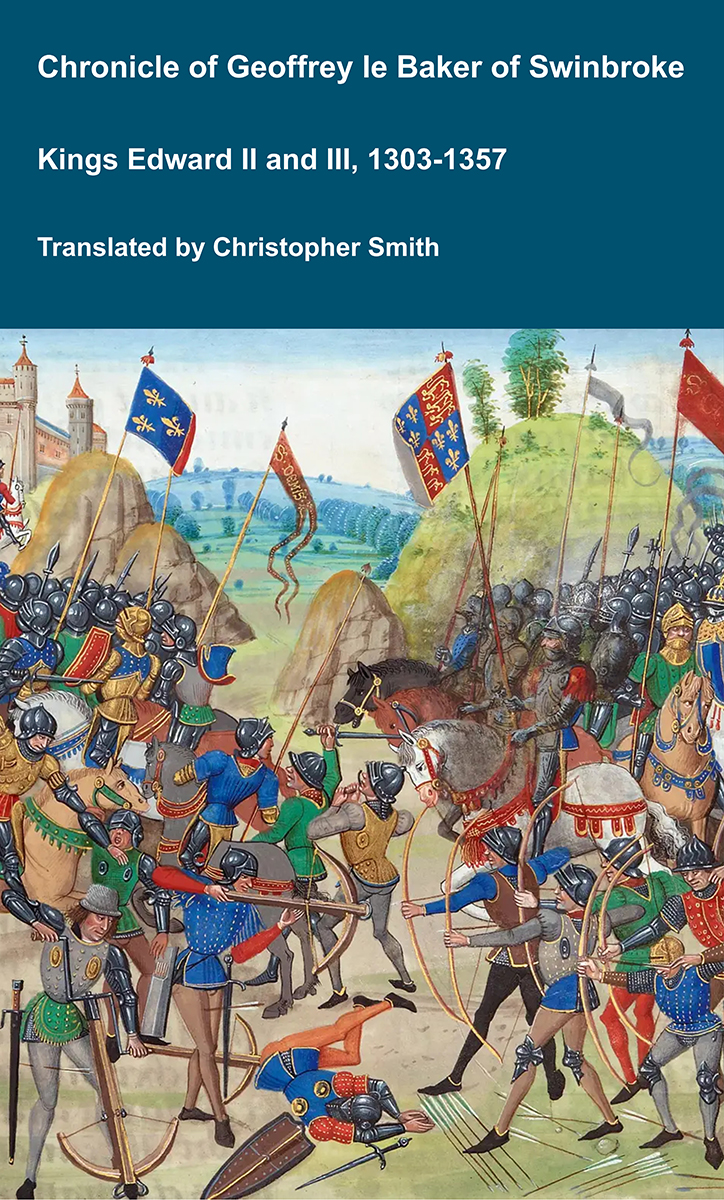
Chronicle of Geoffrey le Baker of Swinbroke
Baker was a secular clerk from Swinbroke, now Swinbrook, an Oxfordshire village two miles east of Burford. His Chronicle describes the events of the period 1303-1356: Gaveston, Bannockburn, Boroughbridge, the murder of King Edward II, the Scottish Wars, Sluys, Crécy, the Black Death, Winchelsea and Poitiers. To quote Herbert Bruce 'it possesses a vigorous and characteristic style, and its value for particular events between 1303 and 1356 has been recognised by its editor and by subsequent writers'. The book provides remarkable detail about the events it describes. Baker's text has been augmented with hundreds of notes, including extracts from other contemporary chronicles, such as the Annales Londonienses, Annales Paulini, Murimuth, Lanercost, Avesbury, Guisborough and Froissart to enrich the reader's understanding. The translation takes as its source the 'Chronicon Galfridi le Baker de Swynebroke' published in 1889, edited by Edward Maunde Thompson.
Available at Amazon in eBook and Paperback format.
Boroughbridge is in North Yorkshire.
See: Aldborough Roman Site [Map], Boroughbridge Bridge [Map], Horsefair Boroughbridge [Map], The Devil's Arrow's [Map].
On 25th August 1330 John Mohun [aged 30] was killed at Boroughbridge [Map]. He was buried at Dunster, Somerset.
In 1558 William Fairfax [aged 27] was elected MP Boroughbridge.
In 1588 Edward Fitton [aged 40] was elected MP Boroughbridge.
In 1601 Thomas Fairfax 1st Viscount Fairfax [aged 27] was elected MP Boroughbridge.
In 1602 Richard Whalley of Kirton [aged 36] was elected MP Boroughbridge.
In 1609 Thomas Vavasour [aged 49] was elected MP Boroughbridge.
In November 1640 Thomas Maulever 1st Baronet [aged 41] was elected MP Boroughbridge.
In 1648 Henry Stapylton aka Stapleton 1st Baronet [aged 31] was elected MP Boroughbridge.
In 1660 Henry Stapylton aka Stapleton 1st Baronet [aged 43] was elected MP Boroughbridge.
The Deeds of the Dukes of Normandy
The Gesta Normannorum Ducum [The Deeds of the Dukes of Normandy] is a landmark medieval chronicle tracing the rise and fall of the Norman dynasty from its early roots through the pivotal events surrounding the Norman Conquest of England. Originally penned in Latin by the monk William of Jumièges shortly before 1060 and later expanded at the behest of William the Conqueror, the work chronicles the deeds, politics, battles, and leadership of the Norman dukes, especially William’s own claim to the English throne. The narrative combines earlier historical sources with firsthand information and oral testimony to present an authoritative account of Normandy’s transformation from a Viking settlement into one of medieval Europe’s most powerful realms. William’s history emphasizes the legitimacy, military prowess, and governance of the Norman line, framing their expansion, including the conquest of England, as both divinely sanctioned and noble in purpose. Later chroniclers such as Orderic Vitalis and Robert of Torigni continued the history, extending the coverage into the 12th century, providing broader context on ducal rule and its impact. Today this classic work remains a foundational source for understanding Norman identity, medieval statesmanship, and the historical forces that reshaped England and Western Europe between 800AD and 1100AD.
Available at Amazon in eBook and Paperback format.
In 1679 John Brookes 1st Baronet [aged 42] was elected MP Boroughbridge.
In 1681 John Brookes 1st Baronet [aged 44] was elected MP Boroughbridge.
In 1689 Christopher Vane 1st Baron Barnard [aged 35] was appointed MP Boroughbridge.
In 1690 Bryan Stapylton 2nd Baronet [aged 32] was elected MP Boroughbridge.
In 1705 John Stapylton 3rd Baronet [aged 22] was elected MP Boroughbridge, which his father Bryan Stapylton 2nd Baronet [aged 47] had represented for twelve of the previous fifteen years.
In 1708 Bryan Stapylton 2nd Baronet [aged 50] was elected MP Boroughbridge replacing his son John Stapylton 3rd Baronet [aged 25].
In 1715 Bryan Stapylton 2nd Baronet [aged 57] was elected MP Boroughbridge.
In 1718 Wilfrid Lawson 3rd Baronet [aged 21] was elected MP Boroughbridge.
On 22nd April 1746 Francis Scott [aged 25] was elected MP Boroughbridge.
In 1755 Cecil Bishopp 6th Baronet [aged 54] was elected MP Boroughbridge which seat he held until 1768.
Henrici Quinti, Angliæ Regis, Gesta, is a first-hand account of the Agincourt Campaign, and subsequent events to his death in 1422. The author of the first part was a Chaplain in King Henry's retinue who was present from King Henry's departure at Southampton in 1415, at the siege of Harfleur, the battle of Agincourt, and the celebrations on King Henry's return to London. The second part, by another writer, relates the events that took place including the negotiations at Troye, Henry's marriage and his death in 1422.
Available at Amazon in eBook and Paperback format.
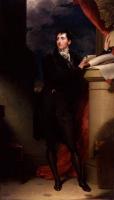
In 1796 Francis Burdett 5th Baronet [aged 25] was elected MP Boroughbridge.
The River Ure rises at Ure Head, North Yorkshire [Map] after which it over Aysgarth Falls [Map], past Middleham Castle [Map], Jervaulx Abbey, North Yorkshire [Map], St Nicholas Church, West Tanfield, North Yorkshire [Map], east of Ripon, North Yorkshire [Map], under the bridge at Boroughbridge [Map] after which it is joined by the River Swale to form the River Ouse.
From Eboracum aka York [Map] Dere Street travels to Aldborough [Map], Leeming Bar, North Yorkshire [Map], Cataractonium [Map] aka Catterick, Piercebridge, County Durham [Map], Vinovia aka Binchester, County Durham [Map], on the banks of the River Wear, Ebchester, County Durham [Map], where it crosses the County Durham River Derwent, Corbridge Roman Fort, Northumberland [Map], where it, and crosses the River Tyne and Stanegate Roman Road began.
On 16th March 1322 the rebel army led by Thomas Plantagenet 2nd Earl of Leicester, 2nd Earl Lancaster, Earl of Salisbury and Lincoln [aged 44] attempted to cross the bridge over the River Ure (between Ripon and York) at Boroughbridge Bridge [Map]. Their path was blocked by forces loyal to the King led by Andrew Harclay 1st Earl Carlisle [aged 52]. Bartholomew Badlesmere 1st Baron Badlesmere [aged 46], Roger Mortimer 1st Earl March [aged 34], John Botetort 1st Baron Botetort [aged 57] and John Maltravers 1st Baron Maltravers [aged 32] fought for the rebels. Roger Clifford 2nd Baron Clifford [aged 22], Nicholas Longford [aged 37], Thomas Plantagenet 2nd Earl of Leicester, 2nd Earl Lancaster, Earl of Salisbury and Lincoln, John Mowbray 2nd Baron Mowbray [aged 35] were captured.
Warin Lisle [aged 51] was hanged after the battle at Pontefract [Map].
Following the battle Hugh Audley 1st Earl Gloucester [aged 31] and his wife Margaret Clare Countess Gloucester were both imprisoned. He in Nottingham Castle [Map] and she in Sempringham Priory [Map].
John Clinton 2nd Baron Clinton [aged 22], Ralph Greystoke 1st Baron Greystoke [aged 22], William Latimer 2nd Baron Latimer of Corby [aged 46], Robert Lisle 1st Baron Lisle [aged 34], Domhnall Mar II Earl of Mar [aged 29] and Peter Saltmarsh [aged 42] fought for the King.
Adam Everingham 1st Baron Everingham of Laxton [aged 43] was captured.
Humphrey Bohun 4th Earl Hereford 3rd Earl Essex [aged 46] was killed. His son John [aged 15] succeeded 5th Earl Hereford, 4th Earl Essex.
Piers Grandison 2nd Baron Grandison [aged 31] fough for the rebels, and was captured.
Hugh Audley 1st Baron Audley of Stratton Audley [aged 55] surrendered before the battle and was imprisoned in Wallingford Castle [Map] for the rest of his life
John Giffard 2nd Baron Giffard Brimpsfield [aged 34] was captured.
Roger Mortimer 1st Earl March was imprisoned at Tower of London [Map].


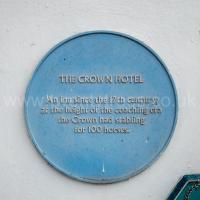
Crown Hotel [Map].
Also under Fishergate (north side) Hotel. Site formerly occupied by the Manor House of the Tancred family, remains of which are indicated by the central stone gable section of the Fishergate elevation which contains a four-centred fireplace and blocked window. Otherwise C18 appearance. Rendered. Slate roof. Bridge Street front:- wooden modillion eaves cornice: 2 storeys, 6 bays. Central entrance has wooden doorcase with consoles, cornice and pediment. Iron boot scrapers to either side. Flanking single-storey canted bays and a further 2-storey canted bay to the right. Sash windows with glazing, 1 bars (some original) in architraves. Fishergate front: total of 15 sashes to 1st floor. 6 single-storey bays to ground floor. Central stone gabled section has C20 French doors. Sash windows with glazing bars in architraves. An important coaching inn in the later C18.
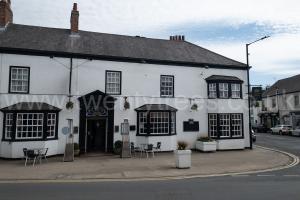
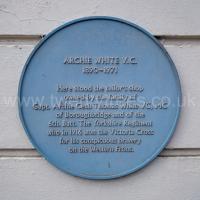
White Tailor's Shop [Map]. Blue Plaque to Archie White.
Archie White: On 5th October 1890 he was born. In 1916 Archie White was awarded the Victoria Cross. See The London Gazette 29802 Supplement. On 20th May 1971 he died.
The Devil's Arrow's is also in North England Standing Stones.
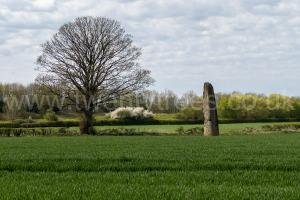
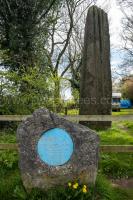
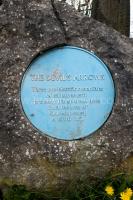
2700BC. The The Devil's Arrow's [Map] are three monoliths, the second highest in England, near Boroughbridge in Yorkshire. The tallest stone is 6.85m high. There are likely to have originally been more. William Camden mentions four stones in his Britannia, noting that "one was lately pulled downe by some that hoped, though in vaine, to finde treasure." The outer stones are 110m and 60m away from the central stone and form an alignment that is almost straight, running NNW-SSE.
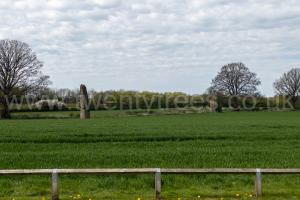
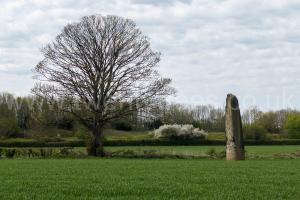
Britannia by Camden Chapter 20. [1607]. Neere unto this bridge Westward wee saw in three divers little fields foure huge stones of pyramidall forme [Map], but very rudely wrought, set as it were in a streight and direct line. The two Pyramides in the middest, whereof the one was lately pulled downe by some that hoped, though in vaine, to finde treasure, did almost touch one another. The uttermore stand not far off, yet almost in equall distance from these on both sides. Of these I have nothing else to say but that I am of opinion with some that they were monuments of victorie erected by the Romans hard by the high street that went this way. For I willingly overpasse the fables of the common people, who call them the Devills Bolts, which they shot at ancient cities and therewith overthrew them. Yet will not I passe over this, that very many, and those learned men, thinke they are not made of naturall stone in deed, but compounded of pure sand, lime, vitriol (whereof also they say there bee certaine small graines within), and some unctuous matter. Of such a kinde there were Rome cisterns, so firmely compact of very strong lime and sand, as Pliny writeth, that they seemed to be naturall stones.
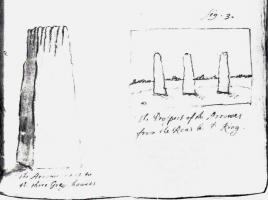
1687. Drawing of the The Devil's Arrow's [Map] by John Aubrey [aged 60].

Avebury by William Stukeley. Boroughbridge. The stones, as much famed by the name of the Devil's Arrows [The Devil's Arrow's [Map]], as misrepresented by writers, stand in some fields, half a mile west of the Roman road south of Boroughbridge. Some think them Roman, though they regard not any Roman work hereabouts: some say they are factitious, though plain stone as possible. They are stones of very large dimensions, and have been hewn pretty square, much as those at Stonehenge; but silly people have knocked off the edges: their height is very great: they were very taper and well-shaped, and much of an obelisk form; but the tops are decayed, and long furrows worn down on all sides along the tenderest part of the grain of the stone. I remarked, that they all lean somewhat southward. The stone is intirely composed of small white crystals, unperishable by weather: they are certainly natural, and brought about ten miles off, from the west, where more such lie above ground in great plenty. Three now stand; one was taken away, as all report, to make a bridge over the bec a little eastward. The cross near the church is of the same stone. These stones stood 200 foot asunder, pretty near in a line north and south: the first stone westward is not so high as the other, but broader much, and stands square, or perpendicular to the line of direction; it is 8½ foot broad, 4½ thick, 23 foot about; the second in the next pasture is square each side, but not precisely; it is 5 foot broad, 4 foot thick, 18 foot fquare: the next is twice as far distant, and beyond the road, of a figure much like the former, but rather higher, as that is higher than the first; this is 5 foot by 4: the two last are very beautiful obelisks, and their height about 25 foot, as I guess. The ground this fine monument stands on is high, and declines every way a little from it; the great river [River Ure], the brook, and some low ground to the south, hem it in as it were. Mr. Gale, and the beforementioned clergyman, some time since dug under one to the foundation, and found that it was about five foot under ground, and fastened into its seat by stones laid in clay, quite around it, as a wall: they put four half-pence, in a leaden box underneath, of queen Anne, Vigo, &c. and filled it up again. I could not commend them for it, as it could only tend to mislead the curious of future times.

14th September 1725. Drawing of the The Devil's Arrow's [Map] by William Stukeley [aged 37].
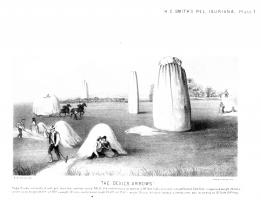
Reliquiæ Isurianæ. Commencing our Illustrations with the Druidical remains, the Devil's Arrows [Map] (so called) claim a primary notice. These remarkable Obelisks appear to belong to that class of Celtic or Druidical monuments termed Meanhirs, Peulvans, or Pillar Stones, the earliest known memorials1 of the primitive inhabitants of Western Europe. They have been the source of unceasing misapprehension to antiquaries for the last three hundred years. Leland, Camden, Drake, and others supposed them to be of Roman origin, notwithstanding the absence of ornament or the least vestige of an inscription, which in Roman workmanship we certainly should expect, from universal analogy. Camden2 states it to be the opinion of many "learned men," but who would appear to have resisted the evidence of their own senses, that these colossal objects were artificial, and composed of fine sand, lime, vitriol, and small pebbles! —instancing, in corroboration of this idea, the compact artificial stone of the Romans described by Pliny. Dr. Gale, suspecting their having been designed for the reception of Roman mercuries, to indicate the way, four roads meeting here, could not be convinced to the contrary, till, by personal inspection, a sense of the practical impossibility of such a purpose was forced upon him3. Ackerman4 classifies them, with good reason, among Druidical remains, but erroneously states them (in 1847) to be four in number, and as not unlikely to have formed part of a circle (or temple); whereas these monoliths have for a long period been but three in number, and their line is so slightly curved, that, if part of a circle, the latter must have had a radius above half a mile in length, and would for the greater part of its course have extended along low ground! Their original natural forms appear to us to have been but little altered by art5; they taper upwards, where also the artificial grooves or flutings (long supposed to be rain-worn channels!) are more noticeable than nearer the surface of the ground, but below it they clearly demonstrate the operation of the celt, or some analogous instrument. The stone is the coarse rag or millstone-grit of the North of England, than which probably none other could be selected more calculated for weathering all time. No such stone, however, is to be met with in the immediate vicinity; but at Plumpton, ten miles distant, it occurs in large detached masses, and whence it may safely be considered these Obelisks were procured, though not without incalculable labour and trouble, in the rude and early age that witnessed their erection. They surpass in magnitude the average of the stones of the temple at Stonehenge, which, it may be remembered, were conveyed a distance of fifteen miles. They all lean somewhat to the southward, and occupy a rather elevated position, as the ground slightly declines on all sides; yet their site is not sufficiently commanding to warrant the belief of its use for beacons.
Note 1. "Of more ancient date than Druidism itself." Grose's Antiquities, 1777.
Note 2. Bishop Gibson's, vol. ii., p. 96.
Note 3. Drake's York, p. 25.
Note 4. Archæological Index, pp. 16—18. i
Note 5. In the opinion of Dr. Stukeley and others, they were hewn square Obelisks; but a careful examination of them, and a visit to the site of their probable production, will, we think, dispel the notion.
Anne Boleyn. Her Life as told by Lancelot de Carle's 1536 Letter.
In 1536, two weeks after the execution of Anne Boleyn, her brother George and four others, Lancelot du Carle, wrote an extraordinary letter that described Anne's life, and her trial and execution, to which he was a witness. This book presents a new translation of that letter, with additional material from other contemporary sources such as Letters, Hall's and Wriothesley's Chronicles, the pamphlets of Wynkyn the Worde, the Memorial of George Constantyne, the Portuguese Letter and the Baga de Secrets, all of which are provided in Appendices.
Available at Amazon in eBook and Paperback format.
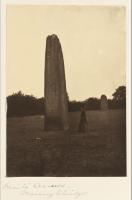
August 1887. Godfrey Bingley [aged 45]. The Devil's Arrow's [Map].
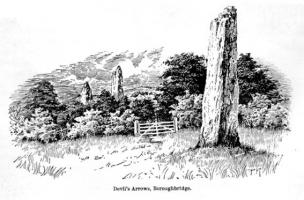
From Edenvale to the Plains of York. Yet stay, there uprears three mysterious relics [The Devil's Arrow's [Map]] just to the west of Boroughbridge; by whom raised, and for what purpose, no one will ever know. That they are the oldest British memorials known, we have not the slightest doubt. Here they still stand, sentinels from hoary antiquity, inscribed with no record; and as we muse in front of the immense blocks, trying to unravel the great mystery of their origin, and peer back into the far past, we almost imagine some voice from the old world will come to our aid, but, as we ponder, our thoughts only become more and more confused amidst the hazy web of an unfathomable mystery which surrounds them; yet the great blocks, defying the ravages of time, stand silent in front of us, revealing the fact that some powerful people, far away down the shadowy aisles of time, who have not left their names on the pages of history, have raised them, to be gazed on for all ages, and have not left a key to solve the problem whereby to tell the story of their use or origin. Thus musing, a gruff voice of the 19th century breaks the stillness, and disperses the dim figures of two thousand years ago: *' Hi, mister, deant ya knaw what them thair stenes is?" On acknowledging our ignorance, he triumphantly informed us "that they wer't devil's arrows."