

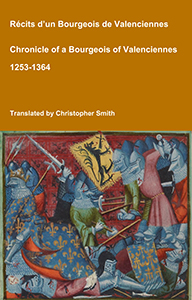
Chronicle of a Bourgeois of Valenciennes
Récits d’un bourgeois de Valenciennes aka The Chronicle of a Bourgeois of Valenciennes is a vivid 14th-century vernacular chronicle written by an anonymous urban chronicler from Valenciennes in the County of Hainaut. It survives in a manuscript that describes local and regional history from about 1253 to 1366, blending chronology, narrative episodes, and eyewitness-style accounts of political, military, and social events in medieval France, Flanders, and the Low Countries. The work begins with a chronological framework of events affecting Valenciennes and its region under rulers such as King Philip VI of France and the shifting allegiances of local nobility. It includes accounts of conflicts, sieges, diplomatic manoeuvres, and the impact of broader struggles like the Hundred Years’ War on urban life in Hainaut. Written from the perspective of a burgher (bourgeois) rather than a monastery or royal court, the chronicle offers a rare lay viewpoint on high politics and warfare, reflecting how merchants, townspeople, and civic institutions experienced the turbulence of the 13th and 14th centuries. Its narrative style combines straightforward reporting of events with moral and civic observations, making it a valuable source for readers interested in medieval urban society, regional politics, and the lived experience of war and governance in pre-modern Europe.
Available at Amazon in eBook and Paperback format.
Leicester, Leicestershire is in Leicestershire.
1345 Funeral Henry 3rd Earl Lancaster
1361 Death of Henry of Grosmont
1414 Fire and Faggot Parliament
Fosse Way 5f Leicester to Lincoln. Leaving Ratae Corieltavorum [Map] aka Leicester the Fosse way continues north-west through Thurmaston, Leicestershire [Map], past Syston [Map], where it makes a slight change in direction, through Six Hills, Leicestershire [Map] where Roman road (RM58) forks off north east to Grantham [Map]. Then passing Vernementum [Map] aka Willoughby-on-the-Wolds the Fosse Way make another minor change in alignment at Cotgrave [Map] before continuing through Margidunum, Nottinghamshire [Map], Ad Pontem [Map] aka East Stoke. Ad Pontem refers to it being close to the River Trent. The road continues through Newark on Trent, Nottinghamshire [Map] then Crococalana Roman Settlement [Map] near present day Brough. At Bracebridge [Map] the Fosse Way meets Ermine Street 2 before continuing into Lindum Colonia [Map] aka Lincoln.
Fosse Way Leicester. At Ratae Corieltavorum [Map] aka Leicester the Fosse way crossed the River Soar at Leicester Roman Bridge [Map] entering the town by the west gate. Thereafter it continued straight along the High Street [Map] to the North-East Gate [Map] and thereafter along Haymarket [Map] and Belgrave Gate [Map].
Fosse Way 5e High Cross to Leicester. From Venonae [Map] aka High Cross the Fosse Way continues north-west over the River Soar near to Sapcote, Leicestershire [Map] then continues to Ratae Corieltavorum [Map] aka Leicester.
Anglo-Saxon Chronicle. 917. This year rode the army, after Easter, out of Northampton [Map] and Leicester [Map]; and having broken the truce they slew many men at Hookerton and thereabout. Then, very soon after this, as the others came home, they found other troops that were riding out against Leighton. But the inhabitants were aware of it; and having fought with them they put them into full flight; and arrested all that they had taken, and also of their horses and of their weapons a good deal.
Anglo-Saxon Chronicle. 918. This year, before midsummer, went King Edward to Maldon, Essex [Map]; and repaired and fortified the town, ere he departed thence. And the same year went Earl Thurkytel over sea to Frankland with the men who would adhere to him, under the protection and assistance of King Edward [aged 44]. This year Ethelfleda [aged 48] got into her power, with God's assistance, in the early part of the year, without loss, the town of Leicester, Leicestershire [Map]; and the greater part of the army that belonged thereto submitted to her. And the Yorkists had also promised and confirmed, some by agreement and some with oaths, that they would be in her interest. But very soon after they had done this, she departed, twelve nights before midsummer, at Tamworth [Map], the eighth year that she was holding the government of the Mercians with right dominion; and her body lieth at Glocester, in the east porch of St. Peter's church [Map]. This year also was the daughter of Ethered, lord of the Mercians, deprived of all authority over the Mercians, and led into Wessex, three weeks before midwinter. Her name was Healfwina.
In 1068 Hugh Grandesmil [aged 36] took by storm at Leicester, Leicestershire [Map].
On 22nd February 1098 Hugh Grandesmil [aged 66] died at Leicester, Leicestershire [Map]. He was buried in the Chapter House of the Abbey of Saint-Evroul.
On 19th October 1330 Roger Mortimer 1st Earl March [aged 43] taken to Leicester, Leicestershire [Map].
In 1426 John Talbot 2nd Earl of Shrewsbury [aged 8] was knighted alongside Henry VI at Leicester, Leicestershire [Map].
On 19th May 1426, Whitsunday, King Henry VI of England and II of France [aged 4] was knighted by his uncles John Lancaster 1st Duke Bedford [aged 36] and Humphrey Lancaster 1st Duke Gloucester [aged 35] at Leicester, Leicestershire [Map]. Henry then went on to knight Ralph Longford [aged 25], Thomas Courtenay 5th or 13th Earl Devon [aged 12] and Robert Wingfield [aged 23].
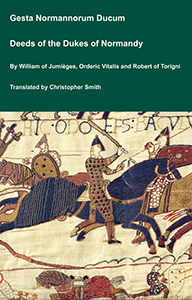
The Deeds of the Dukes of Normandy
The Gesta Normannorum Ducum [The Deeds of the Dukes of Normandy] is a landmark medieval chronicle tracing the rise and fall of the Norman dynasty from its early roots through the pivotal events surrounding the Norman Conquest of England. Originally penned in Latin by the monk William of Jumièges shortly before 1060 and later expanded at the behest of William the Conqueror, the work chronicles the deeds, politics, battles, and leadership of the Norman dukes, especially William’s own claim to the English throne. The narrative combines earlier historical sources with firsthand information and oral testimony to present an authoritative account of Normandy’s transformation from a Viking settlement into one of medieval Europe’s most powerful realms. William’s history emphasizes the legitimacy, military prowess, and governance of the Norman line, framing their expansion, including the conquest of England, as both divinely sanctioned and noble in purpose. Later chroniclers such as Orderic Vitalis and Robert of Torigni continued the history, extending the coverage into the 12th century, providing broader context on ducal rule and its impact. Today this classic work remains a foundational source for understanding Norman identity, medieval statesmanship, and the historical forces that reshaped England and Western Europe between 800AD and 1100AD.
Available at Amazon in eBook and Paperback format.
Chronicle of Gregory. 13th January 1450. Ande aftyr Synt Hyllary is day the Parlyment was remevyd unto Laycetter [Map]; ande yn the mene tyme was Caneyoldyn, ande alle the remenaunt of Normandy, savyng Chyrborowe [Map]. And the Duke of Sowthefolke [aged 53] was a-pechide at that Parlyment, he beynge at London, of verry graunte tresou, and of many poyntys; among alle othyr, for that he schulde have solde Normandy, and also for the dethe of that nobylle prynce the Duke of Glouceter, and for many othyr poyntys of treson, for the whyche he was exylyd out of Ingelonde for certayne yerys.
Close Rolls Edward IV Edward V Richard III 1476-1485. 23rd October 1483 King Richard III of England [aged 31]. Leicester, Leicestershire [Map]. Precept to the Sheriff of Devon to issue a proclamation (English) denouncing Thomas Dorset, late Marquess of Dorset [aged 28], who holds unshameful and mischievous woman called Shore's wife in adultery, Sir William Noreys [aged 42], Sir William Knevet [aged 43], Sir Thomas Bourghchier of Barnes, Sir George Broun, knights, John Cheyne, John Noreis, Walter Hungerford, John Russh and John Harecourt of Staunton, who have assembled the Person by the comfort of the great rebel the late duke of Bukyngham [aged 29] and bishops of Ely and Salisbury, and offering rewards for their capture and pardon for all who withdraw from them. By K.
Close Rolls Edward IV Edward V Richard III 1476-1485. 28th October 1483 King Richard III of England [aged 31]. Leicester, Leicestershire [Map]. General commission of array to the king's kinsman Francis Lovell, Viscount Lovel his chamberlain, for the resistance of the rebel Henry, duke of Buskingham. Mutilated. By K. by word of mouth.
On 22nd August 1485 King Richard III of England [aged 32] was killed during the Battle of Bosworth. His second cousin once removed Henry Tudor [aged 28] succeeded VII King of England.
Humphrey Cotes [aged 35] died. It isn't clear on which side he was fighting.
Those supporting Henry Tudor included:
John Blount 3rd Baron Mountjoy [aged 35].
John Cheney 1st Baron Cheyne [aged 43].
Richard Guildford [aged 35].
Walter Hungerford [aged 21].
Thomas Stanley 1st Earl of Derby [aged 50].
Edward Woodville Lord Scales [aged 29].
Edward Courtenay 1st Earl Devon [aged 26].
Rhys ap Thomas Deheubarth [aged 36].
Jasper Tudor 1st Duke Bedford [aged 53].
William Beaumont 2nd Viscount Beaumont [aged 47].
Giles Daubeney 1st Baron Daubeney [aged 34].
William Stanley [aged 50].
Roger Kynaston of Myddle and Hordley [aged 52].
Henry Marney 1st Baron Marney [aged 38].
William Brandon [aged 29] was killed.
James Harrington [aged 55] was killed.
John Howard 1st Duke of Norfolk [aged 60] was killed and attainted. He was buried firstly at Thetford Priory, Norfolk [Map] and therafter at Church of St Michael the Archangel, Framlingham [Map]. Duke Norfolk, Baron Mowbray, Baron Segrave, Baron Howard forfeit.
John Sacheverell [aged 85] was killed.
Philibert Chandee 1st Earl Bath
William Norreys [aged 44], Gilbert Talbot [aged 33], John de Vere 13th Earl of Oxford [aged 42] and John Savage [aged 41] commanded,.
Robert Poyntz [aged 35] was knighted.
Those who fought for Richard III included:
John Bourchier 6th Baron Ferrers of Groby [aged 47].
John Conyers [aged 74].
Thomas Dacre 2nd Baron Dacre Gilsland [aged 17].
William Berkeley 1st Marquess Berkeley [aged 59].
Richard Fitzhugh 6th Baron Fitzhugh [aged 28].
John Scrope 5th Baron Scrope of Bolton [aged 48].
Thomas Scrope 6th Baron Scrope of Masham [aged 26].
Henry Grey 4th or 7th Baron Grey of Codnor [aged 50].
Edmund Grey 1st Earl Kent [aged 68].
Ralph Neville 3rd Earl of Westmoreland [aged 29].
John de la Pole Earl Lincoln 1st [aged 23].
Humphrey Stafford [aged 59].
George Talbot 4th Earl of Shrewsbury [aged 17].
Thomas Howard 2nd Duke of Norfolk [aged 42] was wounded, captured and imprisoned in the Tower of London [Map] for three years. He was attainted; Earl Surrey forfeit.
Francis Lovell 1st Viscount Lovell [aged 29] fought and escaped.
John Zouche 7th Baron Zouche Harringworth [aged 26] was captured.
John Babington [aged 62], William Alington [aged 65], Robert Mortimer [aged 43], Robert Brackenbury, Richard Ratclyffe [aged 55] and Richard Bagot [aged 73] were killed
Walter Devereux Baron Ferrers of Chartley [aged 53] was killed.
William Catesby [aged 35] was executed at Leicester, Leicestershire [Map] after the battle.
George Stanley 9th Baron Strange Knockin 5th Baron Mohun Dunster [aged 25] held as a hostage by Richard III before the Battle of Bosworth.
Henry Percy 4th Earl of Northumberland [aged 36] betrayed King Richard III of England by not committing his forces at the Battle of Bosworth.
John Iwardby [aged 35] was killed.


 Become a Member via our Buy Me a Coffee page to read more.
Around 1530 Mary Hungerford Baroness Hastings, 4th Baroness Hungerford, 5th Baroness Botreaux and 2nd Baroness Moleyns [aged 64] died at Leicester, Leicestershire [Map]. Her son George [aged 43] succeeded 5th Baron Hungerford, 3rd Baron Moleyns, 6th Baron Botreaux.

On 29th November 1530 Cardinal Thomas Wolsey [aged 57] died in Leicester, Leicestershire [Map]. Just before his death he reputedly spoke these words: "I see the matter against me how it is framed. But if I had served God as diligently as I have done the King, he would not have given me over in my grey hairs".
On 15th September 1649 Henry Hastings [aged 71] died in Leicester, Leicestershire [Map].
John Evelyn's Diary. 9th August 1654. To the old and ragged city of Leicester [Map], large and pleasantly seated, but despicably built, the chimney flues like so many smiths' forges; however, famous for the tomb of the tyrant, Richard III, which is now converted to a cistern, at which (I think) cattle drink. Also, here in one of the churches lies buried the magnificent Cardinal Wolsey. John of Gaunt has here also built a large but poor hospital, near which a wretch has made him a house out of the ruins of a stately church. Saw the ruins of an old Roman Temple, thought to be of Janus. Entertained at a very fine collection of fruits, such as I did not expect to meet with so far North, especially very good melons. We returned to my uncle's.
The River Soar rises near Wibtoft, Warwickshire [Map] after which it travels broadly north through Leicester, Leicestershire [Map], past Mountsorrel Castle [Map], Normanton on Soar, Nottinghamshire [Map] and Holy Trinity Church Ratcliffe on Soar [Map] before joining the River Trent.
The capital of the Corieltauvi was Ratae Corieltauvorum aka Leicester, Leicestershire [Map].
Fosse Way Leicester. At Ratae Corieltavorum [Map] aka Leicester the Fosse way crossed the River Soar at Leicester Roman Bridge [Map] entering the town by the west gate. Thereafter it continued straight along the High Street [Map] to the North-East Gate [Map] and thereafter along Haymarket [Map] and Belgrave Gate [Map].
Bow Bridge, Leicester [Map]. Two bridges originally crossed the western arm of the River Soar where the present Bow Bridge stands. Bow Bridge carried the road from Leicester to Hinckley, whilst nearby the smaller Little Bow Bridge, which belonged to the neighbouring Augustinian friary, gave the friars access across the river to a close containing St Augustine's Well.
The two bridges both probably take their name from the Little Bow Bridge, which was described as 'one large arch like a bow'. The Little Bow Bridge was swept away in a flood in 1791. Bow Bridge was built of stone with five semi-circular arches, piers with cut-waters, and niches at intervals along both sides in which pedestrians could stand to allow vehicles to pass – this was because the bridge was 21m long but only 1.8m wide, leaving enough space for only a single waggon to cross at once. The bridge was repaired in 1666, and again in 1784 when it was widened with brickwork, but was eventually demolished in 1861 and replaced with a wider iron bridge.
On 21st August 1485, King Richard [aged 32] and his army marched out of Leicester, leaving through the west gate and over Bow Bridge [Map], as they made their way towards Bosworth.
In 1863 the present Bow Bridge, Leicester [Map]was built, designed by the city as a memorial to Richard III. Its decorative ironwork bears the town's coat-of-arms: a white cinquefoil on a red shield, interspersed with roses and the coats-of-arms of Richard III and Henry VIII.
Greyfriars Church Leicester, Leicestershire is also in Churches in Leicestershire.
After 22nd August 1485 King Richard III of England [deceased] was buried at Greyfriars Church Leicester, Leicestershire [Map].
Greyfriars Priory, Leicester is also in Priories in England.
In May 1414 the Fire and Faggot Parliament at Greyfriars Priory, Leicester [Map]. Walter Hungerford 1st Baron Hungerford [aged 35] was appointed Speaker of the House of Commons. It was named for the Suppression of Heresy Act which called for burning the Lollards with bundles of sticks known as faggots.
Chronicles of London Vitellius A XVI. [15th August 1485] And after the ffeeld doon, the said Kyng Richard was caried vpon an hors behynd a man all naked to Leyciter, fast by the ffeeld; and there buryed wt in the ffreres [Map].
Fosse Way Leicester. At Ratae Corieltavorum [Map] aka Leicester the Fosse way crossed the River Soar at Leicester Roman Bridge [Map] entering the town by the west gate. Thereafter it continued straight along the High Street [Map] to the North-East Gate [Map] and thereafter along Haymarket [Map] and Belgrave Gate [Map].
Fosse Way Leicester. At Ratae Corieltavorum [Map] aka Leicester the Fosse way crossed the River Soar at Leicester Roman Bridge [Map] entering the town by the west gate. Thereafter it continued straight along the High Street [Map] to the North-East Gate [Map] and thereafter along Haymarket [Map] and Belgrave Gate [Map].
Leicester Abbey is also in Abbeys in England.
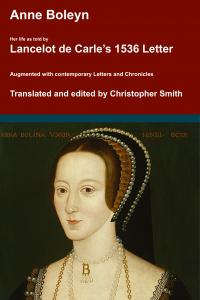
Anne Boleyn. Her Life as told by Lancelot de Carle's 1536 Letter.
In 1536, two weeks after the execution of Anne Boleyn, her brother George and four others, Lancelot du Carle, wrote an extraordinary letter that described Anne's life, and her trial and execution, to which he was a witness. This book presents a new translation of that letter, with additional material from other contemporary sources such as Letters, Hall's and Wriothesley's Chronicles, the pamphlets of Wynkyn the Worde, the Memorial of George Constantyne, the Portuguese Letter and the Baga de Secrets, all of which are provided in Appendices.
Available at Amazon in eBook and Paperback format.
On 9th November 1241 Stephen Segrave [aged 70] died at Leicester Abbey [Map].
Wriothesley's Chronicle [1508-1562]. 29th November 1530. This yeare, on the even of St. Andrewe,d the Cardinall, Thomas Wolsey [aged 57], died at Leicester, cominge to London to his indictment,e and there is buried in Our Ladies Chappell. Some recken he killed himselfe with purgations.f
Note d. November 29.
Note e. The Cardinal had been arrested by the Earl of Northumberland [aged 28] on a charge of high treason at Cawood [Map], near York, on the 4th of November.
Note f. Wolsey is generally believed to hare died of dysentery at Leicester Abbey [Map], on the third day of his jourmey, about 8 o'clock in the morning of the 29th of November, being in the sixtieth year of his age. He was buried at midnight, without any solemnity, in Our Lady Chapel in the church of that monastery.
Leicester Castle is also in Castles in Leicestershire.
On 22nd September 1345 Henry Plantagenet 3rd Earl of Leicester 3rd Earl Lancaster [aged 64] died at Leicester Castle [Map]. His son Henry [aged 35] succeeded 4th Earl of Leicester, 4th Earl Lancaster.
On 31st March 1360 Philippa of Lancaster Queen Consort Portugal was born to John of Gaunt 1st Duke Lancaster [aged 20] and Blanche Duchess of Lancaster [aged 18] at Leicester Castle [Map]. She a granddaughter of King Edward III of England. She married 2nd February 1387 her half fourth cousin King John I of Portugal, son of Peter I King Portugal and Inês Castro, and had issue.
On 23rd March 1361 Henry of Grosmont 1st Duke Lancaster [aged 51] died at Leicester Castle [Map]. He was buried at Church of the Annunciation of our Lady of the Newark [Map]. Duke Lancaster, Earl Lincoln extinct.
Blanche Duchess of Lancaster [aged 18] succeeded 5th Countess Lancaster and 2nd Countess Derby. John of Gaunt 1st Duke Lancaster [aged 21] by marriage Earl Lancaster, Earl Derby.
Maud Plantagenet Duchess Lower Bavaria [aged 20] succeeded 5th Countess of Leicester.
On 24th March 1394 Constance of Castile Duchess of Lancaster [aged 40] died at Leicester Castle [Map]. She was buried at Church of the Annunciation of our Lady of the Newark [Map].
On 3rd February 1399 John of Gaunt 1st Duke Lancaster [aged 58] died at Leicester Castle [Map]. Katherine Swynford aka Roet Duchess Lancaster [aged 48] was by his side. His son Henry [aged 31] succeeded 2nd Duke Lancaster, 7th Earl of Leicester. He was buried in the Choir of St Paul's Cathedral [Map] with his first wife Blanche Duchess of Lancaster.
King Richard II of England [aged 32] witheld the future Henry IV's inheritance from him giving Henry reason to return to England to claim his lands and titles.


After 22nd September 1345 Henry Plantagenet 3rd Earl of Leicester 3rd Earl Lancaster [deceased] was buried at Church of the Annunciation of our Lady of the Newark [Map], or possibly the Hospital Chapel, at a ceremony attended by King Edward III of England [aged 32] and his wife Philippa of Hainaut Queen Consort England [aged 35]. His son Henry of Grosmont 1st Duke Lancaster [aged 35] subsequently had his remains moved to St Mary de Castro Leicester, Leicestershire [Map].
Before 1367 Geoffrey Chaucer [aged 23] and Philippa Roet [aged 20] were married at St Mary de Castro Leicester, Leicestershire [Map].
In 1618 Mabel Faunt died. She was buried at St Mary de Castro Leicester, Leicestershire [Map].
Leicester Cathedral is also in Cathedrals in England.
In 1786 Archdeacon Andrew Burnaby [aged 53] was appointed Archdeacon of Leicester.
On 26th March 2015 King Richard III of England was reburied at Leicester Cathedral [Map].
Fosse Way Leicester. At Ratae Corieltavorum [Map] aka Leicester the Fosse way crossed the River Soar at Leicester Roman Bridge [Map] entering the town by the west gate. Thereafter it continued straight along the High Street [Map] to the North-East Gate [Map] and thereafter along Haymarket [Map] and Belgrave Gate [Map].

Effigy of Sir William de Staunton. THIS singular tomb in Staunton Church, Nottinghamshire, commemorates Sir William de Staunton. This family, who took their surname from the spot where they were settled and had possessions, are said to have nourished there before the æra of the Norman Conquest. A rhyming herald of the sixteenth century, speaking of them, says,
"The first Sir Mauger Staunton, Knight,
Before Wiiiiam came in-"
They held their lands at Staunton by tenure of castle guard of the Lords of Belvoir. There was a tower in that fortress [Map] called Staunton Tower, which they, by obligation of the tenure no doubt, built and kept in repair. Sir William was the son of Sir Geoffrey de Staunton and Alice his wife. He was a knight of active reputation, favoured by Edward I and employed in his service. He made his will in 1312, and from it we may gather that he was under a vow of pilgrimage to the Holy Land, for he left a bequest of five marks each to two footmen who should go "the first passage," in his name. He died in 1326. The monumental stone of Sir William de Staunton is somewhat fanciful; it appears intended to represent him lying in his coffin, the lid of which is cut away to show the figure as far as the elbows, and the feet to the ancles. On the centre of the stone is his helmet, and his shield with two chevronsa. Round the edge of the stone runs the following inscription in the black letter character, being an early instance of its adoption.
Hic jacet Will's de Staunton miles filius galfridde eademb militis que obiit in idu maii anno d'ni......CCXXVI cui' an .. p'picietur. On that part of his surcoat visible, the upper of the two chevrons appears.
Note a. A seal of his Father Geoffrey, appendant to a charter, bears two bars and a!arge canton, charged with a mullet of six points. His son, it appears, adopted another coat: his seal, as well the tomb, exhibits the two chevrons. Legend, s . WILL . DE . STANTON . MILITIS.
Note b. Blundered for Galfridi ejusdem, as also que for qui, the second following word.
The History of William Marshal was commissioned by his son shortly after William’s death in 1219 to celebrate the Marshal’s remarkable life; it is an authentic, contemporary voice. The manuscript was discovered in 1861 by French historian Paul Meyer. Meyer published the manuscript in its original Anglo-French in 1891 in two books. This book is a line by line translation of the first of Meyer’s books; lines 1-10152. Book 1 of the History begins in 1139 and ends in 1194. It describes the events of the Anarchy, the role of William’s father John, John’s marriages, William’s childhood, his role as a hostage at the siege of Newbury, his injury and imprisonment in Poitou where he met Eleanor of Aquitaine and his life as a knight errant. It continues with the accusation against him of an improper relationship with Margaret, wife of Henry the Young King, his exile, and return, the death of Henry the Young King, the rebellion of Richard, the future King Richard I, war with France, the death of King Henry II, and the capture of King Richard, and the rebellion of John, the future King John. It ends with the release of King Richard and the death of John Marshal.
Available at Amazon in eBook and Paperback format.
Fosse Way Leicester. At Ratae Corieltavorum [Map] aka Leicester the Fosse way crossed the River Soar at Leicester Roman Bridge [Map] entering the town by the west gate. Thereafter it continued straight along the High Street [Map] to the North-East Gate [Map] and thereafter along Haymarket [Map] and Belgrave Gate [Map].