


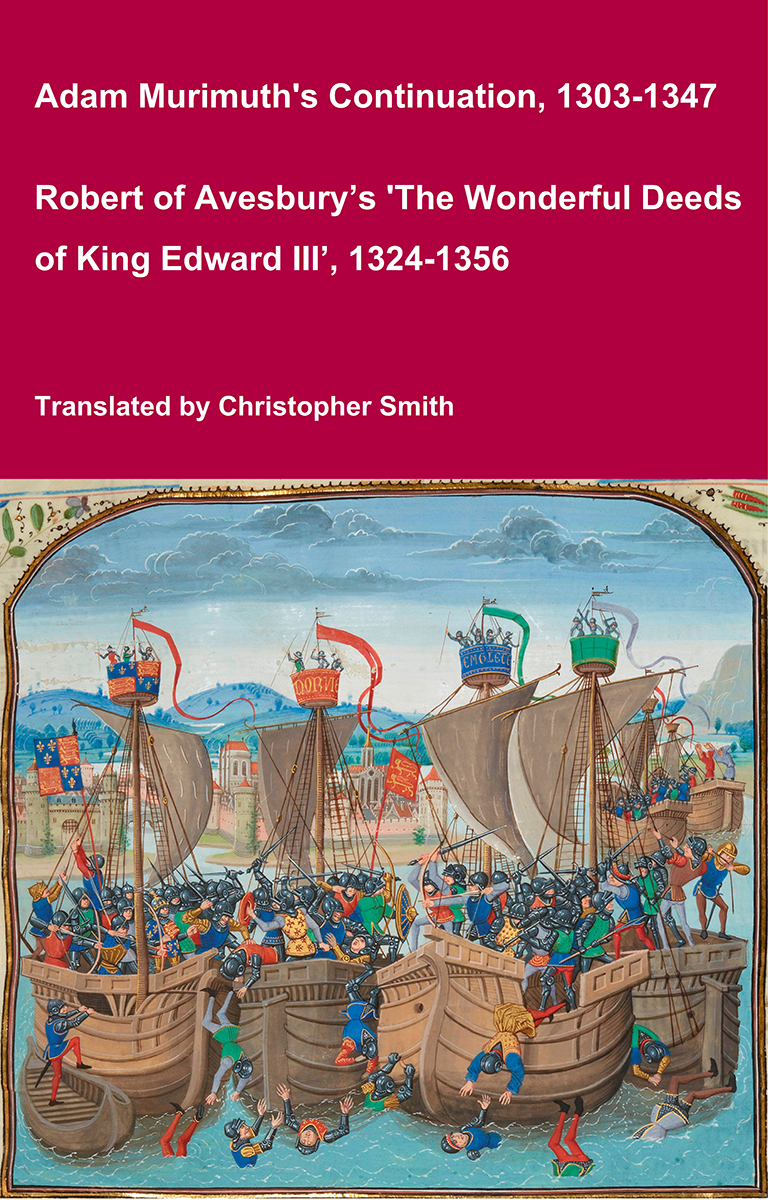
Adam Murimuth's Continuation and Robert of Avesbury’s 'The Wonderful Deeds of King Edward III'
This volume brings together two of the most important contemporary chronicles for the reign of Edward III and the opening phases of the Hundred Years’ War. Written in Latin by English clerical observers, these texts provide a vivid and authoritative window into the political, diplomatic, and military history of fourteenth-century England and its continental ambitions. Adam Murimuth Continuatio's Chronicarum continues an earlier chronicle into the mid-fourteenth century, offering concise but valuable notices on royal policy, foreign relations, and ecclesiastical affairs. Its annalistic structure makes it especially useful for establishing chronology and tracing the development of events year by year. Complementing it, Robert of Avesbury’s De gestis mirabilibus regis Edwardi tertii is a rich documentary chronicle preserving letters, treaties, and official records alongside narrative passages. It is an indispensable source for understanding Edward III’s claim to the French crown, the conduct of war, and the mechanisms of medieval diplomacy. Together, these works offer scholars, students, and enthusiasts a reliable and unembellished account of a transformative period in English and European history. Essential for anyone interested in medieval chronicles, the Hundred Years’ War, or the reign of Edward III.
Available at Amazon in eBook and Paperback format.
Richmond Palace is in Richmond, Surrey.
1394 Death and Funeral of Anne of Bohemia
1503 Margaret Tudor's Journey to Scotland
Archaeologia Volume 35 1853 XXXIII. On the following day, the 16th of April [1358], Isabella set out on a journey from Hertford, and the movements of her household are recorded to have been - on the 16th to Tottenham; on the 17th to London; on the 20th to Shene; on the 21st to Upton ( near Windsor ), the Queen herself going, it is stated, to Chertsey; on the 26th to Shene again; and on the 30th to London, where it remained till the 13th of May.
Archaeologia Volume 35 1853 XXXIII. On the 26th [Apr 1358], having returned to Shene, doubtless from Windsor, Isabella receives her daughter Joan Queen of Scotland, with her retinue. Joan is stated to have come at this time on a political mission to the court of Edward III.; and from the present document it would appear that she continued a guest with her mother Isabella up to the time of the death of the latter; and that even her own dress and the livery of her retinue were supplied from Isabella's funds.
Archaeologia Volume 35 1853 XXXIII. On the 29th, being still at Shene, Isabella is visited by Edward III., the Lady Isabella ( the King's eldest daughter ), and the Earl of March, who sup with her.
On 21st June 1377 King Edward III of England died of a stroke at Sheen Palace. He was buried in the Chapel of St Edward the Confessor, Westminster Abbey. King Richard II of England succeeded II King of England.


On 7th June 1394 Anne of Bohemia Queen Consort England died of plague (probably) at Sheen Palace. King Richard II of England was so distraught at her death he ordered the destruction of Sheen Palalce.
Wriothesley's Chronicle [1508-1562]. 1501. This yeare the Kinge buylded new his manner at Sheene,d and chaunged the name and named it Richmonde;e and buylded new his place, called the Baynards Castle, in London; and repayred his place in Greenewich, with muche new buyldinge.f
Note d. Stow has placed this paragraph under the year 1507, being the twenty-second year of Henry's reign.
Note e. After his own title.
Note f. Greenwich has much favoured by Henry VII and here his son, afterwards Henry VIII was born.


On 27th June 1503 Margaret Tudor Queen Scotland left Richmond Palace for Scotland accompanied by Thomas Boleyn 1st Earl Wiltshire and Ormonde, Edward Howard, Richard Neville 2nd Baron Latimer of Snape and Ralph Ogle 3rd Baron Ogle. During her journey she stayed at Collyweston, Northamptonshire and York.
On 21st April 1509 King Henry VII of England and Ireland died of tuberculosis at Richmond Palace. Henry VIII succeeded VIII King of England. Duke York and Earl Chester merged with the Crown.


Wriothesley's Chronicle [1508-1562]. 21st April 1509. This yeare, in Aprill, died King Henry the Vllth at Richmond and his Sonne King Henry the VIII was proclaymed Kinge on St Georges dayeg 1508 [1509], in the same moneth.
Note g. We should here read St George's Eve, 22nd April, 1509, from which day Henry Vlll reckoned his regnal years. Stow, however, says that Henry was not proclaimed till the 24th.
On 1st January 1511 Prince Henry Duke of Cornwall was born to Henry VIII and Catherine of Aragon at Richmond Palace. He was appointed Duke of Cornwall at birth.
On 22nd February 1511 Prince Henry Duke of Cornwall died. He was buried at Westminster Abbey. He died aged less than one years old.


Wriothesley's Chronicle [1508-1562]. 1st January 1511. This yeare, Prince Henrie, the Kings first sonne, was borne at Richmonde on Newe Yeares dayeb, and on St. Mathie's day [Note. 23 Feb] after the saide Prince died, and was buried at Westminster.
Note b. On the 1st January, 1510 [Note. 1511 if years are adjusted to begin on 01 Jan.]
Note c. Or rather St. Mathias' eve, February 23. Hall, howerer, says that this Prince died on "the 22 Feb. being the Even of Saint Mathy," which would seem to show that St. Mathias' day was sometimes kept on the 23rd, instead of the 24th February, in which case our text is correct.
On 9th July 1540 Henry VIII's marriage to Anne of Cleves was annulled. He gave her a generous settlement including Richmond Palace and Hever Castle, Kent, at an annual rent of £9-13s-3½d.. Bishop Robert Parfew aka Warton signed the delcaration. She was given precedence above all other women other than the King's wife future wives and daughters, referring to her thereafter as The King's Sister. She lived seventeen more years outliving Henry's two next wives Queen Catherine Howard of England and Catherine Parr Queen Consort England, and King Edward VI of England and Ireland.


Wriothesley's Chronicle [1508-1562]. The eight daie of October [1547] my Lord Protectors Grace came from North home, and in Finsburie Fields my lord major, with the aldermen in their skarlett gownes, with certaine of the comens in their liveries with their hoodes, mett his Grace, the major and aldermen on horsebacke, and he ever tooke one of them by the handea, and after my lord major rode with him to the pounde in Smythfield, where my Lord Protector tooke his leve of them, and so rode that night to his place at Shene, and the morrowe after to the King at Hampton Court.
Note a. Probably a clerical error for "he tooke every one of them by the hand."
On 3rd June 1550 John Dudley 2nd Earl Warwick and Anne Seymour Countess of Warwick were married at Sheen Palace. She the daughter of Edward Seymour 1st Duke of Somerset and Anne Stanhope Duchess Somerset. He the son of John Dudley 1st Duke Northumberland and Jane Guildford Duchess Northumberland.
On 4th June 1550 Robert Dudley 1st Earl of Leicester and Amy Robsart were married at Sheen Palace. King Edward VI of England and Ireland and William Cecil 1st Baron Burghley attended. He the son of John Dudley 1st Duke Northumberland and Jane Guildford Duchess Northumberland.


The Gentleman's Magazine Volume 179 Pages 595-600. [4th June 1550]. Lord Robert Dudley, at the period of his marriage, was eighteen years of age, and it is probable that the lady [Amy Robsart] was not older. The wedding took place on the 4th of June, 1550, the day after the memorable alliance had been accomplished between the Lord Lisle, Lord Robert's elder brother, and the Lady Anne Seymour, which it was vainly hoped would have cemented the reconciliation of the rival statesmen their fathers,—Edward Seymour Duke of Somerset, and John Dudley Earl of Warwick, afterwards Duke of Northumberland. The second marriage, which was celebrated, like the former, at the royal palace of Sheen, is thus noticed by King Edward VI. in his diary:
"June 4. Sir Robert Dudely, third sonne to th'erle of Warwic, maried sir John Robsartes daughter; after wich mariage ther were certain gentlemen that did strive who shuld first take away a gose's heade wich was hanged alive on tow crose postes."
Henry Machyn's Diary. 3rd August 1553. The iij day of August, at Rychemond, was my lord Cortnay created the yerle of Denshyre of owre nobulle qwene Mare.


Wriothesley's Chronicle [1508-1562]. 19th May 1554. The xixth of May, beinge Saterday and the eeven of the feast of the Holie Trinitie, Ladye Elizabeth was had out of the Tower and went thorowe London Bridge in her barge at 3 of the clock in the afternoone, lyeinge at Richmond that night; and from thence conveyed to Woodstock, Mr. Benyfieldb, Lorde Williams of Tame, and Sir Leonard Chamberlayne, waytinge on her, with iic horsemen, there to remayne at the Queenes pleasure.
Note b. Sir Henry Bedingfield, the recently appointed Constable of the Tower.


Henry Machyn's Diary. 20th May 1554. The xx day of May my lade Elsabeth the quen('s) syster cam owt of the Towre, and toke her barge at Towre warfe, and so to Rychemond, and from thens unto Wyndsor, and so to Wodstoke.
Henry Machyn's Diary. 29th May 1554. The xxix day of May the Queen removed from St. James's, passing through the park, and took her barge at Whitehall, and so to Rychmond, on her progress.
Note. Pp. 64, 69, 74, 75. Removes of king Philip and queen Mary. These are thus recorded in the churchwardens' accounts of St. Margaret's Westminster:
"Allso payde to the ryngers the xij day of August (1553) when the queenes grace wente to Richmonde; and the xxij day of September when she came from Richmonde to Westminster; and the xixth day of December, when her grace wente to Richemont, and the xxx day of December when her grace cam to Westminster xvjd.
"Item, payde to the ryngers when the queenes majestie went from Westminster to Rychmond the xxix of May [1554; see p. 64] iiijd.
"Item, payde the xvij. and xviij. day of August, when the kyng and the quene cam from Richemonde to Sowthwarke, and so from thens to Westmynster, for bread and drynk to the ryngers vjd.
"Item, the xxj. day when they came to the mynster, and allso the xxiij. day when they went to Hampton Coorte viijd.
"Item, payde to the ryngers the xviijti [read 28th] day of September, when the kyng and the queenes majestie cam to Westmynster [see p. 69] iiijd.
"Item, payde to the ryngers of the belles the xij. day of November, when the kyng and the queenes majesties cam to the mynster to the masse of the holy gost [see p. 74] iiijd.
"Item, payde to the ryngers on sayncte Andrewis day, when the kynges majestie came to the mynster iiijd.
See this last mentioned in p. 77, but without noticing that it was the feast of Saint Andrew.
 Become a Member via our Buy Me a Coffee page to read more.
Wriothesley's Chronicle [1508-1562]. 11th August 1554. The 11 of August the King and Queen removed to Richmond.


Henry Machyn's Diary. 15th July 1557. The xv day of July the Quen('s) grace dynyd at Lambeth with my lord cardenall Polle, and after dener removyd to Rychmond, and ther (her) grace tares ther her plesur.
Henry Machyn's Diary. 29th July 1560. The xxix day of July the Quen('s) grace removyd from Grenwyche on her grace('s) progresse, and at Lambeth she dynyd with my lord of Canturbere and her consell; and after [took her] gorney towhard Rychmond, and her grace lay ther v [5] days; and after to Ottland, and ther So[nday and] Monday dener, and to Suttun to soper.
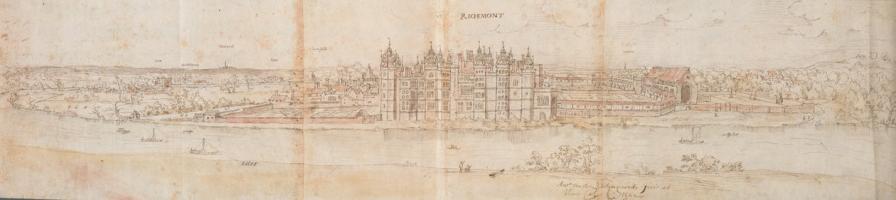
1562. Anton van den Wyngaerde. "Richmond Palace from Across the Thames".

On 7th August 1574 Robert Dudley was born illegitimately to Robert Dudley 1st Earl of Leicester and Douglas Howard Baroness Sheffield at Richmond Palace.
On 10th November 1599 Margaret Radclyffe of Ordsall Hall died at Richmond Palace. She had never recovered from the news of her twin brother Alexander's death earlier in the year. Margaret was buried in St Margaret's Church, Westminster with all the ceremonies of a great lady's obsequies. Elizabeth I ordered the Court into mourning. A magnificent monument was erected over her grave at the Queen's expense, and Ben Jonson wrote the inscription for it:
Marble weep, for thou dost cover.
A dead beauty underneath thee,.
Rich as nature could bequeath thee:
Grant, then, no rude hand remove her.
All the gazers on the skies.
Read not in fair heaven's story.
Expresser truth or truer glory,.
Than they might in her bright eyes.
Rare as wonder was her wit;.
And like nectar ever flowing:
Till time, strong by her bestowing,.
Conquered have both life and it.
Life whose grief was out of fashion.
In these times. Few have so rued.
Fate in a brother. To conclude,.
For wit, feature, and true passion.
Earth, thou hast not such another.
The Monument is no longer extant.
Become a Member via our Buy Me a Coffee page to read more.
On 24th March 1603 Elizabeth I died at Richmond Palace around three in the morning. King James I of England and Ireland and VI of Scotland succeeded I King England Scotland and Ireland.
Immediately following her death Robert Carey 1st Earl Monmouth started on horseback for Edinburgh to inform King James I of England and Ireland and VI of Scotland arriving at Holyrood Palace late on the 26 Mar 1603. His conduct met with general disapproval and merited censure as contrary to all decency, good manners and respect. George Carew and Thomas Lake were sent by the Council to formally inform James of her death.


On 20th June 1667 James Stewart 1st Duke Cambridge died at Richmond Palace. He was buried at Westminster Abbey. Duke Cambridge extinct.
John Evelyn's Diary. 27th August 1678. I took leave of the Duke, and dined at Mr. Henry Bruncker's, at the Abbey of Sheene, formerly a monastery of Carthusians, there yet remaining one of their solitary cells with a cross. Within this ample inclosure are several pretty villas and fine gardens of the most excellent fruits, especially Sir William Temple's (lately Ambassador into Holland), and the Lord Lisle's, son to the Earl of Leicester, who has divers rare pictures, above all, that of Sir Brian Tuke's, by Holbein.


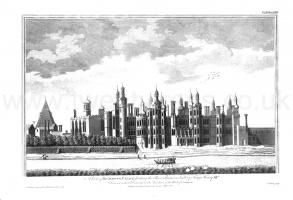
Vesta Monumenta. 1753. Plate 2.23. Richmond Palace. Engraved by James Basire Sr..
Archaeologia Volume 35 1853 XXXIII. On the 20th of April, at Shene, the Earl of Tancarville, the Countesses of Pembroke and Warren, "et alii magnates1," dined with the Queen.
Note 1. "and other magnates".