

Chronicle of a Bourgeois of Valenciennes
Récits d’un bourgeois de Valenciennes aka The Chronicle of a Bourgeois of Valenciennes is a vivid 14th-century vernacular chronicle written by an anonymous urban chronicler from Valenciennes in the County of Hainaut. It survives in a manuscript that describes local and regional history from about 1253 to 1366, blending chronology, narrative episodes, and eyewitness-style accounts of political, military, and social events in medieval France, Flanders, and the Low Countries. The work begins with a chronological framework of events affecting Valenciennes and its region under rulers such as King Philip VI of France and the shifting allegiances of local nobility. It includes accounts of conflicts, sieges, diplomatic manoeuvres, and the impact of broader struggles like the Hundred Years’ War on urban life in Hainaut. Written from the perspective of a burgher (bourgeois) rather than a monastery or royal court, the chronicle offers a rare lay viewpoint on high politics and warfare, reflecting how merchants, townspeople, and civic institutions experienced the turbulence of the 13th and 14th centuries. Its narrative style combines straightforward reporting of events with moral and civic observations, making it a valuable source for readers interested in medieval urban society, regional politics, and the lived experience of war and governance in pre-modern Europe.
Available at Amazon in eBook and Paperback format.
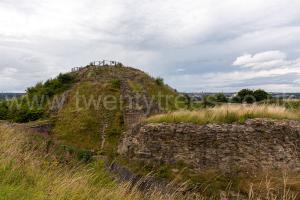
Sandal Castle is in Sandal, Castles in West Yorkshire.
On 30th December 1460 the Lancastrian army took their revenge for the defeats of the First Battle of St Albans and the Battle of Northampton at the Battle of Wakefield near Sandal Castle [Map]. The Lancastrian army was commanded by Henry Holland 3rd Duke Exeter [aged 30], Henry Beaufort 2nd or 3rd Duke of Somerset [aged 24] and Henry Percy 3rd Earl of Northumberland [aged 39], and included John Courtenay 7th or 15th Earl Devon [aged 25] and William Gascoigne XIII [aged 30], both knighted, and James Butler 1st Earl Wiltshire 5th Earl Ormonde [aged 40], John "Butcher" Clifford 9th Baron Clifford [aged 25], John Neville 1st Baron Neville of Raby [aged 50], Thomas Ros 9th Baron Ros Helmsley [aged 33], Henry Roos and Thomas St Leger [aged 20].
The Yorkist army was heavily defeated.
Richard Plantagenet 3rd Duke of York [aged 49] was killed. His son Edward [aged 18] succeeded 4th Duke York, 7th Earl March, 9th Earl of Ulster, 3rd Earl Cambridge, 9th Baron Mortimer of Wigmore.
Thomas Neville [aged 30], and Edward Bourchier were killed.
Father and son Thomas Harrington [aged 60] and John Harrington [aged 36] were killed, the former dying of his wounds the day after.
William Bonville 6th Baron Harington [aged 18] was killed. His daughter Cecily succeeded 7th Baroness Harington.
Thomas Parr [aged 53] fought in the Yorkist army.
Following the battle Richard Neville Earl Salisbury [aged 60] was beheaded by Thomas "Bastard of Exeter" Holland. William Bonville [aged 40] was executed.
Edmund York 1st Earl of Rutland [aged 17] was killed on Wakefield Bridge [Map] by John "Butcher" Clifford. Earl of Rutland extinct.
Chronicle of Gregory. 30th December 1460. Ande the same year, the xxx [30] day of December, the Duke of Exceter [aged 30], the Duke of Somersett [aged 24], the Erle of Northehomberlond [aged 39], the Lord Roos [aged 33], the Lord Nevyle [aged 50], the Lord ClyfForde [aged 25], with many mo lordys, knyghtys, squyers, and gentyllys, and the commyns of the Quenys party, met with the Duke of Yorke [aged 49] at Wakefylde [Map], and there they made a grete jorney a-pon the lord and Duke of Yorke, and toke him and the Erle of Saulysbury [aged 60], the Erle of Rutlond [aged 17], and the Lord Haryngdon [aged 18], and Syr Thomas Nevyle [aged 30], and Syr Thomas Haryngdon [aged 60], and many mo knyghtys were take a slayne by syde alle the comyns. But this good Duke of Yorke with his lordys a-fore said loste her heddys; God have marcy on there soulys, for they loste in that jorneys the nombyr of xxvc [2500] men. And in the Quenys party were slay but ii c [200] men, &c.
Before 5th June 1511 Edward Stanhope [aged 49] was appointed Constable of Sandal Castle.
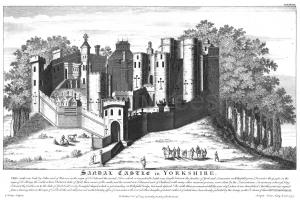
Vesta Monumenta. 1753. Plate 2.11. Sandal Castle [Map]. Engraving by George Vertue [aged 69] after a drawing originally produced for a survey of the properties of the Duchy of Lancaster conducted by the Chancellor of the Duchy, Ambrose Cave, in 1561.
2021. Photos of Sandal Castle [Map].
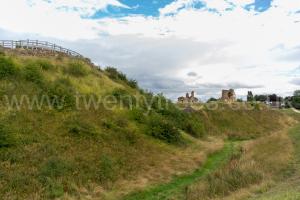
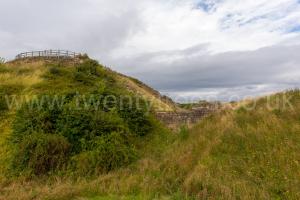
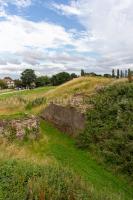
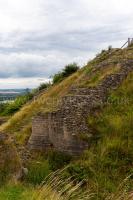
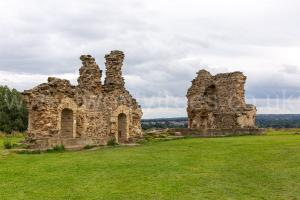
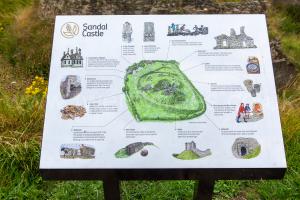
The River Calder rises on Heald Moor near Todmorden [Map] after which it passes Hebden Bridge [Map], Mytholmroyd [Map], Sowerby Bridge [Map], Dewsbury [Map], Sandal Castle [Map], under Wakefield Bridge [Map] before joining the River Aire at Castleford [Map].