

Chronicle of Walter of Guisborough
A canon regular of the Augustinian Guisborough Priory, Yorkshire, formerly known as The Chronicle of Walter of Hemingburgh, describes the period from 1066 to 1346. Before 1274 the Chronicle is based on other works. Thereafter, the Chronicle is original, and a remarkable source for the events of the time. This book provides a translation of the Chronicle from that date. The Latin source for our translation is the 1849 work edited by Hans Claude Hamilton. Hamilton, in his preface, says: 'In the present work we behold perhaps one of the finest samples of our early chronicles, both as regards the value of the events recorded, and the correctness with which they are detailed; Nor will the pleasing style of composition be lightly passed over by those capable of seeing reflected from it the tokens of a vigorous and cultivated mind, and a favourable specimen of the learning and taste of the age in which it was framed.'
Available at Amazon in eBook and Paperback format.
Wakefield is in West Yorkshire.
On 9th April 1436 Richard Stanhope [aged 76] died at Wakefield [Map].
Henry Machyn's Diary. 5th July 1557. At Wakefeld [Map], Robert Hawgatt, skott; and all thes for enteryng in Skarborow castylle.
On 20th May 1643 Mary Witham 1st Baronetess Bolles [aged 63] entertained Royalist troops to a Bowling Match at Heath Old Hall. Wakefield [Map] was taken the next day by Paliamentary troops.
Around 1676 Robert Benson 1st Baron Bingley was born at Wakefield [Map].
In 1889 Bishop William Walsham How [aged 65] was was appointed the first Bishop of Wakefield.
The River Aire rises around Malham Tarn, North Yorkshire [Map] after which it travels broadley south-west past Skipton Castle [Map], Keighley, West Yorkshire [Map], Bingley [Map], Shipley, West Yorkshire [Map], Apperley Bridge, West Yorkshire [Map], Kirkstall Abbey, West Yorkshire [Map], Leeds [Map], Methley [Map], Castleford [Map], where it is joined by the River Calder, within 2km of All Saints Church, Ledsham [Map] then Brotherton [Map], Ferrybridge, where there was an historical crossing, Beal, North Yorkshire [Map], West Haddlesey, North Yorkshire [Map], Chapel Haddlesey, North Yorkshire [Map], Temple Hirst, North Yorkshire [Map], Snaith, East Yorkshire [Map], Rawcliffe, East Yorkshire [Map] before joining the River Ouse 800m north of Airmyn [Map].
The River Calder rises on Heald Moor near Todmorden [Map] after which it passes Hebden Bridge [Map], Mytholmroyd [Map], Sowerby Bridge [Map], Dewsbury [Map], Sandal Castle [Map], under Wakefield Bridge [Map] before joining the River Aire at Castleford [Map].
Around 1275 Isabel Deincourt was born to Edmund Deincourt 1st Baron Deincourt [aged 25] and Isabel Mohun Baroness Deincourt [aged 32] at Emley Wakefield. She married in or before 1298 William Fitzwilliam and had issue.
In 1275 William Fitzwilliam was born at Emley Wakefield.
In 1325 Isabel Deincourt [aged 50] died at Emley Wakefield. She was buried at St Mary's Church, Sprotbrough [Map].
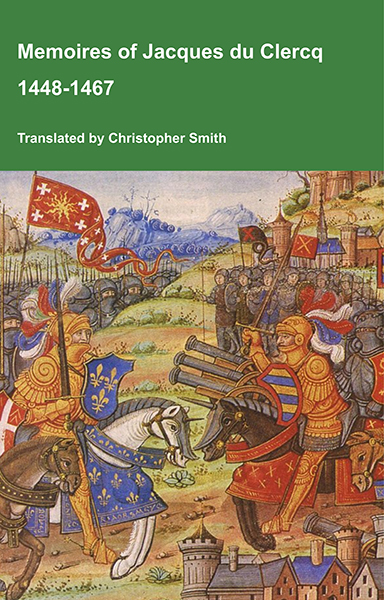
This is a translation of the 'Memoires of Jacques du Clercq', published in 1823 in two volumes, edited by Frederic, Baron de Reissenberg. In his introduction Reissenberg writes: 'Jacques du Clercq tells us that he was born in 1424, and that he was a licentiate in law and a counsellor to Philip the Good, Duke of Burgundy, in the castellany of Douai, Lille, and Orchies. It appears that he established his residence at Arras. In 1446, he married the daughter of Baldwin de la Lacherie, a gentleman who lived in Lille. We read in the fifth book of his Memoirs that his father, also named Jacques du Clercq, had married a lady of the Le Camelin family, from Compiègne. His ancestors, always attached to the counts of Flanders, had constantly served them, whether in their councils or in their armies.' The Memoires cover a period of nineteen years beginning in in 1448, ending in in 1467. It appears that the author had intended to extend the Memoirs beyond that date; no doubt illness or death prevented him from carrying out this plan. As Reissenberg writes the 'merit of this work lies in the simplicity of its narrative, in its tone of good faith, and in a certain air of frankness which naturally wins the reader’s confidence.' Du Clercq ranges from events of national and international importance, including events of the Wars of the Roses in England, to simple, everyday local events such as marriages, robberies, murders, trials and deaths, including that of his own father in Book 5; one of his last entries.
Available at Amazon in eBook and Paperback format.
On 6th January 1326 John Deincourt [aged 60] died at Emley Wakefield.
On 6th January 1327 Edmund Deincourt 1st Baron Deincourt [aged 77] died at Emley Wakefield. His nephew William [aged 26] succeeded 2nd Baron Deincourt. Millicent Zouche Baroness Deincourt by marriage Baroness Deincourt.
Around February 1328 John Fitzwilliam was born to John Fitzwilliam [aged 30] at Emley Wakefield.
Around 1346 William Fitzwilliam was born to John Fitzwilliam [aged 17] at Emley Wakefield. He married before 25th July 1377 Maud Cromwell, daughter of Ralph Cromwell 1st Baron Cromwell and Maud Bernake, and had issue.
On 8th April 1398 William Fitzwilliam [aged 52] died at Emley Wakefield.
On 5th July 1417 John Fitzwilliam [aged 39] died at Emley Wakefield.
On 14th March 1666 William Jobson 2nd Baronet [aged 30] died without male issue at Heath. He was buried at Church of St Peter Kirkthorpe [Map]. Baronet Bolles extinct.
Church of St Peter Kirkthorpe is also in Churches in West Yorkshire.
Church of St Peter Kirkthorpe [Map]. The chief merit of the church is a fine collection of C18 wall monuments. The most important of these is the Stringer Monument by Guelfi: 2 detached busts on a sarcophagus with straight tapering sides; background by Kent with inscription, a frame starting from 2 big volutes and crowned by an open-segmental pediment carved coat-or-arms with putti. The Smyth chapel has numerous monuments dating from 1731; including that to John Smyth of 2 putti uncovering his portrait on an oval medallion, that to Lady Georgina Smyth and others signed by Flaxman; 1799.
On 14th March 1666 William Jobson 2nd Baronet [aged 30] died without male issue at Heath. He was buried at Church of St Peter Kirkthorpe [Map]. Baronet Bolles extinct.
Nostell Priory, Wakefield is also in Priories in England.
In 1654 Nostell Priory, Wakefield [Map] was purchased by Rowland Winn after its last owner, Sir John Wolstenholme, was declared bankrupt in 1650.
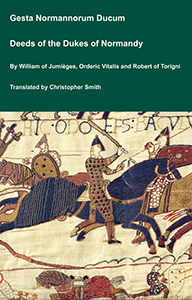
The Deeds of the Dukes of Normandy
The Gesta Normannorum Ducum [The Deeds of the Dukes of Normandy] is a landmark medieval chronicle tracing the rise and fall of the Norman dynasty from its early roots through the pivotal events surrounding the Norman Conquest of England. Originally penned in Latin by the monk William of Jumièges shortly before 1060 and later expanded at the behest of William the Conqueror, the work chronicles the deeds, politics, battles, and leadership of the Norman dukes, especially William’s own claim to the English throne. The narrative combines earlier historical sources with firsthand information and oral testimony to present an authoritative account of Normandy’s transformation from a Viking settlement into one of medieval Europe’s most powerful realms. William’s history emphasizes the legitimacy, military prowess, and governance of the Norman line, framing their expansion, including the conquest of England, as both divinely sanctioned and noble in purpose. Later chroniclers such as Orderic Vitalis and Robert of Torigni continued the history, extending the coverage into the 12th century, providing broader context on ducal rule and its impact. Today this classic work remains a foundational source for understanding Norman identity, medieval statesmanship, and the historical forces that reshaped England and Western Europe between 800AD and 1100AD.
Available at Amazon in eBook and Paperback format.
On 14th October 1805 Rowland Winn 6th Baronet [aged 30] died unmarried. His second cousin once removed Edmund [aged 43] succeeded 7th Baronet Winn of Nostel in Yorkshire. Nostell Priory, Wakefield [Map] was inherited by his nephew John Williamson aka Winn [aged 12], son of Rowland's sister Esther Winn [aged 37]. All of Esther's children changed their surname to Winn.
From 1874 Rowland Winn 1st Baron St Oswald [aged 53] lived at Nostell Priory, Wakefield [Map] which he had inherited from his father Charles Williamson aka Winn [aged 78].
On 19th May 1713 Abel Smith [aged 23] and Jane Beaumont [aged 24] were married at Sandal.
1897. Monument to Richard Plantagenet 3rd Duke of York [aged 49] on Manygates Lane [Map] at the location where he is traditionally thought to have been killed at the Battle of Wakefield.


On 30th September 1850 William Pilkington 8th Baronet [aged 74] died. He was buried at St Helen's Church, Sandal. His son Thomas [aged 21] succeeded 9th Baronet Pilkington of Stanley in Yorkshire.
St Michael and Our Lady's Church, Wragby is also in Churches in West Yorkshire.
St Michael and Our Lady's Church, Wragby [Map]. Wall monument to Sir Rowland Winn 4th baronet by John Flaxman, 1806.
In 1759 George Gordon 3rd Earl Aberdeen [aged 36] and Catherine Elizabeth Hanson Couness Aberdeen [aged 29] were married. She, apparently, being the cook at the Stafford Arms, Wakefield, blackmailed him into marriage with a loaded pistol after he had seduced her. He the son of William Gordon 2nd Earl Aberdeen and Susan Murray.
On 30th December 1460 the Lancastrian army took their revenge for the defeats of the First Battle of St Albans and the Battle of Northampton at the Battle of Wakefield near Sandal Castle [Map]. The Lancastrian army was commanded by Henry Holland 3rd Duke Exeter [aged 30], Henry Beaufort 2nd or 3rd Duke of Somerset [aged 24] and Henry Percy 3rd Earl of Northumberland [aged 39], and included John Courtenay 7th or 15th Earl Devon [aged 25] and William Gascoigne XIII [aged 30], both knighted, and James Butler 1st Earl Wiltshire 5th Earl Ormonde [aged 40], John "Butcher" Clifford 9th Baron Clifford [aged 25], John Neville 1st Baron Neville of Raby [aged 50], Thomas Ros 9th Baron Ros Helmsley [aged 33], Henry Roos and Thomas St Leger [aged 20].
The Yorkist army was heavily defeated.
Richard Plantagenet 3rd Duke of York [aged 49] was killed. His son Edward [aged 18] succeeded 4th Duke York, 7th Earl March, 9th Earl of Ulster, 3rd Earl Cambridge, 9th Baron Mortimer of Wigmore.
Thomas Neville [aged 30], and Edward Bourchier were killed.
Father and son Thomas Harrington [aged 60] and John Harrington [aged 36] were killed, the former dying of his wounds the day after.
William Bonville 6th Baron Harington [aged 18] was killed. His daughter Cecily succeeded 7th Baroness Harington.
Thomas Parr [aged 53] fought in the Yorkist army.
Following the battle Richard Neville Earl Salisbury [aged 60] was beheaded by Thomas "Bastard of Exeter" Holland. William Bonville [aged 40] was executed.
Edmund York 1st Earl of Rutland [aged 17] was killed on Wakefield Bridge [Map] by John "Butcher" Clifford. Earl of Rutland extinct.
Chronicle of William of Worcester. On the 29th of December1, at Wakefield, while the soldiers of the Duke of York [aged 49] were wandering through the country seeking provisions, a dreadful battle occurred between the said Duke of Somerset [aged 24], the Earl of Northumberland [aged 39], and Lord Neville [aged 50] with a large army, and the opposing party, where the Duke of York, Thomas Neville [aged 30], son of the Earl of Salisbury [aged 60], Thomas Harington [aged 60], Thomas Parr, Edward Bourchier, James Pickering, and Henry Radford, as well as many other knights and esquires, and about two thousand commoners, were killed on the field. In the retreat after the battle, Lord Clifford killed, some say murdered, Lord Edmund, Earl of Rutland [aged 17], son of the Duke of York, on the bridge at Wakefield [Map]. And on the same night, the Earl of Salisbury was captured by the servant of Andrew Trollope. On the next day, at Pontefract, the Bastard of Exeter killed the said Earl of Salisbury, where, by the counsel of the lords, the lifeless bodies of the Duke of York, the Earl of Salisbury, and Rutland, Thomas Neville, Edward Bowcher, Thomas Harington, Thomas Parre, James Pykeryng, and John Harrowe of London, mercer, were beheaded, and their heads were placed on various parts of York. They crowned the head of the Duke of York with a paper crown in mockery.
xxix. die mensis Decembris apud Wakfelde, gentibus ducis Eborum vagantibus per patriam pro victualibus quærendis, factum est execrabile bellum inter dictum ducem Somercetiæ, comitem Northumbriæ ac dominum Nevylle cum magno exercitu et partem aliam; ubi occubuerunt in campo dux Eboracensis, Thomas Nevil, filius comitis Sarum, Thomas Haryngtone, Thomas Parre, Edwardus Bowcher, Jacobus Pykeryng, et Henricus Rathforde, ac etiam multi alii milites et armigeri, et plebs ad duo millia. Et in fugiendo post campum super pontem apud Wakefelde dominus de Clyfforde occidit dominum Edmundum, comitem de Rutlande, filium ducis Eboraci. Et eadem nocte comes Sarum captus est per servientem Andreæ Trolloppe. Et in crastino apud Pountfrett bastardus Exoniæ occidit dictum comitem Sarum, ubi per consilium dominorum decollaverunt corpora mortua ducis Eboracensis, et comitis Sarum et Ruttland, Thomas Nevyle, Edwardi Boucher, Thomas Haryngton, Thomæ Parre, Jacobi Pykeryng, et Johannis Harrowe de London, mercer, posueruntque capita eorum super diversas partes Eboraci. Caput quoque ducis Eboraci in despectu coronaverunt carta.
Note. The Battle of Wakefield took place on the 30th of December 1460.
The River Calder rises on Heald Moor near Todmorden [Map] after which it passes Hebden Bridge [Map], Mytholmroyd [Map], Sowerby Bridge [Map], Dewsbury [Map], Sandal Castle [Map], under Wakefield Bridge [Map] before joining the River Aire at Castleford [Map].
Around 1500 Matthew Witham of Bretonby was born to Thomas Witham of Bretonby [aged 46] at West Bretton, Wakefield.