William of Worcester's Chronicle of England
William of Worcester, born around 1415, and died around 1482 was secretary to John Fastolf, the renowned soldier of the Hundred Years War, during which time he collected documents, letters, and wrote a record of events. Following their return to England in 1440 William was witness to major events. Twice in his chronicle he uses the first person: 1. when writing about the murder of Thomas, 7th Baron Scales, in 1460, he writes '… and I saw him lying naked in the cemetery near the porch of the church of St. Mary Overie in Southwark …' and 2. describing King Edward IV's entry into London in 1461 he writes '… proclaimed that all the people themselves were to recognize and acknowledge Edward as king. I was present and heard this, and immediately went down with them into the city'. William’s Chronicle is rich in detail. It is the source of much information about the Wars of the Roses, including the term 'Diabolical Marriage' to describe the marriage of Queen Elizabeth Woodville’s brother John’s marriage to Katherine, Dowager Duchess of Norfolk, he aged twenty, she sixty-five or more, and the story about a paper crown being placed in mockery on the severed head of Richard, 3rd Duke of York.
Available at Amazon in eBook and Paperback format.
Watford, Hertfordshire is in Hertfordshire.
In 1585 Richard Anderson was born to Henry Anderson [aged 16] and Elizabeth Bowyer [aged 24] in Watford, Hertfordshire. He married in or before 1608 Mary Spencer, daughter of Robert Spencer 1st Baron Spencer and Margaret Willoughby, and had issue.
On 13th February 1585 William Russell 1st Baron Russell [aged 25] and Elizabeth Long Baroness Russel Thornhaugh were married at Watford, Hertfordshire. He the son of Francis Russell 2nd Earl Bedford [aged 58] and Margaret St John Countess Bedford.
In 1598 Sarah Anderson was born to Henry Anderson [aged 29] and Elizabeth Bowyer [aged 37] in Watford, Hertfordshire. She married 1605 Charles Wilmot 1st Viscount Wilmot and had issue.
On 23rd March 1631 John Cooper 1st Baronet [aged 33] died at Cassiobury, Watford. He was buried in Wimborne St Giles Church. His son Anthony [aged 9] succeeded 2nd Baronet Cooper of Rockbourne in Southampton.


On 20th August 1628 Charles Morrison 1st Baronet [aged 41] died. Baronet Morrison of Cashiobury extinct. He was buried at St Marys Church, Watford where he has a monument by Nicholas Stone [aged 41]. Cassiobury House, Watford was inherited by his daughter Elizabeth Morrison Baroness Capell Hadham [aged 17] and her husband Arthur Capell 1st Baron Capell Hadham [aged 20].
John Evelyn's Diary. 18th April 1680. On the earnest invitation of the Earl of Essex [aged 48], I went with him to his house at Cashiobury, in Hertfordshire. It was on Sunday, but going early from his house in the square of St. James, we arrived by ten o'clock; this he thought too late to go to church, and we had prayers in his chapel. The house is new, a plain fabric, built by my friend, Mr. Hugh May [aged 58]. There are divers fair and good rooms, and excellent carving by Gibbons, especially the chimney-piece of the library. There is in the porch, or entrance, a painting by Verrio, of Apollo and the Liberal Arts. One room pargeted with yew, which I liked well. Some of the chimney mantels are of Irish marble, brought by my Lord from Ireland, when he was Lord-Lieutenant, and not much inferior to Italian. The tympanum, or gable, at the front is a bass-relievo of Diana hunting, cut in Portland stone, handsomely enough. I do not approve of the middle doors being round: but, when the hall is finished as designed, it being an oval with a cupola, together with the other wing, it will be a very noble palace. The library is large, and very nobly furnished, and all the books are richly bound and gilded; but there are no MSS., except the Parliament Rolls and Journals, the transcribing and binding of which cost him, as he assured me, £500.
Adeline Horsey Recollections. My last recollection of Cassiobury was in 1849, when I stayed there after the announcement of my engagement to the Count Montemolin [aged 25]. The great Lord Brougham [aged 65] was included in the house-party, and one day when he was walking in the gardens, talking about my approaching marriage, he suddenly dropped on one knee, and taking my hand, kissed it, saying as he did so, "Let me be the first to kiss your hand as future Queen of Spain".
This somewhat theatrical behaviour was exactly what Lord Brougham delighted in. He was a very ugly man, and like most ugly people he was very vain. He was a wonderful speaker, and few cared to provoke his powers of sarcasm; Hazlitt describes him as "a man of inordinate ambition and little heart"; but he certainly possessed some heart, for he adored his daughter Eleanor, who died at Cannes when she was only nineteen. The poor girl was an invalid all her short life, and her father resided at Cannes solely on her account. He built the Villa Eleanor for her, and until Lord Brougham's death her bedroom was always known as "Eleanor's room", and kept exactly as it had been when she occupied it.
The Villa is now an hotel, and Cannes is very different to what it was when Lord Brougham settled there. He told me that the town had only one hotel and one street when he first saw it.
Eleanor Brougham's body was brought to England, and she was buried in the small graveyard which belongs to Lincoln's Inn Chapel. I do not think any other woman has ever been interred there. The Marquis of Wellesley wrote her epitaph, and I believe it is a very beautiful and touching one.


Adeline Horsey Recollections. We spent many week-ends at Cassiobury with Lord and Lady Essex [Note. presumed to refer to before 1838 when Lady Essex died?], and as it is only seventeen miles from London, we found it most accessible, and used to go there in the winter as well as the summer.
Cassiobury was the scene of a practical joke which originated with Henry Blackwood [aged 24], who was staying there one summer. Some very self-important young men had been invited for the week-end, and Henry Blackwood thought it would be great fun to enact the part of highwaymen and stop their travelling-carriage as they were driving through the lonely park. He enlisted two other kindred spirits to help him, and, of course, the whole house-party was in the secret.
We were all full of conjectures as to how these young bloods would face the highway-men. They would naturally be startled, we thought, but as they were (according to themselves) such ultra-superior people, we could not imagine them behaving, even under such conditions, in any other than an ultra-superior way. The eventful evening was fine and dark, and we all went to the place destined for the scene of the robbery, and hid under cover, patiently waiting for the fun to begin. Henry Blackwood and his friends were disguised beyond recognition, and did indeed look desperadoes of the road.
Note A. last the faint noise of wheels in the distance was heard, and as they drew nearer we were breathless with expectation. The travelling-carriage was dimly discernible - it approached - Henry Blackwood rushed forward to the horses' heads, while his friends told the trembling post-boys to drive on at their peril. Needless to say the carriage was at once brought to a standstill, one highwayman stood by the two horses, and Henry Blackwood went to the carriage door and told the occupants to alight, and hand over their valuables.
We thought that the crucial moment had arrived for our superior friends to assert themselves, but we were speedily disillusioned, for the young men, who were giving vent to a series of frightened squeaks, were terrified out of their wits. "Spare our lives", they cried in an imploring chorus, "and you can take everything we have!" "Spare our lives", they kept on repeating as they handed over their money, watches and jewellery to the merciless Henry. At last, half dead with fear, they were allowed to enter the carriage, which was driven away as though pursued by the devil.
When we emerged from our hiding-place and saw the booty, we were highly amused, and, I may say, very disgusted at the cowardice shown by the superior young men. It was a difficult task to enact the part of sympathetic listeners later in the evening, and hear a very much embroidered account of the dozens of highwaymen who infested the Park, armed to the teeth and apparently villains of the deepest dye.
The feelings of the young cowards can be easily imagined when next morning, at breakfast, Henry Blackwood returned them their belongings "with the compliments of the high-waymen", and the suppressed laughter which greeted the announcement made them feel very small indeed. They left later in the day, but the story got about, and they never felt so superior afterwards.


New York Times 15 Dec 1893. MARRIED TO AN EARL.
Miss Adele Grant or New-York Becomes the Countess of Essex.
LONDON, Dec. 14 [1893].—The marriage of Miss Adele Grant [aged 27], daughter of the late Beach Grant of New-York, to the Earl of Essex [aged 36] took place at 2:30 0'clock this afternoon at St. Margaret's Church, Westminster [Map]. Archdeacon Farrar, assisted by the Rev. Mr. Lee, the Rev. Mr. James, and the Chaplain of the Duke of Essex, the Rev. George Chapel, officiated.
The bride wore a white satin dress, the train of which was embroidered with silver sunrays. The bodice was trimmed with point d'Alençon lace. The bridal veil was of Alençon lace, which the bride's mother wore at her wedding. The only ornament worn by the bride was a diamond tiara, the gift of the Earl of Essex. Instead of a bouquet, she carried an ivory Prayer Book.
There were seven bridesmaids. Those were Edythe Grant, Alberta Paget, Mary Colebrooke, Diana Sturt, the Hon. Eustace Daunay, the Hon. Leila Daunay, and Gwenfra Williams. They wore white satin dresses, draped in soft folds and bordered with mink, and velvet toques trimmed with fur. Each of them carried a long Louis XV. stick, with a gold tip, decorated with roses, the gift of the Earl of Essex. Baron Tuyll was the best man. Suydam Grant, a brother [a mistake for uncle] of the bride, gave her away. The service was full choral. Sir Arthur Sullivan presided at the organ. The floral decorations were extensive and rich.
After the ceremony, a reception was given at the residence of Mrs. Grant, 35 Great Cumberland Place. It was largely attended. In the early afternoon, the newly-married couple departed for their honeymoon, which will be spent at Cassiobury, Watford.
Over 300 presents were received, many of which came from the United States and the Continent.



On 31st March 1599 Charles Morrison [aged 50] died. He was buried at St Marys Church, Watford.
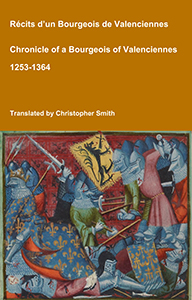
Chronicle of a Bourgeois of Valenciennes
Récits d’un bourgeois de Valenciennes aka The Chronicle of a Bourgeois of Valenciennes is a vivid 14th-century vernacular chronicle written by an anonymous urban chronicler from Valenciennes in the County of Hainaut. It survives in a manuscript that describes local and regional history from about 1253 to 1366, blending chronology, narrative episodes, and eyewitness-style accounts of political, military, and social events in medieval France, Flanders, and the Low Countries. The work begins with a chronological framework of events affecting Valenciennes and its region under rulers such as King Philip VI of France and the shifting allegiances of local nobility. It includes accounts of conflicts, sieges, diplomatic manoeuvres, and the impact of broader struggles like the Hundred Years’ War on urban life in Hainaut. Written from the perspective of a burgher (bourgeois) rather than a monastery or royal court, the chronicle offers a rare lay viewpoint on high politics and warfare, reflecting how merchants, townspeople, and civic institutions experienced the turbulence of the 13th and 14th centuries. Its narrative style combines straightforward reporting of events with moral and civic observations, making it a valuable source for readers interested in medieval urban society, regional politics, and the lived experience of war and governance in pre-modern Europe.
Available at Amazon in eBook and Paperback format.
On 20th August 1628 Charles Morrison 1st Baronet [aged 41] died. Baronet Morrison of Cashiobury extinct. He was buried at St Marys Church, Watford where he has a monument by Nicholas Stone [aged 41]. Cassiobury House, Watford was inherited by his daughter Elizabeth Morrison Baroness Capell Hadham [aged 17] and her husband Arthur Capell 1st Baron Capell Hadham [aged 20].
Close Rolls Edward II 1307-1313. 16th January 1310 King Edward II of England [aged 25]. The Grove, Watford [Map]. To the Treasurer and the Barons of the Exchequer. Order to discharge the Abbot of Hayles of £100 yearly, the rent of the manor of Lychelad [Map], as the King granted it to Piers Gaveston 1st Earl Cornwall [aged 26] and Margaret his wife.
To the same. Order to discharge the men of Wallingford, Oxfordshire [Map] of the ferm of that town from August 5 last, to Piers Gaveston 1st Earl Cornwall and Margaret his wife.
On 2nd October 1914 Edward Villiers 5th Earl Clarendon [aged 68] died at The Grove, Watford [Map]. His son George [aged 37] succeeded 6th Earl Clarendon, 6th Baron Hyde of Hindon in Wiltshire 1756. Adeline Verena Ishbel Cocks Countess of Clarendon [aged 28] by marriage Countess Clarendon.