

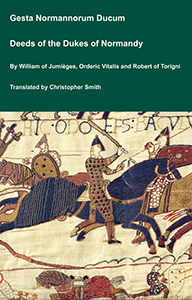
The Deeds of the Dukes of Normandy
The Gesta Normannorum Ducum [The Deeds of the Dukes of Normandy] is a landmark medieval chronicle tracing the rise and fall of the Norman dynasty from its early roots through the pivotal events surrounding the Norman Conquest of England. Originally penned in Latin by the monk William of Jumièges shortly before 1060 and later expanded at the behest of William the Conqueror, the work chronicles the deeds, politics, battles, and leadership of the Norman dukes, especially William’s own claim to the English throne. The narrative combines earlier historical sources with firsthand information and oral testimony to present an authoritative account of Normandy’s transformation from a Viking settlement into one of medieval Europe’s most powerful realms. William’s history emphasizes the legitimacy, military prowess, and governance of the Norman line, framing their expansion, including the conquest of England, as both divinely sanctioned and noble in purpose. Later chroniclers such as Orderic Vitalis and Robert of Torigni continued the history, extending the coverage into the 12th century, providing broader context on ducal rule and its impact. Today this classic work remains a foundational source for understanding Norman identity, medieval statesmanship, and the historical forces that reshaped England and Western Europe between 800AD and 1100AD.
Available at Amazon in eBook and Paperback format.
Wimborne Minster, Dorset is in Wimborne, Dorset, Minsters in England.
In 871 King Æthelred of Wessex [aged 24] was buried at Wimborne Minster, Dorset [Map]. King Alfred "The Great" of Wessex [aged 22] succeeded King of England. Æalhswith of Mercia Queen Consort of England by marriage Queen Consort England.
Assers Life of Alfred 871. 871. 41. Æthelred's Death.92 That same year, after Easter, the aforesaid King Æthelred [aged 24], having bravely, honourably, and with good repute governed his kingdom five years through many tribulations, went the way of all flesh, and was buried in Wimborne Minster [Map]93, where he awaits the coming of the Lord and the first resurrection with the just.
Note 92. Mostly from the Chronicle.
Note 93. In Dorsetshire.
Anglo-Saxon Chronicle. Around 22nd March 871. About two months after this, King Ethered [aged 24] and Alfred [aged 22] his brother fought with the army at Marden. They were in two divisions; and they put them both to flight, enjoying the victory for some time during the day; and there was much slaughter on either hand; but the Danes became masters of the field; and there was slain Bishop Heahmund, with many other good men. After this fight came a vast army in the summer to Reading. And after the Easter of this year died King Ethered. He reigned five years, and his body lies at Winburn-minster [Map]. Then Alfred, his brother, the son of Ethelwulf, took to the kingdom of Wessex.
Anglo-Saxon Chronicle. 961. This year departed Odo, the good archbishop, and St. Dunstan [aged 52] took to the archbishopric. This year also died Elfgar, a relative of the king, in Devonshire; and his body lies at Wilton [Map]: and King Sifferth killed himself; and his body lies at Wimborn [Map]. This year there was a very great pestilence; when the great fever was in London; and St. Paul's minster was consumed with fire, and in the same year was afterwards restored. In this year Athelmod the masspriest, went to Rome, and there died on the eighteenth before the calends of September.
On 8th August 1482 Margaret Beauchamp Duchess Somerset [aged 72] died. She was buried at Wimborne Minster, Dorset [Map].
On 30th November 1769 Admiral Richard King 1st Baronet [aged 39] and Susanna Margaretta Coker [aged 24] were married at Wimborne Minster, Dorset [Map].
On 15th April 1855 William John Bankes [aged 68] died. He was buried at Wimborne Minster, Dorset [Map].
The Dorset River Stour rises at Stourhead, Wiltshire [Map] from where it flows through Bourton, Berkshire [Map], past Milton-on-Stour, Dorset [Map], Gillingham, Dorset [Map], where it is joined by Shreen Water. From Gillingham, Dorset [Map] it flows south where it is joined by the Wiltshire River Lodden before Ecliffe, Dorset [Map]. The river continues past West Stour, Dorset [Map], Stour Provost, Dorset [Map], Marnhull, Dorset [Map], Henstridge Marsh, Somerset [Map], where it is joined by the River Cale.
The Dorset River Stour continues south to Sturminster [Map] where it heads south-east to Shillingstone, Dorset [Map] then Durweston, Dorset [Map], around Blandford Forum, Dorset [Map], Charlton Marshall, Dorset [Map], Spetisbury, Dorset [Map], Sturminster Marshall, Dorset [Map], Wimborne Minster, Dorset [Map], Canford Magna, Dorset [Map], Knighton, Dorset [Map], West Parley, Dorset [Map], Parley Green, Dorset [Map], Holdenhurst, Dorset [Map] before passing through Christchurch, Dorset [Map] into Christchurch Harbour.
The River Allen, Dorset rises at Monkton Up Dorset [Map] from where it flows past Wimborne St Giles, Dorset [Map], Knowlton Circles [Map], Horton Inn, Dorset [Map], Crichel Mill, Dorset [Map], Newtown, Dorset [Map], Witchampton, Dorset [Map], Hinton Parva, Dorset [Map], Clapgate, Dorset [Map] through Wimborne Minster, Dorset [Map] after which it joins the Dorset River Stour.
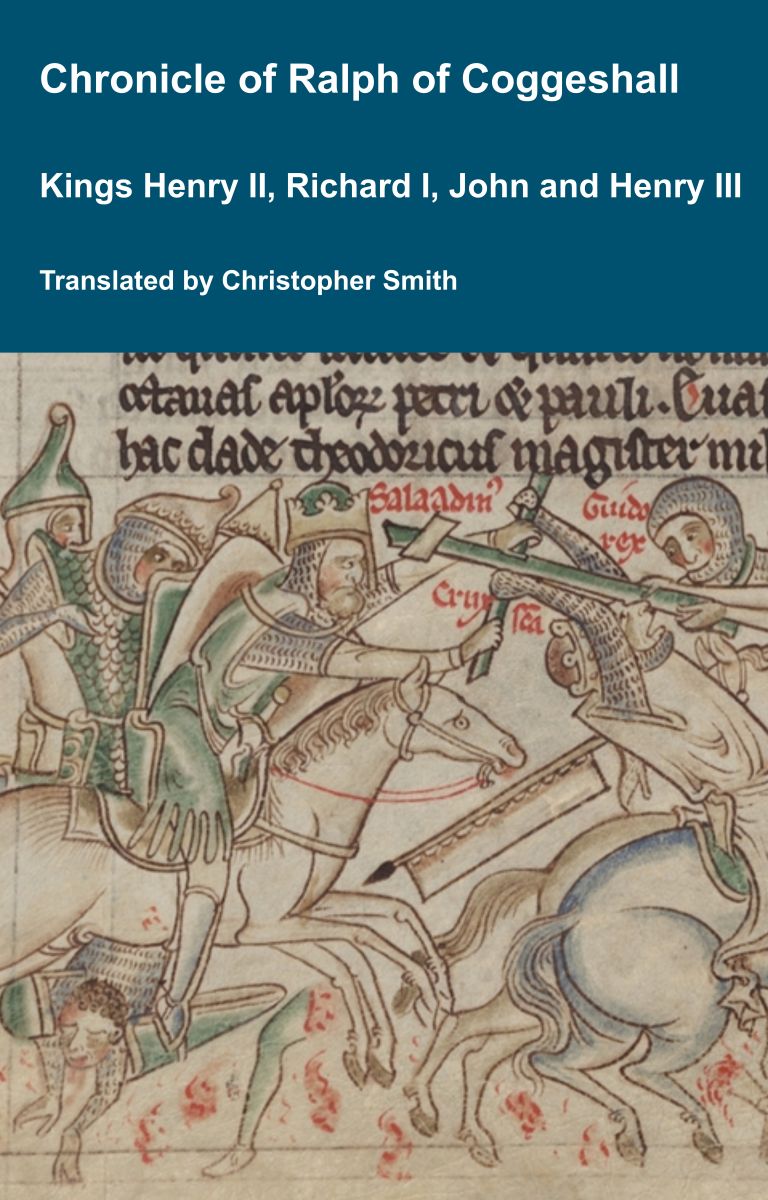
Chronicle of Abbot Ralph of Coggeshall
The Chronicle of Abbot Ralph of Coggeshall (Chronicon Anglicanum) is an indispensable medieval history that brings to life centuries of English and European affairs through the eyes of a learned Cistercian monk. Ralph of Coggeshall, abbot of the Abbey of Coggeshall in Essex in the early 13th century, continued and expanded his community’s chronicle, documenting events from the Norman Conquest of 1066 into the tumultuous reign of King Henry III. Blending eyewitness testimony, careful compilation, and the monastic commitment to record-keeping, this chronicle offers a rare narrative of political intrigue, royal power struggles, and social upheaval in England and beyond. Ralph’s work captures the reigns of pivotal figures such as Richard I and King John, providing invaluable insights into their characters, decisions, and the forces that shaped medieval rule. More than a simple annal, Chronicon Anglicanum conveys the texture of medieval life and governance, making it a rich source for scholars and readers fascinated by English history, monastic authorship, and the shaping of the medieval world.
Available at Amazon in eBook and Paperback format.
Cuthburh Wessex Queen Consort Northumbria was appointed Abbot Wimbourne Minster.