

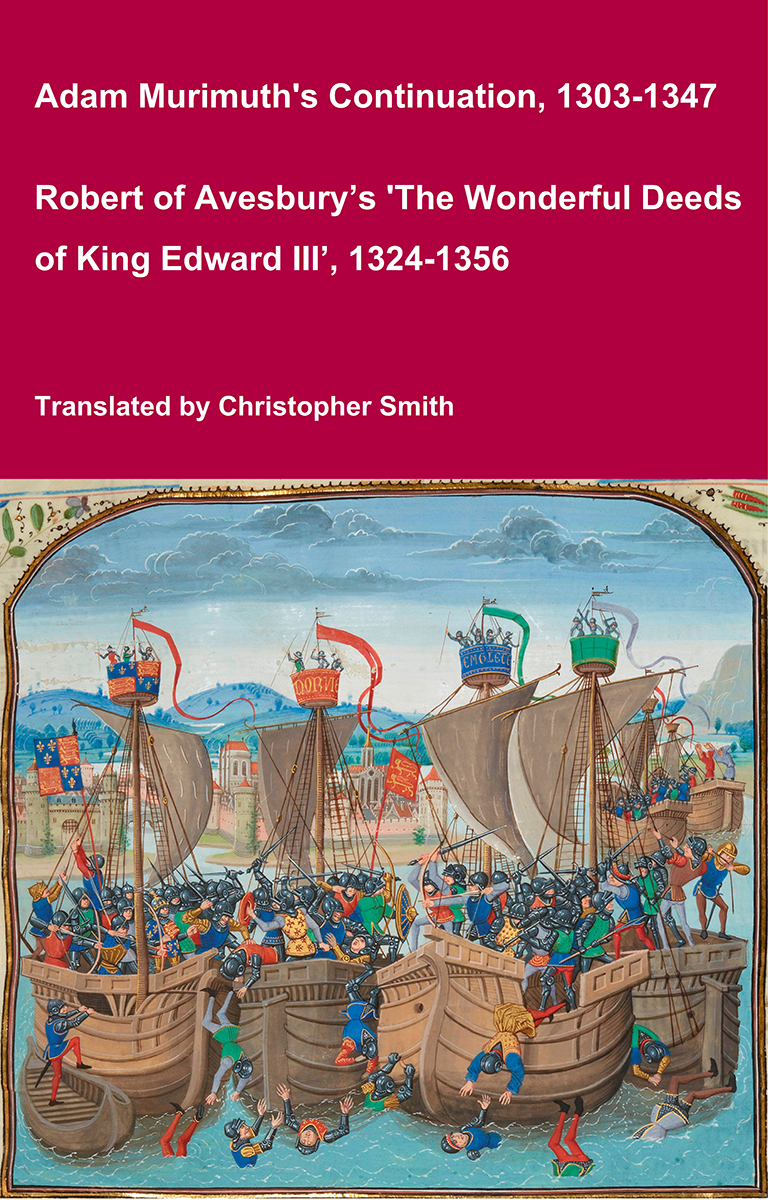
Adam Murimuth's Continuation and Robert of Avesbury’s 'The Wonderful Deeds of King Edward III'
This volume brings together two of the most important contemporary chronicles for the reign of Edward III and the opening phases of the Hundred Years’ War. Written in Latin by English clerical observers, these texts provide a vivid and authoritative window into the political, diplomatic, and military history of fourteenth-century England and its continental ambitions. Adam Murimuth Continuatio's Chronicarum continues an earlier chronicle into the mid-fourteenth century, offering concise but valuable notices on royal policy, foreign relations, and ecclesiastical affairs. Its annalistic structure makes it especially useful for establishing chronology and tracing the development of events year by year. Complementing it, Robert of Avesbury’s De gestis mirabilibus regis Edwardi tertii is a rich documentary chronicle preserving letters, treaties, and official records alongside narrative passages. It is an indispensable source for understanding Edward III’s claim to the French crown, the conduct of war, and the mechanisms of medieval diplomacy. Together, these works offer scholars, students, and enthusiasts a reliable and unembellished account of a transformative period in English and European history. Essential for anyone interested in medieval chronicles, the Hundred Years’ War, or the reign of Edward III.
Available at Amazon in eBook and Paperback format.
1350-1359 Battles of Winchelsea and Poitiers is in 14th Century Events.
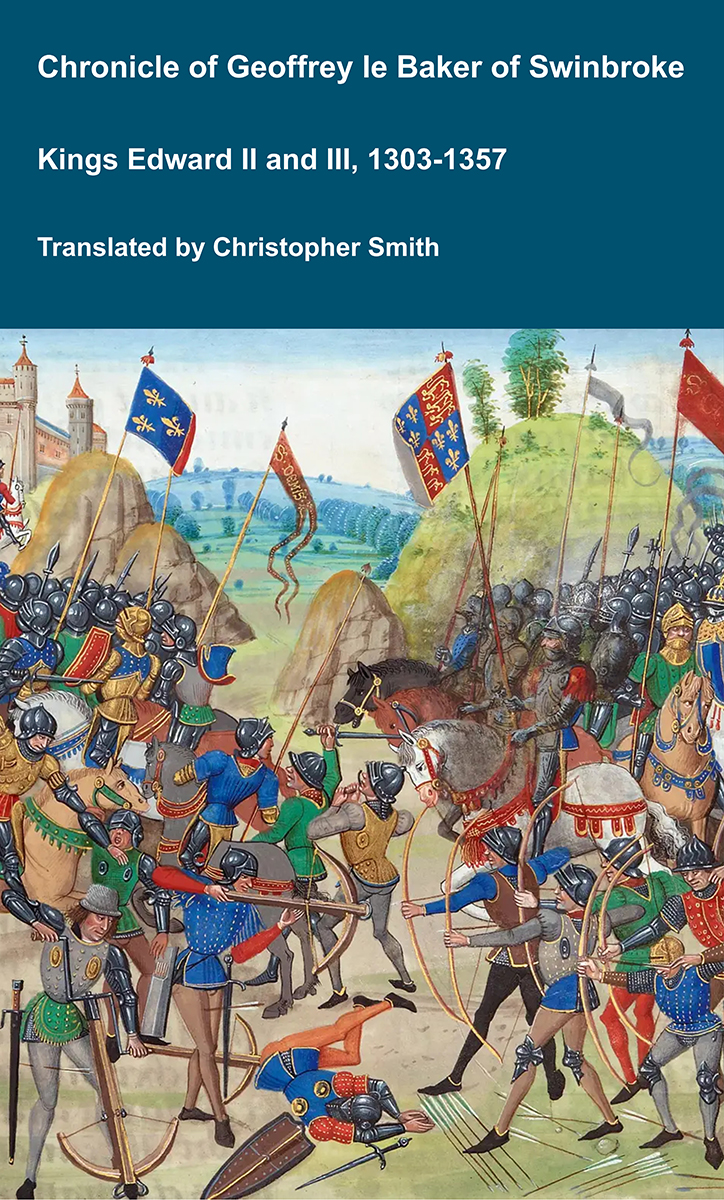 Chronicle of Geoffrey le Baker of Swinbroke. In this year,1 on the feast day of Saint George [23rd April 1350], the king held a great banquet at Windsor Castle [Map], where he established a chantry of twelve priests, and founded a hospital, in which impoverished knights, whose means were insufficient, could, in the service of the Lord, receive suitable support from the perpetual alms of the founders of that college. Besides the king, other nobles contributed to the foundation of this hospital, namely: the king's eldest son, the Earl of Northampton [aged 40], the Earl of Warwick [aged 37], the Earl of Suffolk [aged 51], the Earl of Salisbury [aged 21], and other barons. Also included were simple knights, such as: Roger de Mortimer [aged 21], now Earl of March, Lord Walter de Mauny [aged 40], Lord William FitzWarin [aged 34], John de Lisle [aged 14], John de Mohun [aged 30], John de Beauchamp [aged 31], Walter de Pavely [aged 31], Thomas Wale [aged 47] and Hugh de Wrottesley [aged 16]. Men whose proven virtue ranked them among the wealthiest earls. Together with the king, all these men were clothed in robes of powdered russet, with garters of Indian colour, also wearing garters on their right legs, and mantles of blue, adorned with the shield of Saint George. In such attire, bareheaded, they devoutly attended a solemn Mass, sung by the bishops of Canterbury, Winchester, and Exeter. They then sat together at a common table, in honour of the holy martyr, to whom they dedicated this noble brotherhood, calling their company "The Knights of Saint George of the Garter."
Isto anno, in die sancti Georgii, rex celebravit grande convivium apud Wyndesore in castro, ubi instituit cantariam xij. sacerdotum, et fundavit zenodochium, in quo milites depauperati, quibus sua non sufficerent, possent in Domini servitute de perpetuis elemosinis fundatorum illius collegii sustentacionem competentem habere. Preter regem fuerunt alii compromittentes in fundacionem istius zenodochii, scilicet regis primogenitus, comes Norhamptonie, comes Warewici, comes Suthfolchie, comes Salisbiriensis, et alii barones; simplices quoque milites, scilicet Rogerus de Mortuo mari, nunc comes Marchie, dominus Walterus de Magne, dominus Willelmus filius Garini, Iohannes de Insula, Iohannes de Mohun, Iohannes de Bealchampe, Walterus de Pavely, Thomas Wale, et Hughe de Wrotesley, quos probitas experta ditissimis comitibus associavit. Una cum rege fuerunt omnes isti vestiti togis de russeto pulverizato cum garteriis Indie coloris, habentes eciam tales garterias in tibiis dextris, et mantella de blueto cum scutulis armorum sancti Georgii. Tali apparatu nudi capita audierunt devote missam celebrem per antistites Cantuariensem, Wintoniensem, et Exoniensem decantatam, et conformiter sederunt in mensa communi ob honourem sancti martiris, cui tam nobilem fraternitatem specialiter intitularunt, appellantes istorum comitivam sancti Georgii de la gartiere.
Note 1. Stow Annales 390: "This yeere, on Saint Georges day [23rd April 1350], the king held a great and solemne feast at his castle of Windsor, where he had augmented the chappel which Henry the first and other his progenitors, kings of England, had before erected, of eight chanons. He added to those eight chanons a deane and fifteene chanons more, and 24 poore and impotent knights, with other ministers and servants, as appeareth in his charter dated the two and twentieth of his reigne. Besides the king, there were other also that were contributors to the foundation of this colledge, as followeth: i. The sovereigne king Edward the third, 2. Edward, his eldest sonne, prince of Wales, 3. Henry, duke of Lancaster, 4. the earle of Warwicke, 5. Captaine de Bouch [aged 19], 6. Ralph, earle of Stafford [aged 48], 7. William Montacute, earle of Salisburie, 8. Roger, lorde Mortimer, earle of March, 9. sir John de Lisle [aged 31], 10. sir .
It will be seen that Stow here alters the names to tally with the list of the original knights or First Founders of the order of the Garter. Baker seems to be anticipating. William Bohun, 1st earl of Northampton, and Robert Ufford, 1st earl of Suffolk, and sir William Fitz-Warine became knights of the order at an early date; but Roger Mortimer, here styled 'now Earl of March,' did not have that title before 1352, and sir Walter Manny did not receive the garter till the end of 1359.
The date of the foundation of the order of the Garter has never been exactly determined. Froissart 203.
The Brute chronicle (Egerton MS. 650) has this description, although under a wrong year: "And in the XIX yere of his regne, anone aftre, in Jannuere, before Lenten, the same kyng Edward lete make fulle noble iustice and grete festes in the place of hys byrth, at Wyndsore, that ther were never none suche seyne before that tyme, ne I trowe sythene. At whech iustice, festis and ryalte weryn II kinges, II quenys, and the prince of Wales and the duke of Cornewale, ten erles, nine countesse, many barons, knyghttes, and worthy burgesse, the whech myght not lyghtly be nombrede; and also of dyverse londes as byyonde the see were many strangers. And at that tyme, whene the iustes had done, the kyng Edward made a grete souper, in the wheche he begone fyrst hys round table, and ordayned stedfastly the day of the forsayd table to be holde ther at Wyndessore in the Whytesonwyke evermore yerely."
Relying on the date given in the statutes of the order and on this passage in Baker, writers on the subject have adopted 1349 or 1350 as the year of foundation. But an entry in the household-book of the Black Prince affords a reason for dating the event a year earlier, payment having been made on the 18th November 1348, for twenty-four garters which were given by the prince "militibus de societate garterias" i.e. "garters [were given] to the knights of the society"; Beltz, Memorials of the Order of the Garter, pp. XXXII, 385. Proof however is not conclusive, as the ministers' accounts in the household-book were rendered between 1352 and 1365, and there is therefore room for error; moreover, the garters in question may have been prepared in anticipation. The date of 1349, which is given in the preamble to the earliest copies of the statutes, although it is true that those copies are not contemporary, is not to be lightly set aside. It is, indeed, most probable that the order was never solemnly instituted at an early period, but that it was gradually taking shape during the years following the foundation of the Round Table. Edward's patent, bearing date of 22nd August 1348, whereby he instituted a chapel at Windsor, with a fraternity of eight secular canons and a warden, fifteen other canons, and four-and-twenty poor knights, appears to be the first formal document which can be quoted as a foundation-deed of the order. After this there is no direct reference to it until 1350, when robes were issued for the King against the coming Feast of St. George, together with a Garter containing the King's motto, "Hony soyt qui mal y pense!" Nicolas, History of Orders of Knighthood, 1.24.
Annales of England by John Stow. This yeere, on Saint Georges day [23rd April 1350], the king held a great and solemne feast at his castle of Windsor, where he had augmented the chappel which Henry the first and other his progenitors, kings of England, had before erected, of eight chanons. He added to those eight chanons a deane and fifteene chanons more, and 24 poore and impotent knights, with other ministers and servants, as appeareth in his charter dated the two and twentieth of his reigne. Besides the king, there were other also that were contributors to the foundation of this colledge, as followeth: i. The sovereigne king Edward the third, 2. Edward, his eldest sonne, prince of Wales, 3. Henry, duke of Lancaster, 4. the earle of Warwicke [aged 37], 5. Captaine de Bouch [aged 19], 6. Ralph, earle of Stafford [aged 48], 7. William Montacute [aged 21], earle of Salisburie, 8. Roger, lorde Mortimer [aged 21], earle of March, 9. sir John de Lisle [aged 31], 10. sir Bartholomew Burwash [aged 22], 11. sir John Beauchampe [aged 34], 12. sir John Mahune [aged 30], 13. sir Hugh Courtney, 14. sir Thomas Holland [aged 36], 15. sir John Grey [aged 49], 16. sir Richard Fitz Simon, 17. sir Miles Stapleton [aged 30], 18. sir Thomas Walle [aged 47], 19. sir Hugh Wrothesley [aged 16], 20. sir Nele Loring [aged 30], 21. sir John Chandos [aged 30], 22. sir James de Audley [aged 32], 23. sir Othes Holland [aged 34], 24. sir Henry Eme, 25. sir Sechet Dabridgecourt [aged 20], 26. sir Wiliam Panell [aged 31]. All these, together with the king, were clothed in gownes of russet, poudered with garters blew, wearing the like garters also on their right legges, and mantels of blew with scutcheons of S. George. In this sort of apparell they, being bare-headed, heard masse, which was celebrated by Simon Islip, archbishop of Canterbury, and the bishops of Winchester and Excester, and afterwards they went to the feast, setting themselves orderly at the table, for the honor of the feast, which they named to be of S. George the martyr and the choosing of the knights of the Garter.
On 29th August 1350 the English fleet defeated a Castilian fleet at Winchelsea [Map] during the Battle of Winchelsea. Around twenty Castilian ships were captured; several were sunk. For the English King Edward III of England [aged 37] and his son Edward "Black Prince" [aged 20], James Audley [aged 32], Henry Scrope 1st Baron Scrope of Masham [aged 37], Henry of Grosmont 1st Duke Lancaster [aged 40] and John Sully [aged 67] fought.
Chronicle of Geoffrey le Baker of Swinbroke. In the following summer,1 after a dispute arose between the sailors of England and Spain, the Spaniards blockaded the English Channel with forty-four large warships,2 and captured, plundered, and sank ten English ships that had been sailing from Aquitaine to England. Having thus taken vengeance for injuries suffered, they put in at the port of Sluys in Flanders. When this was reported, the king3 assembled his fleet, gathering fifty ships and pinnaces, and prepared to intercept the returning Spaniards. With him he had the Prince of Wales, the Earls of Lancaster, Northampton, Warwick, Salisbury, Arundel, Huntingdon, and Gloucester, as well as other barons and knights, with their personal retinues and archers. Finally, on the Feast of the Beheading of Saint John [29th August 1350], around the hour of vespers [evening], the fleets collided. The large Spanish ships,4 like floating castles, towered over our galleys and vessels.
In estate sequenti, orta dissencione inter nautas Anglie et Ispanie, Ispani obsederunt mare Britannicum cum XLlIIIJ magnis navibus bellicosis, qui decem naves Anglicas versus Angliam ab Aquitannia velificantes captas atque spoliatas submerserunt, et, taliter iniuria passa vindicata, in portum de Sclusa Flandrie applicuerunt. Hiis auditis, rex, suo navigio coadunato in quinquaginta navibus et spinaciis, Ispanis reversuris obviare disponebat, secum habens principem Wallie, comites Lancastrie, Norhamptonie, Warewici, Sarisburie, Arundellie, Huntindonie, Gloucestrie, et alios barones atque milites, cum eorum precise l secretis commensalibus et sagittariis. Denique in festo Decollations sancti lohannis, circa d horam vesperarum, classes colliserunt; ubi magne buscee Ispanienses, quasi castra casellis, ita nostris liburnis et navibus supereminebant.
Note 1. Stow Annales 391.
The battle of 'Les Espagnols sur Mer' was fought off Winchelsea on Sunday, the 29th August 1350. The Spanish admiral was Carlos de la Cerda. Froissart's picturesque narrative of the action is the principal source of information. In Baker's account we have valuable details regarding the number and losses of the Spanish fleet and the prominent part taken in the struggle by the English archers.
Note 2. Baker is here very exact in his numbers, and may no doubt be followed. Froissart 324.
Note 3. Edward first issued orders for the gathering of ships at Sandwich on the 23rd July. See Nicolas, A History of the Royal Navy, II 103. Baker is wrong in including the earl of Gloucester among those present. The title had become extinct with the death of Hugh de Audeley in 1347.
Note 4. The 'buscee' was a large vessel, comPARAtively short, but broad in the beam and deep in the hold. Froissart 325.
Deeds of King Edward III by Robert of Avesbury. On the Feast of the Beheading of Saint John the Baptist [29th August], in the year of our Lord 1350, in the 24th year of his reign over England and the 11th year of his claimed reign over France, the said Lord King of England, reflecting in his heart how, around the previous [1st November 1349], the Spaniards, arriving by sea, had attacked the port of Gironde, on the maritime approach toward Bordeaux, and had seized many English ships loaded with wine for transport to England, killing all the Englishmen found aboard, he resolved to punish and terrify them with a similar fate, that they might not dare to commit such crimes again. Having assembled a sufficient fleet at Sandwich, and taken with him many nobles, as well as men-at-arms and archers of the realm, he engaged in a naval battle near Winchelsea with the Spaniards, who were sailing from Flanders in many armed warships, fully manned and stocked with weapons and defensive gear, sailing homeward, and preparing to plunder and burn along the English coast. The king engaged them in battle1, and, although the Spaniards fought valiantly, he defeated them. There were very many Spaniards aboard 24 large ships, and none of them was willing to surrender. So they were put to death by sword and arrow, and the said 24 ships were captured, together with much merchandise, especially various cloths purchased in Flanders. However, some Spanish ships that had kept farther from the battle, holding both their goods and distance, escaped, as no one pursued them.
In festo vero Decollationis sancti Johannis baptistæ, anno Domini millesimo CCCL, dictus dominus rex Anglorum, anno regni sui Angliæ XXIIIL, regni vero Franciæ XJ, in corde suo revolvens quod, circiter festum Omnium Sanctorum proximo tunc præteritum, Ispanici, navigio venientes, in portu de Gerounde, tendente de mari versus Burdeaux, plures naves Anglorum ibidem cum vino in Angliam transvehendo onustas, peremptis omnibus Anglicis in eisdem navibus inventis, ceperunt, cogitansque eosdem pœna consimili castigare et terrere ne ad talia facinora extenderent amplius manus suas, in sufficienti navigio, apud Sandwich congregato, assumptis secum multis nobilibus aliisque hominibus armorum et sagittariis regni Angliæ, in mari juxta Winchelse cum Hispannicis, de partibus Flandriæ, cum multis navibus bellicosis hominibus armatis, cum telis et armis aliis defensivis munitis fortiter et onustis, versus partes proprias navigantibus, et ad faciendas deprædationes et incendia per litora maris Angliæ se disponentibus, bellum navale commisit, ipsosque strenue se habentes devicit. Multis admodum Hispannicis in XXIIIJ magnis navibus exsistentibus, nullo ipsorum volente se reddere, gladiis et sagittis volantibus vita privatis, dictæ xxiiijor naves, cum multis mercimoniis prsecipue diversis pannis emptis in Flandria, in eisdem inventis, capte sunt; quidam tamen, cum suis mercimoniis in navibus aliis repositis a prœlio longius se tenentes, ipsos nullis insequentibus, evaserunt.
Chronicle of Geoffrey le Baker of Swinbroke: "In the following summer, after a dispute arose between the sailors of England and Spain, the Spaniards blockaded the English Channel with forty-four large warships, and captured, plundered, and sank ten English ships that had been sailing from Aquitaine to England. Having thus taken vengeance for injuries suffered, they put in at the port of Sluys in Flanders. When this was reported, the king assembled his fleet, gathering fifty ships and pinnaces, and prepared to intercept the returning Spaniards. With him he had the Prince of Wales, the Earls of Lancaster, Northampton, Warwick, Salisbury, Arundel, Huntingdon, and Gloucester, as well as other barons and knights, with their personal retinues and archers. Finally, on the Feast of the Beheading of Saint John, around the hour of vespers [evening], the fleets collided. The large Spanish ships, like floating castles, towered over our galleys and vessels. The enemy attacked our men fiercely, hurling stones from the turrets of their masts, shooting javelins and crossbow bolts sharply and frequently, wounding our men, and fighting hand-to-hand with lances and swords, defending themselves bravely in full battle armour. The clash grew fiercer, so much so that our men had never before experienced such a terrible fight. At last, our archers, with their longer-range arrows, began to strike down the enemy crossbowmen, who could only shoot their bolts to a shorter distance, and so they were forced to abandon their post. Others, fighting hand-to-hand on the edges of the Spanish ships and at their castles, tried to shield themselves with the planking of the ships, but found themselves made vulnerable and defenceless. Those who had been hurling stones from the towers were driven to hide themselves entirely, no longer daring to expose their heads or shoulders in the usual way. They raised only their hands but even these were not safe from the English arrows. No longer did they throw the stones, they merely let them fall, often causing more harm to their own side than to ours. Then our men, climbing up with scaling ladders, stormed the Spanish ships, cutting down their opponents with swords and axes, and soon emptied the vessels of Spaniards, refilling them with Englishmen until the jealous darkness of night fell over them, and they could no longer see the other twenty-seven enemy ships. There you would have seen ships painted with blood and brains, arrows embedded in masts, sails, rudders, and towers; archers retrieving their arrows from the wounds of the dead; and men calling in vain for the battle to resume the next day. Our men dropped anchor, thinking about the fight still to come believing nothing had been accomplished, as long as anything remained to be done. They treated their wounded, threw dead and dying Spaniards into the sea, ate, slept, and posted armed guards to keep watch. At dawn, as silence faded and light returned, the English, prepared for a new battle, sounded trumpets, horns, and war pipes, calling their men to arms. But under the full light of the rising sun, they saw no sign of resistance. Indeed, the 27 remaining Spanish ships, having fled in the night with all their strength, had left seventeen of their vessels, stripped, bloodstained, and covered in brains, to the will of the king. The king returned to England unwillingly, victorious, yes, but having won at great personal and collective cost. His men bore the scars of battle: heads bound in linen, arms and legs pierced by quarrels and weapons, teeth knocked out, noses cut off, lips split, and eyes gouged out. But, proud of their glorious triumph and survival, they mingled laughter with pain, and were delighted to show their cloaks stained with the blood of a defeated enemy. There, the king knighted eighty valiant squires, but mourned the loss of one, Sir Richard de Goldesborough, who, it was said, sold his life dearly, too dearly, it seemed, even to the Spaniards."
 Become a Member via our Buy Me a Coffee page to read more.
Chronicle of Henry Knighton. At that same time, the Spaniards returned from Spain with a strong fleet and robust men, bringing with them countless treasures and vast quantities of merchandise, and they rested at Sluis in Flanders. They plundered at sea whatever they could, killed many Englishmen, and committed numerous atrocities. During their arrival at Sluys, they encountered an English fleet sailing toward Gascony in search of wine. They seized their goods and killed many Englishmen, especially off the coast of Brittany, causing great losses. Therefore, King Edward sent word to Flanders that the Spaniards should be removed from their lands at his request. And immediately King Edward gathered his forces. For, since the Spaniards had inflicted so many wrongs upon the English; burning English ports, plundering, and killing, King Edward went to meet them at sea, and attacked them fiercely. The Spaniards nobly and bravely defended themselves for a long time, but at last they were overcome, and many were drowned. And the king seized their goods, by the grace of God, and brought them back to England, specifically, on the Sunday just before the Feast of the Assumption [29th August 1350].
Eodem tempore Hispaniei redierunt de Estlandia cum forti classe et gente robusta, habentes gazas innumeras et mercimonia infinita, et quieverunt apud le Sclusse! in Flandria. Et prædati sunt in mari quecunque potuerunt, et multos Anglos occiderunt et multa mala fecerunt, et in eorum adventu apud le Sclusse obviaverunt Anglicanæ classi tendenti versus Vasconiam pro vino quærendo, bona eorum rapuerunt et occiderunt de Anglis ad magnam summam, sub maritima Britanniæ. Unde rex Edwardus misit in Flandriam ut eos amoverent a finibus suis ad instantiam suam, et statim rex Edwardus congregavit populum suum [et] pro eo quod Hispanici tanta mala intulerant Anglicis incendendo portus Angliee, depresdando et occidendo, rex Edwardus dedit eis obviam in mari et eis acriter insultum fecit, et ipsi se nobiliter et fortiter defenderunt longo tempore, et tandem subacti sunt et multi submersi, et tulit rex bona eorum per dei gratiam, et adduxit secum in Angliam, scilicet Dominica proxima ante festum Assumptionis.
Become a Member via our Buy Me a Coffee page to read more.
In 1351 the Statute of Labourers was a futher attempt by Parliament to constrain worker's wages following the 1348 Black Death Plague Outbreak. In practice, the Statute was poorly enforced and caused considerable resentment, ultimately being one of the causes of the Peasant's Revolt.
In 1351 the Treason Act defined Treason for the first time: High Treason and Petty Treason, and the associated penalties. Hanging, drawing an quartering for men, burning for women.
In 1351 the Statute of Provisors attempted to constrain the appointment of benefices to aliens ie non-English who are not subject to English Laws.
Chronicle of a Bourgeois of Valenciennes
Récits d’un bourgeois de Valenciennes aka The Chronicle of a Bourgeois of Valenciennes is a vivid 14th-century vernacular chronicle written by an anonymous urban chronicler from Valenciennes in the County of Hainaut. It survives in a manuscript that describes local and regional history from about 1253 to 1366, blending chronology, narrative episodes, and eyewitness-style accounts of political, military, and social events in medieval France, Flanders, and the Low Countries. The work begins with a chronological framework of events affecting Valenciennes and its region under rulers such as King Philip VI of France and the shifting allegiances of local nobility. It includes accounts of conflicts, sieges, diplomatic manoeuvres, and the impact of broader struggles like the Hundred Years’ War on urban life in Hainaut. Written from the perspective of a burgher (bourgeois) rather than a monastery or royal court, the chronicle offers a rare lay viewpoint on high politics and warfare, reflecting how merchants, townspeople, and civic institutions experienced the turbulence of the 13th and 14th centuries. Its narrative style combines straightforward reporting of events with moral and civic observations, making it a valuable source for readers interested in medieval urban society, regional politics, and the lived experience of war and governance in pre-modern Europe.
Available at Amazon in eBook and Paperback format.
In 1351 Henry of Grosmont 1st Duke Lancaster [aged 41] was created 1st Duke Lancaster by King Edward III of England [aged 38]. Isabel Beaumont Duchess Lancaster [aged 31] by marriage Duchess Lancaster.
Lionel of Antwerp 1st Duke of Clarence [aged 12] was created 1st Earl of Ulster.
John of Gaunt 1st Duke Lancaster [aged 10] was created 1st Earl Richmond.
Ralph Stafford 1st Earl Stafford [aged 49] was created 1st Earl Stafford.
Chronicle of Geoffrey le Baker of Swinbroke. In the year of Christ 1351, and the 25th year of the king's reign, after the octave of the Purification of the Glorious Virgin [2nd February 1351], at the parliament held in London at Westminster, Lord Henry [aged 41], son of Henry, Earl of Lancaster, himself Earl of Lincoln, Leicester, Derby, Grismond, and Ferrers, was made Duke of Lancaster, receiving liberties and privileges from the royal bounty such as no other earl had ever held. Also Lord Lionel of Antwerp [aged 12], the king's son, was made Earl of Ulster in Ireland, Lord John of Gaunt [aged 10], his brother, was made Earl of Richmond and Lord Ralph of Stafford [aged 49], formerly a baron, was created Earl of the same name.
Anno Christi MCCCLJ et regis XXV post octabas Purificacionis Virginis gloriose, in parliamento Londoniis apud Westmonasterium celebrato, dominus Henricus filius Henrici comitis Lancastrie, ipse comes Lincolnie, Leicestrie, Derbie et Grossimontis atque de Ferrariis, factus est dux Lancastrie, datis sibi libertatibus atque privilegiis munificencia regali qualia nullus comitum habebat. Item, dominus Leunecius de Andewerpe, regis filius, fit comes de Holvestria in Hybernia, et dominus Tohannes de Gandavo, germanus eius, fit comes Richemundie, et dominus Radulfus de Staffordia, pridem baro, comes eiusdem tituli creabatur.
Chronicle of Henry Knighton. In the year of grace 1350, it was a Jubilee Year in Rome, and it began on the Feast of the Annunciation of the Glorious Virgin Mary [25th March 1351]. Henry, the noble Earl of Lancaster, was made Duke of Lancaster. He was the first Duke of Lancaster, and before him, no one is known to have held the ducal title in England except in Cornwall. John of Gaunt, son of King Edward, was made Earl of Richmond. Lord Ralph, Baron of Stafford, was made Earl of Stafford. Lord Robert de Ufford was made Earl of Suffolk. And a fifteenth was granted to the king in Parliament. In the same year, John of Valois, son of the King of France, was crowned as King of France.
On 26th March 1351 the Combat of the Thirty was an arranged joust, or melee, between selected combatants from both sides of the conflict, fought at Guillac, a site midway between the Breton castles of Josselin and Ploërmel among 30 champions, knights, and squires on each side.
Robert Knollys [aged 26] took part.
Hugh Calverley [aged 27] fought, was captured and ransomed.
The date of the battle sometimes given as the 27th of March 1351. De la Borderie, History of Brittany, vol. III, p. 514, note 4: Up to now, all historians who have written about the Battle of the Thirty have dated it to March 27, 1351. That is also the date inscribed on the commemorative pyramid at Mi-Voie. However, this date is one day Officer According to a contemporary poem, the battle was fought on a Saturday, the eve of Laetare Sunday (Jerusalem), that is, the fourth Sunday of Lent. In 1351, Easter fell on April 17, so Laetare Sunday was March 27. Therefore, the eve of that Sunday—the day of the Battle of the Thirty—was not March 27, but March 26. See the title and conclusion of the poem, ed. Crapelet, pp. 13 and 35, and stanza 34, Crapelet p. 30.
Chronicle of Jean le Bel Chapter 86. How thirty Frenchmen fought against thirty Englishmen and Germans under certain agreed conditions in Brittany, and how the English and Germans1 were defeated.
Comment XXX Françoys se combatirent contre XXX que Angloys que Alamans par certaines convenances en Bretaigne, et furent vaincus les Angloys et Alamans.
Note 1. See Froissart, ed. Luce, vol. IV, p. 110, § 335, to p. 115, § 338. In the final paragraph, Froissart speaks of two knights who had taken part in the Combat of the Thirty. Variants, pp. 338 to 341.
Cf. Froissart, éd. Luce, t. IV, p. 110, § 335, à p. 115, § 338. Dans le dernier alinéa, Froissart parle de deux chevaliers qui avaient été au combat des Trente. Variantes, p. 338 à 341.
Bentleys Miscellany Volume 45. The Combat of the Thirty from an old breton lay of the Fourteenth Century by William Harrison Ainsworth.
Froissart Book 4: 1346-1356. [332] There was then a good battle1, hard and stoutly fought, and many great feats of arms were done, for they were the very flower of chivalry on one side and on the other. For a long time they wheeled about the fields, fighting most skillfully, before anyone could know or judge which would have the advantage, and which not. And it happened at times that the English wavered and were near to being discomfited, and then they recovered themselves and gained the upper hand, and by bold and valiant fighting broke their enemies and defeated them. There were taken there all those knights of Poitou and Saintonge named above, and Sir Guy de Nesle. No man of honour escaped. And the English and the Gascons had there good prisoners, who were worth to them a hundred thousand moutons, besides the great gain of horses and armor that they had upon the field. So it seemed to them that for this expedition they had done enough. Then they turned to securing their prisoners, and since the town of Saint-Jean could not by them, at that time, be revictualled or reinforced, they returned toward the city of Bordeaux, and so well did they journey that they arrived there, where they were received with great joy.
Là eut bonne bataille et dure et bien combatue, et fait tamainte grant apertise d'armes, car il estoient droite fleur de chevalerie, d'un costé et d'aultre. Si furent un grant temps tournoiant sus les camps et combatant moult ablement, ançois que on peuist savoir ne cognoistre liquel en aroient le milleur, et liquel non. Et fu tel fois que li Englès branlèrent, et furent priès desconfi, et puis se recouvrèrent et se misent au dessus, et desrompirent, par bien combatre et hardiement, leurs ennemis, et les desconfirent. Là furent pris tout cil chevalier de Poito et de Saintonge dessus nommé, et messires Guis de Neelle. Nulz homs d'onneur ne s'en parti. Et eurent là li Englès et li Gascon de bons prisonniers qui leur vallirent cent mille moutons, sans le grant conquès des chevaus et des armeures que il avoient eu sus le place. Si leur sambla que, pour ce voiage, il en avoient assés fait. Si entendirent au sauver leurs prisonniers, et que la ville de Saint Jehan ne pooit par yaus, tant c'à celle fois, estre ravitaillie et rafreschie. Si s'en retournèrent vers le cité de Bourdiaus, et fisent tant par leurs journées que il y parvinrent; si y furent recueilliet à grant joie.
Note 1. Robert of Avesbury describes the date as 8th April 1351.
Become a Member via our Buy Me a Coffee page to read more.
Deeds of King Edward III by Robert of Avesbury. While the French, with a large force, were besieging the town of Saint-Jean-d'Angély, which Lord Henry of Lancaster, Earl of Derby, during his earlier service in Gascony under the King of England, had easily seized from the French by direct assault and subjected to the English crown, a force of men-at-arms gathered in Gascony, led by the son of the Lord of Bret, set out toward the said siege to bring aid to the besieged. Hearing this, the French besiegers sent out many thousands of their best troops to confront the Gascons, though they left a sufficient number of forces behind to maintain the siege and on the 8th day of April [1351], the Gascons and French encountered each other near Saintes and engaged in a fierce battle. In the end, many French were killed, some turned in flight, and more than 300 French knights and noble men-at-arms were captured there. However, the siege continued, until the besieged, lacking supplies, surrendered under honourable terms. And thus, the town of Saint-Jean-d'Angély was restored to the former control of the King of France.
Francigenis cum magna potentia obsidentibus villam Sancti Johannis Angelyn, quam dominus Henricus Lancastriæ, comes de Derby, dum sub rege Anglorum in Vasconia militaverat, de manibus Francorum solo insultu leviter eripuit ac regi Anglie subjugavit, de viri armorum congregati in Vasconia, filio domini de Bret eorum duce, versus dictam obsidionem, ad præstandum obsessis subsidium, duxerunt iter suum. Hæc audientes, Francigeni exsistentes in obsidione miserunt multa millia electorum dictis Vasconicis in occursum, sufficienti tamen numero Francigenorum in obsidione dimisso et VIIJ die Aprilis, anno Domini millesimo CCCLI, dicti Vasconici et Francigeni, juxta Seyntes, ad invicem obviam sibi dantes, fortiter preeliarunt, et finaliter, multis Francigenis interfectis ac quibusdam eorum in fugam conversis, plus quam CCC milites et nobiles homines armorum Francigenorum capti fuerunt ibidem; obsidione tamen durante, quousque obsessi, deficientibus sibi victualibus, se bonis conditionibus reddiderunt. Et sic dicta villa Sancti Johannis in potestatem pristinam regis Franciæ est redacta.
Become a Member via our Buy Me a Coffee page to read more.
Chronicle of Geoffrey le Baker of Swinbroke. Also, around the feast of Saint George1 [23rd April 1351], matters in Gascony were going well. For the Marshal of France, with a large number of armed men, had ravaged the territory of the town of Saint-John-d'Angély, the defence of which had been entrusted to Edmund Rose of Norfolk. Thereupon, the locals, joined by the garrison of the said town, bravely confronted the enemy, and, after engaging in battle, and with many killed, they captured the said Marshal and many other French nobles, while more than 400 men of knightly rank were put to flight.
Item, circa festum sancti Georgii, res in Vasconia bene gerebatur, quippe marescallus regni Francie cum magna multitudine armatorum depopulavit patriam ville sancti Iohannis Ewangeliste, cuius custodie Edmundus Rose Nortfolchiensis preficiebatur; unde populares, coadunati cum garnestura predicte ville, hostibus viriliter obviarunt, et, inito congressu, multis quoque occisis, ceperunt predictum marescallum et multos alios nobiles Francorum, fugatis amplius quam CCCC viris status militaris.
Note 1. This action, which is here dated about the 23rd April, took place, according to Avesbury 413, on the 8th of the month. It was fought near Saintes, some distance south of Saint-Jean-d'Angély, which was being besieged by the French. It was the result of an attempt to relieve the city, which was too closely invested for the garrison to take any part in it. Although the English were victorious and made many prisoners, including Gui de Nesle, sire d'Offemont, marshal of France, they failed to raise the siege; and the place fell early in September.
Bourgeois de Valenciennes. It happened on a Wednesday [8th June] at Pentecost in the year 1351 that Sir John de Beauchamp [aged 35] and his company, about six hundred men, set out from Calais. They advanced so swiftly that at dawn they were near Saint-Omer, and they rode up to the Boulogne gate, seized livestock and plunder, and drove it off. The alarm was raised in Saint-Omer, and when the Marshal of France heard the news, he armed himself quickly and had all those with him at Saint-Omer arm themselves as well. He mounted his horse, and with a fine company rode out of the town. With him were the Viscount of Narbonne, Sir Guy of Poitiers, Sir Guichard of Beaujeu and his brother, the Bastard of Bourbon, Sir Oudart of Renty, Sir Baudart of Cuvillier, and many others. They pursued the English and overtook them near Ardres. The English drew up in battle array, but they sent the plunder on ahead to Calais with two hundred men. The French approached, and there was a ditch between the two forces. Then Edward of Beaujeu [aged 35], in great eagerness, took his spear and attempted to leap across the ditch. As he was leaping, an Englishman thrust a spear upward from below and struck him in the body, casting him down mortally wounded. At this his men, greatly angered, leapt across the ditch one after another and charged into the English ranks, and fierce fighting began. The English fought so stoutly that they captured five French knights and held them as prisoners, and would have defeated the rest. But foot soldiers from Saint-Omer who had followed the pursuit, about eight hundred in number, arrived on the field and attacked the English. Those who had been captured broke free and rejoined the fight. A fierce and remarkable battle followed. Sir Guichard of Beaujeu, brother of the slain marshal, was grievously wounded, as was Sir Baudart of Cuvillier. In the end the English were defeated, and Sir John de Beauchamp and the best of his company were taken prisoner and brought to Saint-Omer. Sir Guichard of Beaujeu was carried back on a litter and arranged for his brother’s body to be taken to their homeland in Burgundy, which was done. He was buried at Belleville in the abbey called Saint-Martin. The lands around Belleville belonged to the lord of Beaujeu who was slain near Ardres, Marshal of France, while defending the realm for King John of Valois.
Sy avint que par ung merquedy de le Pentecouste, l'an mil CCCLI, que monseigneur Jehan de Beauchamp et sa routte, environ VIc hommes, se partirent de la ville de Calais, et esploitèrent tant que droit au point du jour de ce merquedy, ils furent environ Saint-Omer et coururent jusques à la porte de BouUongne et eslevèrent la proye et l'emmenè rent. Lors s'esleva la voix et le cry en Saint-Omer; et quant le mareschal de France entendy les nouvelles, il s'arma moult hastivement et fist armer tous ceulx qui avoec luy estoient à Saint-Omer, comme saudoyers, pour le tamps d'adont. Sy monta à cheval et fist monter ses hommes, et yssit de la ville à belle compaignie. Et avoec luy estoient le visconte de Nerbonne, monseigneur Guy de Poitiers, monseigneur Guichart de Beaugeu et son frère, le bastart de Bourbon, monseigneur Oudart de Renty, monseigneur Baudart de Cuvillier et moult d'aultres. Sy siévyrent tant les Englecqs et leur routte, qu'ils les rataindirent assez près d'Ardre; et se misrent les Englecqs en bataille, mais ils envolèrent la proye par CC compaignons à Calais. Et les François les approchèrent, et y avoit ung fosset entre deux. Adont Edouart de Beaugeu, par grant ayr, print son glave et s'esquoella au sallir oultre le fosset; et ainsy qu'il salloit, ung Englès luy puisa ung glave par dessoubs et luy boutta au corps; sy l'abaty là navret à mort. Et alors ses gens moult courouchiës sallirent le fosset, qui mieulx mieulx, et entrèrent ens es Englecqs, et se comba tirent entre eulx. Et se portèrent les Englecqs sy bien qu'ils retinrent V de leurs chevaliers, et les tenoient comme prisonniers, et eussent desconfi les aultres; mais les brigans qui s'estoient partis de Saint-Omer en siévant les gens, vinrent là, et estoient bien VIIIc. Sy assallirent les Englecqs; et ceulx qui prins estoient, rompirent leur prison et se misrent à deffence. Lors comraencha la bataille forte et mervilleuse, et y fut fort navrés monseigneur Guichart de Beaugeu, frère au seigneur de Beaugeu, qui tués estoit, et monseigneur Baudart de Cuviller durement navrés ossy; mais en la fin les Englecqs furent desconfis, et y fut prins monseigneur Jehan de Beauchamp et les milleurs de sa routte et amenés à Saint-Omer. Et fut raportés monseigneur Guichart de Beaugeu en une litière, lequel ordonna de reporter le corps de son frère en son pays en Bourgongne, ainsy comme on fist; et fut ensevely en Belleville en une abbaye qu'on appelloit Saint-Martin. La terre d'environ Belleville estoit au seigneur de Beaugeu qui trespassa dalez Ardre, mareschal de France, en deffendant le royalme pour le roy Jehan de Valois.
Become a Member via our Buy Me a Coffee page to read more.
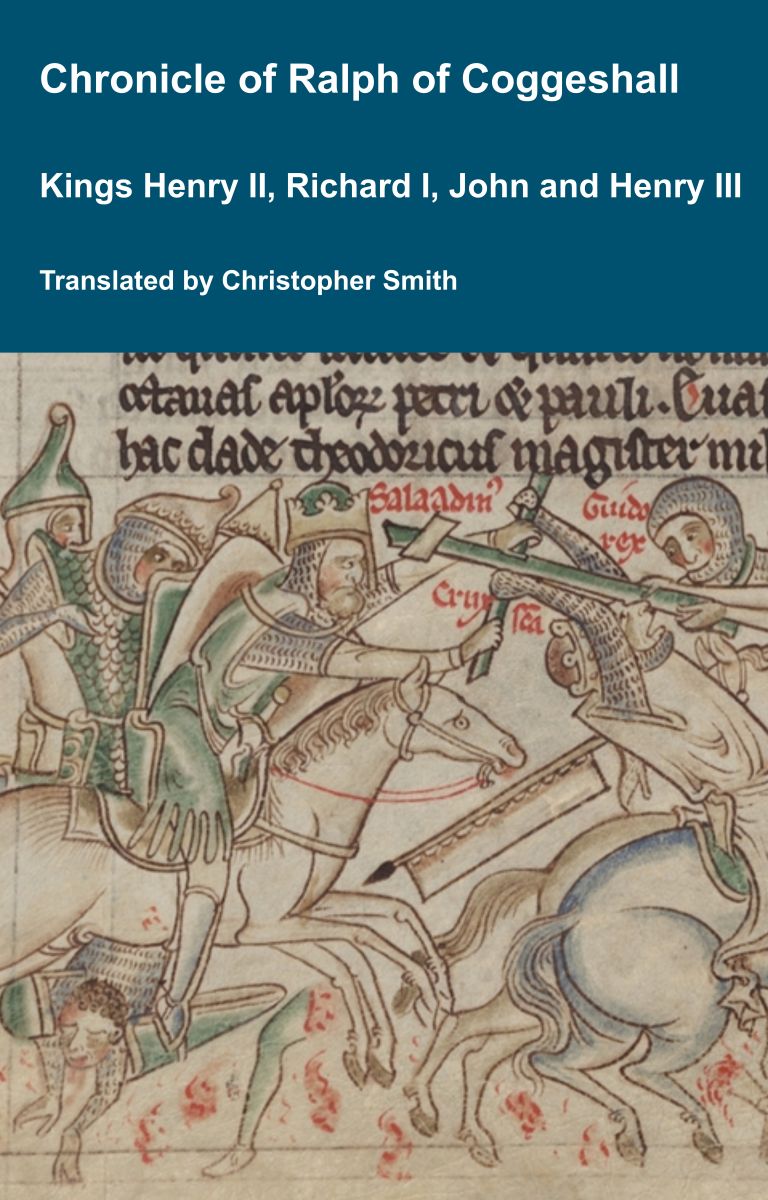
Chronicle of Abbot Ralph of Coggeshall
The Chronicle of Abbot Ralph of Coggeshall (Chronicon Anglicanum) is an indispensable medieval history that brings to life centuries of English and European affairs through the eyes of a learned Cistercian monk. Ralph of Coggeshall, abbot of the Abbey of Coggeshall in Essex in the early 13th century, continued and expanded his community’s chronicle, documenting events from the Norman Conquest of 1066 into the tumultuous reign of King Henry III. Blending eyewitness testimony, careful compilation, and the monastic commitment to record-keeping, this chronicle offers a rare narrative of political intrigue, royal power struggles, and social upheaval in England and beyond. Ralph’s work captures the reigns of pivotal figures such as Richard I and King John, providing invaluable insights into their characters, decisions, and the forces that shaped medieval rule. More than a simple annal, Chronicon Anglicanum conveys the texture of medieval life and governance, making it a rich source for scholars and readers fascinated by English history, monastic authorship, and the shaping of the medieval world.
Available at Amazon in eBook and Paperback format.
Chronicle of Geoffrey le Baker of Swinbroke. In the same year,1 the course of war took a disastrous turn under the command of John de Beauchamp, brother of the Earl of Warwick. At that time he was captain of Calais, and having led out nearly his entire garrison, that is, 300 men-at-arms and the same number of archers. He raided the surrounding countryside for three days and brought back an immense amount of plunder. But on their return to Calais, the Lords of Bailleul and Fiennes, with 1,500 men-at-arms, set ambushes for them in three locations. Though the English defeated the first and second ambushes, they then came near the paved causeway leading to Calais, where fresh enemy forces met them. Then the valiant knight Sir John, a man of great courage and noble spirit, disdained to retreat to that nearby paved road, where, had they reached it, the enemy would not have been able to encircle them, at least according to those who were there. Instead, he chose to stand and fight in open ground, even though his men were exhausted from two earlier battles that day, many were seriously wounded, and the archers had expended their arrows. Still, with great bravery, though not with prudence, they faced the enemy again. So a fierce new battle was begun. In it, the enemy leader, the Lord of Bailleul, was killed. But even so, the French forces prevailed, and they captured nearly all the English, except a few who had been wounded in earlier skirmishes, or who had already returned to Calais with the loot before the third engagement, though those were very few. No Englishman was killed, that is, if he chose to surrender, and almost all were later released either through ransom or exchange.
Eodem anno eventus bellicus sub ducatu Iohannis de Bello campo, germani comitis Warewici, in perversum fuerat mutatus, Ipse nempe, capitaneus tunc Calesii, educta fere tota sua custodia, scilicet trecentis viris armorum atque totidem sagittariis, patriam vicinam triduo vastavit et reduxit predam innumeratam; set in reditu versus Kalesiam domini de Bealgin et de Fienes cum mille et quingentis viris armorum illis insidias in tribus locis imboscarunt, qui, devictis prima et secunda imboscacionibus, venerunt prope pavimentum quod est iter ad Calesiam, ubi hostes recentes ipsis occurrerunt. Predictus igitur Iohannes, miles strenuissimus et mire magnanimitatis, indignatus quasi fugiendo in locum tutum et aptum defensioni suos contrahere, sprevit pavimentum eiis vicinum pro refugio captare, quo si devenissent, hostes in illos non prevaluissent, si fuerit credendum illis qui fuerunt ibidem; tunc enim illos non potuissent circumvallasse. Igitur in plano campo illis restiterunt et quantumcunque lassati ex dupplici in eodem die habito conflictu, et multi ex eiis periculose fuissent sauciati, sagittarii eciam suas sagittas expendissent, animose tamen, licet non sapienter, suos hostes receperunt. Sic innovatur acer conflictus, in quo dux adversariorum, prefatus dominus de Bealgin, cecidit peremtus; quo non obstante, sui constanter nostros expugnarunt, atque omnes ceperunt preter paucos, qui, in aliis conflictibus graviter wlnerati, cum illis qui predam ad villam abigebant ante tercium conflictum fuerant Calesiam, set pauci, regressi. Nullus Anglicus fuit ibi occisus, scilicet qui se voluit alicui reddere; unde fere omnes postea fuerunt aut per redempcionem aut commutacionem aliorum pro illis liberati .
Note 1. This combat was fought, according to Froissart near Ardres, on Whitsun Monday, 1352. He is obviously wrong in the year; but he is probably right in the day, which would be the 6th June. The French leaders here named were Edouard, sire de Beaujeu, marshal of France, who was slain, and Robert, called Moreau, de Fiennes, at this time captain of Saint-Omer. The French won the day by the arrival of reinforcements from the garrison of that place, probably led by Fiennes. The English leader, lord Beauchamp, captain of Calais, was made prisoner. He was a younger son of Guy, 9th earl of Warwick, and was a famous soldier in his day; he carried the royal standard at Crecy. He was summoned to parliament as lord Beauchamp in 1350; was afterwards constable of Dover castle; and died in 1360.
Chronicle of Geoffrey le Baker of Swinbroke. In this year, on the eve of the Assumption of the Virgin Mary, Mother of God1 [14th August 1352], Walter de Bentley, captain, Robert Knolles, and other loyal supporters of the king, encountered the enemy with great valour in the marches of Brittany. In the fierce and prolonged battle, the following were killed: the chief Marshal of France [aged 26], the lords of Quintin, Courtenoc (Curtunoke), Richemonte, Montauban, Lagenel, Launay, Montboucher, Villechastel, La Marche, and other knights, numbering 140, along with some 500 squires, whose coats of arms and armour were taken as spoils. The number of common soldiers slain was not counted. Among the captured were: Lord de Brusebeke, the son of Marshal Bertram, Tristram de Maleis, Lord de Maletret, the Viscount of Comminges, Geoffrey de Goanes, William de la Val, Charles d'Archeville, John de Bause, and other knights and squires numbering more than 130. This French army, under the command of the aforementioned marshal, had been intentionally positioned behind the slope of a hill, a location from which there was no escape, so that desperation might fuel their bravery, as often happens with courageous men. There were also present many from the company of the Knights of the Star,2 who had sworn in their order never to turn their backs on the English. Of them, 45 were among the dead and captured. Few escaped unwounded from that engagement. In it, the English captain Walter de Bentley, though horribly wounded, ordered thirty archers to be executed, these had, in the height of battle, fled in terror from the overwhelming number of French and turned their backs.
Isto anno, in vigilia Assumpcionis Virginis, matris Dei, Walterus de Benteleye, capitaneus, Robertus Knollis et alii regis fideles in marchia Britannie hostibus egregie obviarunt, ubi in certamine diu periculoso fuerant occisi marescallus Francie principalis, item domini de Quintin, de Curtunoke, de Richemont, de Mountalban, de Lagenel, de Launey, de Mountboche, de Vilechastel, de la Marche, et alii milites numero centum quadraginta, atque domicelli ad summam quingentorum, quorum toge armature fuerunt reportate, numero popularium non taxato. Ibidem capti fuerunt dominus de Brusebeke, filius marescalli Bertram, item Tristram de Maleis, item dominus de Maletret item vicecomes de Comayn, item Galfridus de Goanes, Willelmus de la Val, Carolus Darchefil, Iohannes de Bause et alii milites cum domicellis amplius quam centum et triginta. Iste Francorum exercitus sub ducatu predicti marescalli ex proposito ductoris fuerat a tergo declivo cuiusdam montis vallatus, quod non poterat fugam inire, ut ex fuge desperacione cresceret eiis audacia pugnandi, sicud solet animosis. Fuerunt eciam ibidem plures de comitiva militum Stelle, qui in sua professione coniurarunt se nunquam Anglico terga territa versuros, de quibus fuerunt inter captos et occisos numerati quadraginta quinque. Ab illo discrimine pauci non wlnerati evaserunt, in quo ipsorum capitaneus prefatus Walterus horribiliter wineratus iussit triginta sagittarios decapitari, qui in maximo belli fervore teriti a Gallicorum immensitate fugam inierunt.
Note 1. The information in the first part of this paragraph is obtained from sir Walter Bentley's letter to the chancellor, the bishop of Worcester, describing the action, which was fought near Mauron on the 14th August 1352. The letter is given in Avesbury 416 below. The names of the killed and prisoners, which are so disguised in the text, are: Gui de Nesle, sire d'Offemont, marshal of France; the sire de Quintin; Jean, sire de Tinteniac; the sires de Rochemont, de Montauban, and de Raguenel; Guillaume de Lannoy; Aufray de Montbouchier; Guillaume de Vielcastel; and Guillaume de la Marche, killed: and the sire de Briquebecq, son of Robert Bertrand, baron de Briquebecq, marshal; Tristan de Maignelais; the sire de Malestroit; the vicomte de Coalmen; Geoffroi de Coeyghem; Gui(?) de Laval; Charles d'Argeville; and Jean de la Muce, prisoners. The particulars of bringing the French to bay and punishing the runaway archers are not given elsewhere.
Note 2. The Order of the Knights of the Star was founded on the 16th November 1351; Jean Le Bel 2.17.
Deeds of King Edward III by Robert of Avesbury. "Reverend Father in God, please you to know that, since my coming into Brittany, the people that were appointed unto me and I, before that we entered into any stronghold, have ridden abroad on this side and have so much accomplished, praised be God therefore, that the town and castle of Ploérmel and of Fougéres have been right well comforted and victualled, and there hath been taken by assault a stronghold which had been made by the enemy before Fougéres. And, this done, my comrades and I rode through the land against the enemy, until the marshal of France, with all his power of France, Normandy, Anjou, Maine, Poitou, Touraine, Saintogne, and Brittany, with a mighty great number of men of arms and of other folk without number, came against us, near to a town called Mauron, between Rennes and Ploérmel, upon the open fields, without woods, ditches, or other defences; and there we fought with them [on 14th August 1352]. And it was on the eve of the Assumption of our Lady, between the hour of vespers and sunset; and, by the grace of God and the righteous cause which He upholdeth, the enemy were sore discomfited and with scarcely loss of men on our side, praised be God therefor. And there were slain there the seneschal of Anjou, the seneschal of Benavent, the viscount of Rohan, my lord John Frère, the lord of Quintin, the lord of Tinténiac, the lord of Rochemont, the lord of Montauban, my lord Reginald of Montauban, my lord Robert Raguenel, my lord William of Launay, my lord Aufray of Montbouchier, my lord William of Vielcastel, my lord William of La Marche, and other knights slain to the number of seven score, with squires which amount unto five hundred dead upon the field, all bearing coat armour, and common folk without number. And there were taken there the lord of Briquebecq, son of the marshal Bertrand, my lord Tristram of Maignelais, the lord of Malestroit, the viscount of Coótmen, my lord Geoffrey of Coeyghem, my lord John of Laval, the lord Incher, my lord Charles of Argeville, my lord John of La Muce, and many other knighte and squires, up to eight score, of whom, as well slain as taken, are full five and forty knights of rank."
"Reverent piere en Dieu, vous please savoir qe, puis mon ariver en Bretaigne, lez gentz qe maveient este ordeignez et moy, avaunt entrer en nul forteresse, avons chivachez par decea et avons taunt esploites, loiez ent soit Dieu, qe la ville et le chastiel de Ploermelle et de Founger ount este mult bien oonfortez et vitaillez, et pris par assaut une bastille qavoit este fait par les enemys devaunt Fouger. Et, ceo fait, mes compaignouns et moy chevachons sur le pais sur enemys et taunt ge le marschal du Fraunce, od tut son poar du Fraunce, de Normandie, de Angou, de Maine, de Peyto, de Toraigne, de Xantoigne, et de Bretaigne, ou mult graunt nombre des gentz darmes et dautres gentz sauntz nombre vindrent a lencountre de nous, pres dun ville appelle Maurone, entre Rennes et Ploermelle, sur les plaines champs, saung boys, saunz fossez, od aultre forteresce; et illesqes nous combatoms ovesqe eaux. Et fust la veille de lassumpcion de nostre Dame, entre heure de vespre et solail recussant; et, par la grace de Dieu et le bon droit qe le maintent, fasrent lez enemys pleinement descomfits et saunz perdre gaires dez gentz de nostre couste, loiez ent soit Dien. Et illesqes fasrent mortz le seneschal Dangou, le seneschal de Bennofyn, le viscounte de Roane, mounsire Johan Frere, le sire de Quyntine, le sire de Tynteneake, le sire de Rogemond, le siro de Montauban, le mounsire Renaud de Moncauban, mounsire Robert Raguenel, monsire William de Lamay, mounsire Aufray de Montboucher, mounsire Guilham de Vielchastel, mounsire Guilliam de la Marche, et autres chivalers mortz jesqes a VIJxx, ou les esquiers qamountent jusqes a D. mortz sur les champs, totes cotes a armer, et de comune people saunz nombre. Et y fusrent pris le sire de Byquebeke, filtz a marschal Bertram, monsire Tristram de Maleloyse, le sire de Malestret, le viscounte de Coyman, mounsire Geaffray de Coayms, mounsire Johan do la Vaale, le sire Incher, mounsire Charles Dargeville, mounsire Johan de la Muce, et plusors aultres chivalers et esquiers, jusqes a VIIJxx, dez queux qe mortz qe pris sount bien jusqes a XLV chivalers de estaille."
Become a Member via our Buy Me a Coffee page to read more.
On 14th August 1352 Guy II de Clermont-Nesle [aged 26] was killed at the Battle of Mauron.
In 1353 the Statute of Praemunire attempted to constrain the power of Rome over the sovereignty of England.
On 10th February 1355, St Scholatica's Day, the St Scholastica Day Riots began at Oxford, Oxfordshire [Map]. What started as a disagreement between students and the landlord over the quality of the wine at the Swindlestock Tavern Carfax Oxford, Oxfordshire grew into a three day riot in which around thirty townspeople and sixty students were killed.
John of Fordun's Chronicle. Chapter 174. The town of Berwick is surrendered to the King of England.
The same year, in the month of February, Edward III king of England, brooking ill the taking of the town of Berwick by the Scots, and fearing that, if he let them alone so, they would wrest the place and people from him, came to the marches, with a large force, as fast as he could (seeing that he lived so far off), and was going to lay siege to that town. The Scots, seeing this, and being unable to defend the town, because they were few, and had no provisions; and because they had a great dread of the aforesaid king's fierceness, and were hopeless of getting succour from their own nation, owing to the feuds among the chiefs, were wisely advised, and came to the best conclusion under the circumstances: they surrendered the aforesaid town to the king of England, on condition that they were saved harmless in life, limb, and all their substance; and thus every one hied him home scathless.
Chronicle of Geoffrey le Baker of Swinbroke. When they had returned to Calais, the king learned that the Scots had secretly entered England and had taken the town of Berwick,1 while Baron Greystoke, who had not been summoned to war alongside the king, had nonetheless been charged with the defence of the town which had now been captured. Because of this, the king hurried to Scotland, laid siege to Berwick, and within fifteen days the town was surrendered to him, with life and liberty granted to those found inside. He then marched through Scotland as far as the Scottish Sea [the Firth of Forth], but supplies ran short. The Scots, anticipating the king's approach, had moved all provisions to islands, strongholds, and even across the sea of Scotland and since even the ships of Newcastle had failed to properly provision the army,2 the king gave permission for all to return to England. The rear guard of the army,3 including Robert Herle, Aymer de St. Edmund, Robert de Hildesley, and others, followed behind at a distance of twelve miles. That night, the Scots attacked them suddenly, while they were sleeping, suspecting nothing, and gave a loud war cry as they struck. After a long resistance, Robert de Hildesley and John Brancestre, both knights, were captured, while Robert Herle and Aymer de St. Edmund barely escaped. These knights, seeing the superior strength of the Scots, had advised the lords and barons with them to withdraw and leave them behind, saying that it was wiser that lesser knights should be captured rather than noble barons, and that the loss of a few men was more tolerable than that of the entire group.
Et, Calesiam reversi, audivit rex quod Scoti furtim intrarunt et ceperunt villam Berewici, barone de Greistoke non invitato cum rege militante, cui tamen committebatur cura ville iam capte. Unde rex ad Scociam properavit, Berewicum obsessit, et infra quindenam villam sibi redditam recepit, datis vita et libertate inventis in illa. Deinde Scociam usque ad mare Scoticum peragravit, et quia victualia exercitui defuerunt, pro eo quod Scoti ante suspectum regis adventum omnia ad insulas et fortalicia et trans mare Scocie deportarunt, set neque naves Novi castri exercitum victualiarunt tamen ad hoc ordinate, cum rege licenciante omnes in Angliam repatriarunt, sequentibus in fine exercitus ad XIJ miliaria Roberto Herle, Almerico de Sancto Edmundo, Roberto de Hildesleye et aliis. Quibus Scoti de nocte inventis dormientibus, nihil adversum suspicantibus, cum exclamacione insultum dederunt. Ibi post longam resistenciam Robertus de Hildesleye et Iohannes Brancestre, milites, fuerunt capti, Roberto Herle et Almerico vix evasioni se committentibus. Consuluerunt enim predicti milites, visa Scotorum prevalencia, quod sui domini barones, ipsos suos se eximerent; et hoc fecerunt, estimantes comsulte tollerabiliorem pauperum militum quam baronum et paucorum quam omnium capcionem.
Note 1. The town of Berwick was taken by surprise on the 6th November 1355, but the castle held out. Edward returned to England in the latter part of November. He marched north towards the end of the year, was at Durham on the 23rd December, when he issued a proclamation to raise forces to meet him at Newcastle-upon-Tyne, and arrived at the latter place early in the new year (Rymer's Fœdera 3.314, 315). He appeared before Berwick on the 13th January 1356, and re-occupied it on the 24th. Three days later he advanced into Scotland. See Avesbury 413, Avesbury 432 and Avesbury 450.
Note 2. The victualling ships were wrecked or scattered by storms. Avesbury 455 and Froissart 354.
Note 3. Froissart 355, describes this skirmish as an attack made by Douglas on the English when marching through a mountain pass: "That very day, the weather was foul, cold, and rainy, and so harsh for riding, with wind and freezing conditions, that none could imagine worse. The English, who were riding in separate groups, had no idea that the Scots were so close, hidden in ambush. The Scots let the first, the second, and the third group pass, and then hurled themselves upon the fourth, crying out: "Douglas! Douglas!" For they were certainly convinced that the King of England was in that group, because their spies had told them that he rode in the fourth battle. But the night before, the English, through cunning, had reorganized their order, and had divided themselves into seven groups, in order to pass more easily through the narrow passes, which in that land are called the passes of Tweedon. And from these mountains is born the River Tweed, which in ancient times served to divide Scotland and England. The river winds through many places, passing through both Scotland and England, and at its end, beneath Berwick, it flows into the sea, and there it is very large. Avesbury 456
Baker's plausible excuse for the runaways can hardly be taken seriously. Sir Robert Herle held many manors and lands in Northumberland. Of his companions here mentioned, sir Almaric de St. Amand was justiciary of Ireland in 1357-1359, was summoned to parliament in 1371, and died in 1381; sir Robert de Hildesley was probably of a Gloucestershire family, one of his name being the royal escheator in that county in 1350; and sir John Brancestre may be identified with John de Branketre, who was afterwards treasurer of York.
John of Fordun's Chronicle. Chapter 173. Thomas Stewart, Earl of Angus, makes an attempt upon the town of Berwick.
The same year, about Allhallowmas [6th November 1355], Thomas Stewart, Earl of Angus, after having long thought of the undertaking, got together a number of ships from the several harbours of Scotland; and, with a mighty arm, and at the head of a body of stout men conveyed with him by sea, he brought up at Berwick harbour, on a still night, as had been planned between him and the Earl of March. They stealthily disembarked, and came on shore, bearing with them ladders provided for the purpose; and, bivouacking under the city walls, they lay in wait for a fit-time to do what they had come for. Accordinely, in the twilight of the following morning, they set up the ladders, and brave men straightway mounted them, and manfully entered the city; and, though the watchmen on the walls had given them a great deal of trouble on their entrance, they overthrew all who strove to defend the city. At length, all in the city, being panic-stricken at the sudden coming of the Scotsmen, rose out of bed, and rushed headlong without the walls, leaving the Scotsmen gold, and silver, and boundless wealth. These how. ever, dealt unmercifully with what their foes had, with much time and trouble, scraped together unto themselves. Nevertheless, the Scots, though they bravely assaulted the Castle of Berwick, could not manage to take it.
Bourgeois de Valenciennes. At that time it happened that the Scots entered England to ravage the land, and with them were some fifteen thousand French soldiers whom the King of France had sent into Scotland at the request of the Scottish barons. On behalf of the King of France, their leader and captain was Sir John de Garancières, a good knight of great renown. He had with him a great number of Scots who entered into England. Against them marched the Prince of Wales with a large force of good men-at-arms. The Scots were utterly defeated, killed and captured. Sir John de Garancières escaped only with great difficulty and returned to France defeated and stripped of his forces. The Prince of Wales returned to his own country in great triumph.
En celuy tamps avint que les Escochois entrèrent en Engleterre pour grever le pays, et avoient avoec eulx bien XV mille Franchois saudoyers, lesquels le roy de France avoit envoies en Escoche à la pryère des barons d'Escoche. Sy en estoit de par le roy de France conduiseur et capi- taine monseigneur Jehan de Garonsière ung bon chevalier et de grant pris, Cestuy eult avoec luy grantplenté d'Escochois qui entrèrent en Engleterre. Et contre yceulx se mist le prince de Galles à tout grant quantité de bons gens d'armes. Sy furent les Escochois tous desconfis, mors et pris. Et eschappa à moult grant paine monseigneur Jehan de Garensière qui retourna arière en France desconfis et desbaretés. Et le prince de Galles retourna en son pays à moult grant joye.
Deeds of King Edward III by Robert of Avesbury. The capture of Berwick by the Scots.
Captio de Berewyke per Scotos.
Deeds of King Edward III by Robert of Avesbury. How the King of England recaptured the town of Berwick, taken by the Scots.
Qualiter rex Angliæ recuperavit villam de Berwyk captam a Scotis.
On 20th January 1356 King Edward I of Scotland [aged 73] surrendered his claim to the Scottish throne to King Edward III of England [aged 43] in the presence of William Latimer 4th Baron Latimer of Corby [aged 25] in exchange for an English pension.
Bourgeois de Valenciennes. It is true that at Michaelmas [29th September 1357], after the peace between the two kingdoms of France and England had been concluded in the manner described above, King Edward of England and his five sons came into Calais. These were: Edward, Prince of Wales, the eldest; the second called Lionel; the third John; the fourth Edmund; and the fifth Thomas. With them also came Duke Henry of Lancaster and a great number of other barons and lords. A parliament was assembled outside the town of Calais. There were present King John of France and his four sons: Charles, duke of Normandy; the second, Louis; the third, John; and the fourth, Philip. There were also present the Duke of Orléans, brother to King John, and many great lords of the realm of France.
Vray est qu'à la Saint-Michiel, après ce que la paix fut faite des II royalmes de France et d'Engleterre en la manière comme dessus est dit, que le roy Édouart d'Engleterre et ses V fils vindrent dedens Calais, c'est-assavoir Édouart prince de Galles aisné des enfans dudit roy, le second estoit appelles Lyon, le tierch Jehan, le quart Aymon, et le V, Thomas. Et avoec eulx vindrent le duc Henry de Lencastre et grande quantité d'aultres barons et seigneurs. Et fut assarablé ung parlement au dehors de la ville de Calais. Sy y fut le roy Jehan de France et ses IIII enfans, c'est-assavoir Charles duc de Normendie, le second Loys, le tierch Jehan, et le quart Philippe. Et sy y fut le duc d'Orliens, frère au roy Jehan, et pluseurs grans sei gneurs du royalme de France.
On 15th December 1357 Gerard Lisle 1st Baron Lisle [aged 53] was created 1st Baron Lisle of Kingston Lisle in Oxfordshire.
Chronicle of Walter of Guisborough
A canon regular of the Augustinian Guisborough Priory, Yorkshire, formerly known as The Chronicle of Walter of Hemingburgh, describes the period from 1066 to 1346. Before 1274 the Chronicle is based on other works. Thereafter, the Chronicle is original, and a remarkable source for the events of the time. This book provides a translation of the Chronicle from that date. The Latin source for our translation is the 1849 work edited by Hans Claude Hamilton. Hamilton, in his preface, says: 'In the present work we behold perhaps one of the finest samples of our early chronicles, both as regards the value of the events recorded, and the correctness with which they are detailed; Nor will the pleasing style of composition be lightly passed over by those capable of seeing reflected from it the tokens of a vigorous and cultivated mind, and a favourable specimen of the learning and taste of the age in which it was framed.'
Available at Amazon in eBook and Paperback format.
On 21st April 1358 Isabella of France Queen Consort England [aged 63] attended the St Georges Day Celebrations (1358) wearing a dress made of silk, silver, 300 rubies, 1800 pearls and a circlet of gold.
On 22nd August 1358 Isabella of France Queen Consort England [aged 63] died at Hertford Castle [Map]; see Archaeologia Vol. 35 XXXIII. She was buried in Christ Church, Greyfriars [Map].
The funeral was performed by Archbishop Simon Islip. She was buried in the mantle she had worn at her wedding and at her request, Edward's heart, placed into a casket thirty years before, was interred with her.
Archaeologia Volume 35 1853 XXXIII. On the 21st [Aug 1358] the Countess of Warren [aged 62] arrived at the Castle [Map], and remained during the following day, to attend at the death-bed of Queen Isabella [aged 63], who expired on the 22nd of August. Sir John de Wynewyk also supped at the castle on the day of the Queen's death.
Respecting Isabella's death, she is stated by chroniclers to have sunk, in the course of a single day, under the effect of a too powerful medicine, administered at her own desire. From several entries however in this account, it would appear that she had been in a state requiring medical treatment for some time previous to her decease.
As early as the 15th of February a payment had been made to a messenger going on three several occasions to London, for divers medicines for the Queen, and for the hire of a horse for Master Lawrence, the physician; and again for another journey by night to London. On the same day a second payment was made to the same messenger for two other journeys by night to London, and two to St. Alban's, to procure medicines for the Queen. On the 1st of August a payment was made to Nicholas Thomasyn apothecary, of London, for divers spices and ointment supplied for the Queen's use. On the 12th of August messengers were paid for several night journeys to London for medicines. On the 20th of August, two days only before the Queen's death, payment was made to a messenger who had been sent to London to fetch Master Simon de Bredon "ad videndum statum Reginæ1." Increased alarm for the Queen's health is now visible, for by a payment made on the 24th of August, two days after her death, it appears that a messenger had been sent to Canterbury "cum maxima festinatione2" with letters of the Queen, to bring Master Lawrence, the physician, to see the Queen's state. And another entry occurs of a payment made on the 12th of September to Master Lawrence, of forty shillings, for attendance on the Queen and the Queen of Scotland, at Hertford, for an entire month. Finally an allowance is made to the accountant, on the 6th of December, in terms which, as they are somewhat obscure, I prefer to quote in the original words, "Magistro Johanni Gateneys, de dono, in precio xv. florenorum de xl. denariis, sibi liberatorum in vita Reginæ, ad decoquend' cum medicinis pro corpore Reginæ3, l. s."
It is evident that the body of the Queen remained in the chapel of the Castle until the 23rd of November, as a payment is made to fourteen poor persons for watching the Queen's corpse there, day and night, from Saturday the 25th of August to that date, each of them receiving two pence daily, besides his food. The body was probably removed from Hertford Castle on the 24th of November, as we find, by the continuation of the Account of the expenses of the household, that on the 22nd and 23rd the Bishop of Lincoln, the Abbot of Waltham (? ), the Prior of Coventry, and "plures extranei4" were there for the performance of a solemn mass in the chapel; and the daily expenditure on those days, and on the 24th, rises from the average of six pounds to fifteen and twenty-five pounds. Moreover, from the 25th to the 28th of November the household is in London, after which it returns again to Hertford. The statement, therefore, of chroniclers that the Queen's funeral took place on the 27th is confirmed. She was interred in the choir of the church of the Grey Friars [Map], within Newgate, now Christ Church, the Archbishop of Canterbury officiating, and the King [aged 45] himself being present at the ceremony. Just twenty-eight years before, on nearly the same day, the body of her paramour Mortimer was consigned to its grave in the same building
Note 1. "to see the state of the Queen".
Note 2. "with the greatest haste".
Note 3. "to see the state of the Queen's Master John Gateneys, of the gift, at the price of xv. 40 florins denarii, which had been delivered to him during the Queen's lifetime, to be decoctioned together with the medicines for the Queen's body".
Note 4. "many strangers".
Become a Member via our Buy Me a Coffee page to read more.
In May 1359 King Edward III of England [aged 46] and his son Edward "Black Prince" [aged 28] took part in a tournament in London. For the amusement of the citizens both Edwards and their friends dressed as the mayor and aldermen of London. The tournament possibly in celebration of the two Royal marriages of his children John of Gaunt 1st Duke Lancaster [aged 19] and Margaret Plantagenet Countess of Pembroke [aged 12] on 19th May 1359.
On 19th May 1359, or thereabouts, a double-royal wedding celebration took place at Reading Abbey, Berkshire [Map] whereby two children of King Edward III of England [aged 46] were married:
John of Gaunt 1st Duke Lancaster [aged 19] and Blanche Duchess of Lancaster [aged 17] were married. She by marriage Countess Richmond. She the daughter of Henry of Grosmont 1st Duke Lancaster [aged 49] and Isabel Beaumont Duchess Lancaster [aged 39]. He the son of King Edward III of England and Philippa of Hainaut Queen Consort England [aged 48]. They were half second cousin once removed. She a great x 2 granddaughter of King Henry III of England.
John Hastings 2nd Earl Pembroke [aged 11] and Margaret Plantagenet Countess of Pembroke [aged 12] were married. At the time John Hastings 2nd Earl Pembroke was a ward of King Edward III of England who would enjoy the benefit of the substantial revenue of the Earldom of Pembroke until John came of age nine years later in 1368. She died two or so years later probably of plague. She the daughter of King Edward III of England and Philippa of Hainaut Queen Consort England. He the son of Laurence Hastings 1st Earl Pembroke and Agnes Mortimer Countess of Pembroke [aged 42]. They were half fourth cousins. He a great x 5 grandson of King John of England.
After 10th July 1359 William Greystoke 2nd Baron Greystoke [deceased] was buried at St Andrew's Church, Greystoke [Map]. The service was conducted by Bishop Gilbert Welton and attended by Roger Clifford 5th Baron Clifford [aged 26], Henry Scrope 1st Baron Scrope of Masham [aged 46] and Thomas Musgrave 1st Baron Musgrave [aged 57].
In September 1359, a case of Marriage of Two Sets of Siblings, siblings from the de Bohun family, children of William Bohun 1st Earl of Northampton [aged 49], his only children, and the Fitzalan family, children of , were married:
Richard Fitzalan 9th Earl of Surrey 4th or 11th Earl of Arundel [aged 13] and Elizabeth Bohun Countess Arundel and Surrey [aged 9] were married. She the daughter of William Bohun 1st Earl of Northampton and Elizabeth Badlesmere Countess Northampton. He the son of Richard Fitzalan 3rd or 10th Earl of Arundel 8th Earl of Surrey [aged 53] and Eleanor Plantagenet Countess Arundel and Surrey [aged 40]. They were third cousins. He a great x 2 grandson of King Henry III of England. She a great granddaughter of King Edward I of England.
Humphrey Bohun 7th Earl Hereford 6th Earl Essex 2nd Earl of Northampton [aged 18] and Joan Fitzalan Countess Essex, Hereford and Northampton [aged 12] were married. She the daughter of Richard Fitzalan 3rd or 10th Earl of Arundel 8th Earl of Surrey and Eleanor Plantagenet Countess Arundel and Surrey. He the son of William Bohun 1st Earl of Northampton and Elizabeth Badlesmere Countess Northampton. They were third cousins. He a great grandson of King Edward I of England. She a great x 2 granddaughter of King Henry III of England.