

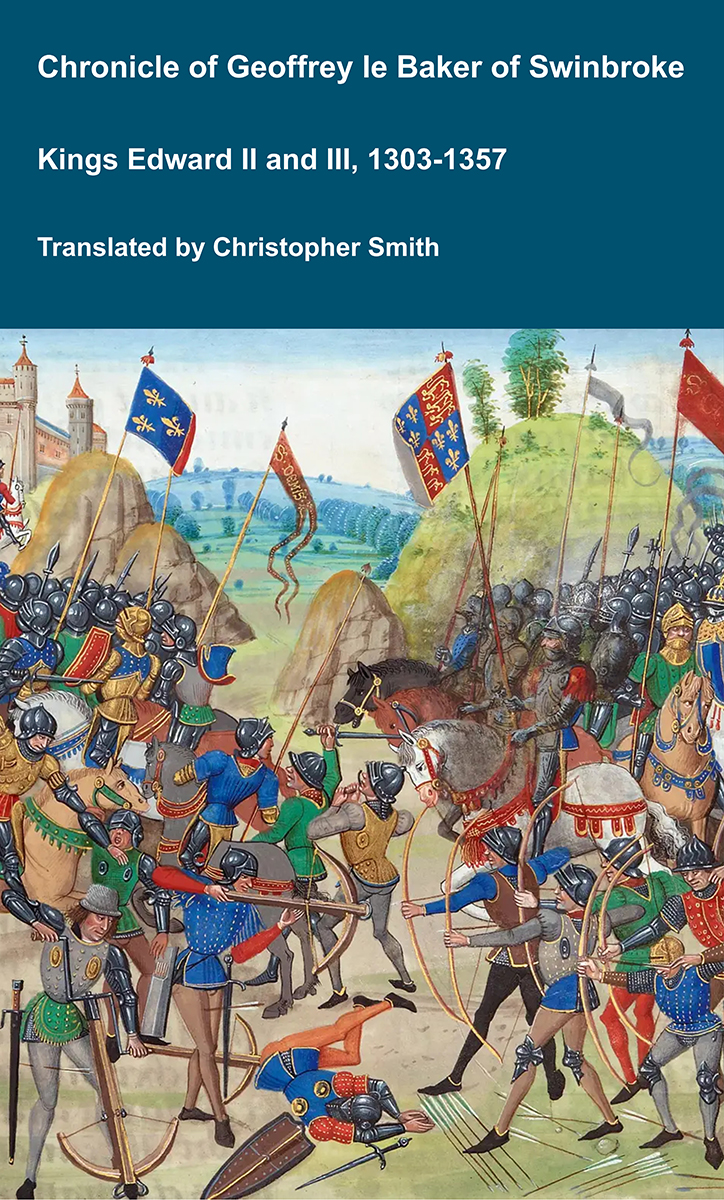
Chronicle of Geoffrey le Baker of Swinbroke
Baker was a secular clerk from Swinbroke, now Swinbrook, an Oxfordshire village two miles east of Burford. His Chronicle describes the events of the period 1303-1356: Gaveston, Bannockburn, Boroughbridge, the murder of King Edward II, the Scottish Wars, Sluys, Crécy, the Black Death, Winchelsea and Poitiers. To quote Herbert Bruce 'it possesses a vigorous and characteristic style, and its value for particular events between 1303 and 1356 has been recognised by its editor and by subsequent writers'. The book provides remarkable detail about the events it describes. Baker's text has been augmented with hundreds of notes, including extracts from other contemporary chronicles, such as the Annales Londonienses, Annales Paulini, Murimuth, Lanercost, Avesbury, Guisborough and Froissart to enrich the reader's understanding. The translation takes as its source the 'Chronicon Galfridi le Baker de Swynebroke' published in 1889, edited by Edward Maunde Thompson.
Available at Amazon in eBook and Paperback format.
1543-1547 Catherine Parr is in 16th Century Events.
In 1543 Nicholas Poyntz [aged 33] was captain of the warship Great Galley used to attack Scotland as part of the Rough Wooing.


15th May 1544 the Abbey of St Mary, Haddington [Map], was burnt during the 'Rough Wooing': "The same day (May 15th 1544) we burnt a fair town of the Earl of Bothwell called Hadyngtoun with a great nunnery and house of the friars."
In 1543, probably around St George's Day, 23rd April 1543, King Henry VIII of England and Ireland [aged 51] created three new Knights of the Garter:
310th. John Dudley 1st Duke Northumberland [aged 39].
311th. William Paulet 1st Marquess Winchester [aged 60].
312th. William Parr 1st Marquess Northampton [aged 31].


On 24th December 1543 John Wallop [aged 53] was appointed 313th Knight of the Garter by King Henry VIII of England and Ireland [aged 52]. See Chronicle of Calais.
On 12th July 1543 Henry VIII [aged 52] and Catherine Parr [aged 30] were married at Hampton Court Palace [Map]. She was crowned Queen Consort England. His sixth and last marriage, her third marriage; her previous husband had died four months before. The difference in their ages was 21 years. He the son of King Henry VII of England and Ireland and Elizabeth York Queen Consort England. They were third cousin once removed. She a great x 5 granddaughter of King Edward III of England.
Henry's two daughters Mary [aged 27] and Elizabeth [aged 9] attended, as did his niece Margaret Douglas Countess Lennox [aged 27].
Catherine's sister Anne [aged 28] attended with her husband William Herbert 1st Earl Pembroke [aged 42].

On 23rd December 1543 Henry VIII [aged 52] enobled his new wife's [aged 31] brother [aged 31] and uncle [aged 60] at ceremony in the Presence Chamber, Hampton Court Palace [Map]. Henry Grey 1st Duke of Suffolk [aged 26] and Edward Stanley 3rd Earl of Derby [aged 34] were present. Christopher Barker read the Patents.
William Parr 1st Baron Parr of Horton was created 1st Baron Parr of Horton. William was sixty with five daughters. He died four years later at which time the Barony became extinct.
William Parr 1st Marquess Northampton was created 1st Earl Essex. His estranged wife Anne Bourchier 7th Baroness Bourchier [aged 26] was daughter of the last Earl of Essex of the Fifth Creation. A somewhat curious choice given his wife had eloped the year previous year with John Lyngfield, the prior of Tandbridge, Surrey [Map], by whom she had an illegitimate child.
On 16th March 1544 the First Battle of Glasgow was fought between an army of Matthew Stewart 4th Earl Lennox [aged 27], who supported a marriage between King Edward VI of England and Ireland [aged 6] and Mary Queen of Scots [aged 1], and an army of James Hamilton 2nd Earl Arran [aged 28] who opposed it.
Robert Boyd 4th Lord Boyd [aged 59] fought for James Hamilton 2nd Earl Arran for which was rewarded with the family lands (which he held in tack), as well as the restoration of his family's title of Lord Boyd.
On 4th May 1544, Sunday, around 10,000 English soldiers landed unopposed at Leith and Granton. The ships had been sighted the day before. Cardinal Beaton [aged 50] and Regent James Hamilton 2nd Earl Arran [aged 28] left Edinburgh. The Scots, with Cardinal Beaton, George Gordon 4th Earl Huntley [aged 30] and James Stewart 1st Earl of Moray attempted unsuccessfully to prevent the English forces at Granton joining those at Leith. The English then entered Leith unopposed where they found two ships of King James V of Scotland: the Salamander of Leith and the Unicorn.


After 7th May 1544 Edward Clinton 1st Earl Lincoln [aged 32] was knighted by Edward Seymour 1st Duke of Somerset [aged 44] at Edinburgh.


Tudor Tracts Chapter 3. [4th May 1544]. And in a valley, upon the right hand, near unto the said town, the Scots were assembled to the number of 5,000 or 6,000 horsemen, besides a good number of footmen; to impeach [prevent] the passage of our said army: in which place, they had laid their artillery at two straits [passes] through which we must needs pass, if we minded to achieve our enterprise. And seeming, at the first, as though they would set upon the Vanguard: when they perceived our men so willing to encounter with them, namely, the Cardinal, who was there present, perceiving our devotion to see his holiness to be such as we were ready to wet our feet for that purpose, and to pass a ford which was between us and them; after certain shot of artillery on both sides: they made a sudden retreat; and leaving their artillery behind them, fled towards Edinburgh. The first man that fled was the holy Cardinal [Beaton] [aged 50] like a valiant champion; and with him the Governor, the Earls of Huntley [aged 30], Murray And Bothwell [aged 32], with divers other great men of the realm. At this passage, were two Englishmen hurt with the shot of their artillery; and two Scottish men slain with our artillery.
Tudor Tracts Chapter 3. [7th May 1544]. And the next morning, very early, we began where we left off, and continued burning all that day and the two days next ensuing continually, so that neither within the walls nor in the suburbs was left any one house unburnt: besides the innumerable booty, spoil and pillage that our soldiers brought from thence; notwithstanding the abundance which was consumed with fire. Also we burnt the Abbey called Holy Rood House, and the Palace adjoining the same.
The Deeds of the Dukes of Normandy
The Gesta Normannorum Ducum [The Deeds of the Dukes of Normandy] is a landmark medieval chronicle tracing the rise and fall of the Norman dynasty from its early roots through the pivotal events surrounding the Norman Conquest of England. Originally penned in Latin by the monk William of Jumièges shortly before 1060 and later expanded at the behest of William the Conqueror, the work chronicles the deeds, politics, battles, and leadership of the Norman dukes, especially William’s own claim to the English throne. The narrative combines earlier historical sources with firsthand information and oral testimony to present an authoritative account of Normandy’s transformation from a Viking settlement into one of medieval Europe’s most powerful realms. William’s history emphasizes the legitimacy, military prowess, and governance of the Norman line, framing their expansion, including the conquest of England, as both divinely sanctioned and noble in purpose. Later chroniclers such as Orderic Vitalis and Robert of Torigni continued the history, extending the coverage into the 12th century, providing broader context on ducal rule and its impact. Today this classic work remains a foundational source for understanding Norman identity, medieval statesmanship, and the historical forces that reshaped England and Western Europe between 800AD and 1100AD.
Available at Amazon in eBook and Paperback format.
Around 24th May 1544 the Second Battle of Glasgow was fought between James Hamilton 2nd Earl Arran [aged 28], who opposed a marriage between King Edward VI of England and Ireland [aged 6] and Mary Queen of Scots [aged 1], and an army of James Hamilton 2nd Earl Arran who supported the marriage. and William Cunningham 4th Earl Glencairn [aged 51]
Andrew Cunningham was killed.
In July 1544 English forces commenced the Siege of Boulogne at Boulogne sur Mer [Map]. John Chichester, William Godolphin [aged 29], Henry Dudley [aged 18] and Anthony Wingfield [aged 57] fought. Henry Strangeways [aged 44] were killed.
In September 1544 Thomas Cawarden of Bletchingly and Nonsuch was knigted at Boulogne sur Mer [Map] during the Siege of Boulogne.

On 19th July 1545 during the Battle of the Solent the Mary Rose sank. Roger Grenville [aged 27] and George Carew [aged 41] drowned.
Chronicle of Edward Hall [1496-1548]. 19th July 1545. After the departyng of thenglyshe nauy, from Newhaven, the Admyrall of Fraunce, called the Lorde Dombalt, a man of greate expteryence, halsed vp hys sayles, and with hys whole navie, came to the point of the Isle of Wyght, called. S. Helenes poynt, and there in good ordre cast their Ankers, and sent. xvi. Galies dayly, to the very haven of Portesmouthe. Thenglyshe nauye liyngin the haven, made them prest and set out towardes the, and styl the one shot at the other. But one day aboue all other, the whole navie of the Englishmen made out, and purposed to set on the Frenchmen: but in their settyng forward, a goodly ship of Englande called the Mary Rose, was by to much foly, drouned in the middest of the haven, for she was laden wyth much ordinaunee, and the portes left open, which were very lowe, and the great ordinaunce, vnbreched, so that when the ship should turne, the water entred, and sodainly she sanke. In her was sir George Carewe knight, Capitain of thesaid shyppe, and foure hundreth men, and much ordinaunce.
Holinshed's Chronicle [1525-1582]. 19th July 1545. The twentith of Iulie1, the whole nauie of the Englishmen made out, & purposed to set on the Frenchmen, but in setting forward, thorough too much follie, one of the kings ships called the Marie Rose was drowned in the middest of the hauen, by reason that she was ouerladen with ordinance, and had the ports left open, which were verie low, and the great artillerie vnbreeched; so that when the ship should turne, the water entered, and suddenlie she suncke. In hir was sir George Carew [aged 41] knight and foure hundred soldiours vnder his guiding. There escaped not past fortie persons of all the whole number. On the morrow after about two thousand of the Frenchmen landed in the Ile of Wight, where one of their chiefe capteins named le cheualier Daux, a Prouencois was slaine with manie other, and the residue with losse and shame driven backe againe to their gallies.
Note. Most sources say 19th July 1545.
Calendar of State Papers of Spain. 19th July 1545. Towards evening, through misfortune and carelessness, the ship [Mary Rose] of Vice-Admiral George Garew foundered, and all hands on board, to the number of about 500, were drowned, with the exception of about five and twenty or thirty servants, sailors and the like, who escaped. I made enquiries of one of the survivors, a Fleming, how the ship perished, and he told me that the disaster was caused by their not having closed the lowest row of gun ports on one side of the ship. Having fired the guns on that side, the ship was turning, in order to fire from the other, when the wind caught her sails so strongly as to heel her over, and plunge her open gunports beneath the water, which flooded and sank her. They say, however that they can recover the ship and guns.
On 30th December 1546 Henry VIII [aged 55] made his last revision to his will signed using the Dry Stamp that was used increasingly commonly. The will confirmed the succession as King Edward VI of England and Ireland [aged 9], Queen Mary I of England and Ireland [aged 30] and Queen Elizabeth I of England and Ireland [aged 13].
The will appointed sixteen executors: Anthony Browne [aged 46], Archbishop Thomas Cranmer [aged 57], Anthony Denny [aged 45], John Dudley 1st Duke Northumberland [aged 42], William Herbert 1st Earl Pembroke [aged 45], Edward Montagu [aged 61], Edward North 1st Baron North [aged 50], William Paget 1st Baron Paget Beaudasert [aged 40], William Paulet 1st Marquess Winchester [aged 63], John Russell 1st Earl Bedford [aged 61], Edward Seymour 1st Duke of Somerset [aged 46], Bishop Cuthbert Tunstall [aged 72] and Thomas Wriothesley 1st Earl of Southampton [aged 41].


On 28th January 1547 Henry VIII [aged 55] died at Whitehall Palace [Map]. His son Edward [aged 9] succeeded VI King of England. Earl Chester merged with the Crown.
Thomas Wendy [aged 46] attended the King. He was one of the witnesses to the King's last will and testament, for which he received £100.
Annales of England by John Stow. 28th January 1547. Edward [aged 9] the first borne at Hampton court [Map] (by the decease of k. Henry [aged 55] his father) began his raigne the 28 of January, and was proclaimed k. of England, France and Ireland, defender of the faith, and of the churches of England and also of Ireland the supreme head immedlatly in earth under God, & on the last day of January, in the yere of Christ after the Church of England 1546 but after the accompt of them that begin the yere at Christmas 1547 being then of the age of nine yéeres. And the same day in the afternoone the saide young king came to the tower of London [Map] from Hertford, and rode into the City at Aldgate, and so along the wall by the crossed Friars [Map] to the Tower hill, & entred at the red bulwarke [Map], where be was received by sir John Gage [aged 67] constable of the tower, and the lieutenant on horseback, the Earle of Hertford [aged 47] riding before the king, and sir Anthony Browne [aged 47] riding after him: and on the bridge next the warde gate, the archbishop of Canterbury [aged 57], the lorde Chancellor [aged 41], with other great lords of the Councell received him, and so brought him to his chamber of pretence, there they were sworne to his majesty.
Ellis' Letters. [On or after 28th January 1547] Henry Radclyf [aged 40], Earl of Sussex, to his Countess [aged 26], notifying the death of Henry the Eighth. A. D. 1547.
MS. COTTON. TITUS B. ii. fol 51. Orig.
Madame with most lovyng and hertie commendacions, thies be to signifie unto you that our late Soveraigne Lord the King departed at Westminster uppon Friday last the xxviijti. of this instant Januarie about two of the clock in the mornyng. And the Kings Majestie that nowe is proclaymed King this present last day of the same moneth. And lik as for the departure of th'on wee may lament, so for th^establisshment of thother to all our comforts we may rejoyce. The names of his Executours ar th'archbischop of Canterburie, the Lord Wriothesley lord Chauncelor of Englond, the Lord St. John lord president of the Counsaile and Gret Master, the Lord Russell Lord Privie Seale, the Erie of Hertford lord Great Chamberlein of Englond, the Viscount Lesley lord Admiral, the bisshop of Derham, Mr. Secretarie Paget, Sir Anthonie Denie, Sir Anthonie Browne, Sir William Herbert, The Chief Justice of the Common Place, Bromley another Justice ther, Sir Thomas Baker Chauncelor of the tenthes, Sir Edward North, and divers other aidours to the same, which for lak of tyme I pretermit. The Parliament is clerely dissolved: the Terme and all writs closed. The Court is nowe at the Tower from whtiis the Kings Majestie tomorrow shalbe receyved and conducted to his Hous Derehamplace. His Hyghnes Coronacion shalbe at Shrovetyme.
For my oone matiers hetherto, thorough the gret and diligent busines that my lord Chauncelor hath had, I could espye no tyme mete to the purpoos; but shal nevertheles as sone as oportunitie may serve set forth the same. And for your repaire hether in th'end of this weke I shall send unto you Henry Northey, by whom you shal knowe my determynat pleasur. In the meane tyme I require you to put all soch things in order as shalbe mete for you here.
Thus, good Madame albeit the contents of your Lettres diverslie at length tending to the lak of good wil in me that ought to be in a lovyng husband; the same nevertheles as I think preceding of a good hert might otherwise have bin qualified I wisse to you my owne hert as to my self. From Eliplace in Holborne the last day of January in the first yere of the reigneof our Sqveraigne King Edward the Sixeth.
Your assured lovyng husbond
Henry Sussex. To my wief the Countas of Sussex.
Chronicle of Geoffrey le Baker of Swinbroke
Baker was a secular clerk from Swinbroke, now Swinbrook, an Oxfordshire village two miles east of Burford. His Chronicle describes the events of the period 1303-1356: Gaveston, Bannockburn, Boroughbridge, the murder of King Edward II, the Scottish Wars, Sluys, Crécy, the Black Death, Winchelsea and Poitiers. To quote Herbert Bruce 'it possesses a vigorous and characteristic style, and its value for particular events between 1303 and 1356 has been recognised by its editor and by subsequent writers'. The book provides remarkable detail about the events it describes. Baker's text has been augmented with hundreds of notes, including extracts from other contemporary chronicles, such as the Annales Londonienses, Annales Paulini, Murimuth, Lanercost, Avesbury, Guisborough and Froissart to enrich the reader's understanding. The translation takes as its source the 'Chronicon Galfridi le Baker de Swynebroke' published in 1889, edited by Edward Maunde Thompson.
Available at Amazon in eBook and Paperback format.
On 16th February 1547 Henry VIII [deceased] was buried in the Henry VIII Vault, St George's Chapel, Windsor Castle [Map]. John Gage [aged 67] attended.
The History of the Reformation Volume 2. This being agreed on the 13th of February [1547], on the day following King Henry's body was, with all the pomp of a royal funeral, removed to Syon, in the way to Windsor. There great observation was made on a thing that was no extraordinary matter: he had been extreme corpulent, and dying of a dropsy, or something like it, it was no wonder if, a fortnight after, upon so long a motion, some putrid matter might run through the coffin. But Syon having been a house of religious women, it was called a signal mark of the displeasure of Heaven, that some of his blood and fat dropped through the lead in the night: and to make this work mightily on weak people, it was said, that the dogs licked it next morning. This was much magnified in commendation of Friar Peto, afterwards made cardinal, who (as was told in page 247 of the former Part) had threatened him in a sermon, at Greenwich, "that the dogs should lick his blood." Though, to consider things more equally, it had been a wonder indeed if it had been otherwise. But having met with this observation in a written near that time, I would not envy the world the pleasure of it.
Annales of England by John Stow. The 14 of February the corpes of k Henrie the eight [deceased], was with great solemnitie and honor conveyed unto Syon [Map], and the next day [15th February 1547] to Windsor, and there buried in the colledge [Map].
Wriothesley's Chronicle [1508-1562]. ... the morrow, being the fiftenth daie [15th February 1547], it was conveyed to Wyndeore, where at the townes end the Deane of Wyndsore [William Frankleyn], with all his quire in rich copes, with Eton Colledg, mett the corps, and so was conveyed to the colledge [St George's Chapel, Windsor Castle [Map]] in the Kinges pallace at Wyndsore, where it was sett under a rych hersee of waxe of 13 stories highe, and was buried the morrow [16th February 1547] after masse in the quire where his late wife Queen Jane lieth.
The History of the Reformation Volume 2. Next day he was brought to Windsor, and interred in St. George's Chapel [on 16th February 1547]. And he having by his will left that church £600 a year for ever for two priests to say mass at his tomb daily, for four obits yearly, and a sermon at every obit, with £10 to the poor, and for a sermon every Sunday, together with the maintenance of thirteen poor knights; the judges were consulted how this should be well settled in law who advised, that the lands which the King had given should be made over to that college by indentures tripartite; the King being one party, the Protector and the other executors a second, and the Dean and Chapter of Windsor a third party. These were to be signed with the King's hand, and the great seal put to them, with the hands and seals of all the rest; and then patents were to be given for the lands, founded on the King's testament, and the indentures tripartite.
Lives of the Queens of England Volume 5. But to return to the ceremonial. "The corpse, being conveyed with great pomp to St. George’s chapel, Windsor castle, was then interred [on 16th February 1547], let down into the vault by means of a vice, with the help of sixteen tall yeomen of the guard; the same bishop [Gardiner [aged 64]], standing at the head of the vault, proceeded in the burial service, and about the same stood all the head officers of the household,—as the lord great-master, the lord chamberlain, lord treasurer, lord comptroller, sergeant-porter, and the four gentlemen ushers in ordinary, with their staves and rods in their hands; and when the mould was brought and cast into the grave by the officiating prelate, at the words ‘pulvis pulveri, cinis cineri [dust to dust, ashes to ashes], then first the lord great-master, and after him the lord chamberlain and all the rest break their staves in shivers upon their heads, and cast them after the corpse into the pit with exceeding sorrow and heaviness, not without grievous sighs and tears. After this, De profundis was said, the grave covered over with planks, and Garter, attended by his officers, stood in the midst of the choir and proclaimed the young king’s titles, and the rest of his officers repeated the same after him thrice. Then the trumpets sounded with great melody and courage, to the comfort of all them that were present1," acting as a cordial to the official weepers, it may be presumed, after their hydraulic efforts were concluded. On the banners carried at Henry VIII.’s funeral, the arms of his late wife, queen Jane, were displayed, quartered with his; likewise a banner of the arms of queen Katharine Parr2, his widow,—these being the only wives he acknowledged out of six.
Note 1. MS. in college of Arms.
Note 2. "Tn the east window of the hall of Baynard’s Castle," Sandford says, "stood the escutcheon of this queen, Katharine Parr, which I delineated from the original on the 8th of November, 1664, in which she did bear quarterly of six pieces :—the Ist, argent, on a pile, gules, betwixt six roses of the first, the roses of the second, which was an augmentation given to her, being queen. 2. Argent, two bars, azure, a border engrailed, sable, Parr. 3. Or, three waterbougets, sable, Roos of Kendal. 4. Varry, argent and azure, a fess, gules, Marmion. 5. Three chevrons interlaced in base, and a chief, or, Fitzhugh. 6. Vert, three bucks, standing at gaze, or, Green. These quarterings are ensigned with a royal crown, and are between a K and a P, for Katharine Parr."’ —Genealogical Hist. of England, fol. ed. p. 460. One of the badges of ‘Parr, marquess of Northampton, borne by him at a review of the gentlemen pensioners in Greenwich park, was a maiden’s head, crowned with gold.