

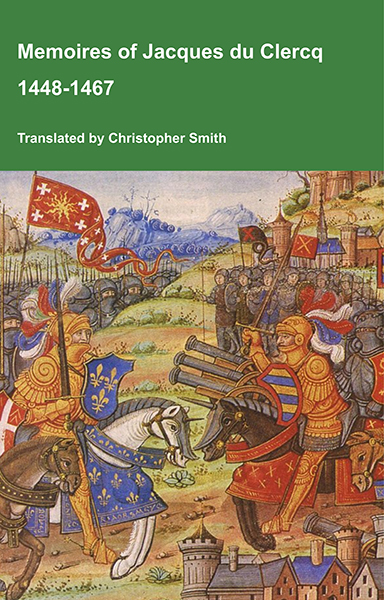
This is a translation of the 'Memoires of Jacques du Clercq', published in 1823 in two volumes, edited by Frederic, Baron de Reissenberg. In his introduction Reissenberg writes: 'Jacques du Clercq tells us that he was born in 1424, and that he was a licentiate in law and a counsellor to Philip the Good, Duke of Burgundy, in the castellany of Douai, Lille, and Orchies. It appears that he established his residence at Arras. In 1446, he married the daughter of Baldwin de la Lacherie, a gentleman who lived in Lille. We read in the fifth book of his Memoirs that his father, also named Jacques du Clercq, had married a lady of the Le Camelin family, from Compiègne. His ancestors, always attached to the counts of Flanders, had constantly served them, whether in their councils or in their armies.' The Memoires cover a period of nineteen years beginning in in 1448, ending in in 1467. It appears that the author had intended to extend the Memoirs beyond that date; no doubt illness or death prevented him from carrying out this plan. As Reissenberg writes the 'merit of this work lies in the simplicity of its narrative, in its tone of good faith, and in a certain air of frankness which naturally wins the reader’s confidence.' Du Clercq ranges from events of national and international importance, including events of the Wars of the Roses in England, to simple, everyday local events such as marriages, robberies, murders, trials and deaths, including that of his own father in Book 5; one of his last entries.
Available at Amazon in eBook and Paperback format.
Around 1270 Andrew Harclay 1st Earl Carlisle was born.
In 1311 Andrew Harclay 1st Earl Carlisle [aged 41] was appointed High Sheriff of Cumberland.
On 25th February 1323 Andrew Harclay 1st Earl Carlisle [aged 53] was arrested at Carlisle Castle [Map] by Anthony Lucy 1st Baron Lucy [aged 40].
On 3rd March 1323 Andrew Harclay 1st Earl Carlisle [aged 53] was arraigned before a royal justice in Carlisle. He was hanged, drawn and quartered at Carlisle, Cumberland [Map] for having negotiated a truce with the Scots without the King's sanction. It recognised Scotland as an independent kingdom. King Edward considered the treaty to be an act treason. Earl Carlisle forfeit. After his death, his head was taken to the king at Knaresborough in Yorkshire, before it was hung up on London Bridge. The four parts of his body were dispersed around the country, and displayed in Carlisle, Newcastle, Bristol, and Dover. Less than three months after Harclay's execution, King Edward agreed on a thirteen-year truce with Scotland.
Heraldry in England. But Heraldry not only formed a convenient mode of bestowing eagerly-sought rewards for meritorious services, but occasionally a terribly severe means of chastising those who failed to uphold the honour and dignity of distinctions already conferred. Take, for instance, the following:
"Andrew de Harcla [aged 52], a knight, and Earl of Carlisle, was in this sort degraded. He, being apprehended, was by the King's commandment brought [on 3rd March 1322] before Sir Antony Lucy [aged 39], apparelled in all the robes of his estate as an earl and a knight, and so led unto the place of judgment. Being thither come, Sir Antony Lucy said to him these words, 'First, thou shalt lose the order of knighthood, by which thou hadst all thy honour ; and further, all worship upon thy body be brought to nought.' Those words being pronounced, Sir Antony Lucy commanded a knave to hew the knight's spurs from his heels, and after caused his sword to be broken over his head. That done, he was despoiled of his furred tabard, of his hood, of his furred coats, and of his girdle. Then Sir Antony said to him these words, 'Andrew, now thou art no knight, but a knave, and for thy treason the king doth will thou shalt be hanged.'"
Sempringham Continuation. And the same year, in the month of February, sir Andrew [aged 53] rebelled against the king; but in the beginning of the March next following the said sir Andrew was taken by sir Anthony de Lucy in the castle of Carlisle, and by the commandment of the king he was drawn, hanged, beheaded, and quartered1, and the quarters were hung in different places in England.
Note 1. Andrew Harclay was executed on 3rd March 1323.
Collectanea by John Leland [1502-1552]. Straite apon this was Syr Andrew Erle of Cairluel attayntid for Conspiracy with James Duglas the Scotte, whereby the Englisch men for lak of Harkeley ready help, wer vanquisshid yn Batel at the Abbay of Beighlande, and jugid be fore Syr Arcelyne Lufcy, the Kinges Commissioner, to be hangid, drawen, and quarterid at Cairluel, as Thomas of Lancastre prophetied of hym. And this was doone the laste day of Octobre yn the Yere a 1322. and this Day the Sunne chaungid in the Morning to blody Color, and so endurid to a xi of the Clok.
On 16th March 1322 the rebel army led by Thomas Plantagenet 2nd Earl of Leicester, 2nd Earl Lancaster, Earl of Salisbury and Lincoln [aged 44] attempted to cross the bridge over the River Ure (between Ripon and York) at Boroughbridge Bridge [Map]. Their path was blocked by forces loyal to the King led by Andrew Harclay 1st Earl Carlisle [aged 52]. Bartholomew Badlesmere 1st Baron Badlesmere [aged 46], Roger Mortimer 1st Earl March [aged 34], John Botetort 1st Baron Botetort [aged 57] and John Maltravers 1st Baron Maltravers [aged 32] fought for the rebels. Roger Clifford 2nd Baron Clifford [aged 22], Nicholas Longford [aged 37], Thomas Plantagenet 2nd Earl of Leicester, 2nd Earl Lancaster, Earl of Salisbury and Lincoln, John Mowbray 2nd Baron Mowbray [aged 35] were captured.
Warin Lisle [aged 51] was hanged after the battle at Pontefract [Map].
Following the battle Hugh Audley 1st Earl Gloucester [aged 31] and his wife Margaret Clare Countess Gloucester were both imprisoned. He in Nottingham Castle [Map] and she in Sempringham Priory [Map].
John Clinton 2nd Baron Clinton [aged 22], Ralph Greystoke 1st Baron Greystoke [aged 22], William Latimer 2nd Baron Latimer of Corby [aged 46], Robert Lisle 1st Baron Lisle [aged 34], Domhnall Mar II Earl of Mar [aged 29] and Peter Saltmarsh [aged 42] fought for the King.
Adam Everingham 1st Baron Everingham of Laxton [aged 43] was captured.
Humphrey Bohun 4th Earl Hereford 3rd Earl Essex [aged 46] was killed. His son John [aged 15] succeeded 5th Earl Hereford, 4th Earl Essex.
Piers Grandison 2nd Baron Grandison [aged 31] fough for the rebels, and was captured.
Hugh Audley 1st Baron Audley of Stratton Audley [aged 55] surrendered before the battle and was imprisoned in Wallingford Castle [Map] for the rest of his life
John Giffard 2nd Baron Giffard Brimpsfield [aged 34] was captured.
Roger Mortimer 1st Earl March was imprisoned at Tower of London [Map].


On 25th March 1322 Andrew Harclay 1st Earl Carlisle [aged 52] was created 1st Earl Carlisle in reward for his capture of Thomas Plantagenet 2nd Earl of Leicester, 2nd Earl Lancaster, Earl of Salisbury and Lincoln [deceased] at the Battle of Boroughbridge.
In 1328 the remains of Andrew Harclay 1st Earl Carlisle were returned for a Christian burial on the petition of his sister.