

William of Worcester's Chronicle of England
William of Worcester, born around 1415, and died around 1482 was secretary to John Fastolf, the renowned soldier of the Hundred Years War, during which time he collected documents, letters, and wrote a record of events. Following their return to England in 1440 William was witness to major events. Twice in his chronicle he uses the first person: 1. when writing about the murder of Thomas, 7th Baron Scales, in 1460, he writes '… and I saw him lying naked in the cemetery near the porch of the church of St. Mary Overie in Southwark …' and 2. describing King Edward IV's entry into London in 1461 he writes '… proclaimed that all the people themselves were to recognize and acknowledge Edward as king. I was present and heard this, and immediately went down with them into the city'. William’s Chronicle is rich in detail. It is the source of much information about the Wars of the Roses, including the term 'Diabolical Marriage' to describe the marriage of Queen Elizabeth Woodville’s brother John’s marriage to Katherine, Dowager Duchess of Norfolk, he aged twenty, she sixty-five or more, and the story about a paper crown being placed in mockery on the severed head of Richard, 3rd Duke of York.
Available at Amazon in eBook and Paperback format.
Murdered is in Murder.
978 Murder of King Edward the Martyr
1170 Murder of Thomas a Becket
1204 Death of Arthur Duke of Brittany
1271 Murder of Henry of Almain
1306 Murder of John "Red" Comyn
1369 Death of Peter I King Castile
1397 Murder of Thomas of Woodstock
1407 Murder of Louis of Orléans
In 661 Sigeberht the Good II King Essex was murdered by Swithhelm King of Essex and Swinfrith of Essex. Swithhelm King of Essex succeeded King Essex.
Before 679 Ansegisel [aged 76] was murdered.
On 25th July 759 Oswulf King of Northumbria was murdered by his servants.
On 23rd September 788 Ælfwald I King of Northumbria was murdered. He was buried at Hexham Abbey [Map]. Osred King of Northumbria succeeded King Northumbria.
On 28th January 891 Muhammed ibn Abd Allah Umayyad [aged 27] was murdered by his brother al Mutarrif Umayyad.
On 26th May 946 King Edmund I of England [aged 25] was murdered by Leofa, an exiled thief, whilst attending mass at Pucklechurch, Gloucestershire. He was buried at Glastonbury Abbey [Map]. His brother Eadred succeeded I King of England.
On 18th March 978 King Edward I of England [aged 16] was murdered at Corfe Castle, Dorset [Map] when visiting his younger half-brother Æthelred [aged 12] and his [Æthelred's] mother Aelfthryth [aged 33]. He was buried in Wareham, Dorset [Map] without ceremony. His half brother Æthelred succeeded II King of England.
In 1006 Aelfhelm Northumbria was murdered by Earldorman Eadric Streona.
In 1016 Uchtred "The Bold" Earldorman of Northumbria and forty of his men were murdered by Thurbrand The Hold in revenge for Uchtred having murdered Thurbrand's father Waltheof of Bamburgh.
In or before 1038 Thurbrand The Hold was murdered by Ealdred Northumbria Earl Bernicia avenging Thurbrand's murder of his father Uchtred "The Bold" Earldorman of Northumbria.
In 1038 Ealdred Northumbria Earl Bernicia was murdered by Carl son of Thurbrand in revenge for the murder of his father Thurbrand The Hold. His brother Eadwulf succeeded Earl Bernicia.
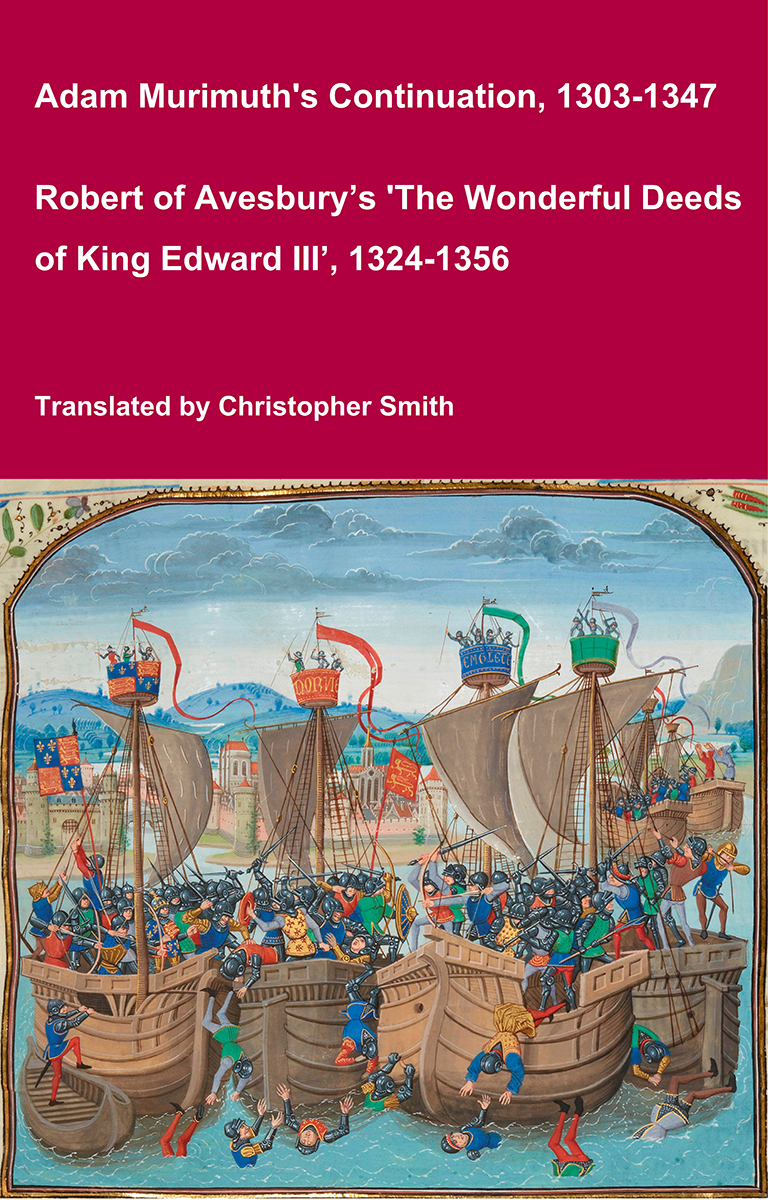
Adam Murimuth's Continuation and Robert of Avesbury’s 'The Wonderful Deeds of King Edward III'
This volume brings together two of the most important contemporary chronicles for the reign of Edward III and the opening phases of the Hundred Years’ War. Written in Latin by English clerical observers, these texts provide a vivid and authoritative window into the political, diplomatic, and military history of fourteenth-century England and its continental ambitions. Adam Murimuth Continuatio's Chronicarum continues an earlier chronicle into the mid-fourteenth century, offering concise but valuable notices on royal policy, foreign relations, and ecclesiastical affairs. Its annalistic structure makes it especially useful for establishing chronology and tracing the development of events year by year. Complementing it, Robert of Avesbury’s De gestis mirabilibus regis Edwardi tertii is a rich documentary chronicle preserving letters, treaties, and official records alongside narrative passages. It is an indispensable source for understanding Edward III’s claim to the French crown, the conduct of war, and the mechanisms of medieval diplomacy. Together, these works offer scholars, students, and enthusiasts a reliable and unembellished account of a transformative period in English and European history. Essential for anyone interested in medieval chronicles, the Hundred Years’ War, or the reign of Edward III.
Available at Amazon in eBook and Paperback format.
In 1040 Geoffrey Chateaudun I Count Perche [aged 45] was murdered at Chartres [Map].
Around 1040 Osbern the Steward was murdered by Barno of Glotis. See  History of the Dukes of Normandy.
On 13th January 1049 Dirk Gerulfing IV Count Holland [aged 24] was murdered. His brother Floris [aged 24] succeeded I Count Holland.
On 2nd December 1079 Mabel de Bellême [aged 44] was murdered.
On 5th December 1082 Ramon Berenguer "Towhead" Barcelona II Count Barcelona [aged 29] was murdered by his twin brother Berenguer Ramon "Fratricide" I Count Barcelona [aged 29]. His son Raymond succeeded III Count Barcelona.
In 1115 Benoît Canhiart Bishop Nantes was murdered.
On 2nd March 1127 Charles I Count Flanders [aged 43] was murdered at Church of St Donatian. His second cousin William [aged 24] succeeded Count Flanders. Joanna Monferrat Countess Essex and Flanders by marriage Countess Flanders.
On 26th October 1132 Floris "The Black" Gerulfing I Count Holland [aged 17] was murdered. He was buried at Rijnsburg Abbey.
On 29th December 1170 Archbishop Thomas Becket [aged 51] was murdered at Canterbury Cathedral [Map] by four knights on behalf of King Henry "Curtmantle" II of England [aged 37]. Whether Henry ordered the murder, or whether the four knights were acting without orders, is a matter of conjecture. The first use of the well-known phrase "Will no-one rid me of this turbulent priest" appears some five hundred and more years later in Robert Dodsley's 1740 Chronicle of the Kings of England.
Around 25th December 1175, Christmas, William de Braose 4th Baron Bramber [aged 31] invited the local Welsh nobles to his Christmas court at Abergavenny Castle [Map] as an act of reconciliation. Seisyll ap Dyfnwal Gwent and his elder son Geoffrey Gwent were murdered. William de Braose 4th Baron Bramber and his men then rode to Seisyll's home. There his younger son Cadwalladr Gwent [aged 7] was murdered and his wife captured.
In 1192 Albert of Louvain Bishop Liege [aged 26] was murdered by three knights of Baldwin Flanders V Count Hainaut [aged 42] who opposed Alberts' appointment.
On 13th January 1200 Otto Hohenstaufen I Count Burgundy [aged 29] was murdered.
In 1204 Prince Arthur 3rd Duke Brittany [aged 16] was murdered at Rouen, France [Map]. His half sister Alix [aged 2] succeeded 5th Countess Richmond. His half-sister Eleanor "Fair Maid of Britanny" 4th Countess of Richmond [aged 20], who was imprisoned from 1202 to her death, also used the title Countess of Richmond.
Abbot John Whethamstede’s Chronicle of the Abbey of St Albans
Abbot John Whethamstede's Register aka Chronicle of his second term at the Abbey of St Albans, 1451-1461, is a remarkable text that describes his first-hand experience of the beginning of the Wars of the Roses including the First and Second Battles of St Albans, 1455 and 1461, respectively, their cause, and their consequences, not least on the Abbey itself. His text also includes Loveday, Blore Heath, Northampton, the Act of Accord, Wakefield, and Towton, and ends with the Coronation of King Edward IV. In addition to the events of the Wars of the Roses, Abbot John, or his scribes who wrote the Chronicle, include details in the life of the Abbey such as charters, letters, land exchanges, visits by legates, and disputes, which provide a rich insight into the day-to-day life of the Abbey, and the challenges faced by its Abbot.
Available at Amazon in eBook and Paperback format.
In 1213 Gertrude Andechs was murdered.
Before 1215 Alice Béthune Countess Pembroke was murdered.
On 15th September 1231 Louis Wittelsbach I Duke Bavaria [aged 57] was murdered. His son Otto [aged 25] succeeded II Duke Bavaria. Agnes Welf Duchess Bavaria [aged 30] by marriage Duchess Bavaria.
On 13th March 1271 Henry "Almain" Cornwall [aged 35] was murdered while attending mass at the Chiesa di San Silvestro, Viterbo by his cousins Simon "Younger" Montfort and Guy Montfort Count Nola [aged 27] in revenge for the deaths of their father Simon and older brother Henry at the Battle of Evesham.
The murder was carried out in the presence of the Cardinals, who were conducting a papal Election, King Philip III of France [aged 25], and King Charles of Sicily [aged 43]. The Montfort brothers were excommunicated.
Henry "Almain" Cornwall was buried in Hailes Abbey [Map].
The deed is mentioned by Dante Alighieri some forty years after in the Divine Comedy who placed Guy de Montfort in the seventh circle of hell.
On 10th February 1306 John Comyn 3rd Lord Baddenoch [aged 37] was murdered by Robert the Bruce [aged 31], future King of Scotland, before the High Altar of the Greyfriars Monastery [Map]. Robert Comyn, John's uncle, was killed by Christopher Seton [aged 28]. Christopher's brother John Seton [aged 28] was also present.
Murder, in a church, in front of the altar, regarded as a terrible crime. The act gave King Edward I of England [aged 66] cause to invade Scotland. Robert the Bruce was ex-communicated by the Pope for his actions.
King Edward I of England charged Bishop David de Moravia as being complicit in the murder.
On 1st May 1308 Albert Habsburg I Duke Austria [aged 52] was murdered by his nephew John "Parricide" Habsburg [aged 18] who he had deprived of his inheritance when Albert Habsburg I Duke Austria forced John's eleven year old father Rudolf Habsburg II Duke Austria to waive his rights to the Habsburg duchies of Austria and Styria as part of the Treaty of Rheinfelden.
On 21st September 1327 King Edward II of England [aged 43] was murdered at Berkeley Castle [Map]. There is speculation as to the manner of his death, and as to whether he died at all. Some believe he may have lived the rest of his life in Europe - see Publications de la Société Archéologique de Montpellier 1877: Fieschi Letter.
On 6th June 1333 William Donn Burgh 3rd Earl of Ulster [aged 20] was murdered by Richard de Mandeville in revenge for the murder of Richard's wife's brother Walter Liath de Burgh the year before. Earl of Ulster and Baron Burgh extinct. There is some argument that his daughter Elizabeth Burgh Duchess of Clarence succeeded as Countess of Ulster although her husband Lionel of Antwerp 1st Duke of Clarence appears to have been Earl of Ulster of a new creation. See Annals of Ulster.
In September 1337 Philip Dampierre III Marquis Namur [aged 18] was murdered by the people of Famagusta after he and his companions caused trouble of some kind. He was buried in the Franciscan church in Famagusta. His brother William [aged 13] succeeded Marquis Namur, Count Namur.
On 25th January 1350 John Douglas of Lothian [aged 47] was murdered on the orders of Sir David Barclay of Brechin.
On 8th January 1354 Charles de la Cerda [aged 27] was murdered on the orders of Charles "Bad" II King Navarre [aged 21] in an inn in L'Aigle.
On 7th January 1355 Inês Castro [aged 30] was murdered on the orders of her husband's [aged 34] father Alfonso "Brave" IV King Portugal [aged 63] who didn't approve of their marriage, or relationship. He, Peter, subsequently captured two of the murderers and had them executed.
In 1358 John Barcelona [aged 27] was murdered.
On 29th May 1358 Fadrique Alfonso Ivrea [aged 24] was murdered at Seville on behalf of his brother Peter "Cruel" I King Castile [aged 23].
On 23rd March 1369 Peter "Cruel" I King Castile [aged 34] was murdered by his half-brother Henry "Fratricide" II King Castile [aged 35] outside the wall of the castle of Montiel, La Mancha. His half brother Henry succeeded II King Castile.
In 1375 Ralph Dacre 3rd Baron Dacre Gilsland [aged 54] was murdered. His brother Hugh [aged 40] succeeded 4th Baron Dacre Gilsland, 4th Baron Multon of Gilsland.
Before 18th February 1383 John Dynham [aged 64] was murdered by robbers including John Broun.
In May 1385 Ralph Stafford [aged 18] was murdered by John Holland 1st Duke Exeter [aged 33]. He was buried at King's Langley Priory, Hertfordshire [Map].
Around 8th September 1397 Thomas of Woodstock 1st Duke of Gloucester [aged 42] was murdered in Calais [Map] for his role as leader of the Lords Appellant. Duke Albemarle, Duke Gloucester, Earl Essex forfeit. His son Humphrey [aged 16] succeeded 2nd Earl Buckingham.
Walter Clopton was part of the inquiry into his death the outcome of which is not known. A John Hall was executed for the murder.
On 23rd November 1407 Louis Valois I Duke Orléans [aged 35] was murdered on the orders of John "Fearless" Valois Duke Burgundy [aged 36] at Paris [Map]. His son Charles [aged 12] succeeded Duke Orléans.
Adam Murimuth's Continuation and Robert of Avesbury’s 'The Wonderful Deeds of King Edward III'
This volume brings together two of the most important contemporary chronicles for the reign of Edward III and the opening phases of the Hundred Years’ War. Written in Latin by English clerical observers, these texts provide a vivid and authoritative window into the political, diplomatic, and military history of fourteenth-century England and its continental ambitions. Adam Murimuth Continuatio's Chronicarum continues an earlier chronicle into the mid-fourteenth century, offering concise but valuable notices on royal policy, foreign relations, and ecclesiastical affairs. Its annalistic structure makes it especially useful for establishing chronology and tracing the development of events year by year. Complementing it, Robert of Avesbury’s De gestis mirabilibus regis Edwardi tertii is a rich documentary chronicle preserving letters, treaties, and official records alongside narrative passages. It is an indispensable source for understanding Edward III’s claim to the French crown, the conduct of war, and the mechanisms of medieval diplomacy. Together, these works offer scholars, students, and enthusiasts a reliable and unembellished account of a transformative period in English and European history. Essential for anyone interested in medieval chronicles, the Hundred Years’ War, or the reign of Edward III.
Available at Amazon in eBook and Paperback format.
On 25th January 1431 Charles Metz II Duke Lorraine [aged 66] died at Nancy. His daughter Isabella [aged 31] succeeded I Duchess Lorraine. His former mistress Alison May was murdered on the same day at Nancy.
On 29th June 1450 Bishop William Ayscough [aged 55] was murdered at Edington, Wiltshire by an angry mob.
On 22nd February 1452 William Douglas 8th Earl Douglas 2nd Earl Avondale [aged 27] was murdered by King James II of Scotland [aged 21] at Edinburgh Castle [Map] for refusing to desist from conspiring with Alexander Lindsay 4th Earl Crawford [aged 29]. His brother James [aged 26] succeeded 9th Earl Douglas, 3rd Earl Avondale.
On 21st July 1457 Henry Pierrepont [aged 49] was murdered at Papplewick Moor, Sherwood by John Grene, an in-law of William Plumpton, with whom Henry was fighting a bitter land dispue. Grene was killed later the same day by Henry's brother John Pierrepont of Radmanthwaite.
On 20th July 1460 Thomas Scales 7th Baron Scales [aged 63] was murdered by boatmen whilst travelling from the Tower of London [Map] to Sanctuary, Westminster Abbey [Map]. His daughter Elizabeth succeeded 8th Baroness Scales. She was, or had been married to, Henry Bourchier (the year of his death may been 1458). She was in 1466 married to Anthony Woodville 2nd Earl Rivers [aged 20], brother of King Edward IV's [aged 18] wife Elizabeth Woodville Queen Consort England [aged 23]; an example of the Woodville family marrying rich heiresses.
On 26th December 1476 Galeazzo Maria Sforza 5th Duke Milan [aged 32] was murdered at the Basilica di Santo Stefano Maggiore, Milan [Map]. Supported by about thirty friends, the three men waited in the church for the duke to arrive for mass. When Galeazzo Sforza arrived, Lampugnani knelt before him; after some words were exchanged, Lampugnani rose suddenly and stabbed Sforza in the groin and breast. Olgiati and Visconti soon joined in, as did a servant of Lampugnani's. Sforza was dead within a matter of seconds. All the assassins quickly escaped in the ensuing mayhem save for Lampugnani, who became entangled in some of the church's cloth and was killed by a guard. His body soon fell into the hands of a mob, which dragged the corpse through the streets, slashing and beating at it; finally, they hung the body upside-down outside Lampugnani's house. The beheaded corpse was cut down the next day and, in an act of symbolism, the "sinning" right hand was removed, burnt and put on display. His son Gian [aged 7] succeeded 6th Duke Milan.
On 30th August 1482 Bishop Louis Bourbon [aged 44] was murdered. He was assassinated by William de la Marck, an adventurer who from 1478 had been operating against the territory from the Castle of Logne.
On 7th December 1487 James Fitzgerald 8th Earl Desmond [aged 28] was murdered by John Murtagh at the instigation of his brother John at Rathkeale, County Limerick. His brother Maurice succeeded 9th Earl Desmond.
On 17th July 1497 James Ormond was murdered by Piers "Red" Butler 8th Earl Ormonde 1st Earl Ossory [aged 30].
On 1st January 1534 Henry Longford was murdered during the attack by Thomas Foljambe and his followers during a service in Chesterfield church on New Year's Day 1434, killing two of his companions - Henry Longford and William Bradshaw - and mutilating Pierrepont by cutting off the fingers of his right-hand.
On 8th June 1547 James Stewart of Beath [aged 41] was murdered at Dunblane, Perth.
Before 28th January 1557 William Hartgill and John Hartgill were murdered by Charles Stourton 8th Baron Stourton [aged 37].

On 9th March 1566 at eight o'clock in the evening David Rizzio [aged 33] was murdered in the presence of the six months pregnant Mary Queen of Scots [aged 23] and her half-sister Jean Stewart Countess Argyll [aged 33] at Holyrood Palace [Map] by rebels led by Patrick Ruthven 3rd Lord Ruthven. Rizzio was dragged through the bed chamber into the adjacent Audience Chamber and stabbed an alleged 57 times. Mary's husband Henry "Lord Darnley" Stewart [aged 20] was suspected of being one of the murderers.
On 15th March 1566 Mary Queen of Scots writes to Queen Elizabeth I of England and Ireland [aged 32]:
As first hes takin our houss slane our maist [most] speciall servand in our awin [own] presence & thaireftir haldin our propper personis captive tressonneblie, quhairby [whereby] we war constrainit to escaipe straitlie about midnyght out of our palice of halliruidhouss [Map] to the place quhair [where] we ar for the present, in the grittest danger feir of our lywis & ewill [ill] estate that evir princes on earth stuid [stood] in.
We thotht to have writtin to you this letter with oure awin [own] hand, that therby ye myght have better onestand all our meaning & takin mair [more] familliarlie therewit. Bot of trewt [truth] we ar so tyrit [tired] & ewill [ill] at eass [ease], quhat [what] throw rydding of twenty millis [miles] in v [5] horis [hours] of the nyght as wit the frequent seikness & weill dispositioun be th'occasioun of our child/that we could not at this tyme as we was willing to have done…
Your richt [right] gud sister and cusignes [cousin] Marie R.
Jean Stewart Countess Argyll: Around 1533 she was born illegitimately to King James V of Scotland and Elizabeth Bethune. She a great granddaughter of King Henry VII of England and Ireland. In 1553 Archibald Campbell 5th Earl Argyll and she were married. She by marriage Countess Argyll. She the illegitmate daughter of King James V of Scotland and Elizabeth Bethune. He the son of Archibald Campbell 4th Earl Argyll and Helen Hamilton Countess Argyll. They were third cousins. She a great granddaughter of King Henry VII of England and Ireland. On 7th January 1588 Jean Stewart Countess Argyll died.
Patrick Ruthven 3rd Lord Ruthven: he was born to William Ruthven 2nd Lord Ruthven and Janet Halyburton Lady Dirletoun. Before 1551 Patrick Ruthven 3rd Lord Ruthven and Janet Douglas were married. She the illegitmate daughter of Archibald Douglas 6th Earl Angus. After 1551 Patrick Ruthven 3rd Lord Ruthven and Janet Stewart were married. His second marriage, her fourth. She the daughter of John Stewart 2nd Earl Atholl and Janet Campbell Countess Atholl. On 13th May 1566 Patrick Ruthven 3rd Lord Ruthven died.

On 10th February 1567 Henry "Lord Darnley" Stewart [aged 21] was murdered at Kirk O Field. Around two in the morning two barrels of gunpowder exploded beneath his room. His body and that of his valet William Taylor were found outside, surrounded by a cloak, a dagger, a chair, and a coat. Darnley was dressed only in his nightshirt. There were no visible marks on the body. He was buried at Holyrood Abbey, Holyrood.
In February 1592 John Campbell [aged 52] was murdered in Knipoch House, Knipoch.
The History of William Marshal was commissioned by his son shortly after William’s death in 1219 to celebrate the Marshal’s remarkable life; it is an authentic, contemporary voice. The manuscript was discovered in 1861 by French historian Paul Meyer. Meyer published the manuscript in its original Anglo-French in 1891 in two books. This book is a line by line translation of the first of Meyer’s books; lines 1-10152. Book 1 of the History begins in 1139 and ends in 1194. It describes the events of the Anarchy, the role of William’s father John, John’s marriages, William’s childhood, his role as a hostage at the siege of Newbury, his injury and imprisonment in Poitou where he met Eleanor of Aquitaine and his life as a knight errant. It continues with the accusation against him of an improper relationship with Margaret, wife of Henry the Young King, his exile, and return, the death of Henry the Young King, the rebellion of Richard, the future King Richard I, war with France, the death of King Henry II, and the capture of King Richard, and the rebellion of John, the future King John. It ends with the release of King Richard and the death of John Marshal.
Available at Amazon in eBook and Paperback format.

On 7th February 1592 James "The Bonnie Earl" Stewart 2nd Earl of Moray [aged 27] was murdered. His son James [aged 1] succeeded 3rd Earl Moray.
Moray, in expectation of a summons to the court, had arrived at Donibristle, a house on the Fife coast owned by his mother Margaret Campbell [deceased]. The house was suddenly beset by the followers of George Gordon 1st Marquess Huntly [aged 30], who called on him to surrender. He declined to do so, and the house was set on fire. Moray escaped but was subsequently killed.
The next day, the corpses of the earl and of Dunbar, Sheriff of Moray, who had also been killed in the attack, were brought to Leith by the earl's mother Margaret Campbell. She intended to confront King James VI [aged 25] and demand that Huntly be brought to justice. The body displayed in the St Giles' Cathedral, Edinburgh; a 'vendetta portrait' showing his wounds was commissioned.
The body remained on display for five years. He was eventually buried on the orders of King James.
James Stewart 3rd Earl of Moray: Before 1591 he was born to James "The Bonnie Earl" Stewart 2nd Earl of Moray and Elizabeth Stewart 2nd Countess Moray. He a great x 3 grandson of King Henry VII of England and Ireland. On 2nd October 1607 James Stewart 3rd Earl of Moray and Anne Gordon Countess Moray were married. She by marriage Countess Moray. She the daughter of George Gordon 1st Marquess Huntly and Henrietta Stewart Marchioness Huntly. He the son of James "The Bonnie Earl" Stewart 2nd Earl of Moray and Elizabeth Stewart 2nd Countess Moray. They were half third cousin once removed. He a great x 3 grandson of King Henry VII of England and Ireland. On 6th August 1638 James Stewart 3rd Earl of Moray died. His son James succeeded 4th Earl Moray.
Margaret Campbell: In 1544 she was born to Archibald Campbell 4th Earl Argyll and Margaret Graham Countess Argyll. On 10th January 1563 James Stewart 1st Lord Doune and she were married. There was a masque involving courtiers and musicians dressed in white taffeta as shepherds. She the daughter of Archibald Campbell 4th Earl Argyll and Margaret Graham Countess Argyll. They were half third cousin once removed. In February 1592 Margaret Campbell died.
On 5th December 1595 James Stewart 1st Earl Arran was murdered by Sir James Douglas of Parkhead, nephew of Regent Morton. Earl Arran extinct.
On 23rd June 1605 Arthur Pole [aged 30] was murdered in Rome, Italy [Map]. Fourteen years later his brother Geoffrey Pole [aged 28] would also be murdered in Rome.
On 19th March 1609 Maud Babington [aged 38] was murdered. A servant, Honora ny Caffry, was burned at the stake for the petty treason of the murder of a mistress. Another, a man, later confessed to the murder.
On 14th May 1610 Henry IV King France [aged 56] was murdered by François Ravaillac, a Catholic zealot who stabbed him while his coach was stopped on Rue de la Ferronnerie. His son Louis [aged 8] succeeded XIII King France: Capet Valois Bourbon.


On or before 7th January 1619 Geoffrey Pole [aged 42] was murdered in Rome. Fourteen years before his brother Arthur Pole had also been murdered in Rome.
On 23rd August 1628 George Villiers 1st Duke of Buckingham [aged 35] was murdered at Greyhound Pub, Portsmouth by a disgruntled soldier John Felton [aged 33]. He was buried at Westminster Abbey [Map]. His son George succeeded 2nd Duke of Buckingham, 2nd Marquess of Buckingham, 2nd Earl Buckingham.
Felton was considered a hero by many who blamed Buckingham for the failures of the 1625 Cádiz Expedition and 1627 Siege of Saint-Martin-de-Ré. Felton was subsequently hanged.


In January 1635 Rowland Holt was murdered by muggers in Clerkenwell Fields. The identity is not certain but likely.
In November 1644 Mary Jeffrey [aged 51] was murdered. In August 1644, Dorchester was being successfully held for Parliament against a Royalist attack, with three of the Sydenham brothers believed to have been involved in the defence. At some time during or shortly after this event a group of Royalist soldiers went to Wynford Eagle, and there Mary Sydenham was killed by a Major Williams.
On 11th April 1646 Edward Sackville was murdered by Parliamentary forces at Chawley Cumnor, Oxfordshire after his capture at the Second Battle of Kidlington. He was buried at Wytham, Berskhire on 18th May 1646.
On 5th June 1677 Robert Perceval [aged 20] was murdered by an unknown person at the Strand [Map].
Chronicle of a Bourgeois of Valenciennes
Récits d’un bourgeois de Valenciennes aka The Chronicle of a Bourgeois of Valenciennes is a vivid 14th-century vernacular chronicle written by an anonymous urban chronicler from Valenciennes in the County of Hainaut. It survives in a manuscript that describes local and regional history from about 1253 to 1366, blending chronology, narrative episodes, and eyewitness-style accounts of political, military, and social events in medieval France, Flanders, and the Low Countries. The work begins with a chronological framework of events affecting Valenciennes and its region under rulers such as King Philip VI of France and the shifting allegiances of local nobility. It includes accounts of conflicts, sieges, diplomatic manoeuvres, and the impact of broader struggles like the Hundred Years’ War on urban life in Hainaut. Written from the perspective of a burgher (bourgeois) rather than a monastery or royal court, the chronicle offers a rare lay viewpoint on high politics and warfare, reflecting how merchants, townspeople, and civic institutions experienced the turbulence of the 13th and 14th centuries. Its narrative style combines straightforward reporting of events with moral and civic observations, making it a valuable source for readers interested in medieval urban society, regional politics, and the lived experience of war and governance in pre-modern Europe.
Available at Amazon in eBook and Paperback format.
On 12th October 1679 Edmund Berry Godfrey [aged 57] was murdered. He was found dead in a ditch at Primrose Hill lying face down on his own sword. The investigation concluded he had been strangled and subsequently moved.
On 4th January 1692 Andrew Clench was murdered between nine and eleven o'clock by Henry Harrison to whose mistress Clench had lent money. Harrison was subequently convicted of the murder.
Around September 1694 Grace Moorwood was murdered by a butcher and his apprentice who had broken into her house.
In 1700 Andrew Slanning 2nd Baronet [aged 26] was murdered during a drunken brawl in the Rose Tavern by John Cowland. Baronet Slanning of Maristow extinct.
On 20th August 1711 Richard Thornhill was murdered at Turnham Green Chiswick by two men who, as they killed him, allegedly invoked the name of Cholmley Dering 4th Baronet, who Thornhill had killed in a duel three months before.
On 5th May 1840 William Russell [aged 72] was murdered.
In August 1895 Reverend George William Atlay was murdered by a party of Ngoni people whilst attached to the Universities' Mission to Central Africa.
On 24th January 1941 Josslyn Victor Hay 22nd Earl of Erroll [aged 39] was murdered. He was found shot dead in his Buick at a crossroads on the Nairobi-Ngong road. He had dined that evening with Major John Delves Broughton 11th Baronet [aged 57] and his wife, Erroll's alledged lover, Diana Caldwell Baroness Delamere [aged 28]. After dinner Erroll and Diana had gone dancing, Erroll's body was discovered half an hour after he had dropped her off. Broughton was subsequently tried, and aquitted, for the murder. His daughter Diana [aged 15] succeeded 23rd Countess Erroll.
On 5th November 2004, his second wedding anniversary, Anthony Ashley-Cooper 10th Earl of Shaftesbury [aged 66] was murdered by Mohammed M'Barek, brother of his wife Jamila Ben M'Barek Countess of Shaftesbury [aged 43] on her behalf. On 7th April 2005 the remains of Anthony Ashley-Cooper 10th Earl of Shaftesbury were discovered in a valley at Théoule-sur-Mer, Alpes-Maritimes on the outskirts of Cannes. His son Anthony [aged 27] succeeded 11th Earl Shaftesbury, 11th Baron Ashley of Wimborne St Giles, 12th Baronet Cooper of Rockbourne in Southampton. He died six weeks after assuming the title following the discovery of his father's remains.
On 7th April 2021 Richard Lexington Sutton 9th Baronet [aged 83] was murdered at his Dorset home. His net worth was estimated at £301 million in May 2020 which included the Sheraton Grand Hotel on Park Lane and the Athenaeum in Mayfair, and thousands of acres of land across the country, including estates in Lincolnshire, Dorset, and Aberdeenshire. His son David [aged 61] succeeded 10th Baronet Sutton of Norwood Park in Nottinghamshire.
Robert Belleme was murdered.
Robert Frankland was murdered at India.