

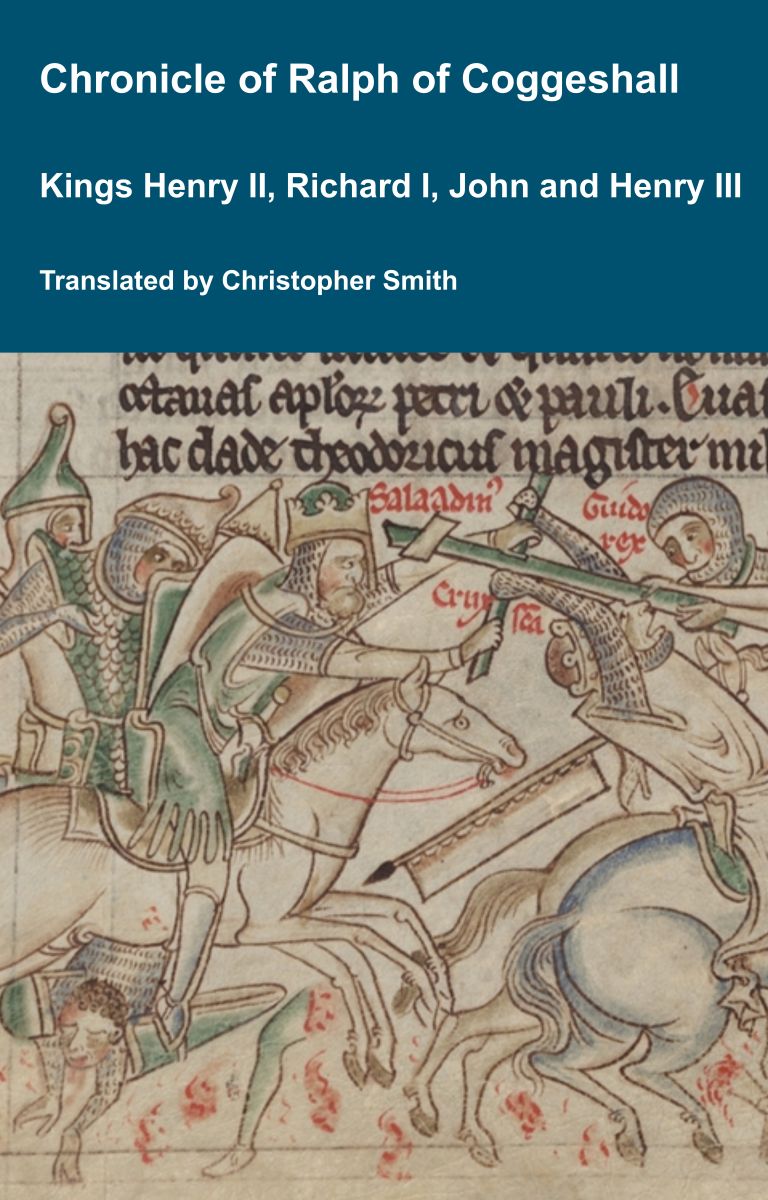
Chronicle of Abbot Ralph of Coggeshall
The Chronicle of Abbot Ralph of Coggeshall (Chronicon Anglicanum) is an indispensable medieval history that brings to life centuries of English and European affairs through the eyes of a learned Cistercian monk. Ralph of Coggeshall, abbot of the Abbey of Coggeshall in Essex in the early 13th century, continued and expanded his community’s chronicle, documenting events from the Norman Conquest of 1066 into the tumultuous reign of King Henry III. Blending eyewitness testimony, careful compilation, and the monastic commitment to record-keeping, this chronicle offers a rare narrative of political intrigue, royal power struggles, and social upheaval in England and beyond. Ralph’s work captures the reigns of pivotal figures such as Richard I and King John, providing invaluable insights into their characters, decisions, and the forces that shaped medieval rule. More than a simple annal, Chronicon Anglicanum conveys the texture of medieval life and governance, making it a rich source for scholars and readers fascinated by English history, monastic authorship, and the shaping of the medieval world.
Available at Amazon in eBook and Paperback format.
Flanders is in Low Countries.
On 19th August 1012 Baldwin "The Good" V Count Flanders was born to Baldwin "Bearded" IV Count Flanders [aged 32] and Ogive Luxemburg Countess Flanders at Arras. He married 1028 his half third cousin twice removed Adela Capet Duchess Normandy, daughter of Robert "Pious" II King of the Franks and Constance Arles Queen Consort France, and had issue.
On 28th March 1183 Elizabeth Capet [aged 40] died at Arras.
On 21st February 1402 Anthony Valois Duke Brabant [aged 17] and Jeanne Luxemburg Duchess Brabant were married at Arras. She by marriage Duchess Brabant. He the son of Philip "Bold" Valois II Duke Burgundy [aged 60] and Margaret Dampierre Duchess Burgundy [aged 54]. They were half third cousin once removed. He a great x 3 grandson of King Edward I of England. She a great x 2 granddaughter of King Edward I of England.
Around 1575 Maximilian Colt was born at Arras. His name appears to have been originally 'Poultrain,' and in early life he is often described as 'Powtran or Poutraine, alias Colt.
In 1618 Maximilian Colt [aged 43] had a house in Farringdon Within when his name appears in a list of foreigners then resident in London, together with that of John Colt, probably his son, who was also a sculptor and a native of Arras.
John Evelyn's Diary. 22nd September 1641. I went again to Rotterdam to receive a pass which I expected from Brussels [Map], securing me through Brabant and Flanders, designing to go into England through those countries. The Cardinal Infante [aged 32], brother to the king of Spain [aged 36], was then governor. By this pass, having obtained another from the Prince of Orange, upon the 24th of September I departed through Dort; but met with very bad tempestuous weather, being several times driven back, and obliged to lie at anchor off Keele, other vessels lying there waiting better weather. The 25th and 26th we made other essays; but were again repulsed to the harbour, where lay sixty vessels waiting to sail. But, on the 27th we, impatient of the time and inhospitableness of the place, sailed again with a contrary and impetuous wind and a terrible sea, in great jeopardy; for we had much ado to keep ourselves above water, the billows breaking desperately on our vessel: we were driven into Willemstad, North Brabant, a place garrisoned by the English, where the Governor of had a fair house. The works, and especially the counterscarp, are curiously hedged with quick, and planted with a stately row of limes on the rampart. The church is of a round structure, with a cupola, and the town belongs entirely to the Prince of Orange, as does that of Breda [Map], and some other places.


4th April 1660 The Declaration of Breda [Map], written on 04 Apr 1660, was a part of the process of King Charles II of England Scotland and Ireland [aged 29] being restored to the English throne written in response to a message sent by George Monck 1st Duke Albemarle [aged 51]. Initially secret the Declaration was made public on 1st May 1660. The Declaration promised a general pardon, retention of property religious toleration, payment of arrears to the army and continued army service.


Samuel Pepys' Diary. 6th May 1660. Lord's Day. This morning while we were at sermon comes in Dr. Clarges [aged 42] and a dozen gentlemen to see my Lord, who, after sermon, dined with him; I remember that last night upon discourse concerning Clarges my Lord told me that he was a man of small entendimiento. [Entendimiento, Spanish: the understanding.] This afternoon there was a gentleman with me, an officer of Dunkirk going over, who came to me for an order and told me he was lately with my uncle and Aunt Fenner and that Kate's fits of the convulsions did hold her still. It fell very well to-day, a stranger preached here for Mr. Ibbot, one Mr. Stanley, who prayed for King Charles, by the Grace of God, &c., which gave great contentment to the gentlemen that were on board here, and they said they would talk of it, when they come to Breda [Map], as not having it done yet in London so publickly. After they were gone from on board, my Lord writ a letter to the King and give it to me to carry privately to Sir William Compton [aged 35] on board the Assistance, which I did, and after a health to his Majesty on board there, I left them under sail for Breda [Map]. Back again and found them at sermon. I went up to my cabin and looked over my accounts, and find that, all my debts paid and my preparations to sea paid for, I have £640 clear in my purse. After supper to bed.
On 8th May 1660 King Charles II of England Scotland and Ireland [aged 29] received a letter inviting him to return to England and become King at Breda [Map].
John Evelyn's Diary. 9th May 1660. I was desired and designed to accompany my Lord Berkeley [aged 32] with the public address of the Parliament, General, etc., to the King [aged 29], and invite him to come over and assume his Kingly Government, he being now at Breda [Map]; but I was yet so weak, I could not make that journey by sea, which was not a little to my detriment, so I went to London to excuse myself, returning the 10th, having yet received a gracious message from his Majesty by Major Scot and Colonel Tuke [aged 45].
Samuel Pepys' Diary. 15th May 1660. After that the judge, I and my boy by coach to Scheveling again, where we went into a house of entertainment and drank there, the wind being very high, and we saw two boats overset and the gallants forced to be pulled on shore by the heels, while their trunks, portmanteaus, hats, and feathers, were swimming in the sea. Among others I saw the ministers that come along with the Commissioners (Mr. Case1 among the rest) sadly dipped.
Note 1. Thomas Case, born 1598, was a famous preacher and a zealous advocate for the Solemn League and Covenant, a member of the assembly of divines, and rector of St. Giles's-in-the-Fields [Map]. He was one of the deputation to Charles II at Breda [Map], and appointed a royal chaplain. He was ejected by the Act of Uniformity, but remained in London after his ejection. Died May 30th, 1682.
Before 1721 Charles John Montagu [aged 62] died at Breda [Map]. He was buried at All Saints Church, Barnwell [Map] on 29th June 1721.
In 1054 Lambert Flanders II Count Lens [aged 38] died at Lille during the Battle of Lille when fighting for Baldwin "The Good" V Count Flanders [aged 41].
On 1st September 1067 Baldwin "The Good" V Count Flanders [aged 55] died at Lille.
After 11th July 1708 Arnold Keppel 1st Earl Albermarle [aged 38] distinguished himself at Lille during the Siege of Lille.
On 23rd November 1503 Margaret of York Duchess of Burgundy [aged 57] died at Mechlin [Map].
On 10th September 1419 Charles "Victorious" VII King France [aged 16] and John "Fearless" Valois Duke Burgundy [aged 48] met on the bridge at Montereau to progress their peace negotiations. During the course of the discussions John "Fearless" Valois Duke Burgundy was assassinated. His son Philip [aged 23] succeeded III Duke Burgundy. Michelle Valois Duchess Burgundy [aged 24] by marriage Duchess Burgundy.
On 2nd July 1600 the Battle of Nieuwpoort took place at Nieuwpoort in Flanders.
Charles Drury was killed.
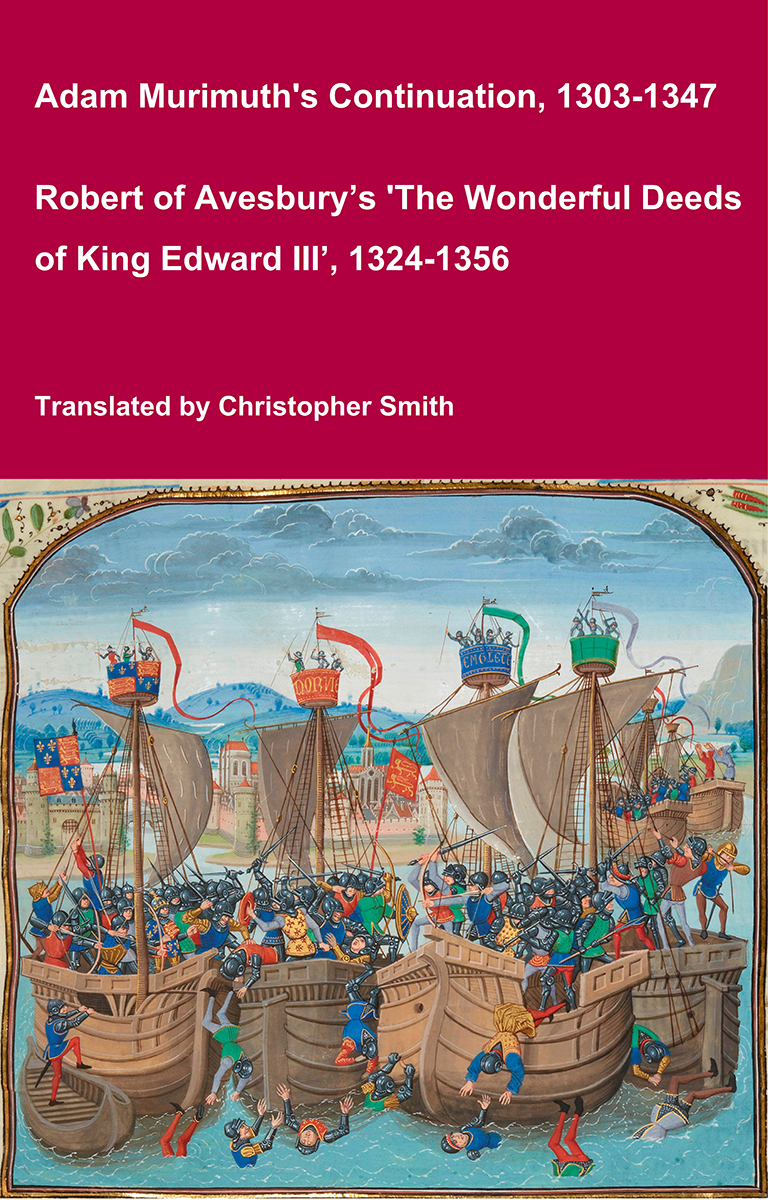
Adam Murimuth's Continuation and Robert of Avesbury’s 'The Wonderful Deeds of King Edward III'
This volume brings together two of the most important contemporary chronicles for the reign of Edward III and the opening phases of the Hundred Years’ War. Written in Latin by English clerical observers, these texts provide a vivid and authoritative window into the political, diplomatic, and military history of fourteenth-century England and its continental ambitions. Adam Murimuth Continuatio's Chronicarum continues an earlier chronicle into the mid-fourteenth century, offering concise but valuable notices on royal policy, foreign relations, and ecclesiastical affairs. Its annalistic structure makes it especially useful for establishing chronology and tracing the development of events year by year. Complementing it, Robert of Avesbury’s De gestis mirabilibus regis Edwardi tertii is a rich documentary chronicle preserving letters, treaties, and official records alongside narrative passages. It is an indispensable source for understanding Edward III’s claim to the French crown, the conduct of war, and the mechanisms of medieval diplomacy. Together, these works offer scholars, students, and enthusiasts a reliable and unembellished account of a transformative period in English and European history. Essential for anyone interested in medieval chronicles, the Hundred Years’ War, or the reign of Edward III.
Available at Amazon in eBook and Paperback format.
On 16th November 1601 Charles Neville 6th Earl of Westmoreland [aged 59] died at Nieuwpoort penniless and largely forgotten. He had been attainted in 1571 hence his title Earl of Westmoreland was forfeit. Raby Castle, County Durham [Map] was taken into Royal custody.
In May 1332 Reginald "Black" I Duke Guelders [aged 37] and Eleanor of Woodstock Plantagenet [aged 13] were married at Nijmegen [Map]. She by marriage Countess Guelders. His second marriage; he had four daughters from his first marriage. He subsequently sent her from court to Deventer Abbey [Map] in 1336 under the pretext that she had leprosy. He subsequently tried to annul the marriage but she contested the annulment by proving she wasn't a leper. The difference in their ages was 23 years. She the daughter of King Edward II of England and Isabella of France Queen Consort England [aged 37]. He the son of Reginald I Count Guelders and Margaret Dampierre Countess Guelders. They were second cousin once removed. He a great x 4 grandson of King Stephen I England.
On 22nd April 1355 Eleanor of Woodstock Plantagenet [aged 36] died. She was buried at Deventer Abbey [Map].
Around 1591 Jan Jasper was born at Rotterdam.
John Evelyn's Diary. 13th August 1641. We arrived late at Rotterdam, where was their annual mart or fair, so furnished with pictures, (especially landscapes and drolleries, as they call those clownish representations,) that I was amazed. Some of these I bought, and sent into England. The reason of this store of pictures, and their cheapness, proceeds from their want of land to employ their stock, so that it is an ordinary thing to find a common farmer lay out two or three thousand pounds in this commodity. Their houses are full of them, and they vend them at their fairs to very great gains. Here I first saw an elephant, who was extremely well disciplined and obedient. It was a beast of a monstrous size, yet as flexible and nimble in the joints, contrary to the vulgar tradition, as could be imagined from so prodigious a bulk and strange fabric; but I most of all admired the dexterity and strength of its proboscis, on which it was able to support two or three men, and by which it took and reached whatever was offered to it; its teeth were but short, being a female, and not old. I was also shown a pelican, or onocratulas of Pliny,with its large gullets, in which he kept his reserve of fish: the plumage was white, legs red, flat, and film-footed: likewise a cock with four legs, two rumps and vents; also a hen which had two large spurs growing out of her sides, penetrating the feathers of her wings.
John Evelyn's Diary. 20th August 1641. Next day (the 20th) I returned to Delft, thence to Rotterdam, the Hague, and Leyden, where immediately I mounted a waggon, which that night, late as it was, brought us to Haerlem. About seven in the morning, after I came to Amsterdam, where being provided with a lodging, the first thing I went to see was a Synagogue of the Jews (being Saturday), whose ceremonies, ornaments, lamps, law, and schools, afforded matter for my contemplation. The women were secluded from, the men, being seated in galleries above, shut with lattices, having their heads muffled with linen, after a fantastical and somewhat extraordinary fashion; the men, wearing a large calico mantle, yellow coloured, over their hats, all the while waving their bodies, whilst at their devotions. From thence, I went to a place without the town, called Overkirk, where they have a spacious field assigned them to bury their dead, full of sepulchres with Hebraic inscriptions, some of them stately and costly. Looking through one of these monuments, where the stones were disjointed, I perceived divers books and papers lie about a corpse; for it seems, when any learned Rabbi dies, they bury some of his books with him. With the help of a stick, I raked out several, written in Hebrew characters, but much impaired. As we returned, we stepped in to see the Spinhouse, a kind of bridewell, where incorrigible and lewd women are kept in discipine and labour, but all neat. We were showed an hospital for poor travellers and pilgrims, built by Queen Elizabeth of England; and another maintained by the city.
John Evelyn's Diary. 1st September 1641. I went to Delft and Rotterdam, and two days after back to the Hague, to bespeak a suit of horseman's armour, which I caused to be made to fit me. I now rode out of town to see the monument of the woman, pretended to have been a Countess of Holland, reported to have had as many children at one birth, as there are days in the year. The basins were hung up in which they were baptized, together with a large description of the matter-of-fact in a frame of carved work, in the church of Lysdun, a desolate place. As I returned, I diverted to see one of the prince's Palaces, called the Hoff Van Hounslers Dyck, a very fair cloistered and quadrangular building. The gallery is prettily painted with several huntings and at one end a Gordian knot, with rustical instruments so artificially represented, as to deceive an accurate eye to distinguish it from actual rehevo. The ceiling of the staircase is painted with the Rape of Ganymede, and other pendent figures, the work of F. Covenberg, of whose hand I bought an excellent drollery, which I afterwards parted with to my brother George of Wotton, where it now hangs. To this palace join a fair garden and park, curiously planted with limes.
John Evelyn's Diary. 8th September 1641. Returned to Rotterdam, through Delftshaven and Sedan, where were at that time Colonel Goring's [aged 33] winter quarters. This town has heretofore been very much talked of for witches.
John Evelyn's Diary. 22nd September 1641. I went again to Rotterdam to receive a pass which I expected from Brussels [Map], securing me through Brabant and Flanders, designing to go into England through those countries. The Cardinal Infante [aged 32], brother to the king of Spain [aged 36], was then governor. By this pass, having obtained another from the Prince of Orange, upon the 24th of September I departed through Dort; but met with very bad tempestuous weather, being several times driven back, and obliged to lie at anchor off Keele, other vessels lying there waiting better weather. The 25th and 26th we made other essays; but were again repulsed to the harbour, where lay sixty vessels waiting to sail. But, on the 27th we, impatient of the time and inhospitableness of the place, sailed again with a contrary and impetuous wind and a terrible sea, in great jeopardy; for we had much ado to keep ourselves above water, the billows breaking desperately on our vessel: we were driven into Willemstad, North Brabant, a place garrisoned by the English, where the Governor of had a fair house. The works, and especially the counterscarp, are curiously hedged with quick, and planted with a stately row of limes on the rampart. The church is of a round structure, with a cupola, and the town belongs entirely to the Prince of Orange, as does that of Breda [Map], and some other places.
On 9th April 1649 James Scott 1st Duke Monmouth 1st Duke Buccleuch was born illegitimately to King Charles II of England Scotland and Ireland [aged 18] and Lucy Walter [aged 19] at Rotterdam. Some thought his father was Colonel Robert Sidney [aged 23] who Evelyn says "he most resembl'd".

The History of William Marshal was commissioned by his son shortly after William’s death in 1219 to celebrate the Marshal’s remarkable life; it is an authentic, contemporary voice. The manuscript was discovered in 1861 by French historian Paul Meyer. Meyer published the manuscript in its original Anglo-French in 1891 in two books. This book is a line by line translation of the first of Meyer’s books; lines 1-10152. Book 1 of the History begins in 1139 and ends in 1194. It describes the events of the Anarchy, the role of William’s father John, John’s marriages, William’s childhood, his role as a hostage at the siege of Newbury, his injury and imprisonment in Poitou where he met Eleanor of Aquitaine and his life as a knight errant. It continues with the accusation against him of an improper relationship with Margaret, wife of Henry the Young King, his exile, and return, the death of Henry the Young King, the rebellion of Richard, the future King Richard I, war with France, the death of King Henry II, and the capture of King Richard, and the rebellion of John, the future King John. It ends with the release of King Richard and the death of John Marshal.
Available at Amazon in eBook and Paperback format.
In 1598 Brilliana Conway was born to Edward Conway 1st Viscount Conway [aged 34] at Brill where her father was Governor. She married 6th November 1656 Robert Harley and had issue.
John Evelyn's Diary. 2nd November 1688. It was now certainly reported by some who saw the fleet, and the Prince [aged 37] embark, that they sailed from the Brill on Wednesday morning, and that the Princess of Orange [aged 26] was there to take leave of her husband.


Before 25th May 1660 King Charles II of England Scotland and Ireland [aged 29] left at Scheveningen.
Chronicle of Gregory. 1405. Ande that year Syr Thomas [aged 17] the kyngys son was Amerelle of the See, and he wente unto Flaundrys and brent bothe in Cachante and in Flaundrys, ande londyd at Scluse [Map] and gaffe there to a strong sawte. Alle so he toke carrekys of Jene and brought them unto Wynchylse [Map], and they were brent thorowe mysse governaunce and moche of the goode ther ynne.
On 20th September 1405 Reginald Braybrooke [aged 49] died at Sluys [Map]. He was buried at Church of St Mary Magdalene, Cobham.
Chronicle of Gregory. 1462. And then my Lord of Warwycke [aged 33] and his brother the Lord Montegewe [aged 31] put them in devyr to rescewe [t]e said castelle of Norham, and soo they dyd, and put bothe King Harry and the Kyng of Schotys [aged 10] to flyghte. And Quene Margarete whythe alle hir consayle, and Syr Perys de Brasey [aged 52] whythe the Fraynysche men, fledde a-wey by water with iiij balynggarys; and they londyd at the Scluse [Map] in Flaundyrs, and lefte Kyng Harry that was be hynde hem, and alle her hors and her harneys, they were so hastyd by my lord of Warwycke, and his brother the lord Mountegewe, and by her feleschippe with them accompanyde. And at the departynge of Syr Perys de Brasyl and his feleschippe was on manly man that purposyd to mete with my lord of Warwycke, that was a taberette, for he stode a-pon an hylle with his tabyr and his pype, taberyng and pyping as merely as any man might, stondyng by him selfe, tylle my lord come unto him he wold not lesse his grownd; and there he be-come my lordys man; ande yet he is with him full good and to his lorde.
On 19th February 1658 Henry Wilmot 1st Earl Rochester [aged 45] died at Sluys [Map]. He was buried in Bruges [Map]. After the Restoration his remains were reburied in All Saints Church, Spelsbury [Map]. His son John [aged 10] succeeded 2nd Earl Rochester, 2nd Viscount Wilmot.


On 9th July 1292 Henry Luxemburg VII Holy Roman Emperor [aged 17] and Margaret Brabant Countess Luxemburg and Namur were married at Tervuren. He the son of Henry Luxemburg VI Count Luxemburg and Beatrice Avesnes Countess Luxemburg.
On 11th July 1302 the army of Flanders unexpectedly defeated the army of France at Kortrijk during the Battle of the Golden Spurs aka Courtrai. Robert Artois II Count Artois [aged 51], Raoul II de Clermont [aged 57], Raoul Nesle and Godfrey Reginar were killed.
Simon de Clermont-Nesle [aged 47] died.
John Brienne II Count of Eu was killed. His son Raoul succeeded I Count Eu.
John of Avesnes [aged 32] was killed
Jacques de Saint Pol died from wounds.
Chronicle of Gregory. 22nd July 1436. Ande the xxvj day of Juylle the Duke of Glouceter [aged 45] whythe alle the substaunce of the lordys of Ingelonde schyppyde at Sondewyche [Map] with xl. M [40000] men of alle the contreys of Ingelonde, for every towne, cytte, or borowe fonde certayne men whythe dyvers lyvereys of the bagys of the towne, and soo dyd abbeys and pryorys in the same wyse of alle Ingelonde. And the same day they londyd at Calys, and there they hylde her consaile the Fryday, Satyrday, and Sonday. And on the Monday he toke his jornaye in-to Flaunders warde; ande he rode throughe Pycardye and dyd moche harme yn the contre of Flaunders, for he brent Poperyng and Belle, ij [2] goode townys, and many moo othyr vylagys in Flaunders and in Pycardye; and soo he come home a-yenne to Calys whythe out any lettynge of any person, thonkyd be God.
On 22nd August 1918 Tom Cecil Noel [aged 20] was killed in action at Westrozebeke, West Flanders. Noel was flying with Latimer when they were shot down by Leutnant Willi Nebgen of Jasta 7. Noel was killed and Latimer was captured. He was awarded a Bar to his Military Cross.
In October 1924 Tom Cecil Noel was buried at Westrozebeke, West Flanders by the Germans. He was reburied at Perth China Wall Cemetery, Ypres when the cemeteries we consolidated after the war.