


The History of William Marshal was commissioned by his son shortly after William’s death in 1219 to celebrate the Marshal’s remarkable life; it is an authentic, contemporary voice. The manuscript was discovered in 1861 by French historian Paul Meyer. Meyer published the manuscript in its original Anglo-French in 1891 in two books. This book is a line by line translation of the first of Meyer’s books; lines 1-10152. Book 1 of the History begins in 1139 and ends in 1194. It describes the events of the Anarchy, the role of William’s father John, John’s marriages, William’s childhood, his role as a hostage at the siege of Newbury, his injury and imprisonment in Poitou where he met Eleanor of Aquitaine and his life as a knight errant. It continues with the accusation against him of an improper relationship with Margaret, wife of Henry the Young King, his exile, and return, the death of Henry the Young King, the rebellion of Richard, the future King Richard I, war with France, the death of King Henry II, and the capture of King Richard, and the rebellion of John, the future King John. It ends with the release of King Richard and the death of John Marshal.
Available at Amazon in eBook and Paperback format.
Paternal Family Tree: Norman
Maternal Family Tree: Gerberge Unknown Viscountess Anjou
Before 1051 [his father] King William "Conqueror" I of England (age 22) and [his mother] Matilda Flanders Queen Consort England (age 19) were married. She the daughter of [his grandfather] Baldwin "The Good" V Count Flanders (age 38) and [his grandmother] Adela Capet Duchess Normandy (age 41). He the illegitmate son of [his grandfather] Robert "Magnificent" Normandy I Duke Normandy and [his grandmother] Herleva of Falaise. They were third cousin once removed.
Around 1051 Robert Curthose III Duke Normandy was born to [his father] King William "Conqueror" I of England (age 23) and [his mother] Matilda Flanders Queen Consort England (age 20).
In 1056 Robert Curthose III Duke Normandy (age 5) and Marguerite Maine Countess Essex (age 11) were betrothed but she died before they could marry.
In 1063 Robert Curthose III Duke Normandy (age 12) was created Count Maine.
The Deeds of the Dukes of Normandy. In the same year, Lord Osbern the abbot, after he had ruled the monastery of Saint-Evroul for five years and two months, a good man and concerned for those under him, died on the sixth day before the Kalends of June [27th May 1066]. He was succeeded by the wise Mainier, a monk of the same monastery, who, with God's help and the good fortune of the time, built the new church and all the houses suited for the monks. After he had ruled the monastery for twenty-two years, in the days of Robert "the Idle" the duke1, and Gilbert Maminot, bishop of Lisieux, he died on the eleventh day before the Nones of March [25th February 1089]. He left the governance of the abbey of Ouche to the most distinguished Serlo, a man endowed with knowledge of the Scriptures and with eloquence, who after two years and three months, by God's grace, received the bishopric of Sées.
Eodem anno domnus Osbernus abbas, postquam cœnobio Sancti Ebrulfi quinque, annis et duobus mensibus præfuit, vir bonus et de subjectis sibi sollicitus, vi. Kal. Junii obiit. Cui sagax Mainnerius ejusdem coenobii monachus successit et novam ecclesiam, omnesque domos monachis congruas, Deo juvante, et temporis felicitate favente construxit. Qui postquam 22 annis monasterium rexit tempore Roberti ignavi ducis et Gisleberti Maminoti Luxoviensis epiocopi, xi Non. Martii obiit. Ulicensis vero abbatiæ regimen elegantissimo Serloni, peritia Scriputurarum et eloquentia pollenti, reliquit; qui post duos annos et tres menses præsulatum Sagiorum Dei gratia suscepit.
Note 1. Robert Curthose (age 15), III Duke of Normandy, around 1051-1134, eldest son of William the Conqueror who inherited Normandy after William died in 1087.
On 14th October 1066 the Norman army led by [his father] King William "Conqueror" I of England (age 38) defeated the English army of King Harold II of England (age 44) at the 14th October 1066 Battle of Hastings fought at Senlac Hill Hastings. Aimery Thouars (age 42), Ralph de Gael 2nd Earl East Anglia (age 24), Eustace II Count Boulogne (age 51), William Fitzosbern 1st Earl Hereford (age 46), Geoffrey Chateaudun II Count Mortain III Count Perche, William Warenne 1st Earl of Surrey, Raoul Tosny, Robert Beaumont 1st Earl of Leicester Count Meulan (age 26), Hugh Grandesmil (age 34), Roger "The Great" Montgomery 1st Earl of Shrewsbury (possibly), [his uncle] Robert Mortain Count Mortain 1st Earl Cornwall (age 35) and [his uncle] Bishop Odo of Bayeux fought for William.
King Harold II of England was killed. Earl Wessex, Earl Hereford extinct.
Leofwine Godwinson 2nd Earl Kent (age 31) was killed. Earl Kent extinct.
His brothers Gyrth Godwinson Earl East Anglia (age 34) and Engenulphe Aigle (age 56) were killed.
On 25th December 1066 [his father] King William "Conqueror" I of England (age 38) was crowned I King of England at Westminster Abbey [Map] by Archbishop Ealdred.
On 11th May 1068 [his mother] Matilda Flanders Queen Consort England (age 37) was crowned Queen Consort England at Westminster Abbey [Map].
Flowers of History. 11th May 1068. [his mother] Matilda (age 37), the wife of king [his father] William (age 40), was consecrated queen on the day of Pentecost, by Aeldred, archbishop of York, on the twenty-second of March. [Note. The date a mistake. Pentecost the fiftieth day after Easter so usually in May. Pentcost known as White Sunday, or Whit-Sunday.] This year also, William had a son born in England, who was called [his brother] Henry. For his first-born, [his brother] William Rufus (age 12), and also Robert (age 17), were born in Normandy, before their father had conquered England.
On 28th January 1069 Robert de Comines Earl Northumbria was burned to death in Durham, County Durham [Map] when a rebel army set fire to the house in which he was staying. All his men were killed. In retaliation [his father] King William "Conqueror" I of England (age 41) commenced the Harrying of the North.
In 1070 Waltheof Northumbria 1st Earl of Northampton 1st Earl Huntingdon and Judith Flanders Countess Huntingdon (age 16) were married. She by marriage Earldorman Northumbria, Countess Huntingdon. She, Judith, a niece of [his father] King William "Conqueror" I of England (age 42). She the daughter of Lambert Flanders II Count Lens and [his aunt] Adelaide Normandy Countess Troyes and Meaux Champagne Aumale Ponthieu (age 40). He the son of Siward "Stout" Earl of Northumbria and Aelfflaed Northumbria.
Flowers of History. 1075. The same year, on Easter day, the above-named [his father] king William (age 47) gave his daughter [his sister] Cecilia (age 19) to be dedicated to the service of God with devout solemnity in the church at Feschamp. Also king William cursed his son Robert (age 24), because he had often provoked him to anger, and in the bitterness of his soul he drove him from his sight and presence. And Robert at the end of his life found out undeniably how great was the effect of the paternal malediction, when having become blind, he was exposed to the hatred and persecution of his brothers, and so died miserably in prison.
Anglo-Saxon Chronicle. 1079. This year Robert (age 28), the son of [his father] King William (age 51), deserted from his father to his uncle [his uncle] Robert in Flanders (age 46); because his father would not let him govern his earldom in Normandy; which he himself, and also King Philip (age 26) with his permission, had given him. The best men that were in the land also had sworn oaths of allegiance to him, and taken him for their lord. This year, therefore, Robert fought with his father, without Normandy, by a castle called Gerberoy; and wounded him in the hand; and his horse, that he sat upon, was killed under him; and he that brought him another was killed there right with a dart. That was Tookie Wiggodson. Many were there slain, and also taken. His son [his brother] William (age 23) too was there wounded; but Robert (age 37) returned to Flanders. We will not here, however, record any more injury that he did his father.
Chronicle of a Bourgeois of Valenciennes
Récits d’un bourgeois de Valenciennes aka The Chronicle of a Bourgeois of Valenciennes is a vivid 14th-century vernacular chronicle written by an anonymous urban chronicler from Valenciennes in the County of Hainaut. It survives in a manuscript that describes local and regional history from about 1253 to 1366, blending chronology, narrative episodes, and eyewitness-style accounts of political, military, and social events in medieval France, Flanders, and the Low Countries. The work begins with a chronological framework of events affecting Valenciennes and its region under rulers such as King Philip VI of France and the shifting allegiances of local nobility. It includes accounts of conflicts, sieges, diplomatic manoeuvres, and the impact of broader struggles like the Hundred Years’ War on urban life in Hainaut. Written from the perspective of a burgher (bourgeois) rather than a monastery or royal court, the chronicle offers a rare lay viewpoint on high politics and warfare, reflecting how merchants, townspeople, and civic institutions experienced the turbulence of the 13th and 14th centuries. Its narrative style combines straightforward reporting of events with moral and civic observations, making it a valuable source for readers interested in medieval urban society, regional politics, and the lived experience of war and governance in pre-modern Europe.
Available at Amazon in eBook and Paperback format.
Flowers of History. 1080. This year also, [his father] king William (age 52) led a powerful army into Wales, and subjugated it; and received homage and hostages for their fidelity from the petty kings of the viscounty. The same year, Antioch was taken by the pagans, together with the adjacent province, which had been a Christian land ever since the time of Saint Peter, without any disturbances. The same year, Malcolm, king of Scotland (age 48), became furious a second time after the Assumption of the blessed Virgin Mary, and ravaged the whole of Northumberland, as far as the river Tyne. But when he heard of this, the king of England sent his son Robert (age 29) with an army into Scotland, who returned without having succeeded in his objects, and built a new castle in the river Tyne, and then returned to his father. The same year also, the king sent his brother [his uncle] Odo, bishop of Bayeux, with a large army, to lay waste Northumberland, the people of which district had risen in insurrection against the king, and had murdered Walcher, bishop of Durham, a man of exemplary character, at Gateshead.
In 1080 [his brother-in-law] Stephen Blois II Count Blois and Chartres (age 35) and [his sister] Adela Normandy Countess Blois (age 13) were married at Chartres [Map]. She by marriage Countess Blois. The difference in their ages was 22 years. She the daughter of [his father] King William "Conqueror" I of England (age 52) and [his mother] Matilda Flanders Queen Consort England (age 49). He the son of Theobald Blois III Count Blois (age 68) and Gersenda Maine Countess Blois. They were third cousins.
Around 1080 [his future sister-in-law] Edith aka Matilda Dunkeld Queen Consort England was christened at Dunfermline [Map]. Robert Curthose III Duke Normandy (age 29) was godfather, [his mother] Matilda Flanders Queen Consort England (age 49) godmother.
On 2nd November 1083 [his mother] Matilda Flanders Queen Consort England (age 52) died.
On 9th September 1087 [his father] King William "Conqueror" I of England (age 59) died at the Priory of St Gervaise, Rouen [Map]. He was buried at the Abbaye aux Hommes, Caen [Map], at a ceremony presided over by Gilbert Arques Bishop Evreux. [his brother] King Henry I "Beauclerc" England (age 19) attended. His son [his brother] William (age 31) succeeded II King of England. His son Robert (age 36) succeeded III Duke Normandy.
Anglo-Saxon Chronicle. 1087. In the same year also, before the Assumption of St. Mary, [his father] King William (age 59) went from Normandy [Map] into France with an army, and made war upon his own lord Philip, the king (age 34), and slew many of his men, and burned the town of Mante, and all the holy minsters that were in the town; and two holy men that served God, leading the life of anachorets, were burned therein. This being thus done, King William returned to Normandy. Rueful was the thing he did; but a more rueful him befel. How more rueful? He fell sick, and it dreadfully ailed him. What shall I say? Sharp death, that passes by neither rich men nor poor, seized him also. He died in Normandy, on the next day after the Nativity of St. Mary, and he was buried at Caen in St. Stephen's minster [Map], which he had formerly reared, and afterwards endowed with manifold gifts. Alas! how false and how uncertain is this world's weal! He that was before a rich king, and lord of many lands, had not then of all his land more than a space of seven feet! and he that was whilom enshrouded in gold and gems, lay there covered with mould! He left behind him three sons; the eldest, called Robert (age 36), who was earl in Normandy after him; the second, called [his brother] William (age 31), who wore the crown after him in England; and the third, called [his brother] Henry (age 19), to whom his father bequeathed immense treasure.
In 1087 [his brother-in-law] Alan Canhiart IV Duke Brittany (age 24) and [his sister] Constance Normandy Duchess Brittany (age 30) were married. She by marriage Duchess Brittany. She the daughter of [his father] King William "Conqueror" I of England (age 59) and [his mother] Matilda Flanders Queen Consort England. They were third cousins.
On 26th September 1087 [his brother] King William II of England (age 31) was crowned II King of England at Westminster Abbey [Map] by Archbishop Lanfranc (age 82). See Anglo-Saxon Chronicle
Anglo-Saxon Chronicle. 1090. Indiction XIII. These things thus done, just as we have already said above, by the [his brother] king (age 34), and by his brother and by this men, the king was considering how he might wreak his vengeance on his brother Robert, harass him most, and win Normandy of him. And indeed through his craft, or through bribery, he got possession of the castle at St. Valeri, and the haven; and so he got possession of that at Albemarle. And therein he set his knights; and they did harm to the land in harrowing and burning. After this he got possession of more castles in the land; and therein lodged his horsemen. When the Earl of Normandy, Robert, understood that his sworn men deceived him, and gave up their castles to do him harm, then sent he to his lord, Philip, king of the Franks; and he came to Normandy [Map] with a large army, and the king and the earl with an immense force beset the castle about, wherein were the men of the King of England. But the King William of England sent to Philip, king of the Franks; and he for his love, or for his great treasure, abandoned thus his subject the Earl Robert (age 39) and his land; and returned again to France, and let them so remain. And in the midst of these things this land was much oppressed by unlawful exactions and by many other misfortunes.
On 13th August 1090 [his sister] Constance Normandy Duchess Brittany (age 33) died.
Anglo-Saxon Chronicle. 1091. In this year the [his brother] King William (age 35) held his court at Christmas in Westminster, and thereafter at Candlemas he went, for the annoyance of his brother, out of England into Normandy. Whilst he was there, their reconciliation took place, on the condition, that the earl put into his hands Feschamp, and the earldom of Ou, and Cherbourg; and in addition to this, that the king's men should be secure in the castles that they had won against the will of the earl. And the king in return promised him those many [castles] that their father had formerly won, and also to reduce those that had revolted from the earl, also all that his father had there beyond, except those that he had then given the king, and that all those, that in England before for the earl had lost their land, should have it again by this treaty, and that the earl should have in England just so much as was specified in this agreement. And if the earl died without a son by lawful wedlock, the king should be heir of all Normandy; and by virtue of this same treaty, if the king died, the earl should be heir of all England. To this treaty swore twelve of the best men of the king's side, and twelve of the earl's, though it stood but a little while afterwards. In the midst of this treaty was Edgar Etheling (age 40) deprived of the land that the earl had before permitted him to keep in hand; and he went out of Normandy to the king, his sister's husband, in Scotland, and to his sister. Whilst the King William was out of England, the King Malcolm (age 59) of Scotland came hither into England, and overran a great deal of it, until the good men that governed this land sent an army against him and repulsed him. When the King William in Normandy [Map] heard this, then prepared he his departure, and came to England, and his brother, the Earl Robert (age 40), with him; and he soon issued an order to collect a force both naval and military; but the naval force, ere it could come to Scotland, perished almost miserably, a few days before St. Michael's mass. And the king and his brother proceeded with the land-force; but when the King Malcolm heard that they were resolved to seek him with an army, he went with his force out of Scotland into Lothaine in England, and there abode. When the King William came near with his army, then interceded between them Earl Robert, and Edgar Etheling, and so made the peace of the kings, that the King Malcolm came to our king, and did homage114, promising all such obedience as he formerly paid to his father; and that he confirmed with an oath. And the King William promised him in land and in all things whatever he formerly had under his father. In this settlement was also Edgar Etheling united with the king. And the kings then with much satisfaction departed; yet that stood but a little while. And the Earl Robert tarried here full nigh until Christmas with the king, and during this time found but little of the truth of their agreement; and two days before that tide he took ship in the Isle of Wight, and went into Normandy, and Edgar Etheling with him.
Note 114. Literally "became his man"—"Ic becom eowr man" was the formula of doing homage.
 Become a Member via our Buy Me a Coffee page to read more.
Chronicon ex Chronicis by Florence and John of Worcester. 1094. The earl [Robert Curthose III Duke Normandy (age 43)], driven to extremity, brought his suzerain, king Philip, with a French army into Normandy, who laid siege to the castle of Argentan, and on the very day he sat down before it, took seven hundred of the king's knights prisoners, with as many squires, and the whole garrison of the place, without loss of blood. He then returned to France, having given orders that the prisoners should be detained in custody until they paid their respective ransoms. Earl Robert also besieged the castle called Holme, until William Peverel (age 54) and eight hundred men who defended it surrendered to him. When the king was informed of this, he sent messengers to England with orders that twenty thousand foot soldiers should be levied and despatched to his aid in Normandy. They were mustered at Hastings, in readiness for crossing the sea, but Ralph Passe-Flambard, by the king's command, withheld the pay which had been allotted for their maintenance, at the rate of ten-pence for each man, and gave them orders to return to their homes: the money he remitted to the king. Meanwhile, all England was distressed by heavy and constant taxation, and by a mortality which was very general in this and the following year.
Chronicle of Abbot Ralph of Coggeshall
The Chronicle of Abbot Ralph of Coggeshall (Chronicon Anglicanum) is an indispensable medieval history that brings to life centuries of English and European affairs through the eyes of a learned Cistercian monk. Ralph of Coggeshall, abbot of the Abbey of Coggeshall in Essex in the early 13th century, continued and expanded his community’s chronicle, documenting events from the Norman Conquest of 1066 into the tumultuous reign of King Henry III. Blending eyewitness testimony, careful compilation, and the monastic commitment to record-keeping, this chronicle offers a rare narrative of political intrigue, royal power struggles, and social upheaval in England and beyond. Ralph’s work captures the reigns of pivotal figures such as Richard I and King John, providing invaluable insights into their characters, decisions, and the forces that shaped medieval rule. More than a simple annal, Chronicon Anglicanum conveys the texture of medieval life and governance, making it a rich source for scholars and readers fascinated by English history, monastic authorship, and the shaping of the medieval world.
Available at Amazon in eBook and Paperback format.
Chronicon ex Chronicis by Florence and John of Worcester. 1094. King William went to Hastings, and while there caused the church of Battle [Map] to be dedicated; and then crossing over to Normandy had a conference with his brother [Robert Curthose III Duke Normandy (age 43)], under a safe conduct, but came away without being reconciled to him, and the earl went to Rouen. The king returned to Eu, and establishing himself there, took soldiers into his pay from all quarters, and induced several of the Norman nobles to forfeit their allegiance to his brother, and place their castles in his power, some by promises, others by gifts of gold, silver, and lands; and having secured their consent, he distributed liis own troops among the castles which he already held, or those which were now made over to him. Meanwhile, he took the castle of Bures, and sent some of the earl's soldiers who were taken there prisoners to England, and contined the rest in Normandy. Thus he harassed his brother in various ways, and used his utmost efforts to deprive him of his inheritance.
Anglo-Saxon Chronicle. 1095. In this year was the [his brother] King William (age 39) the first four days of Christmas at Whitsand, and after the fourth day came hither, and landed at Dover. And Henry, the king's brother, abode in this land until Lent, and then went over sea to Normandy, with much treasure, on the king's behalf, against their brother, Earl Robert (age 44), and frequently fought against the earl, and did him much harm, both in land and in men. And then at Easter held the king his court in Winchester; and the Earl Robert of Northumberland would not come to court. And the king was much stirred to anger with him for this, and sent to him, and bade him harshly, if he would be worthy of protection, that he would come to court at Pentecost.
Anglo-Saxon Chronicle. 1100. During the harvest of this same year also came the Earl Robert (age 49) home into Normandy, and the Earl Robert of Flanders (age 35), Eustace, Earl of Boulogne, from Jerusalem. And as soon as the Earl Robert came into Normandy, he was joyfully received by all his people; except those of the castles that were garrisoned with the [his brother] King Henry's (age 32) men. Against them he had many contests and struggles.
On 2nd August 1100 [his brother] King William II of England (age 44) died in a hunting accident, not known whether accidentally or otherwise, in the New Forest, Hampshire. His brother [his brother] Henry (age 32) succeeded I King of England. The brothers Robert Beaumont 1st Earl of Leicester Count Meulan (age 60) and Henry Beaumont 1st Earl Warwick (age 50), and Roger de Clare (age 34) and Gilbert de Clare (age 34) were present.
On 5th August 1100 [his brother] King Henry I "Beauclerc" England (age 32) was crowned I King of England by Bishop Maurice at Westminster Abbey [Map].
On 11th November 1100, three months after acceeding to the throne, [his brother] King Henry I "Beauclerc" England (age 32) and [his sister-in-law] Matilda of Scotland (age 20) were married. She was crowned Queen Consort England. Baptised Edith she took the regnal name Matilda. The marriage brought together the houses of Normandy and Wessex; she was a great granddaughter of King Edmund I of England. She the daughter of King Malcolm III of Scotland and Margaret Wessex Queen Consort Scotland. He the son of [his father] King William "Conqueror" I of England and [his mother] Matilda Flanders Queen Consort England.
Anglo-Saxon Chronicle. 25th December 1100. In this year at Christmas held the [his brother] King Henry (age 32) his court in Westminster, and at Easter in Winchester, Hampshire [Map]. And soon thereafter were the chief men in this land in a conspiracy against the king; partly from their own great infidelity, and also through the Earl Robert (age 49) of Normandy, who with hostility aspired to the invasion of this land.
Anglo-Saxon Chronicle. 1101. This year also the Bishop Ranulf (age 41) at Candlemas burst out of the Tower of London [Map] by night, where he was in confinement, and went into Normandy; through whose contrivance and instigation mostly the Earl Robert (age 50) this year sought this land with hostility.
Anglo-Saxon Chronicle. 1101. And the [his brother] king (age 33) afterwards sent ships out to sea, to thwart and impede his brother (age 50); but some of them in the time of need fell back, and turned from the king, and surrendered themselves to the Earl Robert.
After 25th July 1101 [his brother] King Henry I "Beauclerc" England (age 33) and Robert Curthose III Duke Normandy (age 50), brothers, both sons of [his father] King William "Conqueror" I of England, signed the Treaty of Alton at Alton, Hampshire by which Robert Curthose III Duke Normandy agreed to renounce his claim to the English throne in exchange for a yearly stipend and other concessions.
Anglo-Saxon Chronicle. June 1101. Then at midsummer went the [his brother] king (age 33) out to Pevensey [Map] with all his force against his brother (age 50), and there awaited him. But in the meantime came the Earl Robert up at Portsmouth, Hampshire [Map] twelve nights before Lammas; and the king with all his force came against him. But the chief men interceded between them, and settled the brothers on the condition, "that the king should forego all that he held by main strength in Normandy against the earl; and that all then in England should have their lands again, who had lost it before through the earl, and Earl Eustace also all his patrimony in this land; and that the Earl Robert every year should receive from England three thousand marks of silver; and particularly, that whichever of the brothers should survive the other, he should be heir of all England and also of Normandy, except the deceased left an heir by lawful wedlock." And this twelve men of the highest rank on either side then confirmed with an oath. And the earl afterwards remained in this land till after Michaelmas; and his men did much harm wherever they went, the while that the earl continued in this land.
On 20th July 1101 Robert Curthose III Duke Normandy (age 50) landed at Portsmouth, Hampshire [Map].
Anglo-Saxon Chronicle. 1102. In this year at the Nativity was the [his brother] king Henry (age 34) at Westminster, and at Easter in Winchester, Hampshire [Map]. And soon thereafter arose a dissention between the king and the Earl Robert of Belesme (age 46), who held in this land the earldom of Shrewsbury, that his father, Earl Roger, had before, and much territory therewith both on this side and beyond the sea. And the king went and beset the castle at Arundel [Map]; but when he could not easily win it, he allowed men to make castles before it, and filled them with his men; and afterwards with all his army he went to Bridgenorth, and there continued until he had the castle [Map], and deprived the Earl Robert (age 51) of his land, and stripped him of all that he had in England. And the earl accordingly went over sea, and the army afterwards returned home. Then was the king thereafter by Michaelmas at Westminster; and all the principal men in this land, clerk, and laity.
In 1102 Robert II Belleme 2nd Count Ponthieu 3rd Earl of Shrewsbury (age 46) forfeit his Earldom of Shrewsbury for having rebelled against [his brother] King Henry I "Beauclerc" England (age 34) and supported Robert Curthose (age 51).
Before 25th October 1102 Robert Curthose III Duke Normandy (age 51) and Sybilla Conversano Duchess Normandy were married. She by marriage Duchess Normandy. He the son of King William "Conqueror" I of England and Matilda Flanders Queen Consort England.
On 25th October 1102 [his son] William Clito Count Flanders was born to Robert Curthose III Duke Normandy (age 51) and [his wife] Sybilla Conversano Duchess Normandy. He a grandson of King William "Conqueror" I of England. He married (1) 1123 his fourth cousin once removed Sibylla Anjou Countess Essex, daughter of Fulk "Young" King Jerusalem and Ermengarde of Maine Countess of Anjou (2) 1127 his third cousin Joanna Monferrat Countess Essex and Flanders, daughter of Rainier Aleramici Marquis of Monferrat and Gisela Ivrea Countess Savoy.
Anglo-Saxon Chronicle. 1103. This year also came the Earl Robert (age 52) of Normandy to speak with the [his brother] king (age 35) in this land; and ere he departed hence he forgave the King Henry the three thousand marks that he was bound by treaty to give him each year. In this year also at Hamstead in Berkshire was seen blood [to rise] from the earth. This was a very calamitous year in this land, through manifold impositions, and through murrain of cattle, and deficiency of produce, not only in corn, but in every kind of fruit.
The Ecclesiastical History of England and Normandy by Orderic Vitalis. [Before 18th March 1103] The monks of Cluni paid great honours to this baron's memory, and commended his soul to the Lord God by incessant prayers, mindful of the berefits they richly enjoyed on his foundation at Longueville. His wife Agnes was sister of Anselm de Ribemont, and fifteen years after their marriage gave birth to a son [Walter Giffard 2nd Earl Buckingham], who was named Walter1. After his father's death, she carefully educated him until he arrived at manhood, and managed his hereditary domains for him many years with great prudence. This lady, giving way to the feelings of her sex, formed an affection for Duke Robert (age 52); and entangled him in an illicit connection, by the blandishments of love. Promising him succour against his enemies, both from her own resources and those of her powerful relations, she induced the silly duke to engage that on the death of his present wife [[his wife] Sybilla Conversano Duchess Normandy], he would not only marry her, but entrust to her the government of the whole of Normandy.
Note 1. Walter Giffard, third of that name, died in 1164, according to Robert du Mont (Hist. de France, t. xiii. p. 309), without leaving any issue by his wife Ermengarde.
On 18th March 1103 [his wife] Sybilla Conversano Duchess Normandy died.
Chronicle of William of Malmesbury Book 4 Chapter 2. [18th March 1103] His [Robert Curthose's (age 52)] wife [[his wife] Sybilla Conversano Duchess Normandy], the daughter of William de Conversano [Geoffrey Count of Conversano], whom he had married in Apulia on his return, and whose surpassing beauty, all endeavours to describe are vain, died after a few years, by disease458; misled, as it is said, by the advice of the midwife, who had ordered her breasts, when in childbed, to be bound with a tight bandage, on account of the copious flow of her milk. A great consolation, however, in this extreme distress, was a son by his consort; who, called William [[his son] William Clito Count Flanders] by presage of his grandfather's [[his father] King William "Conqueror" I of England] name, gave hope of noble talents hereafter.
Note 458. "Sibilla, duchess of Normandy, died by poison, according to Ordericus Vitalis, and the Continuator of William of Jumièges. Malmesbury's account does not appear to be supported by any contemporary testimony."—Hardy.
Note 459. "Normandy was only mortgaged for 10,000 marks, about the 100th part of its present value."—Hardy.
Anglo-Saxon Chronicle. 1104. Afterwards were reconciled the Earl Robert (age 53) of Normandy and Robert de Belesme (age 48), whom the [his brother] King Henry (age 36) had before deprived of his lands, and driven from England; and through their reconciliation the King of England and the Earl of Normandy became adversaries. And the king sent his folk over sea into Normandy; and the head-men in that land received them, and with treachery to their lord, the earl, lodged them in their castles, whence they committed many outrages on the earl in plundering and burning.
Anne Boleyn. Her Life as told by Lancelot de Carle's 1536 Letter.
In 1536, two weeks after the execution of Anne Boleyn, her brother George and four others, Lancelot du Carle, wrote an extraordinary letter that described Anne's life, and her trial and execution, to which he was a witness. This book presents a new translation of that letter, with additional material from other contemporary sources such as Letters, Hall's and Wriothesley's Chronicles, the pamphlets of Wynkyn the Worde, the Memorial of George Constantyne, the Portuguese Letter and the Baga de Secrets, all of which are provided in Appendices.
Available at Amazon in eBook and Paperback format.
Anglo-Saxon Chronicle. 1105. In this year, on the Nativity, held the [his brother] King Henry (age 37) his court at Windsor Castle [Map]; and afterwards in Lent he went over sea into Normandy against his brother Earl Robert (age 54). And whilst he remained there he won of his brother Caen [Map] and Baieux; and almost all the castles and the chief men in that land were subdued. And afterwards by harvest he returned hither again; and that which he had won in Normandy remained afterwards in peace and subjection to him; except that which was anywhere near the Earl William of Moretaine (age 21). This he often demanded as strongly as he could for the loss of his land in this country.
Anglo-Saxon Chronicle. 1106. In this year was the [his brother] King Henry (age 38) on the Nativity at Westminster, and there held his court; and at that season Robert de Belesme (age 50) went unreconciled from the king out of his land into Normandy. Hereafter before Lent was the king at Northampton [Map]; and the Earl Robert (age 55) his brother came thither from Normandy to him; and because the king would not give him back that which he had taken from him in Normandy, they parted in hostility; and the earl soon went over sea back again.
On 28th September 1106 [his brother] King Henry I "Beauclerc" England (age 38) defeated his older brother Robert Curthose III Duke Normandy (age 55) at the Battle of Tinchebray at Tinchebray, Orne.
William Warenne 2nd Earl of Surrey and Robert Beaumont 1st Earl of Leicester Count Meulan (age 66). Elias I Count Maine commanded the reserve. The following fought for Henry:
[his former brother-in-law] Alan Canhiart IV Duke Brittany (age 43).
Raoul Tosny (age 26).
William "Pincerna aka Butler" D'Aubigny (age 42).
Robert Grandesmil (age 28), and.
William Normandy I Count Évreux.
Robert Curthose III Duke Normandy was captured and spent the next twenty-eight years in prison; never released.
William Mortain Count Mortain 2nd Earl Cornwall (age 22) was also captured. He spent the next thirty or more years in prison before becoming a monk. Earl Cornwall forfeit.
King Edgar Ætheling II of England (age 55) was captured and subsequently released; Henry had married to Edgar's niece [his sister-in-law] Edith aka Matilda Dunkeld Queen Consort England (age 26) in 1100.
Robert II Belleme 2nd Count Ponthieu 3rd Earl of Shrewsbury (age 50) escaped.
Robert Stuteville was captured.
Become a Member via our Buy Me a Coffee page to read more.
Anglo-Saxon Chronicle. 1106. After this, and before August, went the [his brother] king (age 38) over sea into Normandy; and almost all that were in that land submitted to his will, except Robert de Belesme (age 50) and the Earl of Moretaine (age 22), and a few others of the principal persons who yet held with the Earl of Normandy (age 55). For this reason the king afterwards advanced with an army, and beset a castle of the Earl of Moretaine, called Tenerchebrai.136 Whilst the king beset the castle, came the Earl Robert of Normandy on Michaelmas eve against the king with his army, and with him Robert of Belesme, and William, Earl of Moretaine, and all that would be with them; but the strength and the victory were the king's. There was the Earl of Normandy taken, and the Earl of Moretaine, and Robert of Stutteville, and afterwards sent to England, and put into custody. Robert of Belesme was there put to flight, and William Crispin was taken, and many others forthwith. Edgar Etheling (age 55), who a little before had gone over from the king to the earl, was also there taken, whom the king afterwards let go unpunished. Then went the king over all that was in Normandy, and settled it according to his will and discretion.
Note 136. Now Tinchebrai.
After 28th September 1106 Robert Curthose III Duke Normandy (age 55) was imprisoned at Devizes Castle [Map].
On 17th July 1119 at the Battle of Bures-en-Bray [his brother] King Henry I "Beauclerc" England (age 51) fought against the army of Louis VI King of the Franks (age 37).
Baldwin VII Count Flanders (age 26) who was killed. His first cousin Charles (age 35) succeeded I Count Flanders. Marguerite Clermont Countess Flanders (age 14) by marriage Countess Flanders.
On 25th November 1120 the White Ship left Barfleur in north-west Normandy, with a party of young Normans. [his brother] King Henry I "Beauclerc" England (age 52) had left earlier on another ship. A mile out the White Ship foundered on a submerged rock. [his nephew] William Adelin Duke Normandy (age 17), his half-siblings [his nephew] Richard Fitzroy (age 19) and [his niece] Matilda Fitzroy Countess Perche, William Bigod (age 27), [his niece] Lucia Mahaut Blois Countess Chester, brothers Geoffrey Aigle and Engenulf Aigle, half-brothers Richard Avranches 2nd Earl Chester (age 26) and Ottiwel Avranches, brothers Ivo Grandesmil and William Grandesmil and Geoffrey Ridel were all drowned.
On 24th January 1121, three months after the disaster that was the 25th November 1120-Sinking of The White Ship in which Henry's only legitimate son was drowned, with [his brother] King Henry (age 53) needing an heir quickly, he and [his sister-in-law] Adeliza of Louvain (age 18) were married at Windsor Castle [Map]. She by marriage Queen Consort England. Despite fourteen years of marriage they didn't have any children. Following Henry's death she married William D'Aubigny 1st Earl Lincoln 1st Earl of Arundel (age 12) with whom she had seven children. The difference in their ages was 35 years. She the daughter of Godfrey Reginar I Count Louvain (age 61) and Ida Chiny Countess Louvain. He the son of [his father] King William "Conqueror" I of England and [his mother] Matilda Flanders Queen Consort England. They were half fourth cousin once removed.
Around May 1121 Miles Gloucester 1st Earl Hereford and Sibyl Neufmarché Countess Hereford (age 21) were married. The marriage had been personally arranged by [his brother] King Henry I "Beauclerc" England (age 53).
In 1123 [his son] William Clito Count Flanders (age 20) and [his daughter-in-law] Sibylla Anjou Countess Essex (age 11) were married. She the daughter of Fulk "Young" King Jerusalem (age 34) and Ermengarde of Maine Countess of Anjou. He the son of Robert Curthose III Duke Normandy (age 72) and [his former wife] Sybilla Conversano Duchess Normandy. They were fourth cousin once removed. He a grandson of King William "Conqueror" I of England.
In 1124 [his son] William Clito Count Flanders (age 21) and [his daughter-in-law] Sibylla Anjou Countess Essex (age 12) were divorced.
Anglo-Saxon Chronicle. After 26th March 1124. After this went the [his brother] king (age 56), and won all the castles of the Earl Waleram (age 20) that were in Normandy, and all the others that his enemies held against him. All this hostility was on account of the son of the Earl Robert (age 73) of Normandy, named [his son] William (age 21). This same William had taken to wife the younger [his daughter-in-law] daughter (age 12) of Fulke, Earl of Anjou (age 35): and for this reason the King of France (age 42) and all the earls held with him, and all the rich men; and said that the king held his brother Robert wrongfully in captivity, and drove his son William unjustly out of Normandy.
Anglo-Saxon Chronicle. 1126. In this year the [his brother] king (age 58) had his brother Robert (age 75) taken from the Bishop Roger of Salisbury, and committed him to his son1 [his nephew] Robert, Earl of Glocester (age 27), and had him led to Bristol, and there put into the castle. That was all done through his [his niece] daughter's (age 23) counsel, and through David, the king of the Scots (age 42), her uncle.
Note 1. Illegitimate.
In 1127 [his son] William Clito Count Flanders (age 24) and [his daughter-in-law] Joanna Monferrat Countess Essex and Flanders were married. She by marriage Countess Essex. She the daughter of Rainier Aleramici Marquis of Monferrat (age 43) and Gisela Ivrea Countess Savoy (age 57). He the son of Robert Curthose III Duke Normandy (age 76) and [his former wife] Sybilla Conversano Duchess Normandy. They were third cousins. He a grandson of King William "Conqueror" I of England.
Jean de Waurin's Chronicle of England Volume 6 Books 3-6: The Wars of the Roses
Jean de Waurin was a French Chronicler, from the Artois region, who was born around 1400, and died around 1474. Waurin’s Chronicle of England, Volume 6, covering the period 1450 to 1471, from which we have selected and translated Chapters relating to the Wars of the Roses, provides a vivid, original, contemporary description of key events some of which he witnessed first-hand, some of which he was told by the key people involved with whom Waurin had a personal relationship.
Available at Amazon in eBook and Paperback format.
Anglo-Saxon Chronicle. 1127. And the King of France (age 45) brought [his son] William (age 24), the son of the Earl of Normandy (age 76), and gave him the earldom; and the people of that land accepted him. This same William had before taken to wife the [his daughter-in-law] daughter (age 15) of the Earl of Anjou; but they were afterwards divorced on the plea of consanguinity. This was all through the [his brother] King Henry (age 59) of England. Afterwards took he to wife the [his daughter-in-law] sister1 of the king's wife of France; and for this reason the king gave him the earldom of Flanders.
Note. Maternal half-sister; their mother Gisela Ivrea Countess Savoy (age 57).
Chronicon ex Chronicis by Florence and John of Worcester. 1134. Robert (age 83), brother of king Henry, and formerly earl of Normandy, who was taken prisoner of war by the king when in Normandy, at the castle of Tinchebrai, and had been long confined in England, died at Cardiff [Map], and, being carried to Gloucester [Map], was buried with great honours in the pavement of the church before the altar.
The Ecclesiastical History of England and Normandy by Orderic Vitalis. In the year of our Lord, 1134, the twelfth indiction, Robert II duke of Normandy (age 83) died at Cardiff [Map] in Britain, in the month of February, twenty-eight years after he had been taken prisoner at Tinchebrai and immured in his brother's dungeon. He lies buried in the abbey of the monks of St. Peter at Gloucester [Map].
Around 3rd February 1134 Robert Curthose III Duke Normandy (age 83) died.
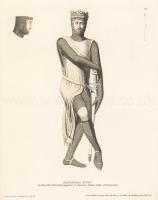
Effigy of Robert Duke of Normandy. Robert Duke of Normandy was the eldest son of [his father] William the First, King of England. He claimed the Dukedom of Normandy of his father during his lifetime, prosecuted a war against him on that account, unhorsed and wounded him, not knowing who he was, at the battle of Gerbrai. On discovering a mistake which might have involved him in the guilt of parricide, he made an humble submission to William, who was however implacable, and denounced a curse against him, to which Robert's subsequent misfortunes are attributed by the historians of the time. On his deathbed the King disinherited him of his claim of succession to the English crown, substituting his second surviving son, [his brother] William le Roux, Rufus, or the Red, in his room.

Kings Wessex: Great x 6 Grand Son of King Alfred "The Great" of Wessex
Kings England: Son of King William "Conqueror" I of England
Kings Franks: Great x 9 Grand Son of Charles "Charlemagne aka Great" King of the Franks King Lombardy Holy Roman Emperor
Kings France: Great x 2 Grand Son of Hugh I King of the Franks
Kings Duke Aquitaine: Great x 6 Grand Son of Ranulf I Duke Aquitaine
Great x 4 Grandfather: Rollo Duke Normandy 
Great x 3 Grandfather: William "Longsword" I Duke Normandy
Great x 4 Grandmother: Poppa Unknown Duchess Normandy
Great x 2 Grandfather: Richard "Fearless" Normandy I Duke Normandy
Great x 3 Grandmother: Sprota
Great x 1 Grandfather: Richard "Good" Normandy II Duke Normandy
Great x 3 Grandfather: Unknown Dane
Great x 2 Grandmother: Gunnora Countess Ponthieu
GrandFather: Robert "Magnificent" Normandy I Duke Normandy
Great x 4 Grandfather: Pascweten Vannes
Great x 3 Grandfather: Judicael Berengar Penthièvre I Count Rennes
Great x 2 Grandfather: Conan "Crooked" Penthièvre III Duke Brittany
Great x 1 Grandmother: Judith Penthièvre Duchess Normandy
Great x 4 Grandfather: Fulk "Good" Ingelger 2nd Count Anjou
Great x 3 Grandfather: Geoffrey "Greygown" Ingelger 1st Count Anjou
Great x 4 Grandmother: Gerberge Unknown Viscountess Anjou
Great x 2 Grandmother: Ermengarde Gerberga Ingelger Duchess Brittany
Great x 4 Grandfather: Robert Vermandois Count Meaux Count Châlons
Great x 3 Grandmother: Adele Vermandois Countess Anjou
Father: King William "Conqueror" I of England -2 x Great Grand Son of King William "Conqueror" I of England
Great x 1 Grandfather: Father of Beatrix and Herleva
GrandMother: Herleva of Falaise
Robert Curthose III Duke Normandy Son of King William "Conqueror" I of England
Great x 4 Grandfather: Arnulf "Great" I Count Flanders
Great x 3 Grandfather: Baldwin III Count Flanders
Great x 4 Grandmother: Adela Vermandois Countess Flanders
Great x 2 Grandfather: Arnulf II Count Flanders
Great x 4 Grandfather: Hermmann Billung Margrave Billung March
Great x 3 Grandmother: Matilda Billung Countess Flanders
Great x 4 Grandmother: Hildegard Westerburg Margrave Billung March
Great x 1 Grandfather: Baldwin "Bearded" IV Count Flanders
Great x 4 Grandfather: Adalbert I Margrave of Ivrea 
Great x 3 Grandfather: Berengar II King of Italy
Great x 2 Grandmother: Rozala of Italy
Great x 4 Grandfather: Boso Unknown Margrave Tuscany
Great x 3 Grandmother: Willa Bosonids Queen Consort Italy
GrandFather: Baldwin "The Good" V Count Flanders
Great x 3 Grandfather: Sigfried of Luxemburg Count of Ardennes
Great x 2 Grandfather: Frederick Luxemburg Ardennes
Great x 4 Grandfather: Eberhard IV Nordgau
Great x 3 Grandmother: Hedwig Nordgau
Great x 1 Grandmother: Ogive Luxemburg Countess Flanders
Great x 3 Grandfather: Heribert I Count Gleiberg Gleiburg
Great x 2 Grandmother: Ermentrude Gleiburg
Mother: Matilda Flanders Queen Consort England
Great x 4 Grandfather: Robert I King West Francia 
Great x 3 Grandfather: Hugh "Great" Capet Count Paris
Great x 4 Grandmother: Beatrice Vermandois
Great x 2 Grandfather: Hugh I King of the Franks
Great x 4 Grandfather: Henry "Fowler" I King East Francia
Great x 3 Grandmother: Hedwig Saxon Ottonian
Great x 4 Grandmother: Matilda Ringelheim Queen Consort East Francia
Great x 1 Grandfather: Robert "Pious" II King of the Franks
Great x 4 Grandfather: Ebles "Manzer aka Bastard" III Duke Aquitaine
Great x 3 Grandfather: William "Towhead" III Duke Aquitaine
Great x 2 Grandmother: Adelaide Poitiers Queen Consort France
Great x 4 Grandfather: Rollo Duke Normandy
Great x 3 Grandmother: Gerloc aka Adela Normandy Duchess Aquitaine
Great x 4 Grandmother: Poppa Unknown Duchess Normandy
GrandMother: Adela Capet Duchess Normandy
Great x 3 Grandfather: Boson II Count Arles
Great x 2 Grandfather: William "Liberator" Arles 1st Count Provence 1st Count Arles
Great x 1 Grandmother: Constance Arles Queen Consort France
Great x 4 Grandfather: Fulk "Red" Ingelger 1st Count Anjou
Great x 3 Grandfather: Fulk "Good" Ingelger 2nd Count Anjou
Great x 4 Grandmother: Roscille Loches Countess Anjou
Great x 2 Grandmother: Adelaide Blanche Ingelger Queen Consort West Francia
Great x 4 Grandfather: Ratburnus I Viscount of Vienne
Great x 3 Grandmother: Gerberge Unknown Viscountess Anjou