All About History Books on Amazon

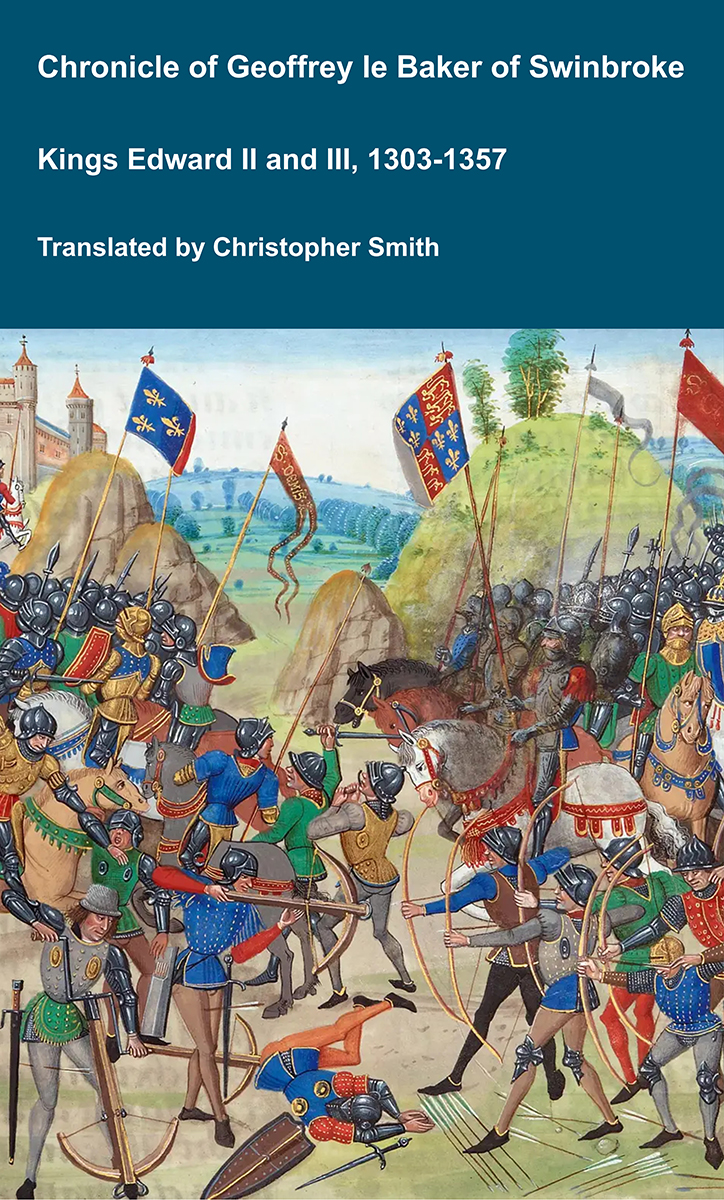
Chronicle of Geoffrey le Baker of Swinbroke

Baker was a secular clerk from Swinbroke, now Swinbrook, an Oxfordshire village two miles east of Burford. His Chronicle describes the events of the period 1303-1356: Gaveston, Bannockburn, Boroughbridge, the murder of King Edward II, the Scottish Wars, Sluys, Crécy, the Black Death, Winchelsea and Poitiers. To quote Herbert Bruce 'it possesses a vigorous and characteristic style, and its value for particular events between 1303 and 1356 has been recognised by its editor and by subsequent writers'. The book provides remarkable detail about the events it describes. Baker's text has been augmented with hundreds of notes, including extracts from other contemporary chronicles, such as the Annales Londonienses, Annales Paulini, Murimuth, Lanercost, Avesbury, Guisborough and Froissart to enrich the reader's understanding. The translation takes as its source the 'Chronicon Galfridi le Baker de Swynebroke' published in 1889, edited by Edward Maunde Thompson.

Available at Amazon in eBook and Paperback format.

John Giffard 2nd Baron Giffard Brimpsfield 1287-1322

Paternal Family Tree: Giffard

After January 1257 [his father] John Giffard 1st Baron Giffard Brimpsfield [aged 25] and Maud Clifford [aged 23] were married.

On 24th June 1287 John Giffard 2nd Baron Giffard Brimpsfield was born to John Giffard 1st Baron Giffard Brimpsfield [aged 55] and Margaret Belet [aged 32].

Around 28th February 1292 [his future brother-in-law] Hugh Courtenay 1st or 9th Earl Devon [aged 15] and Agnes St John Countess Devon [aged 17] were married. She by marriage Baroness Okehampton.

On 29th May 1299 [his father] John Giffard 1st Baron Giffard Brimpsfield [aged 67] died at his home in Boyton, Wiltshire [Map]. His son John [aged 11] succeeded 2nd Baron Giffard Brimpsfield. [his future wife] Aveline Courtenay Baroness Giffard Brimpsfield [aged 18] by marriage Baroness Giffard Brimpsfield.

On 16th March 1322 the rebel army led by Thomas Plantagenet 2nd Earl of Leicester, 2nd Earl Lancaster, Earl of Salisbury and Lincoln [aged 44] attempted to cross the bridge over the River Ure (between Ripon and York) at Boroughbridge Bridge [Map]. Their path was blocked by forces loyal to the King led by Andrew Harclay 1st Earl Carlisle [aged 52]. Bartholomew Badlesmere 1st Baron Badlesmere [aged 46], Roger Mortimer 1st Earl March [aged 34], John Botetort 1st Baron Botetort [aged 57] and John Maltravers 1st Baron Maltravers [aged 32] fought for the rebels. Roger Clifford 2nd Baron Clifford [aged 22], Nicholas Longford [aged 37], Thomas Plantagenet 2nd Earl of Leicester, 2nd Earl Lancaster, Earl of Salisbury and Lincoln, John Mowbray 2nd Baron Mowbray [aged 35] were captured.

Warin Lisle [aged 51] was hanged after the battle at Pontefract [Map].

Following the battle Hugh Audley 1st Earl Gloucester [aged 31] and his wife Margaret Clare Countess Gloucester were both imprisoned. He in Nottingham Castle [Map] and she in Sempringham Priory [Map].

John Clinton 2nd Baron Clinton [aged 22], Ralph Greystoke 1st Baron Greystoke [aged 22], William Latimer 2nd Baron Latimer of Corby [aged 46], Robert Lisle 1st Baron Lisle [aged 34], Domhnall Mar II Earl of Mar [aged 29] and Peter Saltmarsh [aged 42] fought for the King.

Adam Everingham 1st Baron Everingham of Laxton [aged 43] was captured.

Humphrey Bohun 4th Earl Hereford 3rd Earl Essex [aged 46] was killed. His son John [aged 15] succeeded 5th Earl Hereford, 4th Earl Essex.

Piers Grandison 2nd Baron Grandison [aged 31] fough for the rebels, and was captured.

Hugh Audley 1st Baron Audley of Stratton Audley [aged 55] surrendered before the battle and was imprisoned in Wallingford Castle [Map] for the rest of his life

John Giffard 2nd Baron Giffard Brimpsfield [aged 34] was captured.

Roger Mortimer 1st Earl March was imprisoned at Tower of London [Map].

Click to read more ...

Life of Edward II of Caernarfon by a Monk of Bridlington. Likewise, at Gloucester, Lord John Giffard [aged 34], because he had, against his oath of fealty, homage, and allegiance, treacherously seized the town and castle of Gloucester, as well as burned the town of Bridgnorth and destroyed its bridge, committing plunder, murder, and felonies, and then, leading an armed force, marched hostilely against the royal castle of Tickhill, which he besieged along with many others, and later at Burton and Pontefract resisted the lord king, fighting with his own vassals under unfurled banners for these offenses, by the royal record, as stated above, he, along with Lord Roger Elmbridge, was drawn and hanged, as his crimes demanded. Whoever wishes to read or hear the full record and process pronounced against the aforementioned lords, may find it in another book among the chronicles, where it is entirely contained, as presented above in the trial; in which the names of the lords and other knights captured for the aforementioned rebellion are listed, as well as the places where they suffered the penalty of death. There is also recorded the testimony of a certain John de Denome, within the aforementioned process, concerning what he declared on behalf of the said earls to Robert the Bruce and the Scots, regarding a proposed confederation and alliance with them. This last part I do not affirm as true, nor do I know whether it is or not. God knows.

Item apud Gloucestriam dominus Johannes Giffarde, quia contra fidelitatem, homagium et ligiantiam suam, per proditionem cepit villam et castrum domini regis Gloucestriæ, nec non villam de Briggenorth succendit et pontem fregit, ibique fecit prædationes, homicidium, et felonias, et exinde patrias spoliando vi et armis usque castrumn domini regis de Tykhille hostiliter processit, quod cum aliis pluribus obsedit, et postea apud Birtone et Pontemburgi domino regi restitit, et cum suis ligiis, vexillis explicatis, dimicavit, per regis recordum, ut prædicitur, una cum domino Rogero Elmorigge trahitur et suspenditur, exigentibus demeritis supradictis. Qui vero voluerit totum recordum et processum, contra prædictos dominos factum et pronuntiatum, legere vel audire, in alio libro inter incidentia chronicorum totaliter poterit invenire, sicut in judicio superius est ostensum; in quo nomina dominorum et aliorum militum, qui propter præfatam rebellionem capiebantur, reperiet, et loca in quibus mortis supplicium sunt perpessi. Ibidemque continetur credentia cujusdamn Johannis de Denome infra prædictum processum scripta, ex parte predictorum comitum Roberto de Bruys et Scotis exponenda, super confœderatione et alligatione facienda cum eisdem. Istud ultimum non affirmo, sed an sit verum nec ne nescio. Deus novit.

Click to read more ...
In or before May 1322 John Giffard 2nd Baron Giffard Brimpsfield [aged 34] was executed by King Edward II of England [aged 38]. Baron Giffard Brimpsfield forfeit.

Around April 1322 John Giffard 2nd Baron Giffard Brimpsfield [aged 34] and Aveline Courtenay Baroness Giffard Brimpsfield [aged 41] were married.

On 27th April 1327 [his former wife] Aveline Courtenay Baroness Giffard Brimpsfield [aged 46] died.

[his father] John Giffard 1st Baron Giffard Brimpsfield and [his mother] Margaret Belet were married. The difference in their ages was 23 years.

All About History Books on Amazon

The History of William Marshal, Earl of Chepstow and Pembroke, Regent of England. Book 1 of 2, Lines 1-10152.

The History of William Marshal was commissioned by his son shortly after William’s death in 1219 to celebrate the Marshal’s remarkable life; it is an authentic, contemporary voice. The manuscript was discovered in 1861 by French historian Paul Meyer. Meyer published the manuscript in its original Anglo-French in 1891 in two books. This book is a line by line translation of the first of Meyer’s books; lines 1-10152. Book 1 of the History begins in 1139 and ends in 1194. It describes the events of the Anarchy, the role of William’s father John, John’s marriages, William’s childhood, his role as a hostage at the siege of Newbury, his injury and imprisonment in Poitou where he met Eleanor of Aquitaine and his life as a knight errant. It continues with the accusation against him of an improper relationship with Margaret, wife of Henry the Young King, his exile, and return, the death of Henry the Young King, the rebellion of Richard, the future King Richard I, war with France, the death of King Henry II, and the capture of King Richard, and the rebellion of John, the future King John. It ends with the release of King Richard and the death of John Marshal.

Available at Amazon in eBook and Paperback format.

John Neville and [his mother] Margaret Belet were married.

Ancestors of John Giffard 2nd Baron Giffard Brimpsfield 1287-1322

Great x 4 Grandfather: Osberne Giffard

Great x 3 Grandfather: Elias Giffard

Great x 2 Grandfather: Elias "The Boy" Giffard

Great x 1 Grandfather: Elias Giffard

Grandfather: Elias Giffard

Great x 4 Grandfather: Harding Fitzharding

Great x 3 Grandfather: Robert Fitzharding 1st Baron Berkeley

Great x 4 Grandmother: Lavinda Unknown

Great x 2 Grandfather: Maurice Fitzharding aka Berkeley 2nd Baron Berkeley

Great x 3 Grandmother: Eva Unknown Baroness Berkeley

Great x 1 Grandmother: Maud Berkeley

Great x 4 Grandfather: William Berkeley

Great x 3 Grandfather: Roger Berkeley

Great x 2 Grandmother: Alice Berkeley Baroness Berkeley

Father: John Giffard 1st Baron Giffard Brimpsfield

Great x 1 Grandfather: John Maltravers

Grandmother: Alicia Maltravers

John Giffard 2nd Baron Giffard Brimpsfield

Great x 1 Grandfather: Ralph Belet

Grandfather: Ralph Belet

Mother: Margaret Belet