All About History Books on Amazon

Chronicles of the Reigns of Edward I and II Volume 2

The Chronicles of the Reigns of Edward I and Edward II, Volume 2, comprising A Sorrowful Commendation on King Edward, the Life of Edward II by a Monk of Bridlington, Life of Edward II by a Monk of Malmesbury and Life of Edward by Thomas de la More, presents a rich collection of medieval English chronicles illuminating the political, military, ecclesiastical and social upheavals of the late thirteenth and early fourteenth centuries. The volume offers contemporary and near-contemporary accounts of the reigns of Edward I and Edward II, a period marked by war with Scotland, conflict between Crown and nobility, disputes over royal government, ecclesiastical tensions, rebellion, deposition and civil violence. Particular attention is given to the struggle surrounding Piers Gaveston, Thomas of Lancaster and the Despensers, as well as the turbulent final years of Edward II and the political circumstances that shaped the early reign of Edward III. These chronicles are especially valuable for their vivid narrative detail. They preserve speeches, political arguments, descriptions of battles and executions, accounts of parliaments and royal councils, reports of diplomatic missions, ecclesiastical controversies, prodigies and natural events, and contemporary judgements on the conduct of kings, magnates and churchmen. Written from differing institutional and regional perspectives, the texts reveal not only what happened but how medieval observers interpreted events, often through ideas of divine judgement, legitimate kingship, loyalty, treason and moral retribution. An important primary-source collection for readers interested in Edward I, Edward II, medieval politics, the Scottish wars, the baronial opposition, the fall of Edward II, church history and fourteenth-century England, Volume 2 provides an indispensable window into one of the most turbulent periods of the English Middle Ages.

Available at Amazon in eBook and Paperback format.

King Ecgberht I of Kent -673

Paternal Family Tree: Oisingas

King Ecgberht I of Kent was born to King Eorcenberht of Kent and Seaxburh Wuffingas Queen Consort Kent.

Anglo-Saxon Chronicle. 664. This year the sun was eclipsed, on the eleventh of May; and [his father] Erkenbert, King of Kent, having died, Egbert his son succeeded to the kingdom. Colman with his companions this year returned to his own country. This same year there was a great plague in the island Britain, in which died Bishop Tuda, who was buried at Wayleigh-Chad and Wilferth were consecrated-And Archbishop Deus-dedit died.

Bede. 664. Deusdedit, Archbishop Of Canterbury, Dying, Wighard was sent to Rome to succeed him in that dignity; But he dying there, Theodore was ordained Archbishop, and sent into Britain with the Abbot Hadrian.

In the above-mentioned year of the aforesaid eclipse, which was presently followed by the pestilence, in which also Bishop Colman, being overcome by the unanimous consent of the Catholics, returned home, Deusdedit, the sixth bishop of the church of Canterbury, died on the 14th of July. [his father] Erconbert, also, king of Kent, departed this life the same month and day; leaving his kingdom to his son Egbert, which he held nine years. The see then became vacant for some considerable time, until the priest Wighard, a man skilled in ecclesiastical discipline, of the English race, was sent to Rome by the said King Egbert, and Oswy, king of the Northumbrians, as was briefly mentioned in the foregoing book, with a request that he might be ordained bishop of the church of England; sending at the same time presents to the apostolic pope, and many vessels of gold and silver. Arriving at Rome, where Vitalian presided at that time over the Apostolic See, and having made known to the aforesaid pope the occasion of his journey, he was not long after snatched away, with almost all his companions that went with him, by a pestilence which happened at that time.

On 14th July 664 [his father] King Eorcenberht of Kent died. His son Ecgberht succeeded I King of Kent.

Before 14th July 664 [his father] King Eorcenberht of Kent and [his mother] Seaxburh Wuffingas Queen Consort Kent were married. She the daughter of [his grandfather] King Anna of East Anglia. He the son of King Eadbald of Kent and Emma Austrasia Queen Consort Kent.

Anglo-Saxon Chronicle. 667. This year Oswy [aged 55] and Egbert sent Wighard, a priest, to Rome, that he might be consecrated there Archbishop of Canterbury; but he died as soon as he came thither.

Anglo-Saxon Chronicle. 669. This year King Egbert gave to Bass, a mass-priest, Reculver [Map] - to build a minster upon.

Around 670 [his son] King Wihtred of Kent was born to King Ecgberht I of Kent.

Anglo-Saxon Chronicle. 673. This year died Egbert, King of Kent; and the same year there was a synod at Hertford [Map]; and [his aunt] St. Etheldritha [aged 37] began that monastery at Ely [Map].

On 4th July 673 King Ecgberht I of Kent died. His son Eadric succeeded King of Kent.

All About History Books on Amazon

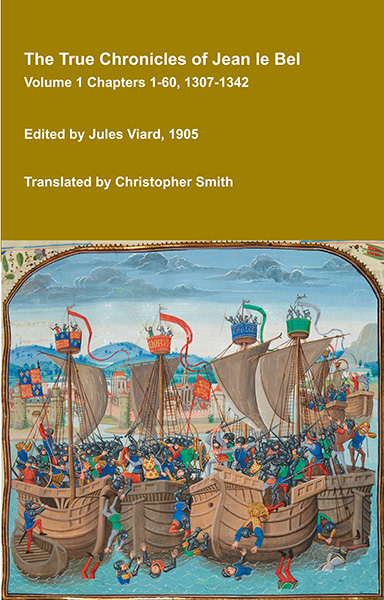
The True Chronicles of Jean le Bel Volume 1 Chapters 1-60 1307-1342

The True Chronicles of Jean le Bel offer one of the most vivid and immediate accounts of 14th-century Europe, written by a knight who lived through the events he describes, and experienced some of them first hand. Covering the early decades of the Hundred Years’ War, this remarkable chronicle follows the campaigns of Edward III of England, the politics of France and the Low Countries, and the shifting alliances that shaped medieval warfare. Unlike later historians, Jean le Bel writes with a strong sense of eyewitness authenticity, drawing on personal experience and the testimony of fellow soldiers. His narrative captures not only battles and sieges, but also the realities of military life, diplomacy, and the ideals of chivalry that governed noble society. A key source for Jean Froissart, Le Bel’s chronicle stands on its own as a compelling and insightful work, at once historical record and literary achievement. This translation builds on the 1905 edition published in French by Jules Viard, adding extensive translations from other sources Rymer's Fœdera, the Chronicles of Adam Murimuth, William Nangis, Walter of Guisborough, a Bourgeois of Valenciennes, Geoffrey le Baker of Swinbroke and Richard Lescot to enrich the original text and Viard's notes.

Available at Amazon in eBook and Paperback format.

[his son] King Eadric of Kent was born to King Ecgberht I of Kent.

Bede. They proceeded by sea to Marseilles, and thence by land to Arles, and having there delivered to John, archbishop of that city, Pope Vitalian's letters of recommendation, were by him detained till Ebrin, the king's mayor of the palace, sent them a pass to go where they pleased. Having received the same, Theodore repaired to Agilbert, bishop of Paris, of whom we have spoken above, and was by him kindly received, and long entertained. But Hadrian went first to Emme, and then to Faro, bishops of Sens and Meaux, and lived with them a considerable time; for the hard winter had obliged them to rest wherever they could. King Egbert, being informed by messengers that the bishop they had asked of the Roman prelate was in the kingdom of France, sent thither his prefect, Redfrid, to conduct him; who, being arrived there, with Ebrin's leave, conveyed him to the port of Quentavic; where, being indisposed, he made some stay, and as soon as he began to recover, sailed over into Britain. But Ebrin detained Hadrian, suspecting that he went on some message from the emperor to the kings of Britain, to the prejudice of the kingdom, of which he at that time took especial care; however, when he found that he really had no such commission, he discharged him, and permitted him to follow Theodore. As soon as he came, he received from him the monastery of St. Peter the apostle [Map], where the archbishops of Canterbury are usually buried, as I have said before; for at his departure, the apostolic lord had ordered that he should provide for him in his diocese, and give him a suitable place to live in with his followers.

Bede. This synod was held in the year from the incarnation of our Lord 673. In which year, Egbert, king of Kent, died in the month of July; his brother Lothere succeeded him on the throne, which he had held eleven years and seven months. Bisi, the bishop of the East Angles, who is said to have been in the aforesaid synod, was successor to Boniface, before spoken of, a man of much sanctity and religion; for when Boniface died, after having been bishop seventeen years, he was by Theodore substituted in his place. Whilst he was still alive, but hindered by much sickness from administering his episcopal functions, two bishops, Ecci and Badwin, were elected and consecrated in his place; from which time to the present, that province has had two bishops.

King Ecgberht I of Kent appears on the following Descendants Family Trees:

Royal Descendants of King Ecgberht I of Kent -673
Number after indicates the number of unique routes of descent. Descendants of Kings and Queens not included.

King Eadric of Kent [1]

King Wihtred of Kent [1]

Ancestors of King Ecgberht I of Kent -673

Great x 3 Grandfather: Octa King of Kent

Great x 2 Grandfather: Eormenric King of Kent

Great x 1 Grandfather: King Æthelberht of Kent

Grandfather: King Eadbald of Kent

Great x 1 Grandmother: Bertha Merovingian Queen Consort Kent

Great x 2 Grandmother: Ingoberga Unknown Queen Consort Paris

Father: King Eorcenberht of Kent

King Ecgberht I of Kent

Great x 4 Grandfather: Wehha Wuffingas

Great x 3 Grandfather: Wuffa King East Anglia

Great x 2 Grandfather: Tytila King East Anglia

Great x 1 Grandfather: Eni Wuffingas

Grandfather: King Anna of East Anglia

Mother: Seaxburh Wuffingas Queen Consort Kent