All About History Books on Amazon

Chronicle of the Abbey of Evesham

The Chronicle of the Abbey of Evesham is a remarkable medieval history of one of England’s great Benedictine monasteries. Beginning with the abbey’s legendary and royal foundations, it traces the fortunes of Evesham through centuries of religious devotion, political conflict, legal struggle, rebuilding, reform, and royal patronage. At the heart of the chronicle is the abbey’s determination to defend its ancient liberties. Its monks record disputes with bishops, appeals to popes and papal legates, contested elections of abbots, lawsuits over lands and privileges, and the long struggle to preserve Evesham’s exemption from episcopal control. Alongside these institutional battles are vivid accounts of saints and miracles, including St Ecgwine, St Odulf and the royal martyr St Wistan, whose relics and cult formed an important part of the abbey’s identity. The chronicle also preserves a wealth of detail about everyday monastic life. It describes the building and repair of churches, cloisters, chapels, halls, mills, granges and fishponds; the acquisition of estates and revenues; the making of vestments, shrines, bells and liturgical books; and the provision of food, clothing, recreation and medical care for the monks. Successive abbots emerge not merely as religious superiors but as administrators, builders, patrons, diplomats and defenders of the community. Extending into the later Middle Ages, the narrative reflects the changing political world around Evesham, from the Norman Conquest and the Angevin kings to the Wars of the Roses and the reign of Henry VIII. The result is both a history of a single monastery and a richly detailed record of medieval English religious, legal, economic and political life. This edition offers modern readers direct access to one of the most important monastic chronicles of medieval England, revealing how the monks of Evesham understood their saints, their privileges, their rulers and their place in history.

Available at Amazon in eBook and Paperback format.

Stanton Harcourt, Oxfordshire, South-Central England, British Isles [Map]

Stanton Harcourt, Oxfordshire is in Oxfordshire.

Around 1203 Richard Harcourt was born to William Harcourt [aged 28] at Stanton Harcourt, Oxfordshire [Map]. He married Arabella Quincy, daughter of Saer Quincy 1st Earl Winchester and Margaret Beaumont Countess Winchester, and had issue.

Around 1204 Robert de Harcourt [aged 52] died at Stanton Harcourt, Oxfordshire [Map].

Around 1227 William Harcourt was born to Richard Harcourt [aged 24] and Arabella Quincy [aged 41] at Stanton Harcourt, Oxfordshire [Map]. He married 1. Alice Zouche and had issue 2. his half third cousin once removed Hilaria or Eleanor Hastings and had issue 3. Isabel Mansel.

On 9th December 1256 Richard Harcourt was born to William Harcourt [aged 29] and Hilaria or Eleanor Hastings [aged 23] at Stanton Harcourt, Oxfordshire [Map]. He married 1. Joan Unknown 2. Margaret Beke, daughter of John Beke 1st Baron Beke and Sarah Furnival, and had issue.

Around 1258 Arabella Quincy [aged 72] died at Stanton Harcourt, Oxfordshire [Map].

On 1st November 1275 John Harcourt was born to Richard Harcourt [aged 18] and Margaret Beke [aged 19] at Stanton Harcourt, Oxfordshire [Map]. He married 1. 1299 his sixth cousin Eleanor Zouche and had issue 2. after 1320 Alice Corbet.

On 19th April 1278 William Harcourt [aged 51] died at Stanton Harcourt, Oxfordshire [Map].

Before 1st March 1293 Richard Harcourt [aged 36] died at Stanton Harcourt, Oxfordshire [Map].

Around 1300 Eleanor Zouche [aged 27] died at Stanton Harcourt, Oxfordshire [Map].

All About History Books on Amazon

Deeds of King Henry V

Henrici Quinti, Angliæ Regis, Gesta, is a first-hand account of the Agincourt Campaign, and subsequent events to his death in 1422. The author of the first part was a Chaplain in King Henry's retinue who was present from King Henry's departure at Southampton in 1415, at the siege of Harfleur, the battle of Agincourt, and the celebrations on King Henry's return to London. The second part, by another writer, relates the events that took place including the negotiations at Troye, Henry's marriage and his death in 1422.

Available at Amazon in eBook and Paperback format.

In 1300 William Harcourt was born to John Harcourt [aged 24] and Eleanor Zouche [aged 27] at Stanton Harcourt, Oxfordshire [Map]. He married his fourth cousin once removed Joan Grey, daughter of Richard Grey 2nd Baron Grey of Codnor and Joan Fitzpayn Baroness Grey Codnor, and had issue.

Around 1303 Margaret Beke [aged 47] died at Stanton Harcourt, Oxfordshire [Map].

On 2nd May 1330 John Harcourt [aged 54] died at Stanton Harcourt, Oxfordshire [Map].

On 6th June 1349 William Harcourt [aged 49] died of plague at Stanton Harcourt, Oxfordshire [Map].

On 29th January 1394 Maud Grey [aged 66] died at Stanton Harcourt, Oxfordshire [Map]\. She was buried at Stanton Harcourt, Oxfordshire [Map].

On 20th September 1410 Robert Harcourt was born to Thomas Harcourt [aged 33] at Stanton Harcourt, Oxfordshire [Map]. He married before 1440 Margaret Byron and had issue.

On 1st February 1416 Richard Harcourt was born to Thomas Harcourt [aged 39] and Joan Francis [aged 33] at Stanton Harcourt, Oxfordshire [Map].

On 6th July 1420 Thomas Harcourt [aged 43] died at Stanton Harcourt, Oxfordshire [Map].

Around 1440 John Harcourt was born to Robert Harcourt [aged 29] and Margaret Byron [aged 28] at Stanton Harcourt, Oxfordshire [Map]. He married Anne Norreys and had issue.

Around 1443 Robert Harcourt was born to Robert Harcourt [aged 32] and Margaret Byron [aged 31] at Stanton Harcourt, Oxfordshire [Map].

Around 1444 Christopher Harcourt was born to Richard Harcourt [aged 27] at Stanton Harcourt, Oxfordshire [Map].

Around 1445 Thomas Harcourt was born to Robert Harcourt [aged 34] and Margaret Byron [aged 33] at Stanton Harcourt, Oxfordshire [Map].

All About History Books on Amazon

The True Chronicles of Jean le Bel Volume 1 Chapters 1-60 1307-1342

The True Chronicles of Jean le Bel offer one of the most vivid and immediate accounts of 14th-century Europe, written by a knight who lived through the events he describes, and experienced some of them first hand. Covering the early decades of the Hundred Years’ War, this remarkable chronicle follows the campaigns of Edward III of England, the politics of France and the Low Countries, and the shifting alliances that shaped medieval warfare. Unlike later historians, Jean le Bel writes with a strong sense of eyewitness authenticity, drawing on personal experience and the testimony of fellow soldiers. His narrative captures not only battles and sieges, but also the realities of military life, diplomacy, and the ideals of chivalry that governed noble society. A key source for Jean Froissart, Le Bel’s chronicle stands on its own as a compelling and insightful work, at once historical record and literary achievement. This translation builds on the 1905 edition published in French by Jules Viard, adding extensive translations from other sources Rymer's Fœdera, the Chronicles of Adam Murimuth, William Nangis, Walter of Guisborough, a Bourgeois of Valenciennes, Geoffrey le Baker of Swinbroke and Richard Lescot to enrich the original text and Viard's notes.

Available at Amazon in eBook and Paperback format.
Around 1447 George Harcourt was born to Robert Harcourt [aged 36] and Margaret Byron [aged 35] at Stanton Harcourt, Oxfordshire [Map].

Around 1470 Letitia Harcourt was born to John Harcourt [aged 30] and Anne Norreys [aged 20] at Stanton Harcourt, Oxfordshire [Map]. She married Thomas Neville.

On 14th November 1470 Robert Harcourt [aged 60] was killed by an adherent of the Staffords with whom he had a long running feud for Robert having murdered Robert Stafford in 1448 at Stanton Harcourt, Oxfordshire [Map].

In 1474 Christopher Harcourt [aged 30] died at Stanton Harcourt, Oxfordshire [Map].

On 25th May 1486 Margaret Byron [aged 74] died at Stanton Harcourt, Oxfordshire [Map]. She was buried at Stanton Harcourt, Oxfordshire [Map].

Around 1500 Simon Harcourt was born to Simon Harcourt [aged 28] in Stanton Harcourt, Oxfordshire [Map].

Around 1517 Simon Harcourt was born to Simon Harcourt [aged 17] at Stanton Harcourt, Oxfordshire [Map]. He married 1. 1545 Mary Aston and had issue 2. after 1562 Grace Fitzherbert 3. after 1563 Jane Spencer.

On 16th January 1546 Simon Harcourt [aged 74] died in Stanton Harcourt, Oxfordshire [Map].

Around 1553 Walter Harcourt was born to Simon Harcourt [aged 36] and Mary Aston [aged 23] in Stanton Harcourt, Oxfordshire [Map].

On 19th February 1566 Simon Harcourt [aged 66] died in Stanton Harcourt, Oxfordshire [Map].

On 25th July 1577 Simon Harcourt [aged 60] died at Stanton Harcourt, Oxfordshire [Map].

In 1603 Simon Harcourt was born to Robert Harcourt [aged 29] in Stanton Harcourt, Oxfordshire [Map]. He married before 1652 Anne Paget, daughter of William Paget 4th Baron Paget Beaudasert and Lettice Knollys Baroness Geneville Beaudasert.

In 2nd February 1608 Robert Harcourt [aged 34] died in Stanton Harcourt, Oxfordshire [Map].

In 1616 George Cornwall [aged 70] died at Stanton Harcourt, Oxfordshire [Map].

Around 1639 Walter Harcourt [aged 86] died in Stanton Harcourt, Oxfordshire [Map].

In December 1661 Simon Harcourt 1st Viscount Harcourt was born to Philip Harcourt [aged 24] in Stanton Harcourt, Oxfordshire [Map]. He married 30th September 1724 Elizabeth Vernon Viscountess Harcourt.

On 20th March 1688 Philip Harcourt [aged 51] died at Stanton Harcourt, Oxfordshire [Map].

Around January 1699 Elizabeth Evelyn died at Stanton Harcourt, Oxfordshire [Map].

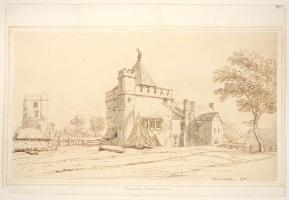
1792. Joseph Farington [aged 44]. Stanton Harcourt, Oxfordshire [Map].

Time Team Series 3 Episode 2: Hunting for Mammoth was filmed between 21st April 1995 and 23rd April 1995. It was originally shown on 14th January 1996.

Location: Stanton Harcourt, Oxfordshire [Map].

All About History Books on Amazon

The True Chronicles of Jean le Bel Volume 2 Chapters 61-109 1342-1361

The Chronicle of Jean le Bel, Volume 2 continues one of the most important fourteenth-century accounts of the early Hundred Years’ War. Written by the Liège chronicler Jean le Bel, this vivid narrative follows the fortunes of Edward III, Jean II of France, the Black Prince, the great nobles of France and England, and the soldiers, captains and companies who shaped the conflict. This volume covers some of the most dramatic events of the period, including the battles of Crécy and Poitiers, the siege and capture of Calais, the captivity of King John, the rise of the Jacquerie, the turmoil in Paris under Étienne Marcel and Charles of Navarre, the devastation caused by the free companies, Edward III’s great campaign of 1359–1360, and the negotiations leading to the Treaty of Brétigny. Jean le Bel’s chronicle is especially valuable for its lively detail, its interest in chivalry, warfare, politics and reputation, and its influence on later chroniclers, most famously Froissart. This English translation presents the text in clear, readable British English while preserving the force and character of the original narrative. The translation includes extensive notes to help the reader better understand Jean le Bel's text. Volume 2 also includes translated appendices drawn from royal and administrative records, many from the English Record Office, which illuminate Edward III’s campaigns in Brittany, the siege and occupation of Calais, naval preparations, military finance, appointments, safe conducts and related affairs.

Available at Amazon in eBook and Paperback format.
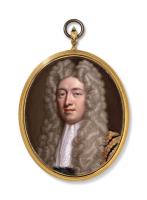
Alice Noel died at Stanton Harcourt, Oxfordshire [Map].

Devil's Quoits, Stanton Harcourt, Oxfordshire, South-Central England, British Isles [Map]

Devil's Quoits [Map]. The henge ditch enclosed a circular area up to 120 metres across, with opposed entrances facing almost due east and west. The northern half of the henge appears to have had a second enclosing ditch circuit. Within the henge was a stone circle and a central stone setting which may have been put up after the henge had been in use for some time, in the Early Bronze Age. The Devil's Quoits were restored between 2002 and 2008, with the original quoits A, B, and C re-erected along with other conglomerate stones found at the site. Twenty new replacement stones were placed in the original holes for a total of 28 stones, and the surrounding earthworks re-built.

Folklore 13 1902 Pages 288-295. The Devil's Quoits [Map] at Stanton Harcourt are three large standing stones, which are all that remain of what was probably a circle considerably larger than that at Avebury, and which doubtless gave their name to the neighbouring village (Stanton = A.S. Stántún, the stone enclosure).1 Beacon Hill is a very conspicuous landmark, just above Eynsham Bridge, on the Berkshire side of the Thames, about two and a half miles in a straight line from the "Quoits." It is very steeply scarped on three sides, and it has been suggested that it was the British fortress of Egonesham, captured by the Saxons under Cuthwulf in 571."2

The devil was playing quoits on Beacon Hill on a Sunday, and in a rage at being told it was wrong, he threw these three to where they are now.

One of the quoits standing in Walker's Field was once taken away, and put over a ditch called the "Back Ditch" in the "Farm Close" to make a bridge ; but it was always slipping, and although often put back, it would not rest, and they were obliged at last to take it back to where it now stands. Wheel marks can still be seen on it. — (From Chas. Batts, labourer, of Stanton Harcourt, aged 35, who had it from his father. January i, 1898.)

Mr. Akerman,3 in 1858, records a rationalised version of the same story, as follows : "There is a tradition in the neighbourhood that the northernmost stone was once removed by an occupier of the land, and laid across a watercourse, where it served as a bridge over which waggons and carts for some time passed, and that it was restored to its old locality at the request of one of the Harcourt family. A groove in this stone, eight inches from the top, seven inches in width, and about three inches deep, is believed to have been caused by the wheels of the vehicles when it lay prostrate."

Joseph Goodlake of Stanton Harcourt (now of Yarnton), aged 63, in March, 1901, gave me the following particulars which he had from his father: "When the war was in England, the fighting ended at Stanton by those stones, and from there across to Stanlake Down by Cut Mill. Harcourt was the general; he was Emperor in England; he is buried in the church with his sword and gun and clothes." Further : "When the war was in England the officers used to hide behind them" (the Devil's Quoits) "from the bullets," and the men used to pick the bullets out of them when my informant was young.

The legend connecting the Quoits with a battle is confirmed by a story told by Tom Hughes:4 "An old man in that village" (Stanton Harcourt) "told me that a battle was fought there, which the English were very near losing, when the general rode up to one of his captains, named Harcourt, who was in the thick of it, and called out, 'Stan' to un, Harcourt, stan' to un, Harcourt,' and that Harcourt won the battle, and the village has been called Stanton Harcourt ever since."

Note 1. J. Y. Akerman, "Ancient Limits of the Forest of Wychwood," Archaeologia, xxxvii., 430 ; A. J. Evans, "Rollright Stones and their Folklore," Folk-Lore, vi., 10.

Note 2. J. Parker, Early History of Oxford (Oxf. Hist. Soc), p. 81.

Note 3. Akerman, I.c. p. 431.

Note 4. T. Hughes, Scouring of the White Horse (1859), p. 32. There are several monuments to the Harcourt family in the church, the most conspicuous of which are two altar tombs with effigies in full armour ; one to Sir Robert Harcourt, K.G., and his wife Margaret, 1471, the other to his grandson, Sir Robert, who was Henry VH.'s standard-bearer at Bosworth, and died some time after 1501. One of these two is apparently assigned to "the general."

The story of the fighting may well have arisen from the numerous discoveries of British and Anglo-Saxon remains that have been made in the neighbourhood. A tumulus close to the "Quoits" was destroyed by the grandfather of the present farmer, and on Stanlake Down many Anglo-Saxon burials have been found.

Click to read more ...

St Michael's Church, Stanton Harcourt, Oxfordshire, South-Central England, British Isles

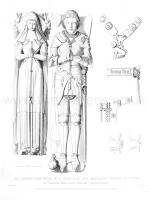
Monumental Effigies. Sir Robert Harcourt KG (died 1471) and Margaret (Byron) [aged 59] his wife in Stanton Harcourt Church, Oxfordshire.

Robert Harcourt: On 20th September 1410 he was born to Thomas Harcourt at Stanton Harcourt, Oxfordshire [Map]. Before 1440 he and Margaret Byron were married. On 14th November 1470 Robert Harcourt was killed by an adherent of the Staffords with whom he had a long running feud for Robert having murdered Robert Stafford in 1448 at Stanton Harcourt, Oxfordshire [Map].