

Chronicle of a Bourgeois of Valenciennes
Récits d’un bourgeois de Valenciennes aka The Chronicle of a Bourgeois of Valenciennes is a vivid 14th-century vernacular chronicle written by an anonymous urban chronicler from Valenciennes in the County of Hainaut. It survives in a manuscript that describes local and regional history from about 1253 to 1366, blending chronology, narrative episodes, and eyewitness-style accounts of political, military, and social events in medieval France, Flanders, and the Low Countries. The work begins with a chronological framework of events affecting Valenciennes and its region under rulers such as King Philip VI of France and the shifting allegiances of local nobility. It includes accounts of conflicts, sieges, diplomatic manoeuvres, and the impact of broader struggles like the Hundred Years’ War on urban life in Hainaut. Written from the perspective of a burgher (bourgeois) rather than a monastery or royal court, the chronicle offers a rare lay viewpoint on high politics and warfare, reflecting how merchants, townspeople, and civic institutions experienced the turbulence of the 13th and 14th centuries. Its narrative style combines straightforward reporting of events with moral and civic observations, making it a valuable source for readers interested in medieval urban society, regional politics, and the lived experience of war and governance in pre-modern Europe.
Available at Amazon in eBook and Paperback format.
In 1284 [his father] Reginald Cobham and [his mother] Joan Devereux were married. There is some confusion here as to which Joan Devereux he married since she was born six years after the supposed marriage?. The difference in their ages was 53 years.
Around 1295 Reginald Cobham 1st Baron Cobham was born to [his father] Reginald Cobham and [his mother] Joan Devereux at Sternborough, Kent.
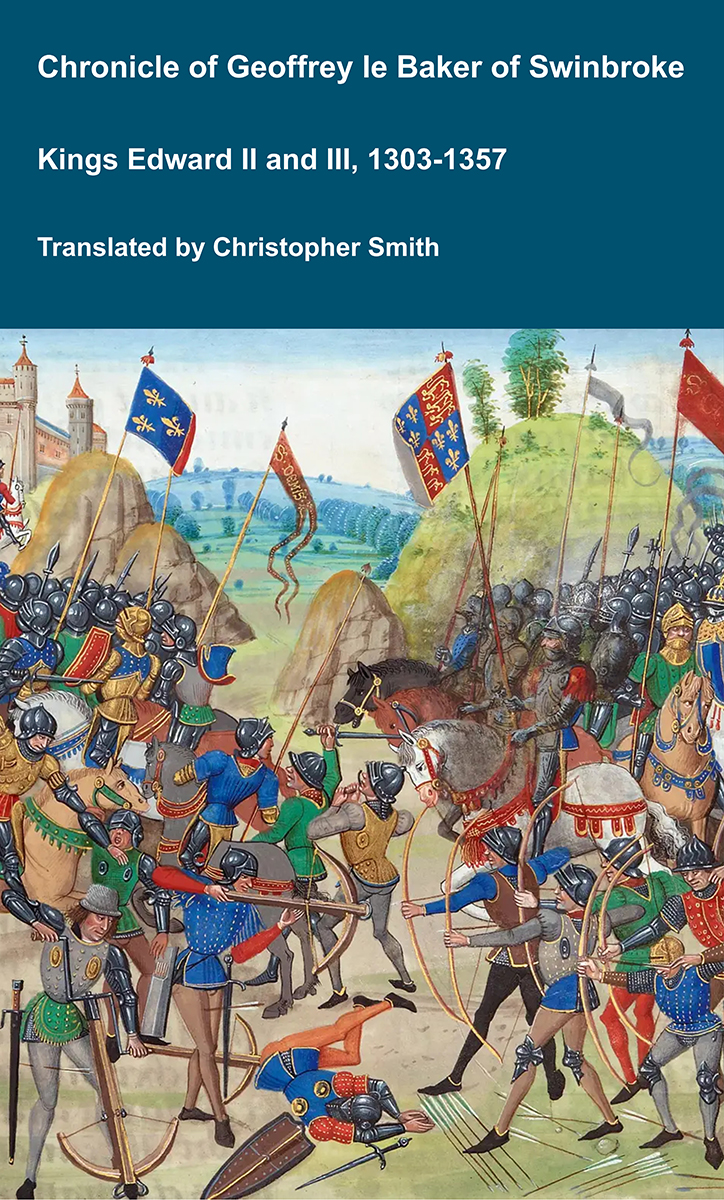 Chronicle of Geoffrey le Baker of Swinbroke. The king then, having returned to Flanders, came to Ghent for the feast of Saint Michael [29th September 1340], where he waited a long time for the confirmation of the truce and the arrival of money, which never came. Later, when all the English who were waiting in Ghent with the king thought that he would remain there until the feast of the Nativity of Christ, the king one day, pretending he wanted to go for a ride, secretly rode off with eight of his men, without informing any of his household. He came to Zeeland, where he found a ship.1 After sailing for three days and nights, on the night of Saint Andrew's day, around cockcrow, he entered the Tower of London by water. He was accompanied by the Earl of Northampton, Sir Nicholas de Cantilupe, Sir Reginald de Cobham, Sir Giles de Beauchamp, Sir John de Beauchamp, and the clerks William de Kyllesby and Philip de Weston.
Rex igitur ad Flandriam reversus venit Gandavum ad festum sancti Michaelis, ubi diu expectavit treuge confirmacionem et pecuniam adfuturam, que non venit. Postea, putantibus omnibus Anglicis expectantibus in Gandavo cum rege ipsum ibidem ad festum Nativitatis Christi expectaturum, una dierum rex cum octo de suis, fingens se velle spaciari, equitans secreto, nullisque familiaribus premunitis, venit Selandiam, ubi nacto navigio, post trium dierum et totidem noctium havigacionem, in nocte sancti Andree circa gallicantum turrim Londoniarum per aquam intravit, ipsum comitantibus comite Norhamptonie et domino Nicholao de Cantilupo, Reginaldo de Cobham, Egidio de Bello campo, Iohanne de Bello campo, militibus, et Willelmo de Kyllesby et Philippo de Westone, clericis.
Note 1. The Brute Chronicle [Egerton MS. 650].
In 1342 Reginald Cobham 1st Baron Cobham was created 1st Baron Cobham.
In 1344 Reginald Cobham 1st Baron Cobham and Joan Berkeley Baroness Cobham Sternborough were married at Lingfield, Surrey. The difference in their ages was 35 years.
In 1345 [his daughter] Joan Cobham was born to Reginald Cobham 1st Baron Cobham and [his wife] Joan Berkeley Baroness Cobham Sternborough. She married 13th April 1358 Henry Grey, son of John Grey 3rd Baron Grey of Codnor and Alice Lisle Baroness Grey Codnor, and had issue.
On 26th August 1346 the army of King Edward III of England defeated the French army at the Battle of Crécy. The English army was commanded by King Edward III of England, his son Edward "Black Prince", Thomas Beauchamp 11th Earl Warwick, William Bohun 1st Earl of Northampton and John Beauchamp 1st Baron Beauchamp Warwick.
The English army was included: Bishop Thomas of Hatfield, Hugh Despencer 1st Baron Despencer, Bernard Brocas, Thomas Felton, James Audley, Robert Bourchier 1st Baron Bourchier, Bartholomew "The Elder" Burghesh 1st Baron Burghesh, Bartholomew "The Younger" Burghesh 2nd Baron Burghesh, Reginald Cobham 1st Baron Cobham, John Darcy 1st Baron Darcy of Knayth, Robert Ferrers 3rd Baron Ferrers of Chartley, Richard Scrope 1st Baron Scrope of Bolton, William Scrope, Stephen Scrope, William Latimer 4th Baron Latimer of Corby, John Lisle 2nd Baron Lisle, Gerard Lisle 1st Baron Lisle, Nicholas Longford, Edward Montagu 1st Baron Montagu, Walter Paveley 4th Baron Burghesh, Michael Poynings 1st Baron Poynings, Robert Ufford 1st Earl Suffolk, John de Vere 7th Earl of Oxford, Thomas West, John Willoughby 2nd Baron Willoughby, John Wingfield, Henry Percy 11th and 3rd Baron Percy, Hugh Courtenay 2nd or 10th Earl Devon (possibly), Walter "Elder" Devereux, [his uncle] John Devereux, Enion Sais Brecon, John Chandos, Richard Pembridge and John Sully.
The French army suffered significant casualties. King Philip "Fortunate" VI of France was wounded. William de Coucy and his son Enguerrand 6th Lord de Coucy and were killed.
Charles II Count Alençon was killed. Charles Valois Archbishop of Lyons succeeded Count Alençon.
Louis Chatillon II Count Blois I Count Chatillon was killed. Louis Chatillon III Count Blois Count Soissons succeeded III Count Blois.
Louis Dampierre II Count Nevers I Count Flanders was killed. Louis of Male III Count Nevers II Count Flanders succeeded III Count Nevers, II Count Flanders.
King John I of Bohemia was killed. Charles IV King Bohemia Holy Roman Emperor Luxemburg succeeded IV King Bohemia, Holy Roman Emperor Luxemburg. Blanche Valois Holy Roman Empress Luxemburg by marriage Holy Roman Empress Luxemburg.
Rudolph "Valiant" Metz I Duke Lorraine was killed. John Metz I Duke Lorraine succeeded I Duke Lorraine.
Jean IV de Harcourt was killed.
On 8th June 1348 [his son] Reginald Cobham 2nd Baron Cobham was born to Reginald Cobham 1st Baron Cobham and [his wife] Joan Berkeley Baroness Cobham Sternborough. He married (1) 1368 Elizabeth Stafford Baroness Cobham, Ferrers and Strange, daughter of Ralph Stafford 1st Earl Stafford and Margaret Audley Countess Stafford (2) 1380 Eleanor Maltravers 2nd Baroness Maltravers Baroness Arundel and Cobham and had issue.
In 1353 Reginald Cobham 1st Baron Cobham was appointed Captain of Calais.
In 1353 Reginald Cobham 1st Baron Cobham was appointed 29th Knight of the Garter by King Edward III of England.
On 19th September 1356 the army of Edward "Black Prince" defeated the French and Scottish army led by King John "The Good" II of France at the Battle of Poitiers
King John "The Good" II of France was captured by three captains including Ivon aka John Fane.
The the English army included: Bernard Brocas, Thomas Felton, James Audley, Thomas Beauchamp 11th Earl Warwick, Bartholomew "The Younger" Burghesh 2nd Baron Burghesh, Reginald Cobham 1st Baron Cobham, Edward Despencer 1st Baron Despencer, Baron Burghesh, Ralph Ferrers, William Scrope, William Montagu 2nd Earl Salisbury, Walter Paveley 4th Baron Burghesh, Robert Ufford 1st Earl Suffolk, William Ufford 2nd Earl Suffolk, John de Vere 7th Earl of Oxford, John Willoughby 3rd Baron Willoughby, Thomas Arderne, Enion Sais Brecon, John Chandos, Richard Pembridge, Jean Grailly, Robert de Fouleshurst and John Sully
John Savile of Shelley and Golcar probably fought having received letters of protection to travel overseas.
Hugh Courtenay 2nd or 10th Earl Devon protected the baggage train.
The French and Scottish army included: King John "The Good" II of France, Philip "Bold" Valois II Duke Burgundy, Jean Bourbon I Count La Marche, Archibald "Grim" Douglas 3rd Earl Douglas, John "Sans Terre" Artois 1st Count of Eu; all captured.
Guichard d'Angle 1st Earl Huntingdon and William Douglas 1st Earl Douglas fought.
Peter Bourbon Duke Bourbon was killed. Louis Bourbon II Duke Bourbon succeeded II Duke Bourbon.
Gauthier VI Comte de Brienne was killed.
 Become a Member via our Buy Me a Coffee page to read more.
On 13th April 1358 [his son-in-law] Henry Grey and [his daughter] Joan Cobham were married at Sternborough, Kent.
On 5th October 1361 Reginald Cobham 1st Baron Cobham died of plague at Lingfield, Surrey. He was buried at Lingfield, Surrey. [his son] Reginald Cobham 2nd Baron Cobham succeeded 2nd Baron Cobham.
The most handsome and splendid man one could see anywhere in the world was the Earl of Northampton1 and of Gloucester. There too was the Earl of Warwick2, and the Earl of Salisbury, who was marshal of the host; with him were the Earl of Suffolk, the Baron of Stafford, Sir John, Viscount of Beaumont, and many other princes and banneret barons, and many more besides whose names I do not know. Yet one must not forget Sir Reginald of Cobham3, who was then and still is held to be the most valiant man of his country. Nor should I omit Sir Walter of Manny, who had performed so many deeds of arms and feats in Scotland and elsewhere that he had gained such favor with the king and with all the English, great and small, that the noble king had retained him in his most secret council and had granted and assigned him such great lands in England that he had become a banneret and maintained a greater estate than many bannerets who were there.
Le plus gent et le plus frique que on pouoit veoir ne trouver en nulle part du monde, ce fut le conte de Noireton et de Clocest; sy y estoit le conte de Warvich, le conte de Salbry, qui estoit mareschal de l'ost; et avecques luy fut le conte de Suffort, le baron de Staffort, messire Jehan, visconte de Beaumont, et pluseurs aultres princes et barons bannerès et plus que bannerès, et biacop d'aultres que je ne sçay nommer; mais on n'y doibt pas oublier messire Regnault de Cobaing, que on debvoit bien tenir pour le plus prœu de son pays adoncq, et encores fait on. Et sy n'y vueil pas oublier messire Watier de Manny, qui avoit tant fait d'armes et de proesses en Escoce et aultre part, que il avoit acquis si grand grace au roy et à tous les Anglois, grands et petis, que le noble roy l'avoit detenu de son plus secret conseil, et luy avoit donné et assigné si grande terre en Angleterre qu'il estoit devenus bannerès, et bien tenoit plus grand estat que bannerès qui là fust.
Note 1. William de Bohun, the younger son of Humphrey de Bohun and Elizabeth, daughter of Edward I of England, was created Earl of Northampton on 17 March 1337 (often dated 1336 in some reckonings, depending on the style of the year). He married Elizabeth de Badlesmere, widow of Edmund Mortimer, and died in September 1360. See concerning him Froissart, ed. Kervyn de Lettenhove, vol. XXII, pp. 293–295.
1. Guillaume de Bohun, fils puîné d'Humpbroi de Bohun et d'Élisabeth, fille d'Édouard III, roi d'Angleterre, fut créé comte de Northampton le 17 mars 1336. II épousa Élisabeth de Badlesmere, veuve d'Edmond de Mortimer, et mourut au mois de septembre 1360. Voy. sur lui Froissart, éd. Kervyn de Lettenhove, t. XXII, p. 293 à 295.
Note 2. Thomas de Beauchamp, Earl of Warwick, was the son of Guy de Beauchamp and Alice de Toeni. He married Katherine Mortimer, daughter of Roger Mortimer. He died of the plague on 13 November 1369. (Froissart, ed. Kervyn de Lettenhove, vol. XXIII, pp. 277–279.)
2. Thomas de Beauchamp, comte de Warwick, était fils de Gui, comte de Warwick, et d'Alice de Toény. Il avait épousé Catherine de Mortimer, fille de Roger de Mortimer. Il mourut de la peste le 13 novembre 1369. (Ibid., 1. X XIII, p. 277 à 279.)
Note 3. Reginald de Cobham was the son of John de Cobham and Joan Neville. He married Joan, daughter of Maurice de Berkeley. He died on 5 October 1361. (Froissart, ed. Kervyn de Lettenhove, vol. XXI, pp. 20–22.)
3. Renaud de Cobham était fils de Jean Cobham et de Jeanne Nevill. Il avait épousé Jeanne, fille de Maurice de Berkeley. II mourut le 5 octobre 1361. (Froissart, éd. Kervyn de Lettenhove, t. XXI, p. 20 à 22.)
Become a Member via our Buy Me a Coffee page to read more.