


26th August 1346 Battle of Crécy is in 1340-1349 Plague and Crecy.
On 26th August 1346 the army of King Edward III of England (age 33) defeated the French army at the Battle of Crécy. The English army was commanded by King Edward III of England, his son Edward "Black Prince" (age 16), Thomas Beauchamp 11th Earl Warwick (age 33), William Bohun 1st Earl of Northampton (age 36) and John Beauchamp 1st Baron Beauchamp Warwick (age 30).
The English army was included: Bishop Thomas of Hatfield (age 36), Hugh Despencer 1st Baron Despencer (age 38), Bernard Brocas (age 16), Thomas Felton (age 16), James Audley (age 28), Robert Bourchier 1st Baron Bourchier, Bartholomew "The Elder" Burghesh 1st Baron Burghesh (age 59), Bartholomew "The Younger" Burghesh 2nd Baron Burghesh (age 18), Reginald Cobham 1st Baron Cobham (age 51), John Darcy 1st Baron Darcy of Knayth (age 66), Robert Ferrers 3rd Baron Ferrers of Chartley (age 37), Richard Scrope 1st Baron Scrope of Bolton (age 19), William Scrope (age 21), Stephen Scrope (age 21), William Latimer 4th Baron Latimer of Corby (age 16), John Lisle 2nd Baron Lisle (age 28), Gerard Lisle 1st Baron Lisle (age 42), Nicholas Longford (age 61), Edward Montagu 1st Baron Montagu, Walter Paveley 4th Baron Burghesh (age 27), Michael Poynings 1st Baron Poynings (age 28), Robert Ufford 1st Earl Suffolk (age 48), John de Vere 7th Earl of Oxford (age 34), Thomas West (age 34), John Willoughby 2nd Baron Willoughby (age 43), John Wingfield (age 26), Henry Percy 11th and 3rd Baron Percy (age 25), Hugh Courtenay 2nd or 10th Earl Devon (age 43) (possibly), Walter "Elder" Devereux (age 37), John Devereux (age 44), Enion Sais Brecon, John Chandos (age 26), Richard Pembridge (age 26) and John Sully (age 63).
The French army suffered significant casualties. King Philip "Fortunate" VI of France (age 52) was wounded. William de Coucy (age 60) and his son Enguerrand 6th Lord de Coucy (age 33) and were killed.
Charles II Count Alençon (age 49) was killed. His son Charles (age 9) succeeded Count Alençon.
Louis Chatillon II Count Blois I Count Chatillon was killed. His son Louis succeeded III Count Blois.
Louis Dampierre II Count Nevers I Count Flanders (age 42) was killed. His son Louis (age 15) succeeded III Count Nevers, II Count Flanders.
King John I of Bohemia (age 50) was killed. His son Charles (age 30) succeeded IV King Bohemia.
Rudolph "Valiant" Metz I Duke Lorraine (age 26) was killed. His son John succeeded I Duke Lorraine.
Jean IV de Harcourt (age 39) was killed.
 Become a Member via our Buy Me a Coffee page to read more.
. 26th August 1346. And the said battle was committed near Crecy on the Saturday after the feast of Saint Bartholomew, which was the twenty-sixth day of August, as is evident from other letters sent previously and some other, albeit not contradictory, contents.
Et fuit commissum dictum bellum prope Cressy die Sabbati post festum sancti Bartholomæi, que fuit vicesima, sexta mensis Augusti, sicut patet per alias literas præmissa et quædam alia, non tamen contraria, continentes.
Life of the Black Prince by Chandos Herald. 26th August 1346
| A quoy faire vous conteroye | Why should I recount and prolong |
| Le matere et alongeroye? | The matter? |
| Celuy jour y ot il bataille | That day there was a battle |
| Si orible, que, tout sanz faille, | So horrible, that, without fail, |
| Onques ne fu corps si hardis | There was never a body so brave |
| Que n'en pooit estre esbahis. | That could not be astonished. |
| Qui veist venir le puissance | Whoever saw the power |
| Et le pooir du Roi de ffrance, | And the might of the King of France, |
| Grant mervaille seroit a dire! | It would be a great marvel to tell! |
| Espris de mautalent et d'ire | Driven by malice and wrath |
| Se vont ensamble entr'encontrer, | They went together to meet, |
| En faisant d'armes le mester, | In making their craft of arms, |
| Si tres chevalerousement | So very chivalrously |
| Que onques puis 'avenement | That ever since the advent |
| Ne vit on bataille plus fiere. | No fiercer battle was ever seen. |
| La veoit on maynte baniere, | There one could see many banners, |
| Pointe de fin or et de soye, | Pointed with fine gold and silk, |
| Et la, se li vrais Dieux m'avoye, | And there, if the true God aids me, |
| Englois estoient tout a pie, | The English were all on foot, |
| Com cil qui feurent afaitie | As those who were accustomed |
| De combatre et entalente. | To fight and eager. |
| La fu li Princes de bonte, | There was the Prince of goodness, |
| Qui I'avantgarde conduisoit, | Who led the vanguard, |
| Si vaillantment se governoit | So valiantly he conducted himself |
| Que merveille fu a veir; | That it was a marvel to see; |
| A paines lessoit envair | He scarcely let |
| Nuli, tant fust hardyz ne forz. | Anyone, however brave or strong, invade. |
| Que vous feroie lons recorz? | What long record should I make? |
| Tant combatirent celui jour | They fought so much that day |
| Qu'Englois en avoyent le meillour. | That the English had the better of it. |
| Et la fu morz li nobles Roys | And there died the noble King |
| De Behaigne qui fu courtoys, | Of Bohemia who was courteous, |
| Et li bons ducs de Loerayne | And the good Duke of Lorraine |
| Qui moult fu noble capitayne, | Who was a very noble captain, |
| Et de fflandres li nobles conte | And the noble Count of Flanders |
| Dont on fesoit un grant aconte, | Of whom a great account was made, |
| Et li bons conte d'Alencion | And the good Count of Alençon |
| Qui fu frere au Roy Philippon, | Who was brother to King Philip, |
| Cils de Joii + de Harcourt. | Those of Joinville + of Harcourt. |
| Que vous diroye a brief mot court? | What can I tell you in brief words? |
| Uns roys, uns ducs et sept contes | A king, a duke, and seven counts |
| Et, ensi com dit li acontes, | And, as the account says, |
| Plus que LX baneres | More than sixty banners |
| ffurent illoecques mort, tout fres, | Were there killed, all fresh, |
| Et trois roi qui s'en departirent; | And three kings who departed from there; |
| Et plusours autre s'en fuirent, | And many others fled, |
| Dont je ne say mie le nombre, | Of whom I do not know the number, |
| Ne n'est pas droiz que je le nombre; | Nor is it right that I count them; |
| Mais je sai bien que celi jour | But I know well that that day |
| Li nobles Princes de valour | The noble Prince of valor |
| Del bataille avoit 'avantgarde | Had the vanguard of the battle |
| Si com on doit bien prendre garde, | As one must take note, |
| Car par lui et par ses vertus | For by him and by his virtues |
| ffu li champs gaigniez et vaincus. | Was the field won and conquered. |
Become a Member via our Buy Me a Coffee page to read more.
Chronicle of Henry Knighton. Battle of Crécy. 26th August 1346. And then, because Philip of Valois was moving from that place with his army, King Edward with his people withdrew into the forest of Cressy. Around the ninth hour, new rumours came to King Edward that King Philip was ready and arrayed in three distinct battle lines. King Edward, made joyful by this, prepared his people. And he came to the bridge of Cressy, and around the hour of vespers, and a little before, Edward watched the enemies approach. The English had remained fasting due to the long delay in waiting for the French, so that they could always be ready at their arrival. Immediately the trumpets and horns sounded, and there was an accompanying downpour of rain, with great thundering horror, and soon that remarkable storm ceased.
Bellum de Cressy. Et tunc quia Philippus Valoys se mouebat de illo loco cum exercitu, rex Edwardus cum populo suo recepit se in forestam de Cressy. Et circa horam nonam uenerunt noui rumores ad regem Edwardum, quod rex Philippus paratus erat et arraiatus in .iij. distentibus aciebus. Rex Edwardus, ex hoc letus effectus, parauit populum suum. Et uenit ad pontem de Cressy, et circa horam uesperarum et parum ante, prospexit Edwardus inimicos appropinquare. Anglici ieiuni adhuc erant pre longa mora Francos expectando, ut semper possent esse parati in eorum aduentu. Statimque clanxerunt clarriones et tube, inundacioque pluuiarum comitabatur, tonutruique magni horribilitas, et in breui cessauit illa mirabilis tempestas.
. 26th August 1346. And on the Saturday, in the morning, he moved towards Crécy ; and the scouts of our lord the king spied out the king of France, who was coming against us in four great battles, and they perceived there their enemy. And, by the will of God, a little before the hour of vespers his power gathered against ours in open field ; and the battle was very stubborn, and endured a long while, for the enemy bore themselves right nobly. But, praised be God, there were our enemies discomfited, the king our adversary took to flight ; and there were slain the king of Bohemia, the duke of Lorraine, the count of Alengon, the count of Flanders, the count of Blois, the count of Harcourt and his two sons, the count of Aumarle, the count of Nauvers and his brother the lord of Trouard, the archbishop of Nimes, the archbishop of Sens, the grand prior of the Hospital of France, the count of Savoy, the lord of Moreuil, the lord of Guyes, the lord of Saint Venant, the lord of Rosenberg, six counts of Germany, and great numbers of other counts and barons and other men and lords whose names cannot yet be known. And Philip of Valois and the marquis who is called the elect of the Romans escaped wounded, as they say. The full number of the good men of arms which were slain in the field on that day, without reckoning the commons and foot soldiers, amounteth to fifteen hundred and forty and two, all told. And the same night the king of England with all his host abode in arms on the field where was the discomfiture.
Et ln Samady a matin se remus devers Cressy, et lez descoverers nostre seignur le roi discovererent le roy de Fraunce, qe vint devers nous en iiIJ grosses batailles, et entenderont illesqes lor enemys. Et, a la volente de Dieu, un poy avaunt le heure de vespre sa poair assembla a nostre en plain champ; et le bataille estoit tres fort et endura longement, car lez enemys se porterount mult noblement. Mais, loiez soit Dieux, illesqes farent noz enemys descomfitz, le roy nostre adversarie se mist a fayte; et fusrent mortz le roy de Bealme, le duc de Loreigne, le counte Dalesoun, le counte de Flaundrez, le counte de Bloys, le counte de Harecourt et sez IJ filtz, le counte Damarle, le counte de Nauvers et son frere le seignur de Trouard, lercevesqe de Niemes, lercevesqe de Saunz, le haut priour de lospitel de Fraunce, le counte de Savoie, le seignur de Morles, le seignur de Guyes, le sire de Seint Vinaunt, le seignur de Rosingbergh, vj. countes Dalmaigne, et tut plein dez autres countes et barons et anltres gentz et seignurs dount homme ne peot unquore savoir lez nouns. Et Phelip de Valoise et le markys qest appelle le elitz du Romeyns eschaperent naufrez, a ceo qe homme dist. La summe dez bones gentz darmes qe fusrent mortz en la champ a ceste jour, saunz comunes et pedailles, amounte a mil DXLIJ acountez. Et mesme la nuyt, le roy Dengleterre od tout son host demurra en la champ armez, od la disconfiture fuist.
Become a Member via our Buy Me a Coffee page to read more.
Chronicle of the Monastery of Melsa. 26th August 1346. Where King Edward, having left his horses and wagons behind to prevent his men from fleeing more freely, divided his army into three battalions and chose a field between the town and the forest of Crécy. In these three battalions, there were estimated to be a total of 8,000 men at arms, with archers placed strategically on either side. And when Edward was thus positioned with his men on that Saturday, the 26th day of August, behold, Philip appeared with 30,000 armed men and innumerable commoners, arranged in order. There, they fought continuously from the hour of vespers until night. The French, forming one large battalion from their three divisions, fiercely attacked the first battalion of the English, in which was Edward, Prince of Wales, the eldest son of King Edward. And immediately, a great multitude of crows and ravens appeared flying and croaking around the French, and a terrifying thunderstorm followed, with thunder roaring twice and rain falling, which brought down the dust that had been lifted into the air. It had not rained on that land since the day King Edward entered the kingdom of France, for 6 weeks and 8 days.
Ubi rex Edwardus, equis suis et cariagiis post tergum dimissis, ne sui liberius ad fugam convolarent, exercituque suo in tres acies diviso, inter villam et forestam de Cressy campum preelegit. In istis siquidem tribus aciebus 8,000 hominum ad arma fuerunt totaliter eestimati, aliis hinc inde dispositis de sagittariis constitutis. Et ipso Edwardo sic cum suis ibidem constituto, sabbato 26 die Augusti, ecce Philippus cum 30,000 armatorum et communitatibus innumerabilibus, ordine disposito, apparebat. Ibique ab hora vesperarum usque ad noctem continue decertarunt. Franci autem de tribus ocuneis unam aciem maximam componebant, et Anglorum primam aciem, in quo erat Edwardus Princeps Wallis, regis Edwardus primogenitus, acrius invadebant. Et statim videbatur maxima multitudo corvorum et cornicum circumquaque volantium et orocitantium super Francos; et tonitruum terribilem bis tonantem pluvia, que pulverem per aiera levatum dejecit, sequebatur. Nec pluerat super terram illam a die quo rex Edwardus regnum Francie ingressus est, per 6 videlicet septimanas et 8 dies.
Become a Member via our Buy Me a Coffee page to read more.
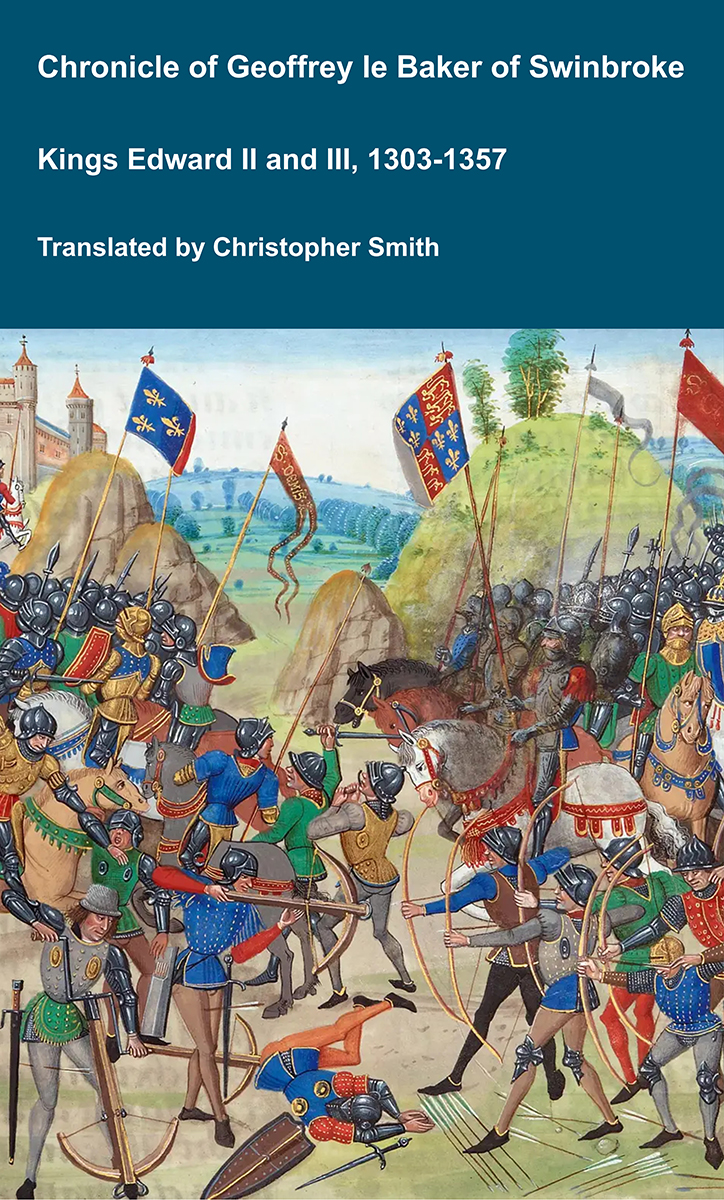 Chronicle of Geoffrey le Baker of Swinbroke. 26th August 1346 Battle of CrécyOn the evening of the following Friday, while the king (of England) was resting along the bank of the Somme, there arrived on the opposite shore, where they had previously passed, Philip of Valois, tyrant of the French, along with the kings of Bohemia and Majorca, and with an innumerable army divided into eight great battalions. The French shouted arrogantly against the king and the English, while knights on both sides skirmished in the water and along the bank in the manner of war. The king (Edward III) sent a message1 to the tyrant, offering him a peaceful and unhindered passage through the ford so that he might choose for himself a place suited to battle. But this cowardly Philip, who had previously boasted he would pursue the king, refused to engage in battle at that time, instead turning aside as if to cross the river elsewhere. The king waited for him all through the night.
Ad vesperum diei Veneris sequentis, rege super litus de Summe residente, venit super ripam, quam antea peragrarunt, Philippus de Valesio tirannus Francorum, et cum ipso reges Boemie et Malogrie, cum exercitu innumerabili in acies octo magnas diviso. Gallic! regem et Anglicos superbe exclamaverunt, militibus utrinque in vado et super litus more guerre hastiludiantibus. Rex misit tiranno offerens pacificum et indempnem transitum per vadum ad eligendum sibi locum aptum bello; set formidolosus iste Philippus, qui se antea minabatur insequiturum regem, noluit tune bellum, set quasi ad alium locum aquam transiturus divertebat, et rex ipsum expectabat per totam noctem.
Note 1. Philip had already challenged Edward and the latter had replied, on the 14th and 15th August, at the time of the passage of the Seine at Poissy. See the Philip's letter to Edward in Guisborough, ii. 423: "Philip, by the grace of God, King of France, to Edward, King of England, a declaration of the truth. By every way and means possible, without reasonable cause, you have made war upon us, violating the faith, loyalty, and liege homage by which, as our liegeman, you are bound to us. And now, persisting in your irrational purpose, you have entered our kingdom of France with your army, and have burned, devastated, and plundered our land, our people, and our subjects and, if none were to resist, you would do worse still, striving daily to add evil to evil. Therefore, considering the unjust injuries and plundering that you have not feared to bring upon our people and our subjects, and for the preservation of our right and honour without stain, we bear this burden with no small grief, not out of pride, arrogance, or presumption, nor in confidence in the power of our nation, but in the confidence of God and the justice of our cause, hoping that this war may soon reach its end. We therefore notify you that, if you, who have entered our land in pride and presumption, dare and are willing to await us between Saint-Germain-des-Prés outside Paris and the Valley of Girard, or between Franconville and Pontoise, on the next Thursday, Saturday, Sunday, or following Tuesday, or on whatever assigned day you may choose to accept, to do battle against us and our army together with our subjects and allies, we shall accept whatever fortune God Almighty sees fit to give us. Therefore, since you claim to seek battle, you should not refuse this offer. And so that all may plainly know that no delay is caused by us, we offer to provide and designate a common place where the armies of France and England may properly and fittingly meet in battle. In the meantime, you and your people should cease the destruction, burning, and plundering you are committing. Without delay, you must inform us of your will concerning these matters by letter. For if you truly desire battle, as you say, and do not neglect but accept this offer, then, under the terms proposed, a battle must surely follow. In witness whereof we have caused these letters to be sealed with our great seal. Given at Saint-Denis in France, the 14th day of August, in the year of grace 1346."
And Edward's response in Guisborough, ii. 425: "Philip of Valois, we have understood your letters, in which you inform us that you wish to engage in battle against us and our army between Saint-Germain-en-Laye outside Paris, or between Franconville and Pontoise, on the coming Thursday, Saturday, Sunday, or Tuesday; and that you wish us and our men not to cause damage, burning, or pillaging in the meantime. Concerning this, you are to know that, in the confidence of God and of our most clear right, which we acknowledge to hold in the crown of France (which you, in disinheriting us, dare unjustly occupy against God and justice), we have entered into our kingdom of France, not in pride, arrogance, or presumption, to bring this war to an end and to pursue our claim against you. But since you, who have had the opportunity to make battle almost at your own choosing, have had the bridges between us and you broken down, so that we could not approach you nor cross the river Seine until we came to Poissy, where we rebuilt the bridge you had caused to be destroyed, we waited there for you and your assembled army for three days. According to your own proposal, you could have met us there, on either side of the river; but clearly, as is now evident, you avoided doing so, showing no true desire for the combat you claim. Therefore, having deliberated, since we cannot obtain the long-desired engagement, we are passing through our aforesaid kingdom to strengthen our friends and loyal subjects, and to punish our rebels whom you unjustly claim as your subjects. And we intend to remain in said kingdom for the continuation of our war, for our advantage, and to your and our rebels' loss. If, indeed, you truly wish to fight against us and protect those whom you claim as your subjects, as your letter suggests, you will find us always prepared, with God's favour, whom we earnestly invoke for the common good of Christendom, to resist you in battle, if you come. For you refuse to treat or accept any reasonable path to peace. As for your proposal to assign us a specific time and place for battle: we were not consulted, nor do we intend to be bound by you, nor to accept such conditions. Rather, according to our own way and the grace that God has bestowed upon us as king in our own kingdom, we shall set our own course and make our own decisions. Given under our seal, the 15th day of August, in the 7th year of our reign of France and the 20th of England."
Baker appears to be the only authority for the statement that Edward offered to allow the French to cross the Somme with a view to fighting a battle.
Become a Member via our Buy Me a Coffee page to read more.