

Chronicle of Geoffrey le Baker of Swinbroke
Baker was a secular clerk from Swinbroke, now Swinbrook, an Oxfordshire village two miles east of Burford. His Chronicle describes the events of the period 1303-1356: Gaveston, Bannockburn, Boroughbridge, the murder of King Edward II, the Scottish Wars, Sluys, Crécy, the Black Death, Winchelsea and Poitiers. To quote Herbert Bruce 'it possesses a vigorous and characteristic style, and its value for particular events between 1303 and 1356 has been recognised by its editor and by subsequent writers'. The book provides remarkable detail about the events it describes. Baker's text has been augmented with hundreds of notes, including extracts from other contemporary chronicles, such as the Annales Londonienses, Annales Paulini, Murimuth, Lanercost, Avesbury, Guisborough and Froissart to enrich the reader's understanding. The translation takes as its source the 'Chronicon Galfridi le Baker de Swynebroke' published in 1889, edited by Edward Maunde Thompson.
Available at Amazon in eBook and Paperback format.
Beheaded is in Executions.
30BC Death of Antony and Cleopatra
1312 Capture, Trial and Execution of Piers Gaveston
1322 Trial and Execution of Lord Badlesmere
1326 Murder of the Bishop of Exeter
1326 Execution of the Despencers
1330 Execution of Edmund of Woodstock
1397 Arrest and Execution of Richard Fitzalan 9th Earl of Surrey 11th Earl Arundel
1399 Execution of Richard II's Favourites
1425 Purge of the Albany Stewarts
24th November 1400-Douglas Black Dinner
1450 Murder of William de la Pole
1460 June Yorkist Landing at Sandwich
1461 Battle of Mortimer's Cross
1461 Second Battle of St Albans
1461 King Edward IV leaves London
29th March 1461 Battle of Towton
1462 Vere Plot to Murder Edward IV
1464 July 1464 Sieges of Lancastrian Castles
1469 Execution of Warwick's Supporters
1469 Execution of the Woodvilles
1469 Execution of the Neville Brothers
1470 March 1470 Welles' Rebellion and Battle of Losecoat Field aka Empingham
1470 Execution of John Tiptoft
1483 Execution of William Hastings by Richard III
1483 Execution of the Yorkists and their Affinity
1485 Execution of Roger Clifford
1497 Battle of Blackheath aka Deptford Bridge
1502 Trial and Execution of James Tyrrell
1510 Execution of Richard Empson and Edmund Dudley
1513 Execution of Edmund de la Pole
1521 Trial and Execution of the Duke of Buckingham
1535 Execution of Bishop Fisher and Thomas More
1536 Execution of George Boleyn, Brereton, Norris, Smeaton and Weston
1540 Execution of Thomas Cromwell
27 May 1541 Execution of Margaret Pole
1541 Catherine Howard Tyburn Executions
1542 Execution of Catherine Howard and Jane Parker
1547 Execution of Henry Howard, Earl of Surrey
1549 Trial and Execution of Thomas Seymour
1552 Trial and Execution of Edward Seymour Duke of Somerset and his Supporters
1553 Trial and Execution of Lady Jane Grey's Supporters
1557 Scarborough Castle Rebellion
1587 Execution of Mary Queen of Scots
1618 Execution of Walter Raleigh
1631 Execution of Lord Castlehaven
1641 Trial and Execution of the Earl of Strafford
1644 Execution of Alexander Carew 2nd Baronet
1644 Trial and Execution of the Hothams
1645 Execution of Archbishop William Laud
1662 Trial and Execution of Henry Vane "The Younger"
1680 Trial and Execution of William Howard 1st Viscount Stafford
1685 Execution of the Duke of Monmouth
On 23rd August 30BC Marcus Antonius aka Antyllus 47BC 30BC [aged 17] was beheaded following the suicide of his father Mark Antony 83BC 30BC [deceased] and stepmother Cleopatra VII Philopator 69BC 30BC [deceased].
On 22nd June 209 (or 251 or 304) St Alban was beheaded.
On 20th May 794 Æthelberht II King East Anglia was beheaded on the orders of King Offa of Mercia.
On 31st May 1076 Waltheof Northumbria 1st Earl of Northampton 1st Earl Huntingdon was beheaded at St Gile's Hill, Winchester. His daughter Maud [aged 2] succeeded 2nd Countess Huntingdon, 2nd Countess of Northampton.
Anglo-Saxon Chronicle. 1076. This year also was Earl Waltheof beheaded at Winchester, Hampshire [Map], on the mass-day of St. Petronilla;99 and his body was carried to Croyland [Map], where he lies buried. King William [aged 48] now went over sea, and led his army to Brittany, and beset the castle of Dol; but the Bretons defended it, until the king [aged 23] came from France; whereupon William departed thence, having lost there both men and horses, and many of his treasures.
Note 99. This notice of St. Petronilla, whose name and existence seem scarcely to have been known to the Latin historians, we owe exclusively to the valuable MS. "Cotton Tiberius" B lv. Yet if ever female saint deserved to be commemorated as a conspicuous example of early piety and christian zeal, it must be Petronilla.
On 29th June 1149 Raymond Poitiers [aged 34] was beheaded at the Battle of Inab.
On 4th July 1187 the Battle of Hattin took place on 4 July 1187, between the Crusader states of the Levant and the forces of the Ayyubid sultan Saladin. The Muslim armies captured or killed the majority of the Crusader forces resulting in the Muslims once again becoming the pre-eminent military power in the Holy Land, re-capturing Jerusalem and most of the other Crusader-held cities and castles.
Raynald of Châtillon [aged 63] was captured during the battle and personally beheaded by Saladin after he refused to convert to Islam.
On 18th January 1256 Maria Reginar Duchess Bavaria [aged 30] was beheaded having been accused of adultery by her husband Louis "Strict" Wittelsbach II Duke Upper Bavaria [aged 26] although there was no proof.
In 1276 Pope Gregory X [aged 46] was beheaded.
On 19th June 1312 Piers Gaveston 1st Earl Cornwall [aged 28] was taken to Blacklow Hill, Warwickshire [Map] where he was beheaded. Earl Cornwall extinct. Blacklow Hill, Warwickshire [Map] being outside of the lands of Guy Beauchamp 10th Earl of Warwick [aged 40]. Gaveston's body was left where it lay eventually being recovered by Dominican friars who took it to King's Langley Priory, Hertfordshire [Map].
On 22nd March 1322 Thomas Plantagenet 2nd Earl of Leicester, 2nd Earl Lancaster, Earl of Salisbury and Lincoln [aged 44] was beheaded at Pontefract Castle [Map] following his capture six days before at the Battle of Boroughbridge. He was buried at Pontefract Priory [Map]. Earl of Leicester, Earl Lancaster forfeit.
On 14th April 1322 Bartholomew Badlesmere 1st Baron Badlesmere [aged 46] was tried by Henry Cobham 1st Baron Cobham [aged 62] at Canterbury, Kent [Map].
Sentenced to death Bartholomew Badlesmere 1st Baron Badlesmere was drawn for three miles behind a horse to Blean, Canterbury, where he held property, where he was beheaded. His head was displayed on the Burgh Gate, Canterbury and the rest of his body left hanging at Blean, Canterbury. He was buried at Whitefriars. His nephew Henry Burghesh's [aged 30] lands were also seized. These were restored around 1326.
On 15th October 1326 brothers Richard Stapledon and Bishop Walter Stapledon [aged 65] were beheaded in the street by a mob loyal to Queen Isabella.
On 17th November 1326 Edmund Fitzalan 2nd or 9th Earl of Arundel [aged 41] was beheaded at Hereford [Map]. Earl Arundel forfeit. According to the Llandaff Chronicle he was executed by a "worthless wretch" ("villissimi ribaldi") with a blunt sword requiring twenty-two strokes although I have been unable to find a copy of the Chronicle to confirm this story. He was initially buried at the Franciscan Church, Hereford, subsequently reburied at his family's traditional place of burial Haughmond Abbey [Map].
On 7th October 1328 Robert Holland 1st Baron Holand [aged 45] was captured at Boreham, Essex [Map]. He was beheaded on the 15th October 1328. His son Robert [aged 17] succeeded 2nd Baron Holand.
On 19th March 1330 the King's uncle Edmund of Woodstock 1st Earl Kent [aged 28] was beheaded at Winchester Castle [Map]. Earl Kent forfeit. Edmund had been convicted of plotting against the court believing his brother King Edward II was still alive. It later emerged the plot had been created by Roger Mortimer 1st Earl March [aged 42] to entrap Edmund. King Edward III of England [aged 17] was unable to show leniency risking complicity in the plot. He was buried at Westminster Abbey [Map].
See
Geoffrey le Baker of Swinbroke,  Walter of Guisborough, Knighton 2555,
  Murimuth and Parliament Rolls.
On 2nd August 1343 Oliver IV de Clisson [aged 43] was beheaded.
On 5th April 1356 Jean V de Harcourt [aged 31] was beheaded. See Robert de Avesnes.

On 14th June 1381 the mob gained access to the Tower of London [Map] capturing Joan "Fair Maid of Kent" Princess Wales [aged 52], the future King Henry IV of England [aged 14], Joan Holland Duchess York [aged 1] and Archbishop Simon Sudbury [aged 65].
Archbishop Simon Sudbury was beheaded at Tower Hill [Map]. He was buried at Canterbury Cathedral [Map].
Lord Treasurer Robert Hales [aged 56], who had only been appointed on the 1st February 1381, was beheaded at Tower Hill [Map].
On 15th June 1381 King Richard II of England [aged 14] met with Wat Tyler at Smithfield [Map]. During the course of the meeting Wat Tyler was wounded by William Walworth. Wat Tyler was then captured and beheaded at Smithfield [Map]. His head was placed on top a pole and carried through the city, then displayed on London Bridge.
William Walworth and John Philpot were knighted by King Richard II of England.


Chronicle of a Bourgeois of Valenciennes
Récits d’un bourgeois de Valenciennes aka The Chronicle of a Bourgeois of Valenciennes is a vivid 14th-century vernacular chronicle written by an anonymous urban chronicler from Valenciennes in the County of Hainaut. It survives in a manuscript that describes local and regional history from about 1253 to 1366, blending chronology, narrative episodes, and eyewitness-style accounts of political, military, and social events in medieval France, Flanders, and the Low Countries. The work begins with a chronological framework of events affecting Valenciennes and its region under rulers such as King Philip VI of France and the shifting allegiances of local nobility. It includes accounts of conflicts, sieges, diplomatic manoeuvres, and the impact of broader struggles like the Hundred Years’ War on urban life in Hainaut. Written from the perspective of a burgher (bourgeois) rather than a monastery or royal court, the chronicle offers a rare lay viewpoint on high politics and warfare, reflecting how merchants, townspeople, and civic institutions experienced the turbulence of the 13th and 14th centuries. Its narrative style combines straightforward reporting of events with moral and civic observations, making it a valuable source for readers interested in medieval urban society, regional politics, and the lived experience of war and governance in pre-modern Europe.
Available at Amazon in eBook and Paperback format.
On 15th June 1381 John Cavendish [aged 35] was captured at Church of St Mary, Cavendish during the Peasants' Revolt. He was beheaded in the Market Place in Bury St Edmunds.
On 3rd February 1388 the Merciless Parliament commenced. It ended on 4th June 1388. Its primary function was to prosecute members of the Court of King Richard II of England [aged 21]. The term "Merciless" is contemporary having been coined by the chronicler Henry Knighton.
Michael de la Pole 1st Earl Suffolk [aged 58] was sentenced to be hanged, drawn and quartered in his absence. He had escaped to France.
Archbishop Alexander Neville [aged 47] was found guilty of treason and it was determined to imprison him for life in Rochester Castle, Kent [Map]. He fled to Louvain [Map] where he became a parish priest for the remainder of his life.
On 19th February 1388 Robert Tresilian was hanged naked and his throat cut. See Chronicle of Adam of Usk.
On 25th March 1388 Nicholas Brembre was hanged. He was buried at Christ Church, Greyfriars [Map].
On 5th May 1388 Simon Burley [aged 48] was executed despite the protestations of his friend Edmund of Langley 1st Duke of York [aged 46]. See Chronicle of Adam of Usk.
On 12th May 1388 John Beauchamp 1st Baron Beauchamp [aged 69] was beheaded at Tower Hill [Map]. He was buried at Worcester Cathedral [Map]. Baron Beauchamp of Kidderminster forfeit.
Robert de Vere 1st Duke Ireland [aged 26] was attainted.
 Become a Member via our Buy Me a Coffee page to read more.
On 21st September 1397 Richard Fitzalan 9th Earl of Surrey 4th or 11th Earl of Arundel [aged 51] was tried at Westminster [Map].
He was beheaded at Tower Hill [Map] immediately thereafter. Earl Surrey and Earl Arundel forfeit.
On 29th July 1399 William Scrope 1st Earl Wiltshire [aged 49], Henry Green [aged 52] and John Bussy were beheaded at Bristol Castle, Gloucestershire [Map]. Earl Wiltshire forfeit.
On 10th August 1399 Piers Legh [aged 79] was beheaded on the orders of Henry of Bolingbroke, the future King Henry IV. See MS. Harleian 1989. fol. 381.. His head was 'set upon the east gate of Chester'. He was initially burie aat the Carmelite Friars at Chester, subsequently at the Legh Chapel, St Michael and All Angels Church, Macclesfield. The inscription: "Here lyeth the bodie of Perkin a Legh that for King Richard the death did die betrayed for righteousness And the bones of Sir Piers his sonne that with King Henrie the fift did wonne in Paris."
In January 1400 Richard Maudelain was beheaded.
On 7th January 1400 at Cirencester, Gloucestershire [Map] Ralph Lumley 1st Baron Lumley [aged 40] was beheaded by the townspeople following an unsuccessful attempt to seize the town. Baron Lumley forfeit.
Thomas Holland 1st Duke Surrey [aged 26] was beheaded. He had to forfeit the honours and estates he had gained after the arrests of Gloucester and Arundel: Duke Surrey extinct. He retained those he had received before: His brother Edmund [aged 16] succeeded 4th Earl Kent, 3rd Baron Holand, 8th Baron Wake of Liddell. He was buried, or re-buried, at his foundation Mount Grace Priory, North Yorkshire [Map].
John Montagu 3rd Earl Salisbury [aged 50] was captured, tried and beheaded. Earl Salisbury, Baron Montagu, Baron Montagu, Baron Monthermer forfeit.
Bernard Brocas [aged 46] was captured.
On 13th January 1400 Thomas Despencer 1st Earl Gloucester [aged 26] was beheaded at Bristol, Gloucestershire [Map].
On 4th February 1400 Bernard Brocas [aged 46] was tried, and condemned to death, by Thomas Fitzalan 10th Earl of Surrey 5th or 12th Earl of Arundel [aged 18] at Tower of London [Map] for his role in the Epiphany Rising having been captured in Cirencester, Gloucestershire [Map].
On 5th February 1400 Bernard Brocas was beheaded at Tyburn [Map]. He was buried at Greyfriars Church Farringdon Within [Map].
On 21st July 1403 King Henry IV of England [aged 36], with his son the future King Henry V of England [aged 16], defeated the rebel army of Henry "Hotspur" Percy [aged 39] at the Battle of Shrewsbury at the site now known as Battlefield, Shrewsbury [Map]. King Henry V of England took an arrow to the side of his face. John Stanley [aged 53] was wounded in the throat. Thomas Strickland [aged 36] fought and was awarded £38 and two of the rebel Henry's horses. Richard Beauchamp 13th Earl Warwick [aged 21] fought for the King. Walter Blount [aged 55], the King's Standard Bearer, was killed by Archibald Douglas 1st Duke Touraine [aged 31].
Thomas Wendesley [aged 59], Edmund Cockayne [aged 47] and Robert Goushill were killed.
Edmund Stafford 5th Earl Stafford [aged 25] was killed. His son Humphrey Stafford succeeded 6th Earl Stafford, 7th Baron Stafford.
Hugh Shirley [aged 52] was killed; he was one of four knights dressed as King Henry IV of England.
Of the rebels, Henry "Hotspur" Percy, Madog Kynaston [aged 43] and John Clifton were killed.
Thomas Percy 1st Earl of Worcester [aged 60] was beheaded after the battle. Earl Worcester extinct.
Richard Vernon 11th Baron Shipbrook [aged 48] was hanged. Baron Shipbrook forfeit.
John Rossall was killed. His sister Eleanor Rossall [aged 26] inherited a half-share in the Rossall Shrewsbury [Map] estates.
John Massey [aged 65] was killed.
Become a Member via our Buy Me a Coffee page to read more.
On 8th June 1405 before a great crowd at York [Map]..
Archbishop Richard Scrope [aged 55] was beheaded.
Thomas Mowbray 4th Earl Norfolk 2nd Earl Nottingham [aged 19] was beheaded. His brother John [aged 13] succeeded 5th Earl Norfolk, 3rd Earl Nottingham, 8th Baron Mowbray, 9th Baron Segrave.
On 20th July 1405 John Fauconberg was beheaded in Durham, County Durham [Map].
On 2nd August 1415 Thomas Grey of Werke and Heaton [aged 30] was beheaded at North Gate Southampton, Hampshire [Map] for his role in the Southampton Plot.
On 5th August 1415 two executions of those involved in the Southampton Plot took place at the North Gate aka Bargate [Map]:
Richard of Conisbrough 1st Earl Cambridge [aged 30] was beheaded. His son Richard [aged 3] succeeded 2nd Earl Cambridge.
Henry Scrope 3rd Baron Scrope of Masham [aged 42] was beheaded. His brother John [aged 27] succeeded 4th Baron Scrope of Masham.
On 24th May 1425 Alexander Stewart and Duncan Lennox 8th Earl Lennox [aged 80] were beheaded at Heading Hill at Stirling Castle.
On 25th May 1425 Murdoch Stewart 2nd Duke Albany [aged 63] and his son Walter Stewart [aged 25] were beheaded at Heading Hill at Stirling Castle.
On 24th November 1440 William Crichton 1st Lord Crichton arranged a dinner of reconciliation at the Great Hall, Edinburgh Castle. During the course of the dinner the young brothers William Douglas 3rd Duke Touraine [aged 16] and David Douglas [aged 10] was beheaded in front of the young King James II of Scotland [aged 10].
In 1447 Gruffudd Vychan [aged 52] was beheaded at Powis Castle [Map].
On 4th July 1450 James Fiennes 1st Baron Saye and Sele [aged 55] was beheaded at the Standard in Cheapside [Map]. His son William [aged 22] succeeded 2nd Baron Saye and Sele and inherited his estates including Hever Castle, Kent [Map] and Herstmonceux Castle, East Sussex [Map].
His son in law William Cromer [aged 34] was also beheaded.
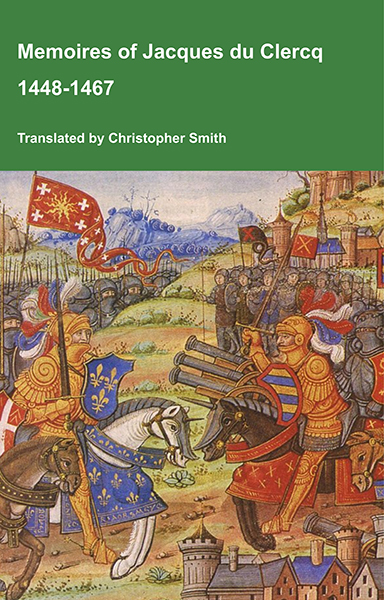
This is a translation of the 'Memoires of Jacques du Clercq', published in 1823 in two volumes, edited by Frederic, Baron de Reissenberg. In his introduction Reissenberg writes: 'Jacques du Clercq tells us that he was born in 1424, and that he was a licentiate in law and a counsellor to Philip the Good, Duke of Burgundy, in the castellany of Douai, Lille, and Orchies. It appears that he established his residence at Arras. In 1446, he married the daughter of Baldwin de la Lacherie, a gentleman who lived in Lille. We read in the fifth book of his Memoirs that his father, also named Jacques du Clercq, had married a lady of the Le Camelin family, from Compiègne. His ancestors, always attached to the counts of Flanders, had constantly served them, whether in their councils or in their armies.' The Memoires cover a period of nineteen years beginning in in 1448, ending in in 1467. It appears that the author had intended to extend the Memoirs beyond that date; no doubt illness or death prevented him from carrying out this plan. As Reissenberg writes the 'merit of this work lies in the simplicity of its narrative, in its tone of good faith, and in a certain air of frankness which naturally wins the reader’s confidence.' Du Clercq ranges from events of national and international importance, including events of the Wars of the Roses in England, to simple, everyday local events such as marriages, robberies, murders, trials and deaths, including that of his own father in Book 5; one of his last entries.
Available at Amazon in eBook and Paperback format.
Chronicle of Gregory. 1450. Ande at Rochester [Map] ix [11] men were be-heddyd at that same tyme, and her heddys were sende unto London by the kyngys commaundement, and sette uppon London Brygge [Map] alle at one tyme; and xij [12] heddys at a nothyr tyme were brought unto London at a sette uppe undyr the same forme, as hysa was commaundyd by the kyng. Men calle it in Kente the Harvyste of Hedys. Willb
Note a. So in MS.
Note b. The Christian name "Will." is added by a somewhat later hand. The date " 1451 " is also added in the margin in a hand decidedly more modern.
Chronicle of Gregory. 4th July 1450. Ande in the morne he come yn a-gayne, that sory and sympylle and rebellyus captayne why the his mayny; that was Satyrday, and it was also a Synt Martyn is day1, the dedycacyon of Synt Martynys in the Vyntry [Map], the iiij day of Juylle. And thenne dyvers questys were i-sompnyd at the Gylhalle [Map]; and ther Robert Home beynge alderman was a-restyde and brought in to Newegate. And that same day Wylliam Crowemere [aged 34], squyer, and Scheryffe of Kentt, was be-heddyde in the fylde whythe out Algate at the mylys ende be-syde Clopton is Place. And a nothyr man that was namyde John Bayle was be-heddyd at the Whytte Chapylle. And the same day aftyr-non was be-heddyd in Cheppe a-fore the Standard [Map], Syr Jamys Fynes [aged 55], beyng that tyme the lord Saye and Grrette Treserer of Ingelonde, the whyche was brought oute of the Toure of London [Map] unto the Gylde Halle [Map], and there of dyvers tresons he was exampnyd, of whyche he knowlachyd of the dethe of that notabylle and famos prynce the Duke of Glouceter. And thenne they brought him unto the Standard in Cheppe [Map], and there he ressayvyd his jewys and his dethe. And so forthe alle the iij [3] heddys that day smetyn of were sette uppon the Brygge of London [Map], and the ij othyr heddys takyn downe that stode a-pon the London Brygge by-fore. And at the comyng of the camptayne yn to Sowtheworke, he lete smyte of the hedde of a strong theff that was namyd Haywardyn.
Note 1. The Translation of St. Martin of Tours.
On 1st May 1450 William "Jackanapes" de la Pole 1st Duke of Suffolk [aged 53] was beheaded at sea whilst travelling into exile his ship having been intercepted by the Nicholas of the Tower, or by Admiral Nicholas of the Tower. His son John [aged 7] succeeded 2nd Marquess Suffolk, 5th Earl Suffolk, 5th Baron Pole. Margaret Beaufort Countess Richmond [aged 6] by marriage Marchioness Suffolk. Earl Pembroke forfeit.

Chronicle of Gregory. 2nd December 1450. And the same day was a man of the forsaid feleschyppe, the whyche was at the spoylynge and robbynge of the Fryer Prechourys, be-heddyde at the Standarde in Cheppe [Map], for to ben an exampylle unto alle othyr; but it was nevyr the bettyr, for it causyd moche the more herte brennyng a gayne the duke and the lordys by-fore said, &c.
On 25th June 1460 Osbert Mountfort and two of his associates were beheaded on the sands at the foot of the Rysbank Tower [Map] by Yorkist sailors.
On 29th July 1460 Thomas Browne [aged 58] was beheaded at Tyburn [Map].
On 30th December 1460 the Lancastrian army took their revenge for the defeats of the First Battle of St Albans and the Battle of Northampton at the Battle of Wakefield near Sandal Castle [Map]. The Lancastrian army was commanded by Henry Holland 3rd Duke Exeter [aged 30], Henry Beaufort 2nd or 3rd Duke of Somerset [aged 24] and Henry Percy 3rd Earl of Northumberland [aged 39], and included John Courtenay 7th or 15th Earl Devon [aged 25] and William Gascoigne XIII [aged 30], both knighted, and James Butler 1st Earl Wiltshire 5th Earl Ormonde [aged 40], John "Butcher" Clifford 9th Baron Clifford [aged 25], John Neville 1st Baron Neville of Raby [aged 50], Thomas Ros 9th Baron Ros Helmsley [aged 33], Henry Roos and Thomas St Leger [aged 20].
The Yorkist army was heavily defeated.
Richard Plantagenet 3rd Duke of York [aged 49] was killed. His son Edward [aged 18] succeeded 4th Duke York, 7th Earl March, 9th Earl of Ulster, 3rd Earl Cambridge, 9th Baron Mortimer of Wigmore.
Thomas Neville [aged 30], and Edward Bourchier were killed.
Father and son Thomas Harrington [aged 60] and John Harrington [aged 36] were killed, the former dying of his wounds the day after.
William Bonville 6th Baron Harington [aged 18] was killed. His daughter Cecily succeeded 7th Baroness Harington.
Thomas Parr [aged 53] fought in the Yorkist army.
Following the battle Richard Neville Earl Salisbury [aged 60] was beheaded by Thomas "Bastard of Exeter" Holland. William Bonville [aged 40] was executed.
Edmund York 1st Earl of Rutland [aged 17] was killed on Wakefield Bridge [Map] by John "Butcher" Clifford. Earl of Rutland extinct.

On 2nd February 1461 following the battle Owen Tudor [aged 61] was beheaded in the Market Place, Hereford [Map]. He was buried thereafter in Greyfriars Church, Hereford in a tomb paid for by his son David Owen [aged 2]. Somewhat curious that his other son Jasper Tudor 1st Duke Bedford [aged 29] didn't contribute although the political situation may have made it difficult to do so.
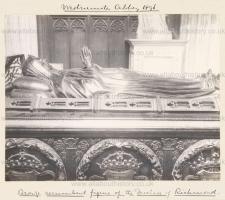
Memorial to Owen Tudor in the Market Place, Hereford [Map]. Somewhat incongruously between a toddlers merry-go-round and a baked potato stall on the day of our visit.
On 17th February 1461 the Lancastrian army defeated the Yorkist army at Second Battle of St Albans and rescued King Henry VI of England and II of France [aged 39]. The Lancastrian army was commanded by Henry Holland 3rd Duke Exeter [aged 30] and included Henry Percy 3rd Earl of Northumberland [aged 39], John Mowbray 3rd Duke of Norfolk [aged 45], Henry Grey 4th or 7th Baron Grey of Codnor [aged 26], Henry Roos and Richard Welles 7th Baron Welles, Baron Willoughby [aged 33].
Thomas Ros 9th Baron Ros Helmsley [aged 33], William Tailboys 7th Baron Kyme [aged 46], John Talbot 3rd Earl of Shrewsbury [aged 12] and Thomas Tresham [aged 41] were knighted.
The Yorkist army included Richard "Kingmaker" Neville Earl Warwick, 6th Earl Salisbury [aged 32], William Fitzalan 9th or 16th Earl of Arundel [aged 43], John Wenlock 1st Baron Wenlock [aged 61] and Henry Bourchier 2nd Count of Eu 1st Earl Essex [aged 57]. John Neville 1st Marquess Montagu [aged 30] was captured. Robert Poynings [aged 42] and James Luttrell [aged 34] were killed.
John Grey [aged 29] was killed fighting for Lancaster. A death that was to have far reaching consequences; his widow Elizabeth Woodville Queen Consort England [aged 24] subsequently married King Edward IV of England [aged 18].
During the battle William Bonville 1st Baron Bonville [aged 68] and Thomas Kyriell [aged 65] were assigned to the protection of the King Henry VI. After the battle both were beheaded against all decent laws of battle.
William Bonville 1st Baron Bonville was beheaded. His great granddaughter Cecily succeeded 2nd Baroness Bonville.
Thomas Kyriell was beheaded.
William Cotton [aged 21] was killed.
Become a Member via our Buy Me a Coffee page to read more.
After 17th February 1461, following his capture at, or shortly after, the Second Battle of St Albans, Henry Lovelace was beheaded.
Chronicle of Robert Fabyan [-1512]. In whiche selfe same daye, which was the xii. [12] day of Marche [1461]1, a grocer of London, named Walter Walker, for offence by hym done agayne the kynge, was behedyd in Smythfelde; but his wyfe, which after was maryed to lohn Norlande, grocer, and lastlye alderman, had suche frendys about the kynge, that hir goodys were not forfeyted to the kynges vse.
Note 1. If the 'selfe same daye' is the 'Fryday next folowynge' referred to in the previous paragraph then this is Friday 13th of March 1461.
On 3rd April 1461 Thomas Courtenay 6th or 14th Earl Devon [aged 29] was beheaded at York [Map] following his capture at the Battle of Towton. he was attainted; Earl Devon, Baron Courtenay, Baron Okehampton forfeit.
On 1st May 1461 James Butler 1st Earl Wiltshire 5th Earl Ormonde [aged 40] was beheaded at Newcastle upon Tyne, Northumberland [Map] having been captured at, or after, the Battle of Towton. His brother John [aged 39] succeeded 6th Earl Ormonde. Earl Wiltshire forfeit.
On 9th September 1461 Baldwin Fulford [aged 46] was beheaded at Bristol, Gloucestershire [Map] on the orders of King Edward IV of England [aged 19] for having supported King Henry VI of England and II of France [aged 39].
On 23rd February 1462 William Tyrrell [aged 54], John Montgomery and Thomas Tuddenham [aged 60] were beheaded at Tower Hill [Map].
In 1463 John Douglas [aged 30] was beheaded.
On 15th May 1464 a Yorkist army commanded by John Neville 1st Marquess Montagu [aged 33] defeated a Lancastrian army commanded by Henry Beaufort 2nd or 3rd Duke of Somerset [aged 28] at Hexham, Northumberland [Map] during the Battle of Hexham.
Those fighting for York included John Stafford 1st Earl Wiltshire [aged 36], John Scrope 5th Baron Scrope of Bolton [aged 26] and Richard Welles 7th Baron Welles, Baron Willoughby [aged 36].
Henry Beaufort 2nd or 3rd Duke of Somerset was beheaded following the battle. The general pardon which he has previously received was annulled. Duke Somerset, Marquess Dorset, Earl Somerset and Earl Dorset forfeit for the second time. His son Edmund Beaufort [aged 25] was styled by supporters of the House of Lancaster as Duke of Somerset but had not right to do so.
Philip Wentworth [aged 40] was executed at Middleham [Map].
On 26th May 1464 William Tailboys 7th Baron Kyme [aged 49] was beheaded at Sandhills, Newcastle upon Tyne, Northumberland [Map] having been captured after the Battle of Hexham. He was buried at Greyfriar's Church, Newcastle upon Tyne [Map]. His son Robert [aged 13] succeeded 8th Baron Kyme. Elizabeth Heron Baroness Kyme [aged 11] by marriage Baroness Kyme.
Chronicle of Gregory. 15th May 1464. The xv day of May folowynge this good Lord Mountegewe [aged 33] let to be smete of the heddys of thes men, the whyche that her namys here folowyn in wrytyng: Henry Beaufort Duke of Somerset [aged 28], Edmon Fysche, knyght, Edmon Bradschawe, Water Hunte, Blacke Jakys.
The History of William Marshal was commissioned by his son shortly after William’s death in 1219 to celebrate the Marshal’s remarkable life; it is an authentic, contemporary voice. The manuscript was discovered in 1861 by French historian Paul Meyer. Meyer published the manuscript in its original Anglo-French in 1891 in two books. This book is a line by line translation of the first of Meyer’s books; lines 1-10152. Book 1 of the History begins in 1139 and ends in 1194. It describes the events of the Anarchy, the role of William’s father John, John’s marriages, William’s childhood, his role as a hostage at the siege of Newbury, his injury and imprisonment in Poitou where he met Eleanor of Aquitaine and his life as a knight errant. It continues with the accusation against him of an improper relationship with Margaret, wife of Henry the Young King, his exile, and return, the death of Henry the Young King, the rebellion of Richard, the future King Richard I, war with France, the death of King Henry II, and the capture of King Richard, and the rebellion of John, the future King John. It ends with the release of King Richard and the death of John Marshal.
Available at Amazon in eBook and Paperback format.
Chronicle of Gregory. 17th May 1464. At the Newecastelle [Map], the xvij day of May, he let to be smete of the heddys, as the namys of them done appere here aftyr in wrytynge: first, the hedde of the Lord Hungerforde [aged 33], the Lord Roos [deceased], Syr Thomas Fyndorne, Barnarde de la Mare, Nycholas Massam.
Chronicle of Gregory. 26th May 1464. At Yorke, the XXVJ day of May, he let to be smete of the heddys of thos men that her namys folowyn here in wrytynge: Syr Thomas Hoosy, Thomas Gosse, Robert Myrfyn, John Butler, Roberte Wattys, porter to Kyng Harry, Thomas Fenwyke, Robert Cockefelde, Wylliam Bryce, Wylliam Dauson, John Chapman, John Edyrbeke, Rycharde Taverner, John Russelle, Robert Conqueror.
On 15th July 1464 Ralph Grey of Chillingham [aged 32] was beheaded at Doncaster [Map].
In 1468 Thomas Fitzgerald 7th Earl Desmond and Thomas Fitzgerald 7th Earl of Kildare [aged 47] attended Parliament in Drogheda [Map] to answer charges of treason. Both were found guilty and attainted. Thomas Fitzgerald 7th Earl Desmond sought sanctuary in Drogheda Priory [Map] where he was captured by John "Butcher of England" Tiptoft 1st Earl of Worcester [aged 40]. On 14th February 1468 Thomas Fitzgerald 7th Earl Desmond was summarily beheaded. He was buried initially in St Peter's Church Drogheda [Map] then Christ Church Cathedral, Dublin [Map]. Some accounts claim John "Butcher of England" Tiptoft 1st Earl of Worcester also murdered two of his young sons. Thomas Fitzgerald 7th Earl of Kildare escaped and was subsequently pardoned and attainder reversed when King Edward IV found Ireland was ungovernable without him. In 1470 Thomas Fitzgerald 7th Earl of Kildare was appointed Lord Deputy of Ireland under George York 1st Duke of Clarence [aged 18] which position he held until the Duke's death in 1478.
On 17th January 1469 Warwick's supporters were executed in Salisbury Marketplace [Map] in the presence of King Edward IV of England [aged 26]:
Thomas Hungerford was beheaded. His father Robert Hungerford 3rd Baron Hungerford 1st Baron Moleyns had been executed five years previously after the Battle of Hexham.
Henry Courtenay was beheaded.
On 12th August 1469 Woodvilles father and son were beheaded at Kenilworth Castle [Map] by supporters of Richard "Kingmaker" Neville Earl Warwick, 6th Earl Salisbury [aged 40].
Richard Woodville 1st Earl Rivers [aged 64] was beheaded. His son Anthony [aged 29] succeeded 2nd Earl Rivers, 2nd Baron Rivers. Elizabeth Scales Countess Rivers by marriage Countess Rivers.
John Woodville [aged 24] was beheaded.
On 29th September 1469 brothers Humphrey Neville of Brancepeth [aged 30] and Charles Neville of Brancepeth were beheaded at York [Map] in the presence of King Edward IV of England [aged 27] and Richard "Kingmaker" Neville Earl Warwick, 6th Earl Salisbury [aged 40] bringing to an end the Neville-Neville feud that arose as a consequence of the senior line being dis-inherited.
On 12th March 1470 King Edward IV of England [aged 27] commanded at the Battle of Losecoat Field (Empingham).
Thomas Dymoke [aged 42] and Richard Welles 7th Baron Welles, Baron Willoughby [aged 42] were beheaded at Queen's Cross, Stamford before the battle1. His son Robert succeeded 8th Baron Welles.
The name 'Losecoat' not contemporary, and its meaning of men "losing their coats" may have been invented in the 19th Century. The name Losecoat appears to be first used in the 16th Century Hall's and Holinshed's Chronicles.
The 1475 attainder of Richard and Robert Welles refers to the battle having taken place "in a field called 'Hornefeld' in Empyngham",
Note 1. Some sources say on battlefield immediately prior to the battle, some after the batte
On 19th March 1470 Robert Welles 8th Baron Willoughby 8th Baron Welles was beheaded at Doncaster [Map]. He was buried at Whitefriars Doncaster [Map]. Baron Welles forfeit. His sister Joan succeeded 9th Baroness Willoughby de Eresby. Richard Hastings Baron Willoughby [aged 37] by marriage Baron Willoughby de Eresby. He, Hastings, a favourite of King Edward IV of England [aged 27], younger brother of Edward's great friend William Hastings 1st Baron Hastings [aged 39].
On 18th October 1470 John "Butcher of England" Tiptoft 1st Earl of Worcester [aged 43] was beheaded at Tower Green, Tower of London [Map]. On 14th April 1471 His son Edward succeeded 2nd Earl Worcester, 3rd Baron Tiptoft.
In 1471 Roger Vaughan [aged 61] was beheaded at Chepstow aka Striguil, Monmouthshire.
On 22nd September 1471 Lancastrian Thomas "Bastard of Fauconberg" Neville [aged 42] was beheaded at Middleham Castle [Map]. See Paston Letters Volume 5 782.
In 1475 Robert Radclyffe was beheaded.
On 19th December 1475 Louis Luxemburg I Count Saint Pol [aged 57] was beheaded at Paris [Map]. His son Peter [aged 35] succeeded II Count Saint Pol. Margaret Savoy Countess Saint Pol [aged 36] by marriage Countess Saint Pol.
On 4th August 1477 Jacques Armagnac Duke Nemours [aged 44] was beheaded.
On 13th June 1483 Richard, Duke of Gloucester [aged 30], [future King Richard III] held a Council meeting at the Tower of London [Map] attended by William Hastings 1st Baron Hastings [aged 52], Cardinal John Morton [aged 63], Archbishop Thomas Rotherham [aged 59] and Henry Stafford 2nd Duke of Buckingham [aged 28]. During the course of the meeting Richard accused William Hastings 1st Baron Hastings, Cardinal John Morton and Archbishop Thomas Rotherham of treasonable conspiracy with the Queen [aged 46].
William Hastings 1st Baron Hastings was summarily beheaded at Tower Green, Tower of London [Map]. He was buried in North Aisle St George's Chapel, Windsor Castle [Map] next to King Edward IV of England. His son Edward [aged 16] succeeded 2nd Baron Hastings.
Cardinal John Morton and Archbishop Thomas Rotherham were arrested.
On 25th June 1483 supporters of the Woodvilles were executed at Pontefract Castle [Map]..
Anthony Woodville 2nd Earl Rivers [aged 43] was beheaded. His brother Richard [aged 30] succeeded 3rd Earl Rivers, 3rd Baron Rivers.
Richard Grey [aged 26] and Thomas Vaughan [aged 73] were beheaded.
On 2nd November 1483 Henry Stafford 2nd Duke of Buckingham [aged 29] was beheaded in Salisbury Marketplace [Map] for his part in the rebellion. Duke of Buckingham forfeit. His son Edward [aged 5] succeeded 8th Earl Stafford, 9th Baron Stafford.
On 4th December 1483 George Browne [aged 43] was beheaded at Tower Hill [Map].
On 2nd May 1485 Roger Clifford [aged 48] was beheaded at Tower Hill [Map] for supporting King Henry VII of England and Ireland [aged 28].
On 12th March 1491 Robert Chamberlayne [aged 53] was beheaded at Tower Hill [Map].
On 16th February 1495 William Stanley [aged 60] and Simon Montfort were beheaded at Tower Hill [Map] for their part in the Perkin Warbeck Plot.
Gilbert Debenham [aged 63] was attainted and condemned to death for treason for having supported Stanley. He remained in prison until 1499 when his sister Elizabeth Brewes, in return for paying a large fine, obtained a pardon for her brother and a promise that the attainder would be reversed.
The Deeds of the Dukes of Normandy
The Gesta Normannorum Ducum [The Deeds of the Dukes of Normandy] is a landmark medieval chronicle tracing the rise and fall of the Norman dynasty from its early roots through the pivotal events surrounding the Norman Conquest of England. Originally penned in Latin by the monk William of Jumièges shortly before 1060 and later expanded at the behest of William the Conqueror, the work chronicles the deeds, politics, battles, and leadership of the Norman dukes, especially William’s own claim to the English throne. The narrative combines earlier historical sources with firsthand information and oral testimony to present an authoritative account of Normandy’s transformation from a Viking settlement into one of medieval Europe’s most powerful realms. William’s history emphasizes the legitimacy, military prowess, and governance of the Norman line, framing their expansion, including the conquest of England, as both divinely sanctioned and noble in purpose. Later chroniclers such as Orderic Vitalis and Robert of Torigni continued the history, extending the coverage into the 12th century, providing broader context on ducal rule and its impact. Today this classic work remains a foundational source for understanding Norman identity, medieval statesmanship, and the historical forces that reshaped England and Western Europe between 800AD and 1100AD.
Available at Amazon in eBook and Paperback format.

On 24th November 1496 John Radclyffe 9th Baron Fitzwalter [aged 44] was beheaded at Calais [Map] for trying to bribe his jailers. His son Robert [aged 13] succeeded 10th Baron Fitzwalter.
On 28th June 1497 James Tuchet 7th Baron Audley, 4th Baron Tuchet [aged 34] was beheaded at Tower Hill [Map]. He was buried at Blackfriars Church Holborn. His head was placed on a spike at London Bridge [Map]. Baron Audley of Heighley in Staffordshire and Baron Tuchet forfeit.

On 21st August 1497 Lorenzo Tornabuoni [aged 32] was beheaded for scheming with France against Florence.
On 6th May 1502 James Tyrrell [aged 47] was beheaded. He was buried at Austin Friars.
On 17th August 1510 Edmund Dudley [aged 48] and Richard Empson [aged 60] were beheaded at Tower Hill [Map] for constructive treason for having carried out King Henry VII's rigorous and arbitrary system of taxation. The new King King Henry VIII of England and Ireland [aged 19] attempting to distance himself from his father's policies.


On 30th April 1513 Edmund Pole 3rd Duke of Suffolk [aged 42] was beheaded at Tower Hill [Map] on the instruction of King Henry VIII after having been imprisoned for seven years. Duke Suffolk, Marquess Suffolk and Earl Suffolk, Baron Pole forfeit.
He, Edmund, was the son of Elizabeth York Duchess Suffolk, sister of Kings Edward IV and Richard III, and George, Duke of Clarence. He, arguably, had a better claim to the throne of England than King Henry VII if King Edward IV's children were illegitimate, and George's children barred from the succession as a consequence of George'a attainder although Anne St Leger's [aged 37] claim better since she descended from an older sister Anne.
He, Edmund, had been given to King Henry VII of England and Ireland as part of the treaty of Malus Intercursus aka Evil Treaty with the condition that he not be executed. King Henry VII in his will instructed his son King Henry VIII to have him executed; an act which attracted the criticism of Montaigne in Chapter 7 of his Essays.
On 17th May 1521 Edward Stafford 3rd Duke of Buckingham [aged 43] was beheaded at Tower Hill [Map]. Duke of Buckingham, Earl Stafford and Baron Stafford forfeit.
He was executed for no specific reason other than his having a significant amount of Plantagenet blood and was, therefore, considered a threat by Henry VIII [aged 29]. He was posthumously attainted by Act of Parliament on 31 July 1523, disinheriting his children. He was buried at St Peter's Church, Britford [Map].
In December 1531 Rhys ap Gruffydd Deheubarth [aged 23] was beheaded for treason for purportedly for inscribing the name Fitz Uryan on his armour in London.
On 22nd June 1535 Bishop John Fisher [aged 65] was beheaded on Tower Hill [Map].
On 6th July 1535 Thomas More [aged 57] was beheaded on Tower Hill [Map]. He was buried at St Peter ad Vincula Church, Tower of London [Map].


On 17th May 1536 George Boleyn Viscount Rochford [aged 33], Henry Norreys [aged 54], Francis Weston [aged 25], William Brereton and Mark Smeaton [aged 24] were beheaded at Tower Hill [Map]. They were buried at St Peter ad Vincula Church, Tower of London [Map].
On 19th May 1536 Queen Anne Boleyn of England [aged 35] was beheaded at Tower Green, Tower of London [Map]. Unusually a sword was used. Her execution was witnessed by Charles Brandon 1st Duke of Suffolk [aged 52], Catherine Carey [aged 12] and Henry Fitzroy 1st Duke Richmond and Somerset [aged 16]. Marquess Pembroke extinct.
She was buried at St Peter ad Vincula Church, Tower of London [Map]. There is myth that her corpse was subsequently removed for burial at the Boleyn family church Church of St Peter and St Paul, Salle [Map] as described in Agnes Strickland's 1852 Lives of the Queens of England Volume 4. Page 212.


On 29th June 1537 John Hussey 1st Baron Hussey of Sleaford [aged 72] was beheaded at Lincoln, Lincolnshire [Map]. Baron Hussey of Sleaford forfeit.
On 30th June 1537 Thomas Darcy 1st Baron Darcy Templehurst [aged 70] was beheaded at Tower Hill [Map]. In 1539 he was postumously attainted; Baron Darcy of Darcy aka Templehurst forfeit.
On 9th December 1538 at Tower Hill [Map]:
Edward Neville [aged 67] was beheaded
Henry Courtenay 1st Marquess Exeter [aged 42] was beheaded with a sword. Marquess Exeter, Earl Devon, Earl Devon, Baron Okehampton forfeit as a consequence of his attainder.
Henry Pole 1st Baron Montagu [aged 46] was beheaded

On 3rd March 1539 Nicholas Carew of Beddington in Surrey [aged 43] was beheaded at Tower Hill [Map].
Chronicle of Edward Hall [1496-1548]. 3rd March 1539. Also on the third day of March, was sir Nicholas Carew [aged 43] of Bedington, in the countie of Surrey knight of the Gartier, and Maister of the kyngs horse, before attainted of treason, behedded at the tower hil, wher he made a godly confession, bothe of his foly and supersticious faith, geving God most harty thankes that ever he came in the prison of the tower, where he first favored the lyfe and swetenes of Gods moste holy word meaning the Bible in English, which there he read by the meane of one Thomas Phelips then keper of that prison, but before he was a citezen and poyntmaker of London, which Phillips two yeres before had ben ther prysoner himselfe, and sore troubled aswel by syr Thomas More as also by Doctor Stokesley [aged 64] bishop of London, who often tymes examined the sayd Phelips, and layed many articles to his charge, but he so wisely and coldly used him selfe, that he maugre their evyl willes, escaped clerly their handes.
On 9th July 1539 or 10th July 1539 Thomas Dingley was beheaded. Greyfriars's Chronicle states the 9th, Hall's Chronicle the 10th.

On 28th July 1540 Thomas Cromwell [aged 55] was beheaded at Tower Hill [Map]. Earl Essex, Baron Cromwell of Wimbledon in Surrey forfeit. He was buried at St Peter ad Vincula Church, Tower of London [Map].
On 28th July 1540 Walter Hungerford 1st Baron Hungerford Heytesbury [aged 37] was beheaded at Tower Hill [Map]. He was attainted; Baron Hungerford of Heytesbury forfeit. He, together with his chaplain, a Wiltshire clergyman named William Bird, Rector of Fittleton and Vicar of Bradford, who was suspected of sympathising with the pilgrims of grace of the north of England, was attainted by act of parliament. Hungerford was charged with employing Bird in his house as chaplain, knowing him to be a traitor; with ordering another chaplain, Hugh Wood, and one Dr. Maudlin to practise conjuring to determine the king's length of life, and his chances of victory over the northern rebels; and finally with committing offences forbidden by the 1533 Buggery Act.

Wriothesley's Chronicle [1508-1562]. 27th May 1541. This yeare, the seaven-and-twentith daie of Maie, 1541a, being Fridaie and the morrow after the Assention Daie, my Ladie of Poole [aged 67], Countesse of Salisburieb, and mother to the Lord Montague, late putt to death for treason, was beheaded within the Tower of London upon the Greene called East Smithfid for treasonc against the Kinges Majestie. And the same daie were three persons more drawen from the Tower of London to Tiburne, one called Lee, a gentleman of the north countrey, which was hanged and quartered; and another called Tartarsall, a cloath man of that countrey; and one Thome, a yeoman of the same partes, was hanged and headed; which persons with their affinitie had pretended to have made a new conspiracie or insurrection in the north countrey in Lent last past, and were brought up to London by Sir Richard Gresshame, knight and alderman of London; and tenne persons more of their affinitie were hanged, drawen, and quartered in Yorke for the same treason; and one Sir John Nevill [aged 53], knight, was sent from the Tower of London to Yorke to suffer execution their for treason, which was of their councell.
Note a. Nearly two years after the passing of the act of attainder.
Note b. Margaret Plantagenet, the nearest relation to the King in blood, was daughter, and eventually sole heir, of George Duke of Clarence, brother of Edward IV. She was created Countess of Salisbury in her own right, 14th October, 1513.
Note c. For a supposed treasonable correspondence with her sons, Cardinal Reginald Pole and Lord Montacute.
On 10th December 1541. At Tyburn [Map]...
Francis Dereham [aged 28] was hanged, drawn and quartered.
Thomas Culpepper [aged 27] was beheaded.
Both were buried at St Sepulchre without Newgate Church; their heads were spiked on London Bridge [Map].
On 13th February 1542 Queen Catherine Howard [aged 19] and Jane Parker Viscountess Rochford [aged 37] were beheaded at Tower Green [Map]. Henry Howard Earl of Surrey [aged 26] attended. They were both buried at St Peter ad Vincula Church, Tower of London [Map].
Mary Boleyn [aged 43] was the heir of Jane Parker Viscountess Rochford being the sister of her deceased husband George Boleyn Viscount Rochford.


On 19th January 1547 Henry Howard Earl of Surrey [aged 31] was beheaded at Tower Hill [Map]. He was buried at Church of St Michael the Archangel, Framlingham [Map]. He had foolishly added the arms of Edward the Confessor1 to his own arms. He was charged with treasonably quartering the royal arms. His father survived sentence since the King died the day before it was due to take place.
Note 1. Arguably the arms of King Edmund "Ironside", his 14 x great grandfather rather than Edmund's brother Edward the Confessor.
On 20th March 1549 Thomas Seymour 1st Baron Seymour [aged 41] was beheaded at Tower Hill [Map]. He was buried at St Peter ad Vincula Church, Tower of London [Map]. Baron Seymour of Sudeley forfeit.
Catherine Willoughby Duchess Suffolk [aged 29] became guardian to his daughter Mary Seymour.


On 22nd January 1552 Edward Seymour 1st Duke of Somerset [aged 52] was beheaded at Tower Hill [Map]. He was buried at St Peter ad Vincula Church, Tower of London [Map]. Duke Somerset, Earl Hertford, Viscount Beauchamp forfeit. His great-grandson William Seymour 2nd Duke of Somerset was restored to the titles in 1660.
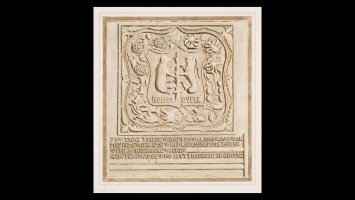
On 26th February 1552 Miles Partridge and Ralph Fane were hanged. Thomas Arundell of Wardour Castle [aged 50] and Michael Stanhope [aged 45] were beheaded at Tower Hill [Map] for plotting to assassinate John Dudley 1st Duke Northumberland [aged 48].
Thomas Arundell of Wardour Castle was buried at St Peter ad Vincula Church, Tower of London [Map].
On 22nd August 1553 John Dudley 1st Duke Northumberland [aged 49] was beheaded at Tower Hill [Map]. Duke Northumberland, Earl Warwick and Viscount Lisle forfeit. John Dudley 2nd Earl Warwick [aged 26], his son, was also attainted, with the Earldom of Warwick forfeit.
Thomas Palmer and John Gates [aged 49] were hanged, drawn and quartered.
On 12th February 1554 Guildford Dudley [aged 19] was beheaded at Tower Hill [Map]. An hour later his wife Lady Jane Grey [aged 18] was beheaded at Tower Green [Map] by order of Queen Mary I [aged 37]. They were buried at St Peter ad Vincula Church, Tower of London [Map].


The Deeds of the Dukes of Normandy
The Gesta Normannorum Ducum [The Deeds of the Dukes of Normandy] is a landmark medieval chronicle tracing the rise and fall of the Norman dynasty from its early roots through the pivotal events surrounding the Norman Conquest of England. Originally penned in Latin by the monk William of Jumièges shortly before 1060 and later expanded at the behest of William the Conqueror, the work chronicles the deeds, politics, battles, and leadership of the Norman dukes, especially William’s own claim to the English throne. The narrative combines earlier historical sources with firsthand information and oral testimony to present an authoritative account of Normandy’s transformation from a Viking settlement into one of medieval Europe’s most powerful realms. William’s history emphasizes the legitimacy, military prowess, and governance of the Norman line, framing their expansion, including the conquest of England, as both divinely sanctioned and noble in purpose. Later chroniclers such as Orderic Vitalis and Robert of Torigni continued the history, extending the coverage into the 12th century, providing broader context on ducal rule and its impact. Today this classic work remains a foundational source for understanding Norman identity, medieval statesmanship, and the historical forces that reshaped England and Western Europe between 800AD and 1100AD.
Available at Amazon in eBook and Paperback format.
On 23rd February 1554 Henry Grey 1st Duke of Suffolk [aged 37] was beheaded at Tower Hill [Map]. Duke Suffolk, Marquess Dorset, Earl Huntingdon, Baron Ferrers of Groby, Baron Harington, Baron Bonville forfeit.
Dean Hugh Weston [aged 49] acted as Confessor.
Henry Machyn's Diary. 28 Apr 1554. The xxviij day of Aprell was heddyd on Towre hyll [Map], betwyn ix and x of the cloke a-for none, my lord Thomas Gray, the duke of Suffoke-Dassett brodur, and bered at Allalow's Barkyng [Map], and the hed (unfinished)

On 11th April 1554 Thomas Wyatt [aged 33] was beheaded at Tower Hill [Map].
Dean Hugh Weston [aged 49] acted as Confessor.
Henry Machyn's Diary. 28th May 1557. [The xxviij day of May Thomas Stafford [aged 24] was beheaded on Tower hill [Map], by nine of the clock, master Wode being his] gostly father; and after ther wher iij more [drawn from the To] wre, and thrugh London unto Tyburne [Map], and ther [they were] hangyd and quartered; and the morow after was master [Stafford] quartered, and hangyd on a care, and so to Nuwgatt to [boil.]
On 28th May 1557 Thomas Stafford [aged 24] was beheaded at Tower Hill [Map].

On 22nd August 1572 Thomas Percy 7th Earl of Northumberland [aged 44] was beheaded at The Pavement in York. He was buried at St Crux Church, York [Map]. His brother Henry [aged 40] succeeded 8th Earl of Northumberland, 11th Baron Percy of Alnwick, 19th Baron Percy of Topcliffe, 2nd Baron Percy of Alnwick, 10th Baron Poynings.
On 11th November 1583 Gerald Fitzgerald 14th Earl Desmond [aged 50] was beheaded in Glenageenty Wood near Tralee, County Kerry. See account of his execution in Selections from Old Kerry Records.
On 3rd May 1584 William Ruthven 1st Earl Gowrie [aged 41] was beheaded at Stirling Castle [Map] for continuing to rebel against the King. His son James [aged 8] succeeded 2nd Earl Gowrie
On 8th February 1587 Mary Queen of Scots [aged 44] was beheaded in the Great Hall at Fotheringhay Castle, Northamptonshire [Map].
George Talbot 6th Earl of Shrewsbury [aged 59], Henry Grey 6th Earl Kent [aged 46], Richard Knightley [aged 54] and Henry Wriothesley 3rd Earl of Southampton [aged 13] witnessed her execution.
There are a number of extant primary sources, eye-witness accounts, describing Mary's execution:
Letter of Robert Wingfield to William Cecil, 08 Feb 1587.
The manner of the execution of Mary Queen of Scots.
The manner of the Scottish Queen's execution
Warrender Papers 167. Anonymous.
Warrender Papers 168. Anonymous. Based on the Narration of Richard Wingfield
Ashmole MS. 830, F. 18, in the Bodleian Library, Oxford.
Jebb's De vita et rebus gestis serenissimæ principis Mariæ Scotorum Reginæ published in French, attributed to her physician Dominique Bourgoin.
letter-books of Sir Amias Poulet, Keeper of Mary Queen of Scots,
the Calendar of State Papers, Spain (known as the Simancas), Volume 4, 1587-1603
Beale's sketch of the execution.
Become a Member via our Buy Me a Coffee page to read more.
In November 1597 John Chichester was beheaded by Randal "Arranach" Macdonnell 1st Earl Antrim at Carrickfergus, County Antrim.
On 25th February 1601 Robert Devereux 2nd Earl Essex [aged 35] was beheaded at Tower Green, Tower of London [Map] as a consequence of his involvement in the Essex Rebellion. Earl Essex, Viscount Hereford, Baron Bourchier and Baron Ferrers of Chartley forfeit. He was the last person to be executed at the Tower of London. It isn't clear whether his other titles Viscount Hereford, Baron Ferrers of Chartley and Baron Bourchier were forfeit.


On 18th March 1601 Charles Danvers [aged 33] and Christopher Blount [aged 36] were beheaded for their part in the Essex Rebellion.
On 5th December 1603 George Brooke [aged 35] was beheaded at Winchester, Hampshire [Map] for his part in the Main and Bye Plots.
On 21st May 1613 John Maxwell 9th Lord Maxwell [aged 30] was beheaded at Edinburgh for the murder of the Laird of Johnstone. Lord Maxwell forfeit.
On 29th October 1618 Walter Raleigh [aged 64] was beheaded at Old Palace Yard, Westminster Palace. He was buried in St Margaret's Church, Westminster [Map].
There are numerous quotes attributed to Raleigh at his execution although none quote an original source. Many quote his last words as being "What dost thou fear? Strike, man, strike!"
Raleigh's head was embalmed and presented to his wife [Elizabeth Throckmorton [aged 53]]. His body was to be buried in the local church in Beddington, Surrey, the home of Lady Raleigh, but was finally laid to rest in St Margaret's Church, Westminster [Map], where his tomb is located.


On 14th May 1631 Mervyn Tuchet 2nd Earl Castlehaven [aged 38] was beheaded at Tower Hill [Map]. His English titles Baron Audley of Heighley in Staffordshire and Baron Tuchet were forfeited as a result of his attainder. His son James [aged 14] succeeded to his Irish titles 3rd Earl Castlehaven, 3rd Baron Audley of Orier in England.
He was executed for the unnatural crime of sodomy in accordance with the 1533 Buggery Act, committed with his page Laurence (or Florence) FitzPatrick, who confessed to the crime and was executed; and assisting Giles Browning (alias Broadway), who was also executed, in the rape of his wife Anne, Countess of Castlehaven [aged 51], in which Lord Castlehaven was found to have participated by restraining her.

On 12th May 1641 Thomas Wentworth 1st Earl Strafford [aged 48] was beheaded at Tower Hill [Map]. Earl Strafford, Viscount Wentworth, Baron Wentworth, Baronet Wentworth of Wentworth Woodhouse in Yorkshire forfeit. His execution was attended by an enormous crowd.
Wenceslaus Hollar [aged 33]. Engraving of the execution of Thomas Wentworth 1st Earl Strafford marked as C with James Ussher [aged 60] marked as A.
On 19th July 1644 John Gordon 1st Baronet [aged 34] was beheaded for treason. His son John [aged 12] succeeded 2nd Baronet Gordon of Haddo for suppressing the Conventers.
On 19th November 1644 Alexander Carew 2nd Baronet [aged 36] was tried for treason, for attempting to betray the Parliamentary cause, by court-martial and convicted at Guildhall [Map].
On 23rd December 1644 Alexander Carew 2nd Baronet was beheaded at Tower Hill [Map]. He was buried at St Augustine's Church, Hackney. His son John [aged 9] succeeded 3rd Baronet Carew of Antony in Cornwall.


In December 1644 Parliament decided to execute the Hothams, father and son, John Hotham 1st Baronet [aged 55] and John Hotham [aged 34].
On 1st January 1645 John Hotham was beheaded for treason by Parliamentarians at Tower Hill [Map]. His father was executed the next day.
On 2nd January 1645 John Hotham 1st Baronet was beheaded for treason by Parliamentarians; his son having been executed the previous day. His grandson John [aged 12] succeeded 2nd Baronet Hotham of Scorborough in Yorkshire.
On 10th January 1645 Archbishop William Laud [aged 71] was beheaded at Tower Hill [Map]. He was buried at St John's College, Oxford University.


On 30th January 1649 Charles I [aged 48] was beheaded with one clean stroke outside the Banqueting House, Whitehall Palace [Map]. He put his head on the block and, after saying a prayer, he signalled the executioner when he was ready by stretching out his hands.


On 9th March 1649 at the Old Palace Yard, Westminster Palace three Royalist Lords were beheaded ...
Arthur Capell 1st Baron Capell Hadham [aged 41] was beheaded. His son Arthur [aged 17] succeeded 2nd Baron Capell Hadham.
Henry Rich 1st Earl Holland [aged 58] was beheaded. His son Robert [aged 30] succeeded 2nd Earl Holland. Elizabeth Ingram Countess Holland [aged 26] by marriage Countess Holland.
James Hamilton 1st Duke Hamilton [aged 42] was beheaded. His brother William [aged 32] succeeded 2nd Duke Hamilton, 3rd Earl Cambridge, 3rd Baron Innerdale by special remainder.
John Owen [aged 49] had been sentenced to death but was subsequently pardoned.


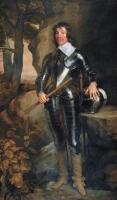
In 1650 Henry Hyde Royalist [aged 45] was beheaded.
On 8th June 1658 Henry Slingsby 1st Baronet [aged 56] was beheaded on Tower Hill [Map] for being a Royalist. His son Thomas [aged 21] succeeded 2nd Baronet Slingsby Scriven.
Jean de Waurin's Chronicle of England Volume 6 Books 3-6: The Wars of the Roses
Jean de Waurin was a French Chronicler, from the Artois region, who was born around 1400, and died around 1474. Waurin’s Chronicle of England, Volume 6, covering the period 1450 to 1471, from which we have selected and translated Chapters relating to the Wars of the Roses, provides a vivid, original, contemporary description of key events some of which he witnessed first-hand, some of which he was told by the key people involved with whom Waurin had a personal relationship.
Available at Amazon in eBook and Paperback format.
On 27th May 1661 Archibald Campbell 1st Marquess Argyll [aged 54] was beheaded for his perceived treason on the restoration of Charles II at Edinburgh. He was buried at Kilmun Church.
Monument in the North Aisle, Edinburgh Cathedral [Map].
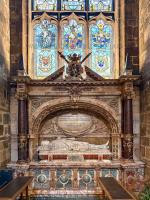
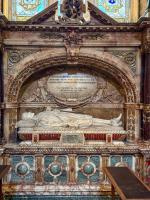
On 14th June 1662 Henry Vane "The Younger" [aged 49] was beheaded at Tower Hill [Map] for treason against King Charles II [aged 32]. He had been sentenced to be hanged, drawn and quartered, however, King Charles II commuted the sentence to beheading.


On 29th December 1680 William Howard 1st Viscount Stafford [aged 66] was beheaded at Tower Hill [Map]. He was attainted; Viscount Stafford forfeit. His wife Mary Stafford Countess Stafford [aged 60], with whom he was jointly created Baron Stafford continued as Baroness.
On 21st July 1683 William Russell [aged 43] was beheaded by Jack Ketch at Lincoln's Inn for his involvement in the Rye House Plot. The executioner was so inept that he took four axe blows to separate the head from the body. After the first failed blow his victim looked up and said "You dog, did I give you 10 guineas to use me so inhumanely?".


On 7th December 1683 Algernon Sidney [aged 60] was beheaded at Tower Hill [Map] during the Rye House Plot.
A True Account of the Horrid Conspiracy. But the whole Evidence against Walcot being elear and positive Testimony, and what he pleaded for himself being only his own single Affirmation and Negation, without any support of Witnesses,the Jury immediately brought him in Guilty of High Treason. According to which Sentence he was Executed on the 20th of the said Month [20th June 1683]. At the time of his Execution he again acknowledg'd what he had told the King, and writ to the Secretary of State, 'That the Business was laid very deep he said, An Act of Indulgence would do well, because the King had a great many Men to take Judgment of: He persisted, he was to have had no hand in his Majesties Death, though he confess'd it was proposed when he was present: He declared he did not know that this Conspiracy was older than the August or September before: but so old he own'd it was.'
On 30th June 1685 Archibald Campbell 9th Earl Argyll [aged 56] was beheaded on the Maiden (an early gullotine) in Edinburgh for his part in Argyll's Rising. His son Archibald [aged 26] succeeded 10th Earl Argyll. Elizabeth Tollemache Duchess Argyll [aged 25] by marriage Countess Argyll.
On 15th July 1685 James Scott 1st Duke Monmouth 1st Duke Buccleuch [aged 36] was beheaded at Tower Hill [Map]. Duke Monmouth and Duke Buccleuch forfeit. Bishop Francis Turner [aged 47] acted a Chaplain.

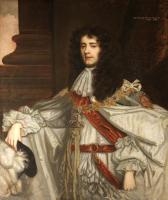

On 2nd September 1685 Alice Beaconshore Lady Lisle [aged 67] was beheaded outside The Eclipse Inn, Winchester Marketplace [Map] from whose window she stepped onto the scaffold. The last judicial execution of a woman by beheading in England.
On 28th January 1697 John Fenwick 3rd Baronet [aged 52] was beheaded for his part in the 1696 Plot to Assassinate King William III. He was buried at St Martin in the Fields Church [Map]. Baronet Fenwick of Fenwick in Northumberland extinct. He was the last person to be executed under an Act of Attainder.
Robert Burdett 3rd Baronet [aged 57] had spoken against the attainder in Parliament.
The 1715 Battle of Preston was the final action of the 1715 Jacobite Rebellion. It commenced on 9th November 1715 when Jacobite cavalry entered Preston, Lancashire [Map]. Royalist troops arrived in number over the next few days surrounding Preston forcing the Jacocobite surrender. 1463 were taken prisoner of which 463 were English. The Scottish prisoners included:
George Seton 5th Earl of Winton [aged 38]. The only prisoner to plead not guilty, sentenced to death, escaped from the Tower of London [Map] on 4th August 1716 around nine in the evening. Travelled to France then to Rome.
On 24th February 1716 William Gordon 6th Viscount Kenmure [aged 44] was beheaded on Tower Hill [Map].
On 9th February 1716 William Maxwell 5th Earl Nithsale was sentenced to be executed on 24th February 1716. The night before his wife [aged 36] effected his escape from the Tower of London [Map] by exchanging his clothes with those of her maid. They travelled to Paris then to Rome where the court of James "Old Pretender" Stewart [aged 27] was.
James Radclyffe 3rd Earl Derwentwater [aged 26] was imprisoned in the Tower of London [Map]. He was examined by the Privy Council on 10th January 1716 and impeached on 19th January 1716. He pleaded guilty in the expectation of clemency. He was attainted and condemned to death. Attempts were made to procure his pardon. His wife Anna Maria Webb Countess Derwentwater [aged 24], her sister Mary Webb [aged 21] [Note. Assumed to be her sister Mary], their aunt Anne Brudenell Duchess Richmond [aged 45], Barbara Villiers 1st Duchess of Cleveland appealed to King George I [aged 55] in person without success.
On 24th February 1716 James Radclyffe 3rd Earl Derwentwater was beheaded on Tower Hill [Map]. Earl Derwentwater, Baronet Radclyffe of Derwentwater in Cumberland forfeit.
William Murray 2nd Lord Nairne was tried on 9th February 1716 for treason, found guilty, attainted, and condemned to death. He survived long enough to benefit from the Indemnity Act of 1717.
General Thomas Forster of Adderstone [aged 31] was attainted. He was imprisoned at Newgate Prison, London [Map] but escaped to France.
On 14th May 1716 Henry Oxburgh was hanged, drawn and quartered at Tyburn [Map]. He was buried at Church of St Gile's in the Fields. His head was spiked on Temple Bar.
The trials and sentences were overseen by the Lord High Steward William Cowper 1st Earl Cowper [aged 50] for which he subsequently received his Earldom.
Become a Member via our Buy Me a Coffee page to read more.
On 9th April 1747 Simon Fraser 11th Lord Lovat [aged 80] was beheaded at Tower Hill [Map] for his part in the Jacobite Rebellion. He was the last man in Britain to be executed by beheading. Among his last words was a quote from Horace: Dulce et decorum est pro patria mori ["It is sweet and seemly to die for one's country"]. At the last moment, an overcrowded timber stand collapsed, leaving nine spectators dead. He was buried at St Peter ad Vincula Church, Tower of London [Map].